Within Disclosure Culture
When Weak Security Made UFO Hunting Possible
Poorly protected government computers transformed disclosure beliefs from speculative stories into targets that an intruder could realistically attempt to
On this page
- Why technical opportunity mattered to motivation
- How vulnerable systems narrowed the gap between belief and action
- Why security flaws did not validate the secrets being sought
Page outline Jump by section
Introduction
The belief that governments were concealing evidence of unidentified flying objects (UFOs) long pre-dated the internet. What changed around the turn of the twenty-first century was that poorly secured government computer systems made those beliefs appear technically testable. For people already convinced that NASA, the US military or defence agencies possessed hidden records, weak cyber security transformed an abstract conspiracy narrative into a practical target for unauthorised searches. The significance of this period lies less in the sophistication of the intrusions than in the unexpectedly low barriers to entry. Disclosure culture supplied the motivation; inadequate passwords, exposed remote administration tools and inconsistent security practices supplied the opportunity. Crucially, however, the ease with which systems could be entered did not provide evidence that the extraordinary information being sought actually existed.[theguardian.com]theguardian.comThe GuardianHacker's progress: how McKinnon pierced Pentagon security | UK news | The GuardianApril 3, 2007…
Why technical opportunity mattered to motivation
Many conspiracy theories remain speculative because believers have no obvious way to test them directly. The early internet altered that calculation. As government agencies expanded internet-connected networks faster than security practices matured, computer enthusiasts increasingly viewed sensitive systems as accessible rather than impenetrable.
For someone motivated by UFO disclosure claims, this changed the psychological equation. Instead of imagining hidden archives beyond reach, it became plausible to believe that classified material might simply be sitting on a poorly protected workstation or file server. The objective was no longer persuading insiders to talk or waiting for declassification. It became finding a technical path into networks believed to contain suppressed information.
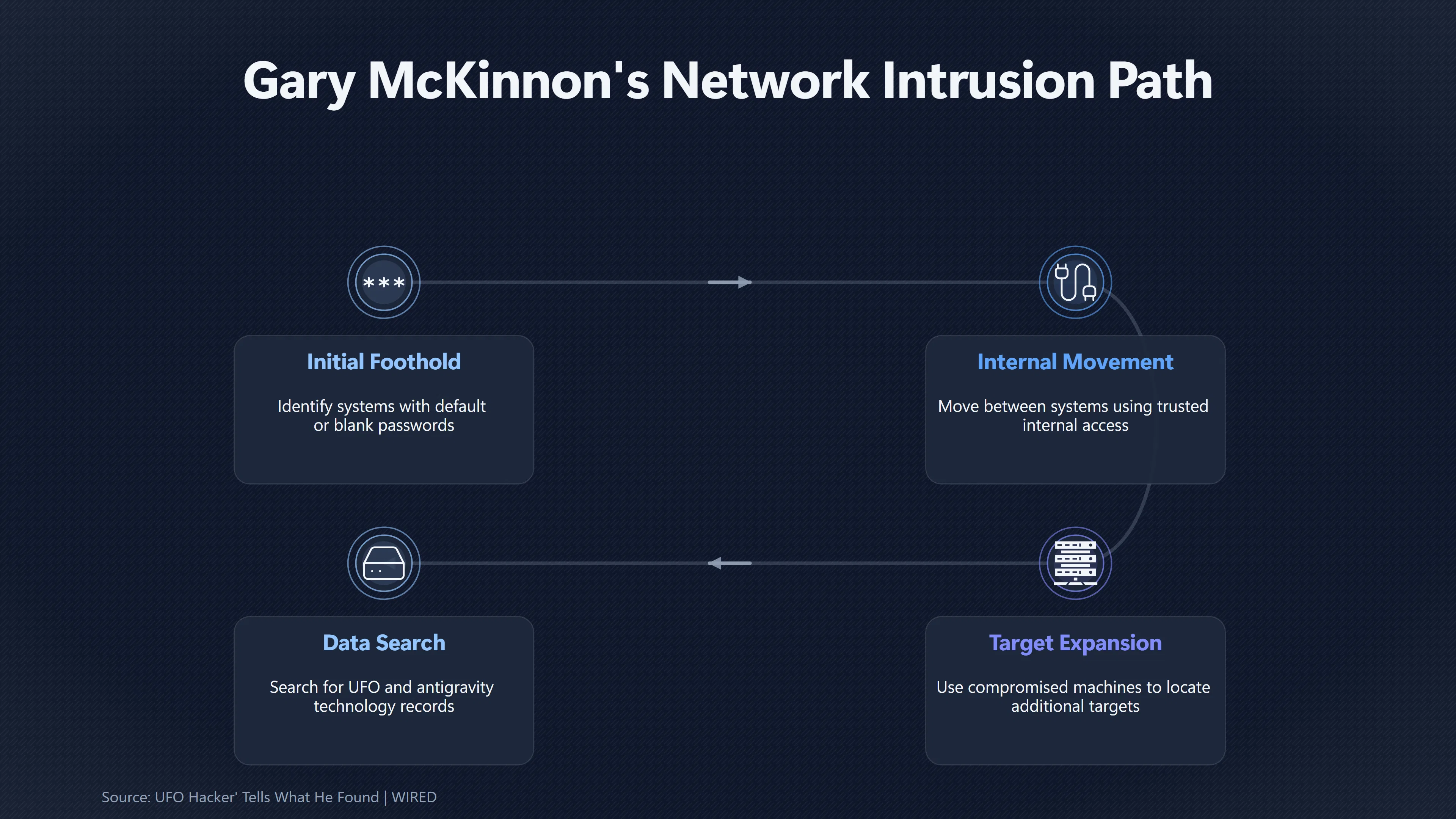
Gary McKinnon repeatedly described his actions in these terms. He said his goal was to search for evidence relating to UFOs, antigravity technology and “free energy”, not to conduct espionage in the traditional sense. Whether those expectations were justified is a separate question; what mattered is that vulnerable systems appeared to make independent verification possible.[WIRED]wired.comUFO Hacker' Tells What He Found | WIREDWIRED'UFO Hacker' Tells What He Found | WIRED…
How vulnerable systems narrowed the gap between belief and action
The McKinnon case became notable because the alleged intrusions highlighted surprisingly basic security weaknesses rather than highly advanced hacking techniques.
Contemporary reporting and later public accounts consistently describe problems such as:
- default or blank passwords remaining on internet-facing systems;
- remote administration software exposed to the internet;
- weak authentication practices;
- insufficient segmentation between networks;
- trusted internal access allowing movement between systems once an initial foothold had been obtained.
According to McKinnon’s own description, he spent much of his time identifying systems protected by weak credentials rather than exploiting sophisticated software vulnerabilities. The Guardian reported that some systems still used default passwords such as “password”, while McKinnon himself portrayed many intrusions as little more than finding machines whose administrators had never implemented basic security measures.[The Guardian]theguardian.comThe GuardianHacker's progress: how McKinnon pierced Pentagon security | UK news | The GuardianApril 3, 2007…
This distinction matters historically. The technical barrier appeared low enough that someone motivated primarily by curiosity and belief—rather than intelligence collection or financial crime—could imagine reaching supposedly hidden information.
Weak security reflected a broader government problem
It would be misleading to interpret these weaknesses as unique to UFO-related systems. Evidence from audits and oversight reports shows that information security problems affected government agencies far more broadly during this period.
A later US Government Accountability Office (GAO) review found that NASA had not consistently implemented effective controls over user authentication, access restrictions, network protection, encryption, configuration management and patching. Investigators also identified weaknesses involving password policies and access controls that increased the risk of unauthorised access. Although this audit was published after McKinnon’s intrusions, it demonstrated that significant institutional security shortcomings persisted well into the following decade.[GAO]gao.govgaoInformation Security: NASA Needs to Remedy Vulnerabilities in Key Networks | U.S. GAOOctober 15, 2009…
Similarly, NASA Office of Inspector General testimony discussing the McKinnon investigation highlighted recurring concerns about inconsistent security guidance, incomplete vulnerability scanning and uneven implementation of security controls across NASA centres.[NASA Office of Inspector General]oig.nasa.govOffice of Inspector General Cyber Security: The Status of InformationNASA Office of Inspector GeneralCyber Security: The Status of InformationJune 13, 2025…
These findings reinforce an important historical point: the opportunity arose from widespread cyber security weaknesses rather than from any special effort to protect—or accidentally expose—alleged UFO programmes.

The search expanded because networks appeared interconnected
Weak security also encouraged the belief that searching one vulnerable computer might eventually reveal access to more sensitive material.
US prosecutors alleged that McKinnon moved through numerous military and NASA systems after obtaining administrative access, using compromised machines to locate additional targets. Rather than treating each computer as an isolated objective, investigators described a progression through interconnected networks once initial access had been achieved.[Department of Justice]justice.govDepartment of JusticeLondon, England Hacker Indicted Under Computer Fraud and Abuse Act For Accessing Military Computers (November 12, 2002)…
For someone already convinced that evidence was hidden somewhere inside government infrastructure, this network structure encouraged persistence. Every successfully accessed system could be interpreted not as the end of the search but as another step towards more highly classified information.
The motivation therefore became self-reinforcing:
- successful access demonstrated that government security was weaker than expected;
- each disappointing search could be explained by assuming the desired files existed elsewhere;
- additional reachable systems appeared to increase the probability of eventually locating hidden evidence.
This dynamic helps explain why broad searches across many organisations made sense from the perspective of disclosure believers, even though no single agency had publicly acknowledged possessing the information they hoped to find.
Why security flaws did not validate the secrets being sought
One of the most persistent misunderstandings surrounding the McKinnon case is the assumption that because government security proved weak, extraordinary UFO claims therefore became more credible.
The evidence does not support that conclusion.
Security failures demonstrate only that unauthorised access was possible. They do not establish that the files sought actually existed, nor do they verify personal recollections about images or documents reportedly observed during remote sessions. McKinnon’s descriptions of what he believed he saw remain uncorroborated by independently authenticated records released from the affected agencies.[WIRED]wired.comUFO Hacker' Tells What He Found | WIREDWIRED'UFO Hacker' Tells What He Found | WIRED…
The distinction is essential:
- Weak security explains how an intruder could reach government computers.
- Extraordinary evidence requires independent verification regardless of how access occurred.
Confusing those two propositions turns a demonstrated cyber security problem into unsupported proof of unrelated claims.

The lasting lesson from the early internet era
The intersection between UFO disclosure culture and weak cyber security illustrates how technical conditions can reshape behaviour without validating underlying beliefs. During the late 1990s and early 2000s, inadequate password management, inconsistent security practices and exposed administrative tools made government networks appear surprisingly accessible. That accessibility reduced the perceived distance between speculation and direct investigation for individuals convinced that official secrecy concealed revolutionary discoveries.
Historically, this helps explain why figures such as Gary McKinnon viewed unauthorised access as a realistic path to disclosure rather than merely an act of curiosity. The episode is therefore best understood as the convergence of two independent factors: a powerful narrative about hidden knowledge and a period in which government cyber defences often failed to match the sensitivity of the systems they were meant to protect. The resulting intrusions revealed genuine security weaknesses, but they did not, by themselves, substantiate the extraordinary UFO claims that motivated the search.[theguardian.com]theguardian.comThe GuardianHacker's progress: how McKinnon pierced Pentagon security | UK news | The GuardianApril 3, 2007…
Amazon book picks
Further Reading
Books and field guides related to When Weak Security Made UFO Hunting Possible. Use these as the next step if you want deeper reading beyond the article.
The Hacker Crackdown: Law and Disorder on the Electronic Fron...
The bestselling cyberpunk author "has produced by far the most stylish report from the computer outlaw culture since Steven Levy's Hacker...
Ghost in the Wires: My Adventures as the World's Most Wanted...
In this "intriguing, insightful and extremely educational" novel, the world's most famous hacker teaches you easy cloaking and counter-me...
This Is How They Tell Me the World Ends: The Cyberweapons Arm...
WINNER OF THE FT & McKINSEY BUSINESS BOOK OF THE YEAR AWARD 2021 The instant New York Times bestseller A Financial Times and The Times Bo...
eBay marketplace picks
Marketplace Samples
Live-tested eBay searches with available results related to this page.
Selected fromretro computer model oneBay.co.uk.




Endnotes
1.
Source: wired.com
Title: ‘UFO Hacker’ Tells What He Found | WIRED
Link:https://www.wired.com/2006/06/ufo-hacker-tells-what-he-found/
Source snippet
WIRED'UFO Hacker' Tells What He Found | WIRED...
2.
Source: justice.gov
Link:https://www.justice.gov/archive/criminal/cybercrime/press-releases/2002/mckinnonIndict.htm
Source snippet
Department of JusticeLondon, England Hacker Indicted Under Computer Fraud and Abuse Act For Accessing Military Computers (November 12, 2002)...
Published: November 12, 2002
3.
Source: gao.gov
Title: gao 10 4
Link:https://www.gao.gov/products/gao
Source snippet
Information Security: NASA Needs to Remedy Vulnerabilities in Key Networks | U.S. GAOOctober 15, 2009...
Published: October 15, 2009
4.
Source: gao.gov
Title: 10-4, Information Security: NASA Needs to Remedy Vulnerabilities in Key Networks
Link:https://www.gao.gov/assets/a296860.html
Source snippet
GAO-10-4, Information Security: NASA Needs to Remedy Vulnerabilities in Key Networks...
5.
Source: oig.nasa.gov
Title: Office of Inspector General Cyber Security: The Status of Information
Link:https://oig.nasa.gov/docs/testimony062403.pdf
Source snippet
NASA Office of Inspector GeneralCyber Security: The Status of InformationJune 13, 2025...
Published: June 13, 2025
6.
Source: oig.nasa.gov
Title: s management of elevated privileges for information systems
Link:https://oig.nasa.gov/audits/nasas-management-of-elevated-privileges-for-information-systems/
Source snippet
nasa.govNASA’s Management of Elevated Privileges for Information Systems - NASA OIGMay 28, 2026 — 1 min read NASA’S MANAGEMENT OF ELEVATE...
Published: May 28, 2026
7.
Source: oig.nasa.gov
Link:https://oig.nasa.gov/news/nasa-cybercrime-sleuths-aid-nation-wide-investigation-to-expose-north-korean-ransomware-scheme/
Source snippet
Cybercrime Sleuths Aid Nation-Wide Investigation to Expose North Korean Ransomware Scheme - NASA OIGSeptember 15, 2025 — 5 min read NASA...
Published: September 15, 2025
8.
Source: oig.nasa.gov
Link:https://oig.nasa.gov/office-of-inspector-general-oig/audit-reports/evaluation-of-nasas-information-security-program-under-the-federal-information-security-modernization-act-for-fiscal-year-2025/
9.
Source: oig.nasa.gov
Link:https://oig.nasa.gov/office-of-inspector-general-oig/evaluation-of-nasas-information-security-program-under-the-federal-information-security-modernization-act-for-fiscal-year-2024/
10.
Source: oig.nasa.gov
Link:https://oig.nasa.gov/office-of-inspector-general-oig/ig-11-017/
11.
Source: wired.com
Title: terrorist or ufo truth seeker
Link:https://www.wired.com/2006/04/terrorist-or-ufo-truth-seeker/
12.
Source: wired.com
Title: brit fights hacking extradition
Link:https://www.wired.com/2002/11/brit-fights-hacking-extradition/
13.
Source: ntrs.nasa.gov
Link:https://ntrs.nasa.gov/citations/19900014594
14.
Source: oversight.gov
Link:https://www.oversight.gov/reports/audit/final-report-vulnerability-assessment-and-penetration-testing-nasas-financial-11
15.
Source: oversight.gov
Link:https://www.oversight.gov/reports/audit/final-report-vulnerability-assessment-and-penetration-testing-nasas-financial-5
16.
Source: oversight.gov
Link:https://www.oversight.gov/reports/audit/final-report-vulnerability-assessment-and-penetration-testing-nasas-financial
17.
Source: oversight.gov
Link:https://www.oversight.gov/reports/audit/audit-nasas-fiscal-year-2017-financial-statements/recommendations/rec-4
18.
Source: theguardian.com
Link:https://www.theguardian.com/uk/2007/apr/03/politics.usa
Source snippet
The GuardianHacker's progress: how McKinnon pierced Pentagon security | UK news | The GuardianApril 3, 2007...
Published: April 3, 2007
19.
Source: theguardian.com
Title: The Guardian Profile: Gary Mc Kinnon | Gary Mc Kinnon | The Guardian
Link:https://www.theguardian.com/technology/2009/jul/31/gary-mckinnon-hacking-extradition
20.
Source: theguardian.com
Title: Briton loses extradition fight over US military hacking | UK news | The Guardian
Link:https://www.theguardian.com/uk/2007/apr/03/politics.usa1
Additional References
21.
Source: youtube.com
Title: Theresa May blocks Gary Mc Kinnon’s extradition to US
Link:https://www.youtube.com/watch?v=5MEQVo8ENC8
Source snippet
Ancient Aliens: Hacking NASA Secrets (Season 12, Episode 9) | History...
22.
Source: youtube.com
Title: Hacking for UFOs and fighting for his life. Who is Gary Mc Kinnon? | Nord VPN
Link:https://www.youtube.com/watch?v=OImdnvQx7sQ
Source snippet
UK hacker's extradition to US blocked...
23.
Source: youtube.com
Title: UK hacker’s extradition to US blocked
Link:https://www.youtube.com/watch?v=v4Js8DF80HY
Source snippet
Theresa May blocks Gary McKinnon's extradition to US...
24.
Source: youtube.com
Title: Ancient Aliens: Hacking NASA Secrets (Season 12, Episode 9) | History
Link:https://www.youtube.com/watch?v=20rWFDfh68Y
Source snippet
Gary McKinnon wins extradition battle...
25.
Source: seclists.org
Title: Information Security News: UK’s NASA hacker breaks his silence
Link:https://seclists.org/isn/2005/Jul/42
26.
Source: learn.microsoft.com
Title: avenues to compromise
Link:https://learn.microsoft.com/en-us/windows-server/identity/ad-ds/plan/security-best-practices/avenues-to-compromise
27.
Source: youtube.com
Title: Gary Mc Kinnon wins extradition battle
Link:https://www.youtube.com/watch?v=y4lecD44F5E
28.
Source: spectrum.ieee.org
Title: the autistic hacker
Link:https://spectrum.ieee.org/the-autistic-hacker