Within NASA Findings
Can a Bad Sensor Create a UFO Mystery?
An uncalibrated sensor can turn equipment behaviour, measurement error or processing artefacts into an apparently extraordinary feature.
On this page
- What calibration establishes
- Common sensor artefacts and false impressions
- Why calibrated instruments support stronger claims
Page outline Jump by section
Introduction
Can a poorly calibrated sensor create what appears to be a UFO mystery? According to NASA’s independent study of unidentified anomalous phenomena (UAP), the answer is yes—at least in the sense that inadequate calibration can make ordinary objects or instrument behaviour appear extraordinary. The agency concluded that many UAP reports cannot be interpreted reliably because the sensors involved were not designed, calibrated or documented for scientific measurement. Without calibration, analysts cannot confidently determine an object’s brightness, position, speed, distance or temperature, making dramatic conclusions far less secure than the imagery alone might suggest.[NASA Science]smd-cms.nasa.govScience NASAUNIDENTIFIED ANOMALOUS PHENOMENA…
Within the broader discussion of NASA’s findings on UFO evidence and data quality, sensor calibration is a crucial mechanism rather than a minor technical detail. It determines whether unusual features belong to the object being observed or to the instrument recording it.
What calibration establishes
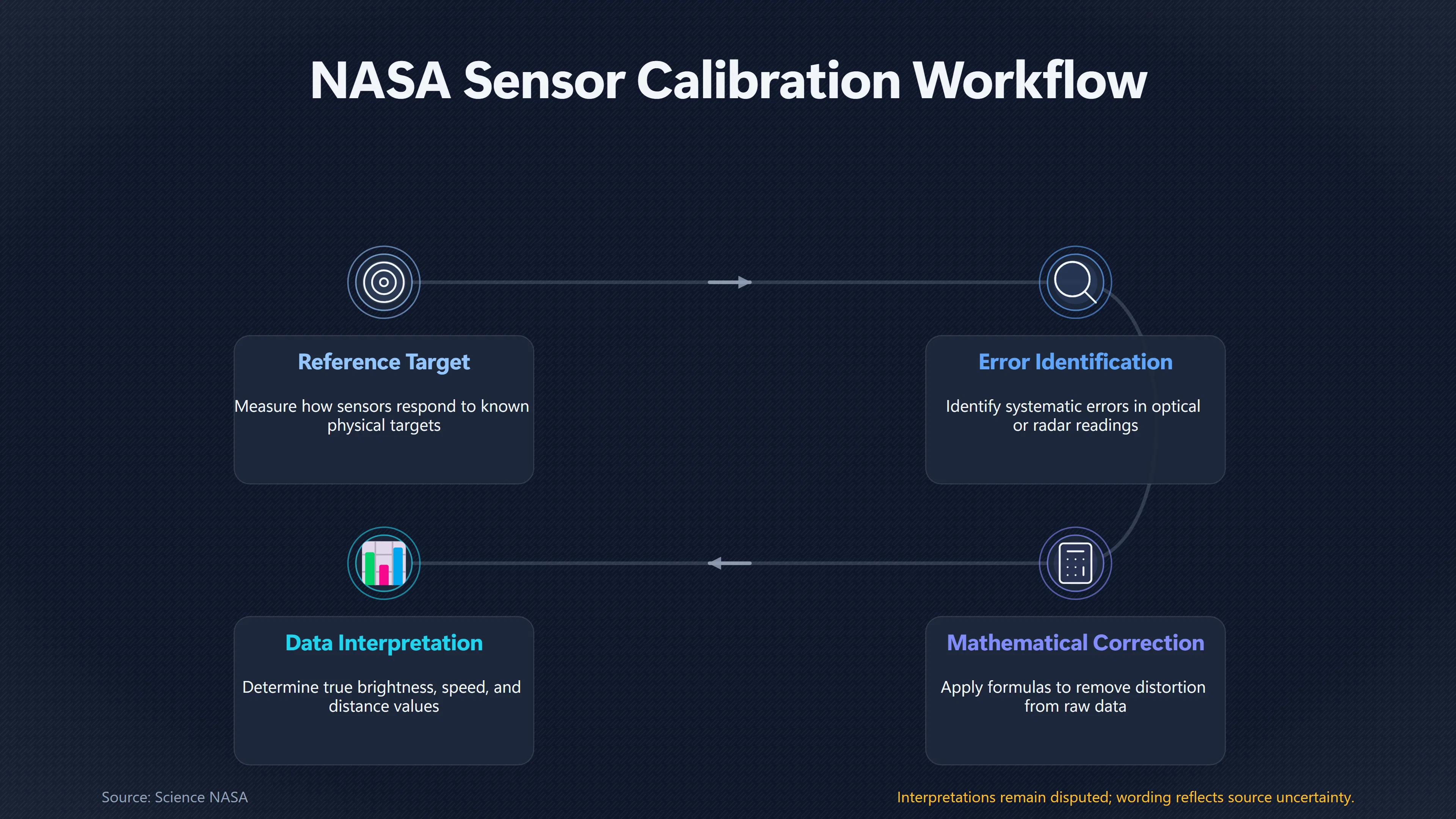
Calibration is the process of measuring how a sensor responds to known reference targets so that its readings can be interpreted correctly. Every scientific instrument, whether an optical camera, infrared detector, radar or telescope, introduces small systematic errors. Calibration identifies those errors and either removes them or allows analysts to account for them mathematically.
For UAP investigations, calibration establishes several critical quantities:
- Whether measured brightness corresponds to the object’s actual brightness or to sensor response.
- How image coordinates relate to true viewing angles.
- How accurately the instrument records timing, which affects speed estimates.
- How temperature measurements relate to genuine infrared emission rather than detector behaviour.
- The level of electronic noise, distortion and measurement uncertainty.
NASA’s report notes that many reported UAP observations originate from instruments never intended to study unidentified objects. Metadata describing sensor type, sensitivity, exposure settings, temperature, bit depth and noise characteristics are often missing, making meaningful calibration impossible after the event.[NASA Science]smd-cms.nasa.govScience NASAUNIDENTIFIED ANOMALOUS PHENOMENA…
How poor calibration changes the interpretation
The same image can support very different explanations depending on whether the recording system has been calibrated.
For example, estimating an object’s size requires knowing both its angular size and its distance. If camera geometry is uncertain because focal length, lens distortion or pointing accuracy are unknown, a nearby small object can be mistaken for a distant large one.
Similarly, apparent speed depends on accurate knowledge of:
- camera motion;
- frame timing;
- viewing direction;
- object distance.
Small calibration errors in any of these measurements can produce very large errors in inferred velocity.
NASA therefore treats many dramatic performance claims with caution because the uncertainties in the measuring system may exceed the apparent anomaly itself.[NASA Science]smd-cms.nasa.govScience NASAUNIDENTIFIED ANOMALOUS PHENOMENA…
Brightness is not always physical
A particularly common misunderstanding involves brightness.
An object appearing intensely bright does not necessarily emit large amounts of light or heat. Camera sensors may saturate when exposed to intense sources, causing pixels to “clip” at their maximum value. Electronic blooming can make bright objects appear much larger than they really are, while automatic exposure systems can alter apparent intensity between frames.
Without calibration, analysts cannot determine whether changing brightness reflects:
- genuine physical changes;
- atmospheric effects;
- automatic camera adjustments;
- detector saturation.
Consequently, apparent luminosity alone provides weak evidence for extraordinary explanations.

Infrared measurements require their own calibration
Infrared cameras present additional challenges because they measure thermal radiation rather than visible light.
Their readings depend on detector temperature, internal gain settings, atmospheric absorption and the emissivity of the object being viewed. Modern thermal imaging research shows that photometric calibration is essential before quantitative temperature estimates can be trusted, particularly for commercial infrared cameras operating with automatic gain control.[arXiv]arxiv.orgarXiv Online Photometric Calibration of Automatic Gain Thermal Infrared CamerasOnline Photometric Calibration of Automatic Gain Thermal Infrared CamerasDecember 7, 2020…
In practical terms, an apparently “cold” or “hot” object in military infrared footage may instead reflect instrument settings or calibration limitations rather than unusual physical properties.
Common sensor artefacts and false impressions
NASA’s report specifically notes that several apparent UAP have later proved to be sensor artefacts once appropriate calibration and metadata review were applied. The lesson is not that every unexplained observation has an ordinary explanation, but that extraordinary interpretations should not precede careful examination of the instrument itself.[NASA]nasa.govuap independent study team final report 0UNIDENTIFIED ANOMALOUS PHENOMENA Independent…
Common examples include:
- Lens distortion. Wide-angle optics bend straight lines and alter apparent motion near the image edges.
- Detector noise. Random electronic fluctuations can create transient bright spots.
- Motion blur. Camera movement may stretch ordinary lights into unusual shapes.
- Automatic exposure adjustments. Sudden brightness changes may originate in the camera rather than the scene.
- Parallax effects. Observing from a moving aircraft can make nearby objects appear to accelerate dramatically against distant backgrounds.
- Infrared processing artefacts. Internal image enhancement can exaggerate edges, contrast or apparent structure.
Individually, these effects are well understood in imaging science. Combined with incomplete metadata, however, they can produce observations that appear highly unusual when viewed without technical context.
Why metadata matters as much as calibration
Calibration cannot be separated from metadata.
To reconstruct what a sensor recorded, investigators need information including:
- instrument model;
- calibration history;
- acquisition time;
- viewing direction;
- exposure settings;
- detector temperature;
- processing pipeline;
- compression history.
NASA emphasises that these details are absent from many historical UAP reports. Even high-resolution imagery loses much of its scientific value if investigators cannot establish how the recording system behaved at the time of capture.[NASA Science]smd-cms.nasa.govScience NASAUNIDENTIFIED ANOMALOUS PHENOMENA…
This is one reason why dramatic videos circulating online often remain scientifically inconclusive despite appearing visually compelling.
Why calibrated instruments support stronger claims
Calibration does not prove that an unusual observation represents something extraordinary. Instead, it strengthens confidence that the measurement itself is real.
NASA recommends systematic calibration, complete metadata and multiple independent measurements because these allow different instruments to corroborate one another. If radar, optical cameras, infrared sensors and satellite observations—all individually calibrated—independently record the same object’s position and motion, analysts can distinguish genuine physical behaviour from equipment artefacts far more effectively.[NASA]nasa.govUPDATE: NASA Shares UAP Independent Study Report; Names DirectorUPDATE: NASA Shares UAP Independent Study Report; Names Director - NASA…
This philosophy also explains why NASA views its own Earth-observing systems as valuable contributors to future UAP research. Although they were not designed specifically to detect UAP, many operate with rigorous calibration standards that make their measurements scientifically trustworthy.[NASA]nasa.govUPDATE: NASA Shares UAP Independent Study Report; Names DirectorUPDATE: NASA Shares UAP Independent Study Report; Names Director - NASA…
What this means for evaluating UFO claims
NASA’s discussion of sensor calibration shifts the central question away from whether an image looks extraordinary and towards whether the measurement is trustworthy. A striking video recorded by an uncalibrated or poorly documented sensor may remain impossible to interpret, regardless of how unusual it appears.
This principle also provides a useful framework when considering wider UFO narratives, including claims associated with figures such as Gary McKinnon. Access to alleged government material or unusual imagery does not by itself establish what was observed. The scientific strength of any claim depends on whether the underlying measurements can be traced to calibrated instruments with preserved metadata and independently verifiable observational context.
Rather than dismissing unexplained sightings, NASA’s approach argues for improving the quality of future evidence. Better-calibrated sensors, preserved metadata and multiple independent observations reduce ambiguity, allowing investigators to separate genuine unknowns from the many ordinary effects that can arise from imperfect instruments.[nasa.gov]smd-cms.nasa.govScience NASAUNIDENTIFIED ANOMALOUS PHENOMENA…
Amazon book picks
Further Reading
Books and field guides related to Can a Bad Sensor Create a UFO Mystery?. Use these as the next step if you want deeper reading beyond the article.
Bad Astronomy
A clever, thought-provoking guide that attacks common astronomical misconceptions What is Bad Astronomy? Anything that accidentally or in...
The Signal and the Noise
This work explores the history, art and science of prediction.
Calling Bullshit
It's not just fake news. Bullshit is everywhere. Now, two science professors give us the tools to dismantle misinformation and think clea...
How to Lie with Statistics
'A great introduction to a crucial topic' Bill Gates 'Perhaps the most popular book on statistics ever published ... It's a marvel ... ga...
eBay marketplace picks
Marketplace Samples
Live-tested eBay searches with available results related to this page.
Selected fromNASA poster oneBay.co.uk.

Endnotes
1.
Source: smd-cms.nasa.gov
Title: Science NASA
Link:https://smd-cms.nasa.gov/wp-content/uploads/2023/09/uap-independent-study-team-final-report.pdf
Source snippet
UNIDENTIFIED ANOMALOUS PHENOMENA...
2.
Source: nasa.gov
Title: UPDATE: NASA Shares UAP Independent Study Report; Names Director
Link:https://www.nasa.gov/news-release/update-nasa-shares-uap-independent-study-report-names-director/
Source snippet
UPDATE: NASA Shares UAP Independent Study Report; Names Director - NASA...
3.
Source: nasa.gov
Title: uap independent study team final report 0
Link:https://www.nasa.gov/wp-content/uploads/2023/09/uap-independent-study-team-final-report-0.pdf?emrc=665b1ec1d2c32
Source snippet
UNIDENTIFIED ANOMALOUS PHENOMENA Independent...
4.
Source: arxiv.org
Title: arXiv Online Photometric Calibration of Automatic Gain Thermal Infrared Cameras
Link:https://arxiv.org/abs/2012.14292
Source snippet
Online Photometric Calibration of Automatic Gain Thermal Infrared CamerasDecember 7, 2020...
Published: December 7, 2020
5.
Source: science.nasa.gov
Title: Science UAP
Link:https://science.nasa.gov/uap/
Source snippet
NASA ScienceUAP - NASA Science...
6.
Source: science.nasa.gov
Title: Science UAP FAQs
Link:https://science.nasa.gov/uap/faqs/
Source snippet
Trump’s direction for whole-of-government transparency and will alw...
7.
Source: earth.gsfc.nasa.gov
Title: biosphere instrument calibration
Link:https://earth.gsfc.nasa.gov/bio/research/biosphere-instrument-calibration
Source snippet
Instrument Calibration | EarthJuly 14, 2026 — BIOSPHERE INSTRUMENT CALIBRATION GSFC laser calibration setup (courtesy Joel McCorkel) Team...
Published: July 14, 2026
8.
Source: science.nasa.gov
Link:https://science.nasa.gov/science-research/earth-science/joint-earth-observation-mission-quality-assessment-framework-optical-guidelines-documents-released/
Source snippet
Earth Observation Mission Quality Assessment Framework - Optical Guidelines Documents Released - NASA ScienceMay 11, 2026 — 3 min read JO...
Published: May 11, 2026
9.
Source: science.nasa.gov
Title: raw images faq
Link:https://science.nasa.gov/solar-system/multimedia/raw-images-faq/
10.
Source: nasa.gov
Title: NAS A to Release, Discuss Unidentified Anomalous Phenomena Report
Link:https://www.nasa.gov/news-release/nasa-to-release-discuss-unidentified-anomalous-phenomena-report/
11.
Source: ntrs.nasa.gov
Link:https://ntrs.nasa.gov/citations/20240001404
12.
Source: nasa.gov
Title: NAS A Provides Coverage of Unidentified Anomalous Phenomena Meeting
Link:https://www.nasa.gov/news-release/nasa-provides-coverage-of-unidentified-anomalous-phenomena-meeting/
13.
Source: nasa.gov
Title: GOE S-17 Mishap Investigation Board Study Completed
Link:https://www.nasa.gov/news-release/goes-17-mishap-investigation-board-study-completed/
14.
Source: terra.nasa.gov
Title: sensor degradation leads to calibration improvements
Link:https://terra.nasa.gov/news/sensor-degradation-leads-to-calibration-improvements
15.
Source: science.nasa.gov
Title: landsat ghostbusters how the landsat calibration team caught a ghost
Link:https://science.nasa.gov/missions/landsat/landsat-ghostbusters-how-the-landsat-calibration-team-caught-a-ghost/
16.
Source: ntrs.nasa.gov
Link:https://ntrs.nasa.gov/citations/20150000753
17.
Source: ntrs.nasa.gov
Link:https://ntrs.nasa.gov/citations/20020060733
18.
Source: ntrs.nasa.gov
Link:https://ntrs.nasa.gov/citations/20000013442
Additional References
19.
Source: youtube.com
Title: Public Meeting on Unidentified Anomalous Phenomena (Official NASA Broadcast)
Link:https://www.youtube.com/watch?v=bQo08JRY0iM
Source snippet
Unidentified Anomalous Phenomena Independent Study Report...
20.
Source: youtube.com
Title: Unidentified Anomalous Phenomena Independent Study Report
Link:https://www.youtube.com/watch?v=TQcqOW39ksk
Source snippet
Breakdown of the Pentagon UFO videos with Mick West...
21.
Source: stir.ac.uk
Link:https://www.stir.ac.uk/research/hub/publication/1388664
22.
Source: sciencedirect.com
Link:https://www.sciencedirect.com/science/article/abs/pii/S1350449507000886
23.
Source: sciencedirect.com
Link:https://www.sciencedirect.com/science/article/pii/S1350449507000886
24.
Source: scribd.com
Link:https://www.scribd.com/document/671256731/UAP-Independent-Study-Team-Final-Report
25.
Source: mdpi.com
Link:https://www.mdpi.com/2072-4292/10/6/830
26.
Source: youtube.com
Title: Gimbal UFO
Link:https://www.youtube.com/watch?v=qsEjV8DdSbs
Source snippet
Just Released MILITARY VIDEO of THREE UAP's in the Western U.S...
27.
Source: researchgate.net
Title: (PDF) A study of IRFPA camera measurement errors: Radiometric artefacts
Link:https://www.researchgate.net/publication/239796489_A_study_of_IRFPA_camera_measurement_errors_Radiometric_artefacts
28.
Source: spiedigitallibrary.org
Title: Influence Of Nonuniformity On Infrared Focal Plane Array Performance
Link:https://www.spiedigitallibrary.org/journals/optical-engineering/volume-24/issue-5/245855/Influence-Of-Nonuniformity-On-Infrared-Focal-Plane-Array-Performance/10.1117/12.7973588.short