Within Claim Checklist
Does Strange Government Language Really Mean Aliens?
A dramatic phrase may reflect routine jargon, so its meaning must be tested against manuals, organisational charts and neighbouring records.
On this page
- Why internal labels can sound misleading
- How to reconstruct historical agency usage
- When a mundane explanation is insufficient
Page outline Jump by section
Introduction
When evaluating a UFO hacking claim, one of the most important questions is not whether a phrase sounds extraordinary but whether it actually meant something extraordinary to the organisation that created it. Government departments, military commands and scientific agencies routinely use specialised terminology that can appear dramatic when removed from its administrative context. A label that seems to imply aliens, secret spacecraft or hidden programmes may instead describe routine personnel categories, logistics, file organisation or internal accounting.
This principle is particularly relevant to claims associated with Gary McKinnon, whose recollections include seeing references such as “Non-Terrestrial Officers” and “fleet-to-fleet transfers”. Because the original files have never been publicly produced or independently verified, the wording itself becomes the primary evidence. That makes understanding agency language at least as important as interpreting the words literally.
Why internal labels can sound misleading
Large organisations develop terminology for administrative efficiency rather than public readability. Personnel databases, procurement systems and technical archives often contain abbreviated or specialised labels whose intended audience already understands their meaning.
Several characteristics make government terminology especially prone to misunderstanding:
- Labels are often written for database fields rather than ordinary readers.
- Space is frequently limited, encouraging abbreviations and compressed wording.
- Technical terms may retain historical meanings long after organisational structures change.
- Administrative language often reflects geography, logistics or jurisdiction rather than popular usage.
A phrase like “non-terrestrial” therefore cannot automatically be interpreted as meaning “alien”. In plain English the words suggest extraterrestrial life, but in institutional language they could simply distinguish activities occurring away from the Earth’s surface, beyond a terrestrial installation or outside a conventional land-based organisation. Without surrounding documentation, the intended meaning cannot safely be inferred.
The same principle appears throughout government and scientific record-keeping. NASA and other research organisations use structured naming conventions that prioritise consistency and machine readability rather than natural language, producing labels that may look cryptic or misleading outside their original context.[SPDF]spdf.gsfc.nasa.govSPDFFilenaming RecommendationsJuly 22, 2026…
How to reconstruct historical agency usage
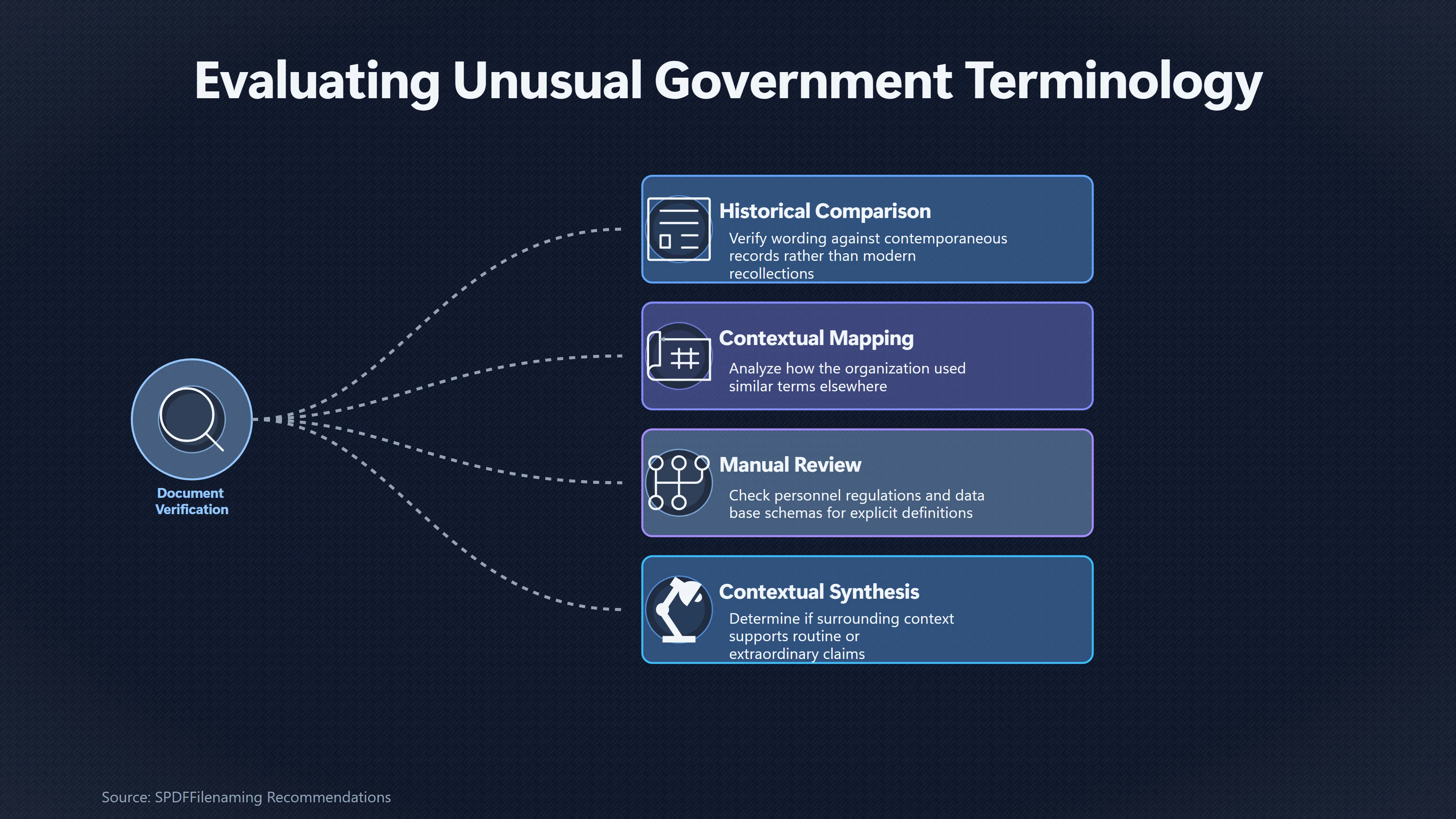
The strongest way to interpret an unusual label is to reconstruct how the organisation used similar terminology during the same period rather than relying on modern assumptions.
Compare neighbouring records
An isolated filename rarely explains itself. Investigators should ask:
- What directory contained the file?
- What other files used similar terminology?
- Were neighbouring records clearly administrative, operational or scientific?
- Did identical prefixes or suffixes appear elsewhere with mundane meanings?
If every adjacent spreadsheet concerns payroll, personnel or equipment transfers, an apparently mysterious title is more likely to belong to that administrative system than to a hidden disclosure about extraterrestrial technology.
Examine organisational structure
Historical organisation charts often explain terminology that later readers misinterpret.
Military commands routinely classify personnel by command assignment, deployment status, operational theatre or physical location. A category referring to personnel serving away from terrestrial bases would be unusual but not inherently impossible as an administrative distinction. Whether that was actually the intended meaning requires documentary corroboration, not speculation.
Likewise, terms such as “fleet”, “transfer”, “command”, “station” or “officer” have highly specific meanings within military administration that differ from everyday speech.
Search contemporaneous manuals
Personnel regulations, database documentation, procurement manuals and archival guidance often define field names explicitly.
Rather than asking whether a phrase sounds extraordinary today, a stronger historical method asks whether the same wording appeared elsewhere in:
- user manuals;
- database schemas;
- procurement systems;
- personnel regulations;
- archival documentation;
- other records from the same office.
Repeated ordinary usage across independent records greatly weakens an extraordinary interpretation.
The “Non-Terrestrial Officers” example
McKinnon has consistently stated that he saw a spreadsheet headed “Non-Terrestrial Officers”. Importantly, he has generally explained that he did not interpret the phrase as referring to extraterrestrial beings. Instead, he suggested it might refer to personnel operating away from Earth as part of a secret space programme.[The Michael S. Heiser Foundation]michaelsheiserfoundation.orgThe Michael S. Heiser FoundationNASA’s Non-Terrestrial Officers? Debunking the Viral ConspiracyJanuary 25, 2016…
That distinction is frequently overlooked.
Even so, several evidential limitations remain.
First, no publicly authenticated copy of the spreadsheet has been released.
Second, no surrounding records have been produced showing how the phrase was used elsewhere within the same information system.
Third, no official personnel manual or database documentation has surfaced confirming that “Non-Terrestrial Officers” was an established administrative category.
Because those contextual records are missing, neither the ordinary interpretation nor the extraordinary interpretation can presently be demonstrated from the phrase alone.
Why file titles are weaker evidence than complete records
Database headings and spreadsheet names rarely carry their complete meaning independently.
Consider how many ordinary records would appear mysterious if only the title survived:
- “Special Access Personnel”
- “Black Program Transfers”[thecontactreport.com]thecontactreport.comSource details in endnotes.
- “Remote Assets”
- “Strategic Platforms”
Without the underlying rows, metadata, authorship, timestamps and surrounding documentation, readers naturally project meanings onto ambiguous words.
Government record systems are also designed around internal workflows rather than public explanation. NASA’s guidance on identifying records for retrieval, for example, stresses the importance of precise titles, dates, offices and related contextual information because filenames alone are often insufficient to identify what a record actually contains.[NASA]nasa.govFOIA GuidanceFOIA Guidance - NASASeptember 19, 2025…
The absence of surrounding context therefore substantially limits what can responsibly be inferred from any reported label.

When a mundane explanation is insufficient
An ordinary explanation should not be accepted automatically simply because it is ordinary.
A mundane interpretation becomes persuasive only if evidence supports it.
Conversely, an extraordinary interpretation requires correspondingly strong evidence.
A routine explanation begins to lose force if investigators discover:
- official manuals defining the phrase differently;
- multiple independent records using the same unusual terminology consistently;
- corroborating personnel databases;
- authenticated documents demonstrating that the label referred to an unexpected organisational category;
- contemporaneous witnesses independently describing the same terminology.
Likewise, an extraordinary explanation gains credibility only when supported by authenticated records rather than by the wording of a single reported filename.
The burden is therefore symmetrical: neither sceptical dismissal nor extraordinary speculation should replace documentary evidence.
Practical guidance when evaluating unusual government terminology
When encountering dramatic language in a UFO-related hacking claim, a structured approach is more reliable than relying on intuition.
Ask the following questions in order:
- Is the original document available for independent examination?
- Can the wording be verified from contemporaneous records rather than later recollection?
- How did the organisation use similar terminology elsewhere?
- Do manuals, organisational charts or database documentation define the label?
- Does the surrounding context support the extraordinary interpretation, or does it point towards routine administration?
- Would the same phrase still appear remarkable if found inside an ordinary personnel or logistics database?
Applying these questions prevents isolated labels from carrying more evidential weight than they deserve.
The broader lesson for UFO hacking claims
The history of government bureaucracy shows that institutional language often differs sharply from ordinary English. Administrative shorthand, technical classifications and legacy database terminology can sound dramatic when detached from their operational setting.
For that reason, an unusual phrase—whether “Non-Terrestrial Officers” or any similarly striking label—should be treated as the beginning of an investigation rather than its conclusion. In the McKinnon case, the wording remains intriguing, but without authenticated records showing how the term functioned within the original system, it cannot by itself establish the existence of a secret off-world programme, nor can it conclusively be reduced to an entirely mundane administrative category. The decisive evidence lies not in the label alone but in the historical context surrounding its documented use.
Amazon book picks
Further Reading
Books and field guides related to Does Strange Government Language Really Mean Aliens?. Use these as the next step if you want deeper reading beyond the article.
Mirage Men
Seeking the truth about UFOs in America, Mark Pilkington and John Lundberg uncover a 60 year-old story stranger than any conspiracy thril...
The Demon-Haunted World
NEW YORK TIMES BESTSELLER • From the renowned astronomer and author of Cosmos comes a “powerful [and] stirring defense of informed ration...
Structured Analytic Techniques for Intelligence Analysis
This book takes the relatively new concept of structured analytic techniques and defines its place in a taxonomy of analytic methods. It...
eBay marketplace picks
Marketplace Samples
Live-tested eBay searches with available results related to this page.
Selected fromUFO poster oneBay.co.uk.


Current eBay listing
I Want To Believe UFO Poster Giclée Fine Art Heavyweight Print

Current eBay listing
VINTAGE UFO FLYING SAUCERS COMIC ADVERTISING A2 POSTER PRINT

Endnotes
1.
Source: spdf.gsfc.nasa.gov
Title: SPDFFilenaming Recommendations
Link:https://spdf.gsfc.nasa.gov/guidelines/filenaming_recommendations.html
Source snippet
July 22, 2026...
Published: July 22, 2026
2.
Source: heasarc.gsfc.nasa.gov
Title: HEASARCFile Names
Link:https://heasarc.gsfc.nasa.gov/adfwww/asca/processing_doc/GS/names.html
3.
Source: nasa.gov
Title: FOIA Guidance
Link:https://www.nasa.gov/foia/foia-guidance/
Source snippet
FOIA Guidance - NASASeptember 19, 2025...
Published: September 19, 2025
4.
Source: nasa.gov
Title: FOI A Homepage
Link:https://www.nasa.gov/foia/
Source snippet
FOIA Homepage - NASAMay 20, 2026 — FOIA * FOIA Home * FOIA Contacts * FOIA Guidance * Access NASA Records * NASA FOIA Reports * FOIA E-Li...
Published: May 20, 2026
5.
Source: sti.nasa.gov
Link:https://www.sti.nasa.gov/nasa-thesaurus/
Source snippet
STI Compliance and Distribution ServicesApril 24, 2026 — Image: Earth as seen from the International Space Station (ISS) NASA...
Published: April 24, 2026
6.
Source: nasa.gov
Title: FOI A Contacts
Link:https://www.nasa.gov/foia/foia-contacts/
7.
Source: hdrl.gsfc.nasa.gov
Title: filenaming recommendations
Link:https://hdrl.gsfc.nasa.gov/guidelines/filenaming_recommendations.html
8.
Source: foia.blogs.archives.gov
Title: what the foia is glomar
Link:https://foia.blogs.archives.gov/2024/01/25/what-the-foia-is-glomar/
9.
Source: soho.nascom.nasa.gov
Link:https://soho.nascom.nasa.gov/hotshots/2003_01_17/
10.
Source: esdpubs.nasa.gov
Title: File Name Overview
Link:https://esdpubs.nasa.gov/content/File_Name_Overview
11.
Source: acd-ext.gsfc.nasa.gov
Link:https://acd-ext.gsfc.nasa.gov/Data_services/doc/df/node109.html
12.
Source: nodis3.gsfc.nasa.gov
Title: display All.cfm
Link:https://nodis3.gsfc.nasa.gov/displayAll.cfm?Internal_ID=N_PR_1450010C&page_name=ALL
13.
Source: ntrs.nasa.gov
Link:https://ntrs.nasa.gov/citations/19730024395
14.
Source: seadas.gsfc.nasa.gov
Title: Rapid Eye
Link:https://seadas.gsfc.nasa.gov/help-9.2.0/rapideye/RapidEye.html
15.
Source: nlsp.nasa.gov
Link:https://nlsp.nasa.gov/explore/lsdahome/datasubmit
16.
Source: lsda.jsc.nasa.gov
Link:https://lsda.jsc.nasa.gov/explore/lsdahome/datasubmit
17.
Source: youtube.com
Link:https://www.youtube.com/watch?v=y6Is7809XFU
Source snippet
UFO - Hacker Gary Mckinnon Interview 5-5-2006 BBC...
18.
Source: youtube.com
Link:https://www.youtube.com/watch?v=B00Fv9VMDq0
Source snippet
Gary McKinnon Non Terrestrial Officers interview “I Found a List of Non-Terrestrial Officers” — Gary McKinnon Jesse Michels Clips...
19.
Source: youtube.com
Title: Jesse Michels Clips
Link:https://www.youtube.com/watch?v=2ttdlCa5ZCI&t=357s
Source snippet
UFO - Hacker Gary Mckinnon Interview 5-5-2006 BBC Star*Trooper...
20.
Source: michaelsheiserfoundation.org
Link:https://michaelsheiserfoundation.org/articles/nasas-non-terrestrial-officers/
Source snippet
The Michael S. Heiser FoundationNASA’s Non-Terrestrial Officers? Debunking the Viral ConspiracyJanuary 25, 2016...
Published: January 25, 2016
Additional References
21.
Source: thegalacticmind.com
Title: The Galactic Mind Gary Mc Kinnon and the Search Inside the Machine
Link:https://www.thegalacticmind.com/the-ufo-hacker-gary-mckinnon/
Source snippet
THE NASA AND PENTAGON INTRUSIONS Between 2001 and 2002, U.S. authorities accused McKinnon of accessing numero...
22.
Source: youtube.com
Title: Gary Mckinnon: The Hacker Who Found UFOs
Link:https://www.youtube.com/watch?v=8_1DuqeU8hw
Source snippet
"PERFECTLY SMOOTH SHELL OF A CRAFT." GARY MCKINNON 1ST INTERVIEW IN YEARS. Richard Dolan Show...
23.
Source: youtube.com
Title: “I Found a List of Non-Terrestrial Officers” — Gary Mc Kinnon
Link:https://www.youtube.com/watch?v=pbQg5P5qGhI
Source snippet
UFO Hacker Shares New Secrets | Gary McKinnon...
24.
Source: jcs.mil
Link:https://www.jcs.mil/Doctrine/DoD-Terminology-Program/
25.
Source: monkeyandelf.com
Link:https://www.monkeyandelf.com/antigravity-unearthly-officers-and-ufos-the-history-of-the-loudest-pentagon-hacking/
26.
Source: thecontactreport.com
Link:https://thecontactreport.com/gary-mckinnon-and-the-secret-space-program-a-deep-dive-into-the-non-terrestrial-officers-and-the-black-budget-shadow-empire/
27.
Source: projectcamelot.org
Link:https://projectcamelot.org/lang/en/gary_mckinnon_interview_transcript_en.html
28.
Source: singjupost.com
Link:https://singjupost.com/transcript-the-lone-hacker-that-found-nasas-secret-ufo-fleet-american-alchemy/
29.
Source: uso.org
Link:https://www.uso.org/brandroom/writing-guide/uso-military-language-glossary
30.
Source: cybernews.com
Link:https://cybernews.com/news/nasa-gary-mckinnon-hacking-ufo/