Within Hidden Technology
Was Unconventional Propulsion Really Suppressed?
Published propulsion studies show that unconventional ideas were investigated openly, but not that practical secret breakthroughs already existed.
On this page
- What researchers proposed about vacuum interactions
- The limits and caveats in published studies
- Why open research complicates suppression claims
Page outline Jump by section
Introduction
Claims surrounding UFO secrecy, including those associated with Gary McKinnon’s stated motivations for searching United States government computers, often assume that research into antigravity or quantum vacuum propulsion has been almost entirely hidden from public view. The historical record shows something more nuanced. Since at least the 1990s, government agencies, universities and independent researchers have openly explored highly speculative propulsion concepts involving the quantum vacuum, spacetime and gravity. These studies demonstrate that unconventional ideas were investigated seriously enough to merit publication and limited research funding. They do not, however, demonstrate that practical propulsion systems were discovered and then concealed.
This distinction matters because the existence of open research complicates a common suppression narrative. Rather than showing a complete ban on investigation, the published literature reveals a field where ambitious hypotheses have been examined under ordinary scientific scrutiny, while practical engineering breakthroughs have remained elusive.
What researchers proposed about vacuum interactions
Quantum field theory does not describe empty space as literally empty. Even in its lowest-energy state, a quantum field exhibits fluctuations that produce measurable effects under specific conditions. One of the best-known examples is the Casimir effect, in which closely spaced conducting surfaces experience a tiny force arising from changes in the allowed quantum electromagnetic modes between them. Precision experiments have repeatedly confirmed this phenomenon.[arXiv]arxiv.orgarXiv New Developments in the Casimir EffectNew Developments in the Casimir EffectJune 8, 2001…
The scientific question raised by some propulsion researchers was whether these vacuum properties might eventually be engineered rather than merely observed.
Among the best-known public discussions is the 2001 paper Engineering the Zero-Point Field and Polarizable Vacuum For Interstellar Flight by Harold Puthoff, Scott Little and Michael Ibison. Rather than claiming a working propulsion system, the authors reviewed theoretical ideas suggesting that if the vacuum possesses physical structure, future technologies might one day manipulate it. They explicitly described the concept as highly speculative and emphasised that substantial physical constraints remained to be understood.[arXiv]arxiv.orgEngineering the Zero-Point Field and Polarizable Vacuum For Interstellar FlightJuly 17, 2001…
The paper explored questions including:
- whether spacetime itself could be regarded as an engineering medium rather than a passive background;
- whether vacuum fluctuations might influence inertia or gravity under presently unknown conditions;
- whether any such effects could eventually contribute to propellant-free propulsion.
Importantly, these were presented as research questions rather than demonstrations.
NASA’s public breakthrough propulsion programme
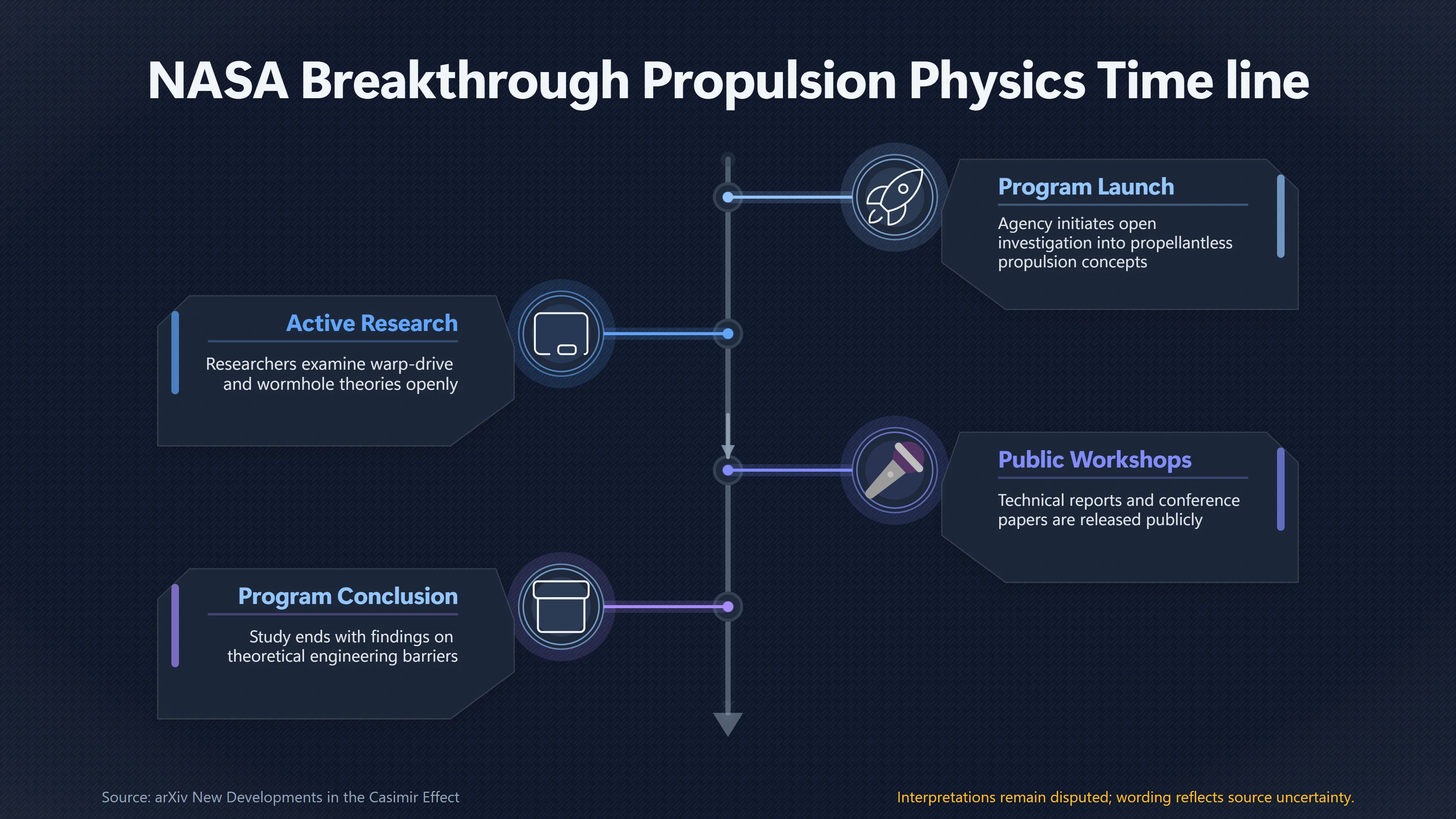
One of the strongest pieces of evidence against the claim that all unconventional propulsion research was suppressed is NASA’s own Breakthrough Propulsion Physics (BPP) programme.
Operating between 1996 and 2002 under physicist Marc Millis, the programme openly investigated concepts including:
- propellantless propulsion;
- faster-than-light travel within known or extended physics;
- possible links between gravity and electromagnetism;
- vacuum fluctuation energy;[ntrs.nasa.gov]ntrs.nasa.govNASA Technical Reports ServerStudy of Vacuum Energy Physics for Breakthrough Propulsion - NASA Technical Reports Server (NTRS)October 1…
- warp-drive and wormhole theories.
NASA’s published programme documents repeatedly stressed that these concepts lay beyond established engineering but deserved careful examination because even incremental progress would have enormous implications for future spaceflight. The emphasis was on identifying measurable experiments and eliminating unproductive ideas rather than promoting extraordinary claims.[ScienceDirect]sciencedirect.comScienceDirect NASA breakthrough propulsion physics programNASA breakthrough propulsion physics program - ScienceDirect…
The programme produced technical reports, conference papers and public workshops rather than classified announcements of revolutionary propulsion.
The limits and caveats in published studies
Perhaps the most striking feature of the public literature is how consistently researchers acknowledged the obstacles.
Theoretical papers generally begin with the observation that quantum vacuum effects are real physical phenomena. They then devote most of their discussion to explaining why translating those effects into useful propulsion is extraordinarily difficult.
Several recurring limitations appear throughout the literature:
- Observable vacuum effects are extremely small. Casimir forces become significant only across microscopic separations.
- Energy conservation still applies. No accepted theory allows unlimited extraction of useful energy from the vacuum without corresponding physical costs.
- No demonstrated reactionless drive exists. Proposed propulsion mechanisms must still satisfy momentum conservation or identify genuinely new physics.
- Laboratory effects do not imply spacecraft technology. Detecting minute forces under tightly controlled conditions is fundamentally different from producing practical thrust.
NASA-sponsored studies investigating vacuum energy physics similarly concentrated on measuring Casimir forces, improving theoretical models and examining whether any engineering applications might eventually emerge. Their findings documented advances in instrumentation and theory, but not the discovery of operational propulsion systems.[NASA Technical Reports Server]ntrs.nasa.govNASA Technical Reports ServerStudy of Vacuum Energy Physics for Breakthrough Propulsion - NASA Technical Reports Server (NTRS)October 1…
Why open research complicates suppression claims
Disclosure narratives sometimes present vacuum propulsion as knowledge that could only exist inside hidden military programmes. The publication record tells a more complicated story.
Researchers have openly published discussions of:
- quantum vacuum engineering;[arxiv.org]arxiv.orgEngineering the Zero-Point Field and Polarizable Vacuum For Interstellar FlightJuly 17, 2001… * spacetime metric manipulation;[arxiv.org]arxiv.orgarXiv Advanced Space Propulsion Based on Vacuum (Spacetime Metric) EngineeringarXiv Advanced Space Propulsion Based on Vacuum (Spacetime Metric) Engineering * warp-drive mathematics;[theguardian.com]theguardian.comSource details in endnotes.
- wormhole solutions within general relativity;
- speculative field propulsion concepts.
Many of these papers are freely available through journals, conference proceedings or preprint archives. Their visibility demonstrates that exploring unconventional propulsion has not itself been prohibited.[arXiv]arxiv.orgEngineering the Zero-Point Field and Polarizable Vacuum For Interstellar FlightJuly 17, 2001…
This does not prove that classified aerospace research does not exist. Governments routinely classify technologies with military value. However, the existence of public programmes investigating similar concepts weakens the simpler claim that the entire field has been hidden from scientific scrutiny.
Instead, the available evidence suggests two parallel realities:
- open scientific exploration of speculative ideas has continued for decades;
- no publicly verified breakthrough has yet emerged from that work.
What the evidence does not show
Public vacuum propulsion research is sometimes cited as indirect proof that secret antigravity craft already exist. That conclusion goes beyond what the evidence supports.
The published literature demonstrates:
- genuine scientific interest in frontier propulsion;
- measurable quantum vacuum phenomena;[ouci.dntb.gov.ua]ouci.dntb.gov.uaSource details in endnotes.
- theoretical frameworks that allow researchers to ask unconventional questions;
- ongoing attempts to identify experimentally testable effects.
It does not demonstrate:
- a working antigravity engine;
- practical reactionless propulsion;
- limitless “zero-point energy” generators;
- evidence that governments possess operational spacecraft based on these principles.
Indeed, NASA’s own assessments repeatedly characterised propulsion breakthroughs as long-term aspirations requiring new physics rather than technologies approaching deployment.[NASA Technical Reports Server]ntrs.nasa.govTechnical Reports Server Assessing Potential Propulsion BreakthroughsNASA Technical Reports ServerAssessing Potential Propulsion Breakthroughs - NASA Technical Reports Server (NTRS)…
The most balanced interpretation
Within debates surrounding UFO secrecy and figures such as Gary McKinnon, public vacuum propulsion research is best understood as evidence that unconventional ideas have been investigated openly rather than suppressed absolutely.
The scientific literature confirms that quantum vacuum effects are real, that respected physicists have explored whether those effects might someday have engineering applications, and that agencies including NASA funded careful investigations into frontier propulsion concepts. At the same time, those same publications consistently acknowledge profound theoretical and experimental barriers, and none provides verified evidence that practical antigravity or vacuum-propulsion technology has already been achieved in secret.
The strongest conclusion supported by the public record is therefore a limited one: unconventional propulsion has been a legitimate, openly discussed research topic for decades, but published evidence has not established that those investigations produced the revolutionary capabilities often claimed in UFO-related suppression narratives.
Amazon book picks
Further Reading
Books and field guides related to Was Unconventional Propulsion Really Suppressed?. Use these as the next step if you want deeper reading beyond the article.
The Quantum Vacuum: An Introduction to Quantum Electrodynamics
Milonni describes the concept of the vacuum in quantum physics with an emphasis on quantum electrodynamics. He elucidates in depth and de...
Physics of the Impossible
Physics of the Impossible takes us on a journey to the frontiers of science and beyond, giving us an exhilarating insight into what we ca...
The Fabric of the Cosmos
'A magnificent challenge to conventional ideas' Financial Times 'I thoroughly enjoyed this book. It manages to be both challenging and en...
Fundamentals of Electric Propulsion: Ion and Hall Thrusters
Throughout most of the twentieth century, electric propulsion was considered the technology of the future. Now, the future has arrived. T...
eBay marketplace picks
Marketplace Samples
Live-tested eBay searches with available results related to this page.
Selected fromspacecraft model oneBay.co.uk.


Endnotes
1.
Source: arxiv.org
Title: arXiv New Developments in the Casimir Effect
Link:https://arxiv.org/abs/quant-ph/0106045
Source snippet
New Developments in the Casimir EffectJune 8, 2001...
Published: June 8, 2001
2.
Source: arxiv.org
Link:https://arxiv.org/abs/astro-ph/0107316
Source snippet
Engineering the Zero-Point Field and Polarizable Vacuum For Interstellar FlightJuly 17, 2001...
Published: July 17, 2001
3.
Source: arxiv.org
Title: arXiv Advanced Space Propulsion Based on Vacuum (Spacetime Metric) Engineering
Link:https://arxiv.org/abs/1204.2184
4.
Source: sciencedirect.com
Title: ScienceDirect NASA breakthrough propulsion physics program
Link:https://www.sciencedirect.com/science/article/pii/S0094576599000454/pdf?md5=319c44c42d46bdc84bf89b7db0baa40c&pid=1-s2.0-S0094576599000454-main.pdf
Source snippet
NASA breakthrough propulsion physics program - ScienceDirect...
5.
Source: ntrs.nasa.gov
Title: Technical Reports Server Assessing Potential Propulsion Breakthroughs
Link:https://ntrs.nasa.gov/archive/nasa/casi.ntrs.nasa.gov/20060000022.pdf
Source snippet
NASA Technical Reports ServerAssessing Potential Propulsion Breakthroughs - NASA Technical Reports Server (NTRS)...
6.
Source: ntrs.nasa.gov
Link:https://ntrs.nasa.gov/search.jsp?R=20040171927&hterms=breakthrough+propulsion+physics
Source snippet
NASA Technical Reports ServerStudy of Vacuum Energy Physics for Breakthrough Propulsion - NASA Technical Reports Server (NTRS)October 1...
7.
Source: ntrs.nasa.gov
Link:https://ntrs.nasa.gov/citations/20040171927
Source snippet
of Vacuum Energy Physics for Breakthrough Propulsion - NASA Technical Reports Server (NTRS)October 1, 2004 — Study of Vacuum Energy Physi...
Published: October 1, 2004
8.
Source: ntrs.nasa.gov
Link:https://ntrs.nasa.gov/archive/nasa/casi.ntrs.nasa.gov/19980017317.pdf
9.
Source: ntrs.nasa.gov
Link:https://ntrs.nasa.gov/search?q=Breakthrough+Propulsion+Physics
10.
Source: ouci.dntb.gov.ua
Link:https://ouci.dntb.gov.ua/en/works/4OrJ6Gq7/
11.
Source: docslib.org
Title: Engineering the Zero-Point Field and Polarizable Vacuum for Interstellar Flight
Link:https://docslib.org/doc/4636354/engineering-the-zero-point-field-and-polarizable-vacuum-for-interstellar-flight
Additional References
12.
Source: diyhpl.us
Title: Extropians: LANL
Link:https://diyhpl.us/~bryan/irc/extropians/extracted-extropians-archive/archive/0201/99117.html
Source snippet
Abstract: Engineering the Zero-Point Field and Polarizable Vacuum For Interstellar FlightJanuary 5, 2002 — LANL ABSTRACT: ENGINEERING THE...
Published: January 5, 2002
13.
Source: theguardian.com
Link:https://www.theguardian.com/science/2001/jan/07/spaceexploration.theobserver
14.
Source: researchgate.net
Link:https://www.researchgate.net/publication/24320571_NASATM-97-206241_Breakthrough_Propulsion_Physics_Workshop_Preliminary_Results
15.
Source: researchgate.net
Link:https://www.researchgate.net/publication/2231381_Engineering_the_Zero-Point_Field_and_Polarizable_Vacuum_For_Interstellar_Flight
16.
Source: youtube.com
Link:https://www.youtube.com/watch?v=9doOLHeW8p4
17.
Source: youtube.com
Link:https://www.youtube.com/watch?v=IsaG_zYrtYo
18.
Source: youtube.com
Link:https://www.youtube.com/watch?v=StKLeD5h_Tw
19.
Source: youtube.com
Link:https://www.youtube.com/watch?v=atGD9dIgYgg
20.
Source: youtube.com
Link:https://www.youtube.com/watch?v=uGSnaIGEmLM