Within Military Targets
How Weak Was US Government Cybersecurity in 2001?
Failing federal cybersecurity grades help explain why prestigious defence and space agencies exposed poorly configured machines to basic password attacks.
On this page
- What the federal security report cards measured
- How defence and NASA systems performed
- Why weak administration mattered more than advanced hacking
Page outline Jump by section
Introduction
The poor cybersecurity grades awarded to US federal agencies in the early 2000s provide important context for understanding how Gary McKinnon and other intruders were able to access government computers while searching for evidence of UFO-related secrecy. Rather than demonstrating exceptionally sophisticated hacking, contemporary government audits consistently described widespread failures in basic security management: weak password controls, incomplete inventories of networked systems, inconsistent patching, poor vulnerability assessments and inadequate oversight. Those documented weaknesses help explain why internet-connected computers belonging to prestigious organisations such as the Department of Defense (DoD) and NASA could be compromised using relatively simple techniques. At the same time, these security failures should not be confused with evidence that the compromised systems contained proof of extraterrestrial technology. The historical record shows serious cybersecurity deficiencies, but it does not substantiate claims about hidden UFO programmes.
What the federal security report cards measured
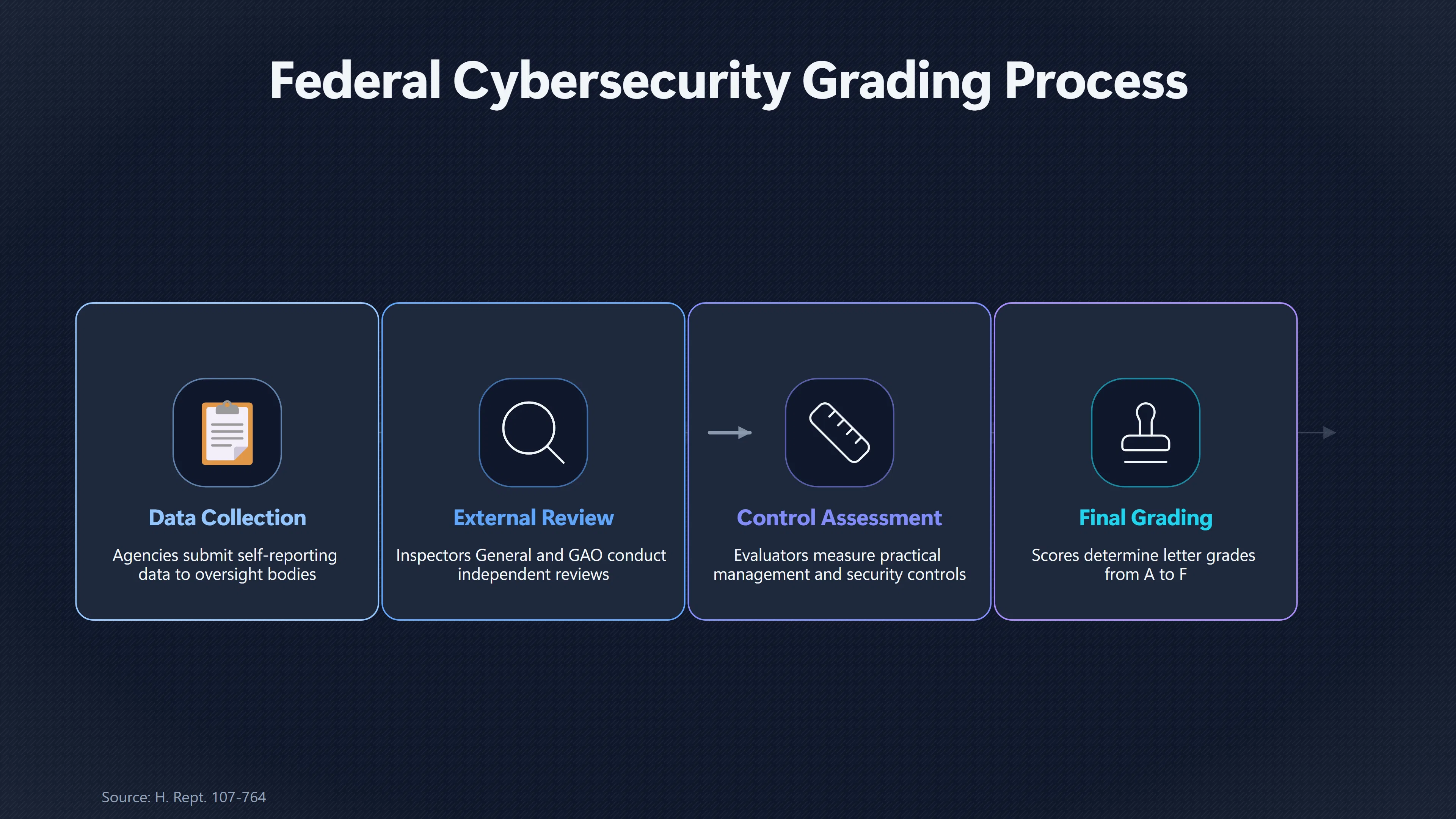
Beginning in 2000, the House Committee on Government Reform published annual federal computer security report cards that evaluated major agencies under the Government Information Security Reform Act. The assessments combined agency self-reporting with reviews by Inspectors General and the US General Accounting Office (now the Government Accountability Office). Agencies were graded on practical management controls rather than on whether they had suffered publicised breaches. The scoring examined areas including:
- Risk assessments.
- Security planning.
- Periodic testing of security controls.
- Incident response capability.[gao.gov]gao.govgaoInformation Security: Challenges to Improving DOD's Incident Response Capabilities | U.S. GAOMarch 29, 2001…
- Security training.
- Configuration management.
- Separation of duties.
- Continuity planning.
- Corrective action processes.
- Programme management.
The grading system reflected whether agencies had established and consistently implemented these fundamental controls. According to the congressional methodology, scores below 60 received an F, while only scores above 90 earned an A. Government-wide performance remained poor during the early report-card years, illustrating that weak cybersecurity governance was viewed as a systemic federal problem rather than an isolated failure within one department.[Congress.gov]congress.govH. Rept.MAKING FEDERAL COMPUTERS SECURE: OVERSEEING EFFECTIVE INFORMATION SECURITY MANAGEMENT | Congress.gov | Library of CongressOctober 24, 2002…
How defence and NASA systems performed
The report cards should be read alongside Government Accountability Office investigations conducted during the same period. GAO repeatedly concluded that DoD faced longstanding information assurance problems despite recognising cyber defence as a strategic priority.
A March 2001 GAO review found that DoD had created computer emergency response organisations but still struggled with department-wide vulnerability management, consistent compliance with security alerts, coordinated incident response and systematic reviews of network weaknesses. The report emphasised that technical capabilities existed, yet implementation across the enormous defence enterprise remained inconsistent.[GAO]gao.govgaoInformation Security: Challenges to Improving DOD's Incident Response Capabilities | U.S. GAOMarch 29, 2001…
A companion GAO assessment published the same month concluded that many objectives of the Defence-wide Information Assurance Programme had not been completed despite their importance. It noted continuing reports of vulnerabilities, organised intrusions and theft affecting defence networks, demonstrating that recognised weaknesses persisted even after years of reform efforts.[GAO]gao.govgaoInformation Security: Progress and Challenges to an Effective Defense-wide Information Assurance Program | U.S. GAOMarch 30, 2001…
Although NASA was not a military organisation, it operated large, distributed research networks with numerous interconnected systems. Like many federal agencies of the era, it was subject to the same government-wide security management requirements. Congressional oversight repeatedly identified uneven implementation of security controls across federal departments, reinforcing that prestige or scientific importance did not necessarily correlate with strong cybersecurity practices.[Congress.gov]congress.govH. Rept.MAKING FEDERAL COMPUTERS SECURE: OVERSEEING EFFECTIVE INFORMATION SECURITY MANAGEMENT | Congress.gov | Library of CongressOctober 24, 2002…
Why weak administration mattered more than advanced hacking
The significance of these report cards is that they align closely with the techniques McKinnon later described using. His own account was not that he defeated sophisticated encryption or exploited previously unknown software vulnerabilities. Instead, he said he searched government networks for poorly secured computers and accounts protected by blank or trivial passwords.
Whether every aspect of McKinnon’s account is accepted or not, the broader mechanism is consistent with the weaknesses documented independently by Congress and GAO. Contemporary oversight reports repeatedly stressed failures in:
- Enforcing password and authentication policies.
- Maintaining accurate inventories of internet-connected systems.
- Applying security updates consistently.
- Monitoring systems for unauthorised activity.
- Correcting known vulnerabilities promptly.
In other words, administrative failures created opportunities that required relatively modest technical skill to exploit. The lesson from the official audits is not that federal systems lacked sophisticated technology, but that fundamental security practices were unevenly implemented across thousands of machines managed by different organisations.[GAO]gao.govgaoInformation Security: Challenges to Improving DOD's Incident Response Capabilities | U.S. GAOMarch 29, 2001…
What these grades do—and do not—say about UFO claims
For discussions of UFO-related hacking, the report cards provide an important evidential boundary.
They support the proposition that:
- Major federal agencies had documented cybersecurity weaknesses.
- Sensitive organisations were vulnerable to preventable compromises.
- Successful intrusions did not necessarily require advanced hacking methods.
However, they do not support the separate claim that compromised systems contained evidence of extraterrestrial technology or secret off-world programmes.
McKinnon’s later statements about seeing unusual files or imagery have never been independently verified through released evidence. The federal security assessments explain how unauthorised access could occur, but they provide no corroboration for what an intruder claimed to have found after gaining access.
This distinction is crucial within the broader history of alleged UFO secrecy. Weak cybersecurity makes unauthorised entry more plausible; it does not validate the content of subsequent extraordinary claims.

The enduring lesson from the early 2000s
Looking back, the federal report cards are valuable because they shift attention away from myths of elite hacking and towards documented institutional weaknesses. They reveal that, at the time McKinnon’s intrusions occurred, congressional oversight bodies were already warning that many agencies responsible for national security and advanced scientific programmes had not yet implemented consistent, government-wide information security practices.
The historical evidence therefore supports a more restrained interpretation of the McKinnon episode. His case illustrates how inadequate cybersecurity governance could expose even highly respected agencies to intrusion. It does not demonstrate that those agencies were concealing verified evidence of extraterrestrial technology. The strongest documentary record concerns the condition of federal cybersecurity itself—a condition that official audits repeatedly judged to be inadequate and in need of significant reform.[GAO]gao.govgaoInformation Security: Challenges to Improving DOD's Incident Response Capabilities | U.S. GAOMarch 29, 2001…
Amazon book picks
Further Reading
Books and field guides related to How Weak Was US Government Cybersecurity in 2001?. Use these as the next step if you want deeper reading beyond the article.
The Hacker and the State
Rating: 5.0/5 from 18 Google Books ratings
“A must-read...It reveals important truths.” —Vint Cerf, Internet pioneer “One of the finest books on information security published so f...
Cybersecurity and Cyberwar: What Everyone Needs to Know
A generation ago, "cyberspace" was just a term from science fiction, used to describe the nascent network of computers linking a few univ...
Security Engineering
Rating: 4.5/5 from 7 Google Books ratings
Now that there's software in everything, how can you make anything secure? Understand how to engineer dependable systems with this newly...
Ghost in the Wires
In this "intriguing, insightful and extremely educational" novel, the world's most famous hacker teaches you easy cloaking and counter-me...
eBay marketplace picks
Marketplace Samples
Live-tested eBay searches with available results related to this page.
Selected fromcybersecurity poster oneBay.co.uk.


Endnotes
1.
Source: congress.gov
Title: H. Rept. 107-764
Link:https://www.congress.gov/congressional-report/107th-congress/house-report/764/1
Source snippet
MAKING FEDERAL COMPUTERS SECURE: OVERSEEING EFFECTIVE INFORMATION SECURITY MANAGEMENT | Congress.gov | Library of CongressOctober 24, 2002...
Published: October 24, 2002
2.
Source: congress.gov
Title: COMPUTE R SECURITY REPORT CARD | Congress.gov | Library of Congress
Link:https://www.congress.gov/event/106th-congress/house-event/LC18339/text
3.
Source: gao.gov
Title: gao 01 341
Link:https://www.gao.gov/products/gao
Source snippet
Information Security: Challenges to Improving DOD's Incident Response Capabilities | U.S. GAOMarch 29, 2001...
Published: March 29, 2001
4.
Source: gao.gov
Title: gao 01 307
Link:https://www.gao.gov/products/gao
Source snippet
Information Security: Progress and Challenges to an Effective Defense-wide Information Assurance Program | U.S. GAOMarch 30, 2001...
Published: March 30, 2001
5.
Source: congress.gov
Title: H. Rept. 107-764
Link:https://www.congress.gov/committee-report/107th-congress/house-report/764/1
Source snippet
MAKING FEDERAL COMPUTERS SECURE: OVERSEEING EFFECTIVE INFORMATION SECURITY MANAGEMENT | Congress.gov | Library of Congress...
6.
Source: gao.gov
Title: Information Security: NASA Needs to Remedy Vulnerabilities in Key Networks | U.S
Link:https://www.gao.gov/products/gao
Source snippet
October 15, 2009 — INFORMATION SECURITY: NASA NEEDS TO REMEDY VULNERABILITIES IN KEY NETWORKS GAO-10-4...
Published: October 15, 2009
7.
Source: gao.gov
Title: This tex
Link:https://www.gao.gov/assets/a296860.html
Source snippet
10-4, Information Security: NASA Needs to Remedy Vulnerabilities in Key NetworksOctober 15, 2009 — This is the accessible text file f...
Published: October 15, 2009
8.
Source: congress.gov
Title: H. Rept. 107-805
Link:https://www.congress.gov/committee-report/107th-congress/house-report/805/1
9.
Source: gao.gov
Link:https://www.gao.gov/assets/a234473.html
10.
Source: oig.nasa.gov
Link:https://oig.nasa.gov/office-of-inspector-general-oig/ig-01-043/
11.
Source: gao.gov
Link:https://www.gao.gov/products/gao-01-1168t
12.
Source: gao.gov
Link:https://www.gao.gov/products/gao-01-1132t
13.
Source: gao.gov
Title: gao 01 1073t
Link:https://www.gao.gov/products/gao-01-1073t
14.
Source: gao.gov
Title: gao 01 751
Link:https://www.gao.gov/products/gao
15.
Source: gao.gov
Link:https://www.gao.gov/products/t-imtec
16.
Source: govinfo.gov
Title: GA O-01-307
Link:https://www.govinfo.gov/app/details/GAOREPORTS-GAO
17.
Source: govinfo.gov
Title: GA O-01-341
Link:https://www.govinfo.gov/app/details/GAOREPORTS-GAO
Additional References
18.
Source: youtube.com
Title: Gary Mc Kinnon wins extradition battle
Link:https://www.youtube.com/watch?v=y4lecD44F5E
Source snippet
This video details Gary McKinnon's computer breaches into U.S. military and NASA systems, illustrating how widespread security vulnerabil...
19.
Source: youtube.com
Title: Hacking for UFOs and fighting for his life. Who is Gary Mc Kinnon? | Nord VPN
Link:https://www.youtube.com/watch?v=OImdnvQx7sQ
Source snippet
Ancient Aliens: Hacking NASA Secrets (Season 12, Episode 9) | History...
20.
Source: ssa.gov
Link:https://www.ssa.gov/news/en/press/releases/2003-12-10.html
Source snippet
Social Security Rated Among the Best in Government on Computer Security Report Card | News | SSADecember 10, 2003 — PRESS OFFICE (SUBSCRI...
Published: December 10, 2003
21.
Source: edweek.org
Title: Federal File
Link:https://www.edweek.org/education/federal-file/2004/01
Source snippet
January 28, 2004 — FEDERAL FILE January 28, 2004 1 min read * * Remove Save to favorites Save to favorites * Print Email Facebook LinkedI...
Published: January 28, 2004
22.
Source: youtube.com
Title: The Man Who Hacked the U.S. Government
Link:https://www.youtube.com/watch?v=ND0zQX1rGdg
Source snippet
Hacking for UFOs and fighting for his life. Who is Gary McKinnon? | NordVPN...
23.
Source: hsgac.senate.gov
Title: sen collins federal government lags behind on cybersecurity
Link:https://www.hsgac.senate.gov/media/reps/sen-collins-federal-government-lags-behind-on-cybersecurity/
24.
Source: youtube.com
Title: Ancient Aliens: Hacking NASA Secrets (Season 12, Episode 9) | History
Link:https://www.youtube.com/watch?v=20rWFDfh68Y
Source snippet
UK hacker's extradition to US blocked...
25.
Source: gao.justia.com
Title: major management challenges and program risks gao 03 98
Link:https://gao.justia.com/department-of-defense/2003/1/major-management-challenges-and-program-risks-gao
26.
Source: youtube.com
Title: UK hacker’s extradition to US blocked
Link:https://www.youtube.com/watch?v=v4Js8DF80HY
Source snippet
Gary McKinnon wins extradition battle...
27.
Source: govinfo.gov
Title: GAOREPORTS GAO 01 1004T
Link:https://www.govinfo.gov/app/details/GAOREPORTS-GAO-01-1004T