Within Image Artefacts
Can an Incomplete Download Invent a Spacecraft?
Interrupted image transfers can shift blocks, scramble brightness and create bounded forms that resemble solid objects.
On this page
- How missing packets disrupt image decoding
- Why low resolution previews exaggerate false shapes
- What metadata is needed to verify the original scene
Page outline Jump by section
Introduction
An incomplete image download can make an ordinary space photograph appear to contain a sharply bounded, artificial object even when no such object exists. This is particularly relevant to discussions surrounding claims such as Gary McKinnon’s description of a NASA image viewed over a slow remote connection. When an image is displayed before all of its data have arrived, or when packets are missing or corrupted, the decoding software may fill gaps with incorrect values, shift image blocks, truncate the frame or display only a coarse preview. The resulting picture can contain smooth outlines, abrupt geometric edges and isolated bright regions that resemble solid spacecraft, even though they are simply consequences of incomplete image reconstruction rather than features in the original scene.[nasa.gov]jpl.nasa.govNASA Jet Propulsion Laboratory (JPL)Opportunity's Last Message | NASA Jet Propulsion Laboratory (JPL)March 12, 2019…
How Missing Packets Disrupt Image Decoding
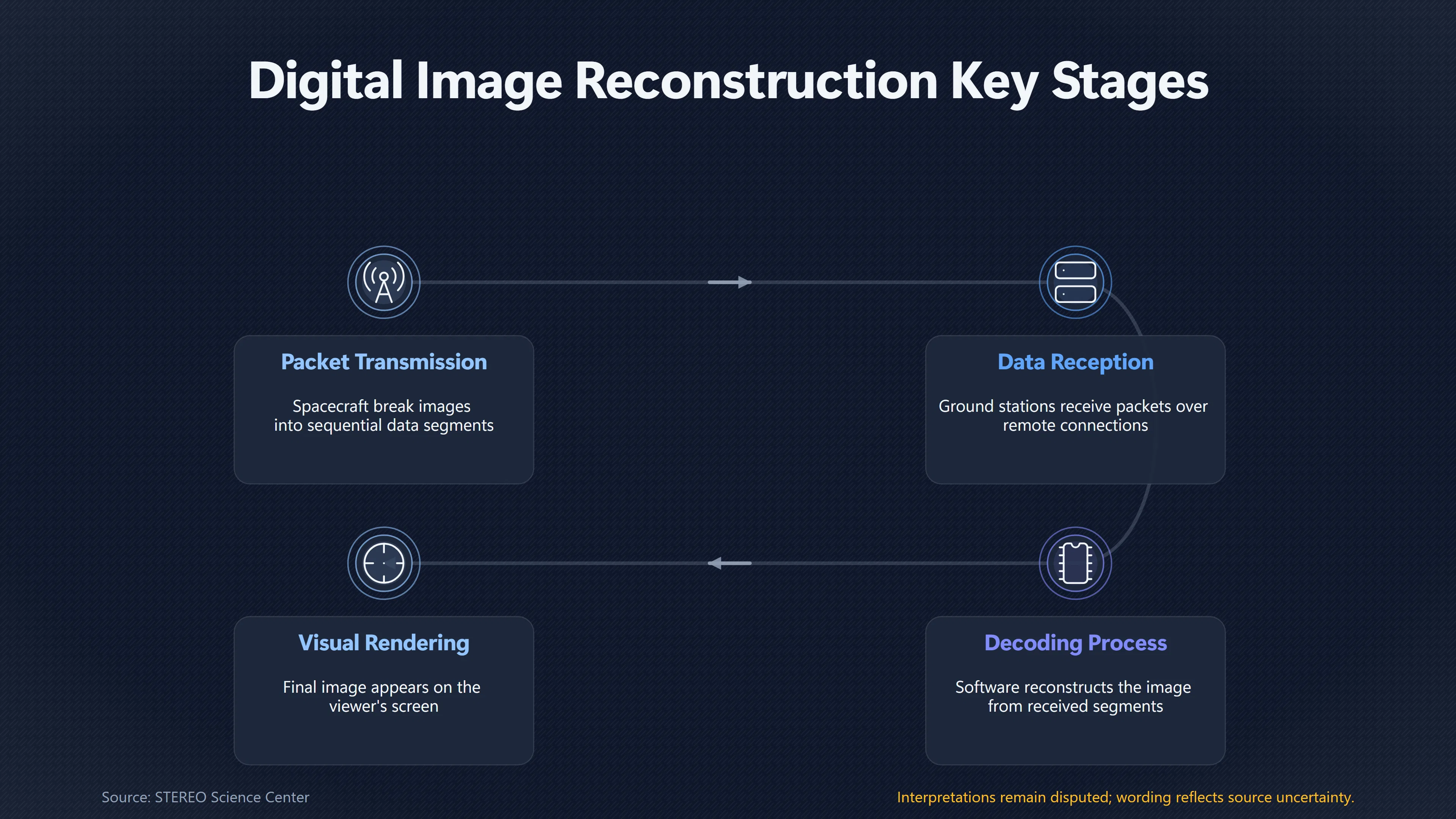
Digital space images are rarely transmitted as a single uninterrupted picture. Instead, they are broken into packets or compressed segments that are sent sequentially and later reconstructed. If some packets fail to arrive or become corrupted, the decoder must either stop, ignore the damaged section or attempt to reconstruct the image from incomplete information. The visual result depends on the image format, compression method and viewing software.[Planetary Data System]pds.nasa.govPlanetary Data Systemsegment_status in Image_Compression_SegmentPlanetary Data Systemsegment_status in Image_Compression_Segment
Typical effects include:
- abrupt rectangular gaps where data are missing;
- shifted image blocks that no longer line up correctly;
- incorrect brightness or colour in part of the image;
- duplicated or misplaced structures;
- truncated images ending in solid black or random-looking regions.
When these defects occur against the dark background of space, they can create surprisingly convincing silhouettes. A bright astronomical feature or instrument reflection may become isolated inside a sharply bounded corrupted region, giving the impression of a smooth metallic craft rather than a decoding failure. Modern studies of corrupted JPEG bitstreams demonstrate that transmission errors can produce block shifts, colour distortions and displaced image content that are unrelated to the original scene.[arXiv]arxiv.orgBitstream-Corrupted JPEG Images are Restorable: Two-stage Compensation and Alignment Framework for Image RestorationApril 14, 2023…
NASA missions have documented comparable effects. The Cassini Imaging Science Subsystem user guide explains that dropped packets and memory errors can produce truncated lossy images, missing data and corrupted image lines when transmission errors occur.[pds-imaging.jpl.nasa.gov]pds-imaging.jpl.nasa.govCassini Imaging Science Subsystem (ISSMarch 26, 2026…
Why Low-Resolution Previews Exaggerate False Shapes
The illusion becomes stronger when the viewer sees only a low-resolution or reduced-colour version of an image.
Many spacecraft first provide quick-look or preview products before the complete science-quality data are available. These previews often use stronger compression, fewer grey levels and lower spatial resolution so they can be transmitted rapidly. Fine texture disappears, while compression smooths boundaries into apparently coherent forms.[NASA Science]science.nasa.govScience Raw Images FAQNASA ScienceRaw Images FAQ - NASA ScienceNovember 2, 2024…
If an incomplete download is viewed at the same time, several effects combine:
- missing detail prevents the eye from recognising familiar astronomical structures;
- compression smooths irregular edges into apparently engineered curves;
- isolated bright regions become visually detached from their surroundings;
- the brain naturally groups disconnected patches into complete objects.
Human visual perception strongly favours recognising meaningful shapes, especially under conditions of incomplete information. A partially decoded image therefore encourages pareidolia—the tendency to perceive recognisable objects where none exist—while the technical artefacts provide the raw material for that interpretation.
NASA’s STEREO mission illustrates a related issue. Its publicly available “beacon” images are intentionally highly compressed to provide rapid space-weather monitoring, and are later replaced with higher-quality science data. Features that appear unusual in the preview images often become ordinary detector artefacts or optical effects once the complete dataset is available.[STEREO Science Center]stereo-ssc.nascom.nasa.govSTEREO Science Center
Real Examples of Incomplete Space Images
Space missions occasionally publish incomplete images precisely because communication ended before transmission finished.
One well-documented example is the final image returned by NASA’s Opportunity rover during the 2018 Martian dust storm. The transmission stopped before the full frame arrived, leaving part of the image represented only by black pixels. The remaining visible region contains increased noise because the scene itself was extremely dark. No one interprets the black region as a physical object because mission documentation records that the transmission ended prematurely.[NASA Jet Propulsion Laboratory (JPL)]jpl.nasa.govNASA Jet Propulsion Laboratory (JPL)Opportunity's Last Message | NASA Jet Propulsion Laboratory (JPL)March 12, 2019…
Other missions have experienced different forms of image corruption:
- The STEREO spacecraft has occasionally produced corrupted images in which data from different telescopes became mixed, creating composite scenes that never existed optically.[STEREO Science Center]stereo-ssc.nascom.nasa.govSTEREO Science Center
- NASA’s Galileo mission returned scrambled Io images after radiation damage affected detector readout, producing a double-exposure appearance that engineers later reconstructed mathematically.[NASA Science]science.nasa.govScience Reconstruction of Scrambled Io ImagesNASA ScienceReconstruction of Scrambled Io Images - NASA ScienceDecember 17, 1999…
- Cassini documentation describes packet loss producing truncated images and missing image sections during processing.[pds-imaging.jpl.nasa.gov]pds-imaging.jpl.nasa.govCassini Imaging Science Subsystem (ISSMarch 26, 2026…
These cases demonstrate that striking geometric structures can arise entirely from known transmission or processing failures without implying unusual objects in front of the camera.

What Metadata Is Needed to Verify the Original Scene
A single displayed image is rarely sufficient to determine whether an apparent object is genuine. Verification depends on the accompanying technical information.
Useful metadata include:
- the original filename and observation identifier;
- acquisition time and spacecraft instrument;
- compression format and processing level;
- transmission status, including whether packets were missing;
- checksum or integrity verification;
- availability of the original uncompressed data;
- adjacent frames from the same observation sequence.
Mission archives routinely preserve these details because they allow engineers and scientists to distinguish genuine celestial features from transmission errors, detector artefacts or incomplete processing. Without this information, later investigators cannot reliably reconstruct what the viewer actually saw.[nasa.gov]science.nasa.govScience How Are Webb’s Full-Color Images Made?NASA ScienceHow Are Webb’s Full-Color Images Made? - NASA ScienceSeptember 3, 2025…
Why This Matters for UFO Image Claims
Within discussions of alleged spacecraft visible in NASA imagery, incomplete downloads represent a plausible technical mechanism that should be excluded before more extraordinary explanations are considered.
In Gary McKinnon’s account, the reported image was viewed remotely over a slow connection using reduced display settings, and no original file, screenshot or observation metadata were preserved. Under those circumstances, it is impossible to determine whether the apparent smooth, structured object reflected a genuine astronomical scene, an ordinary satellite, an optical artefact, a corrupted transmission or an incompletely rendered image. The absence of the original data means none of these possibilities can now be tested directly.
The broader lesson is not that every unusual space image results from partial downloads, but that interrupted transfers, compressed previews and incomplete decoding are well-understood sources of false visual structure. Before an apparent object is treated as evidence of an unknown spacecraft, investigators need the complete image, its metadata and, ideally, the original mission data products to establish what the camera actually recorded.[nasa.gov]stereo-ssc.nascom.nasa.govSTEREO Science CenterSTEREO Science Center
Amazon book picks
Further Reading
Books and field guides related to Can an Incomplete Download Invent a Spacecraft?. Use these as the next step if you want deeper reading beyond the article.
Digital Image Processing
This is the eBook of the printed book and may not include any media, website access codes, or print supplements that may come packaged wi...
Computer Networks
This classic reference for students, and anyone who wants to know more about connectivity, has been totally rewritten to reflect the netw...
Data and Computer Communications
The ninth edition of 'Data and Computer Communications' features improved illustrations, integrated coverage of TCP/IP and Ethernet, a su...
The Handbook of Astronomical Image Processing
First published 2000. Subjects: CCD cameras, Imaging systems in astronomy, Data processing, Astronomical photography.
eBay marketplace picks
Marketplace Samples
Live-tested eBay searches with available results related to this page.
Selected fromspace mission patch oneBay.co.uk.

Endnotes
1.
Source: jpl.nasa.gov
Link:https://www.jpl.nasa.gov/images/pia22929-opportunitys-last-message/
Source snippet
NASA Jet Propulsion Laboratory (JPL)Opportunity's Last Message | NASA Jet Propulsion Laboratory (JPL)March 12, 2019...
Published: March 12, 2019
2.
Source: stereo-ssc.nascom.nasa.gov
Title: STEREO Science Center
Link:https://stereo-ssc.nascom.nasa.gov/artifacts/artifacts_corrupted.shtml
3.
Source: pds.nasa.gov
Title: Planetary Data Systemsegment_status in Image_Compression_Segment
Link:https://pds.nasa.gov/datastandards/documents/dd/all/current/ch43s248.html
4.
Source: image.gsfc.nasa.gov
Title: Overview of IMAGE science data flow (automated, quicklook, daily, udf)
Link:https://image.gsfc.nasa.gov/publication/document/nssdc_image_mou/
5.
Source: arxiv.org
Link:https://arxiv.org/abs/2304.06976
Source snippet
Bitstream-Corrupted JPEG Images are Restorable: Two-stage Compensation and Alignment Framework for Image RestorationApril 14, 2023...
Published: April 14, 2023
6.
Source: pds-imaging.jpl.nasa.gov
Title: Cassini Imaging Science Subsystem (ISS)
Link:https://pds-imaging.jpl.nasa.gov/documentation/iss_data_user_guide_180916.pdf
Source snippet
March 26, 2026...
Published: March 26, 2026
7.
Source: science.nasa.gov
Title: Science Raw Images FAQ
Link:https://science.nasa.gov/solar-system/multimedia/raw-images-faq/
Source snippet
NASA ScienceRaw Images FAQ - NASA ScienceNovember 2, 2024...
Published: November 2, 2024
8.
Source: stereo-ssc.nascom.nasa.gov
Title: STEREO Science Center
Link:https://stereo-ssc.nascom.nasa.gov/artifacts/wheel/
9.
Source: science.nasa.gov
Title: Science Reconstruction of Scrambled Io Images
Link:https://science.nasa.gov/photojournal/reconstruction-of-scrambled-io-images/
Source snippet
NASA ScienceReconstruction of Scrambled Io Images - NASA ScienceDecember 17, 1999...
Published: December 17, 1999
10.
Source: science.nasa.gov
Title: Science How Are Webb’s Full-Color Images Made?
Link:https://science.nasa.gov/mission/webb/science-overview/science-explainers/how-are-webbs-full-color-images-made/
Source snippet
NASA ScienceHow Are Webb’s Full-Color Images Made? - NASA ScienceSeptember 3, 2025...
Published: September 3, 2025
11.
Source: swehb.nasa.gov
Title: R025+ +Data+Is+Incorrect+Or+Incomplete
Link:https://swehb.nasa.gov/spaces/SITE/pages/215777517/R025%2B-%2BData%2BIs%2BIncorrect%2BOr%2BIncomplete?desktop=true¯oName=show-if
Source snippet
nasa.govR025 - Data Is Incorrect Or Incomplete - Site Resources - Global SiteSeptember 30, 2025 — * * Created by Haigh, Fred on Sep 30, 2...
Published: September 30, 2025
12.
Source: jpl.nasa.gov
Title: decoding space images with the dsn
Link:https://www.jpl.nasa.gov/edu/resources/lesson-plan/decoding-space-images-with-the-dsn/
13.
Source: science.nasa.gov
Title: pale blue dot revised
Link:https://science.nasa.gov/image-detail/pale-blue-dot-revised/
14.
Source: science.nasa.gov
Title: engineers pinpoint cause of voyager 1 issue are working on solution
Link:https://science.nasa.gov/blogs/voyager/2024/04/04/engineers-pinpoint-cause-of-voyager-1-issue-are-working-on-solution/
15.
Source: nasa.gov
Title: Engineers Solve Data Glitch on NASA’s Voyager 1
Link:https://www.nasa.gov/missions/voyager-program/engineers-solve-data-glitch-on-nasas-voyager-1/
16.
Source: nasa.gov
Title: Latest Updates from NASA on IMAGE Recovery
Link:https://www.nasa.gov/solar-system/latest-updates-from-nasa-on-image-recovery/
17.
Source: stereo-ssc.nascom.nasa.gov
Title: artifacts beacon.shtml
Link:https://stereo-ssc.nascom.nasa.gov/artifacts/artifacts_beacon.shtml
18.
Source: nasa.gov
Title: lorri 2015 06 10 014016 utc
Link:https://www.nasa.gov/image-article/lorri-2015-06-10-014016-utc/
19.
Source: image.gsfc.nasa.gov
Title: rpi anomalies
Link:https://image.gsfc.nasa.gov/rpi/rpi_anomalies.html
20.
Source: science.nasa.gov
Title: smear campaign
Link:https://science.nasa.gov/photojournal/smear-campaign
21.
Source: stereo-ssc.nascom.nasa.gov
Link:https://stereo-ssc.nascom.nasa.gov/artifacts/artifacts.shtml
22.
Source: lambda.gsfc.nasa.gov
Link:https://lambda.gsfc.nasa.gov/product/iras/docs/exp.sup/ch11/F.html
23.
Source: image.gsfc.nasa.gov
Link:https://image.gsfc.nasa.gov/
Additional References
24.
Source: youtube.com
Title: Ancient Aliens: Hacking NASA Secrets (Season 12, Episode 9)
Link:https://www.youtube.com/watch?v=20rWFDfh68Y
Source snippet
Gary [McKinnon NASA image]({{ 'mckinnon-nasa-image/' | relative_url }}) 56k dialup download Hacking for UFOs and fighting for his life. Who is Gary McKinnon? | NordVPN NordVPN...
25.
Source: youtube.com
Title: The Hacker That Found NASA’s Secret Space Fleet [Gary Mc Kinnon Interview]
Link:https://www.youtube.com/watch?v=2ttdlCa5ZCI
Source snippet
Hacking for UFOs and fighting for his life. Who is Gary McKinnon?...
26.
Source: youtube.com
Title: Gary Mckinnon: The Hacker Who Found UFOs
Link:https://www.youtube.com/watch?v=8_1DuqeU8hw
Source snippet
Ancient Aliens: Hacking NASA Secrets (Season 12, Episode 9)...
27.
Source: youtube.com
Title: UK hacker’s extradition to US blocked
Link:https://www.youtube.com/watch?v=v4Js8DF80HY
Source snippet
Gary Mckinnon: The Hacker Who Found UFOs...
28.
Source: youtube.com
Title: Hacking for UFOs and fighting for his life. Who is Gary Mc Kinnon?
Link:https://www.youtube.com/watch?v=OImdnvQx7sQ
Source snippet
UK hacker's extradition to US blocked...