Within UFO Hackers
Why Strange Government Files May Mean Nothing Exotic
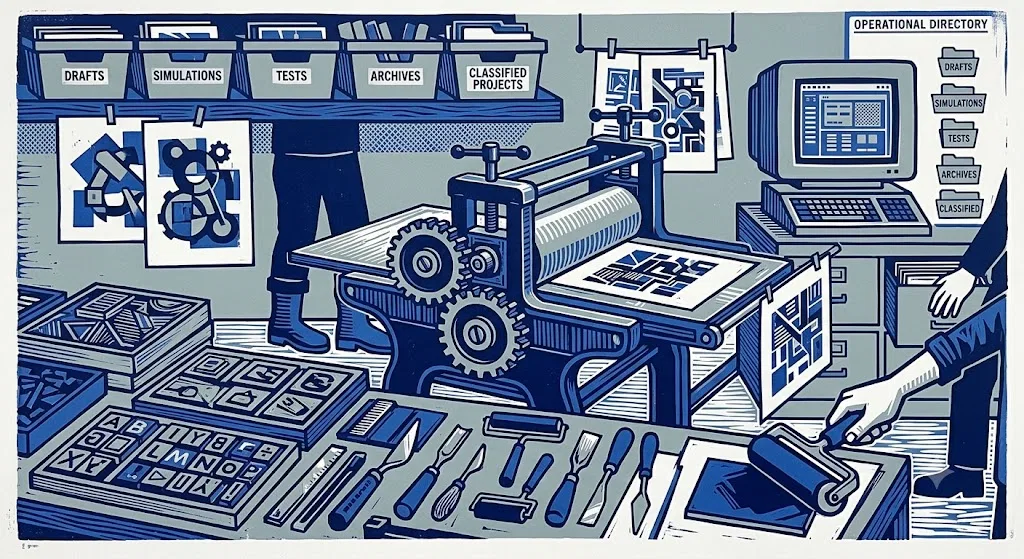
Institutional networks contain drafts, tests, simulations, code names, and informal language that can appear extraordinary without context.
On this page
- Drafts, simulations, and test data
- Code names and internal terminology
- The role of metadata and authorship
Page outline Jump by section
Introduction
A file found on a genuine government computer is not automatically a settled statement of government fact. Institutional networks contain working drafts, staff comments, training scenarios, simulated intelligence, test datasets, copied attachments and documents written by outside organisations. A dramatic phrase may be authentic in the narrow sense that it really appeared on an official server, yet still be preliminary, fictional, obsolete or unrelated to the meaning later assigned to it.
This distinction is crucial when assessing claims by UFO-motivated hackers such as Gary McKinnon. Unauthorised access might establish that someone reached a government system, but it does not establish the status, origin or intended meaning of every file encountered there. Without the surrounding folder structure, document history, authorship, dates, attachments and system purpose, apparently extraordinary material can be easy to misread. Archival and technical standards therefore treat provenance and context—not server ownership alone—as essential to understanding what a digital record actually represents.[nist.gov]nvlpubs.nist.govNIST PublicationsNIST Research Data Framework (RDaF)by VA Alexandria — Metadata and provenance comprise the information about a dataset t…
A Government Server Holds More Than Government Conclusions
Large public institutions use their networks as workplaces, not merely as repositories for approved policy. A single directory may contain final reports alongside early drafts, discarded alternatives, email attachments, administrative copies and background material submitted by contractors or other agencies.
This can produce a misleading chain of inference:
- The computer belongs to a military or intelligence organisation.
- A document on it contains an unusual statement.
- Therefore, the organisation officially accepts that statement as true.
The third step does not follow from the first two. The file may have been received rather than created by the organisation. It may record one employee’s suggestion, reproduce a press article, preserve an allegation for assessment or circulate an idea that was later rejected.
Government recordkeeping rules illustrate how varied official systems can be. The US Government Accountability Office notes that drafts distributed through email may themselves qualify as federal records and therefore require preservation. Their presence in an official recordkeeping environment does not turn them into final decisions; it shows that documentary systems preserve parts of the decision-making process as well as its eventual outcome.[GAO]gao.govGAO-08-742, Federal Records: National Archives and…June 13, 2008 — If agencies do not state that draft documents circulated on e-ma…
Declassified intelligence files offer concrete examples. One CIA record is explicitly labelled as a proposed reply and contains staff recommendations for a senior official’s approval. Another concerns a draft directive that still required circulation, discussion and approval. Both are genuine CIA records, but neither title alone would justify treating every sentence as adopted agency policy.[CIA]cia.govPROPOSED REPLY TO PERSONAL LETTER FROM…This memorandum contains a recommendation for action on the part of the DCI. drafting a prop…
The practical lesson is that authenticity and authority are separate questions. A file may be genuinely located within a government institution while lacking the approval, evidential support or organisational standing required to make it authoritative.
Drafts, Simulations and Test Data Can Look Real
Draft language records possibilities, not decisions
Drafts are often written in the same formal language and formatting as completed documents. They may carry classification markings, official templates, distribution lists and the names of senior offices. Those features can make an unfinished proposal appear conclusive when viewed in isolation.
Yet drafts frequently contain language that will be revised, qualified or removed. Staff may deliberately write a proposal in near-final form so that decision-makers can assess it. The CIA’s archived “Draft DCID 1/5”, for example, was accompanied by requests for approval and references to future consultation within the intelligence community. The file documents a stage in an institutional process rather than an unquestionable final position.[CIA]cia.govDRAFT DCID 1/5 | CIA FOIA (foia.cia.gov)Your approval of the attached draft DCID is requested prior to its circulation to the Communit…
Draft collections may also preserve contradictory versions. A researcher who sees only one copy cannot safely assume it was the latest, that its recipient agreed with it or that it survived later review. Even official auditing standards distinguish completed supporting records from superseded drafts and notes reflecting incomplete or preliminary thinking.[GAO]gao.govcl aicpa080626aSherry Hazel Audit and Attest Standards…June 26, 2008 — The auditor need not include in audit documentation superseded drafts of worki…
For a hacker quickly browsing unfamiliar folders, these distinctions would be particularly difficult to reconstruct. The most surprising wording might come from the most speculative version rather than the version ultimately approved.
Military systems deliberately contain fictional events
Defence organisations routinely create realistic fictional material for exercises. Command-post training may involve imaginary countries, simulated attacks, invented intelligence reports and “injects”—prepared events or messages introduced to force participants to make decisions.
US military exercise guidance describes scenario injects with identifiers, descriptions, intended recipients and a platform through which the fictional event will first be reported. In one African Lion exercise, the US Joint Staff supplied a fictional scenario that required personnel to plan activity across land, sea, air, cyberspace and space.[oe.t2com.army.mil]oe.t2com.army.milMCR P 7-20A.2 Event and Exercise DesignMCR P 7-20A.2 Event and Exercise Design
Exercise environments can mix several kinds of information:
- real personnel and unit names;
- actual communications systems;
- simulated threats and intelligence;
- computer-generated forces or targets;[navy.mil]navy.milSource details in endnotes.
- fictional damage, casualties or movements;
- real-world geography adapted for training.
A US and allied exercise described by the Navy combined virtual participants with computer-generated threats. Earlier naval research also discussed integrating real and simulated targets when reconstructing exercises. A database extracted from such an environment could therefore contain plausible-looking operational records for events that never happened.[ONR]onr.navy.milONR90 EXERCISE RECONSTRUCTIONONR90 EXERCISE RECONSTRUCTION
Some exercise messages are prominently marked as simulations, but that warning may appear in a header, accompanying instruction or related file rather than in every individual data entry. The US Navy has published exercise orders describing simulated hurricanes and earthquakes in the same urgent administrative style used for real emergencies. Detached from their “exercise” labels, portions of those messages could be mistaken for records of genuine disasters or secret operations.[Navy]navy.milOpen source on navy.mil.
Test systems imitate operational systems
Government technical teams also use sample accounts, demonstration records and synthetic data when building or checking software. Test information is often designed to look realistic because unrealistic data cannot properly test search functions, reporting tools, security controls or database capacity.
The National Institute of Standards and Technology emphasises that data interpretation depends on metadata and provenance: information describing where a dataset came from, how it was produced and how it relates to other records. NIST also warns that questions of veracity, context and provenance become more serious when large datasets combine material from multiple systems and organisations.[NIST Publications]nvlpubs.nist.govNIST PublicationsNIST Research Data Framework (RDaF)by VA Alexandria — Metadata and provenance comprise the information about a dataset t…
A spreadsheet containing unfamiliar officers, vessels, flights or destinations might therefore represent a software test, a planning model or a training population. Without the database schema, system documentation and production status, the entries cannot safely be read as a literal roster of real people or missions.
Code Names Do Not Describe Their Subjects Literally
Government and military language is full of labels chosen for administrative convenience or operational security. Project names, exercise titles, call signs and database fields may sound suggestive while conveying little about the underlying activity.
US military terminology has defined a “nickname” as a combination of unclassified words assigned an unclassified meaning for administrative, morale or public-information purposes. In other words, the words are labels rather than descriptions.[Intelligence Resource Program]irp.fas.orgOpen source on fas.org.
This matters because ordinary readers naturally interpret language semantically. A phrase containing “star”, “space”, “alien”, “non-terrestrial” or an unusual maritime term can appear to identify the literal subject of a programme. Inside an institution, however, it might instead be:
- an arbitrary project title;
- an exercise faction or scenario role;
- a category covering activity outside a particular jurisdiction;
- a technical contrast between land-based and non-land-based assets;
- a temporary label created by a database designer;
- shorthand understood only within one office.
Internal terminology may also be local rather than organisation-wide. Different departments can use the same term differently, and informal language may never appear in an official glossary. A staff member might invent a memorable heading for a working spreadsheet without intending it as a formal classification.
The wording attributed to McKinnon—particularly “Non-Terrestrial Officers”—shows the problem. Even assuming the phrase was remembered exactly, its literal interpretation is not self-proving. “Terrestrial” can distinguish land from maritime, airborne or space-related assignments; it can also be used loosely or humorously. Establishing the intended meaning would require the original file, its columns and entries, the office that created it and related documents explaining the category. A striking heading without that context is a clue to investigate, not a conclusion.
Metadata and Authorship Decide What a File Can Prove
The strongest way to evaluate an unusual government file is to reconstruct its provenance: who created it, when, for what activity and in relation to which other records. The US National Archives describes archival record groups in terms of organisational provenance, while its electronic-records requirements define a record partly through the creator, the activity during which it was made or received and its relationship to other records from the same source.[National Archives]archives.govNational Archives Archival Materials and Related ElementsNational Archives Archival Materials and Related Elements
Useful metadata may include:[nist.gov]nist.govadditive manufacturing benchmark 2022 schemaadditive manufacturing benchmark 2022 schema
- the creator and owning office;
- creation, modification and transmission dates;
- version number or approval status;
- email sender and recipient chain;
- directory path and neighbouring files;
- linked attachments;
- document-management identifiers;[nvlpubs.nist.gov]nvlpubs.nist.govAI.600 1AI.600 1
- whether the system was operational, developmental or used for training.
These details can radically change an interpretation. A document apparently written by an intelligence agency may turn out to be an attachment sent by a private correspondent. A file dated by its upload may reproduce material written decades earlier. A polished memorandum may be an unsigned draft. A personnel table may belong to an exercise database rather than a live administrative system.
Authorship is especially important in declassified collections. The CIA’s reading room includes documents created by or copied from newspapers, consultants, other departments and members of the public. The fact that the CIA retained or declassified an item does not mean that the agency endorsed its contents. Its own collection of historical UFO papers demonstrates that intelligence organisations preserve reports and correspondence because they were received or investigated, not because every reported object was judged extraordinary.[CIA]cia.govtake a peek into our x filestake a peek into our x files
A screenshot of a few lines rarely preserves enough of this information. A copied phrase is weaker still. Without a complete file and verifiable metadata, investigators cannot reliably establish whether wording was original, whether nearby labels clarified it or whether the material was current when accessed.
How to Judge an Apparently Extraordinary File
A cautious assessment should begin by asking what the file is, not what its most dramatic phrase seems to imply. Several tests help separate a meaningful disclosure from institutional noise.
Is it complete? A partial screen view may omit the heading, footnote, exercise warning or attachment that explains the content.
Is it final? Look for signatures, approval records, version numbers and evidence that the document was formally issued rather than merely drafted.
Who wrote it? Storage by NASA, the military or an intelligence agency does not prove authorship by that institution.
What system held it? Operational, training, development and archival systems serve different purposes and may contain very different kinds of data.
Can related records confirm the interpretation? Genuine programmes normally generate connected material: budgets, organisational responsibilities, correspondence, technical documentation or repeated references from identifiable offices.
Does the unusual reading depend on one ambiguous term? If an extraordinary conclusion rests mainly on a heading or code name, ordinary institutional meanings must be tested first.
These checks do not prove that every strange file is harmless or mundane. Governments do maintain secret programmes, and incomplete records can contain important evidence. The point is narrower: access to a restricted network does not remove the need for documentary verification. It increases it, because unfamiliar institutional environments contain more specialised shorthand, mixed-status material and simulated content than an outsider can readily recognise.

Why the Missing Originals Matter
The central weakness in many UFO-hacker stories is not simply that authorities deny the claims. It is that the alleged discoveries cannot be examined in their original digital setting.
In McKinnon’s case, the most famous material was not preserved as a complete document, forensic image or authenticated screenshot available for independent analysis. That prevents basic questions from being answered. Researchers cannot inspect file properties, identify the author, compare revisions, determine the folder’s purpose or search for explanatory records elsewhere in the system.
The absence of an original does not prove that the recollection is false. It does, however, sharply limit what the recollection can establish. Human memory tends to preserve the striking interpretation rather than mundane interface details such as directory names, status fields and document headers. Those apparently minor features are precisely what would distinguish an operational secret from a draft, exercise artefact or test record.
The most defensible conclusion is therefore modest. A hacker may truthfully remember encountering unusual words or imagery on an authentic government network while still misunderstanding what those materials represented. Until the file’s provenance, metadata, authorship and institutional function can be checked, the fact that it came from a government computer is evidence of location—not evidence that its most exotic interpretation is correct.
Amazon book picks
Further Reading
Books and field guides related to Why Strange Government Files May Mean Nothing Exotic. Use these as the next step if you want deeper reading beyond the article.
The Craft of Intelligence
"The former chief of the Central Intelligence Agency tells what he has learned from nearly a half-century of experience in diplomacy, int...
Digital Evidence and Computer Crime
Digital Evidence and Computer Crime, Second Edition, is a hands-on resource that aims to educate students and professionals in the law en...
Calling Bullshit
It's not just fake news. Bullshit is everywhere. Now, two science professors give us the tools to dismantle misinformation and think clea...
eBay marketplace picks
Marketplace Samples
Live-tested eBay searches with available results related to this page.
Selected fromUFO poster oneBay.co.uk.

Current eBay listing
I Want To Believe UFO Poster Giclée Fine Art Heavyweight Print

Current eBay listing
VINTAGE UFO FLYING SAUCERS COMIC ADVERTISING A2 POSTER PRINT


Endnotes
1.
Source: nvlpubs.nist.gov
Link:https://nvlpubs.nist.gov/nistpubs/SpecialPublications/1500-18/NIST.SP.1500-18r2.html
Source snippet
NIST PublicationsNIST Research Data Framework (RDaF)by VA Alexandria — Metadata and provenance comprise the information about a dataset t...
2.
Source: archives.gov
Link:https://www.archives.gov/files/era/acera/pdf/significant-properties.pdf
Source snippet
National ArchivesSignificant PropertiesContext may be applied to any information contained in the digital record. Creator name, date of c...
3.
Source: archives.gov
Link:https://www.archives.gov/files/era/about/requirements.pdf
Source snippet
National ArchivesElectronic Records Archives (ERA)30 Jul 2010 — A record has a fixed content, structure, and a specified context that ide...
4.
Source: gao.gov
Link:https://www.gao.gov/assets/a276567.html
Source snippet
GAO-08-742, Federal Records: National Archives and...June 13, 2008 — If agencies do not state that draft documents circulated on e-ma...
Published: June 13, 2008
5.
Source: cia.gov
Link:https://www.cia.gov/readingroom/document/cia-rdp80b01676r001200150044-7
Source snippet
PROPOSED REPLY TO PERSONAL LETTER FROM...This memorandum contains a recommendation for action on the part of the DCI. drafting a prop...
6.
Source: cia.gov
Link:https://www.cia.gov/readingroom/document/cia-rdp83b01027r000100030034-7
Source snippet
DRAFT DCID 1/5 | CIA FOIA (foia.cia.gov)Your approval of the attached draft DCID is requested prior to its circulation to the Communit...
7.
Source: gao.gov
Title: cl aicpa080626a
Link:https://www.gao.gov/assets/cl_aicpa080626a.pdf
Source snippet
Sherry Hazel Audit and Attest Standards...June 26, 2008 — The auditor need not include in audit documentation superseded drafts of worki...
Published: June 26, 2008
8.
Source: oe.t2com.army.mil
Title: MCR P 7-20A.2 Event and Exercise Design
Link:https://oe.t2com.army.mil/site-content/OEE/Scenario%20Development/MCRP%207-20A.2.pdf
9.
Source: army.mil
Title: military planners put final touches on african lion 23 jtf validation exercise
Link:https://www.army.mil/article/263847/military_planners_put_final_touches_on_african_lion_23_jtf_validation_exercise
10.
Source: onr.navy.mil
Title: ONR90 EXERCISE RECONSTRUCTION
Link:https://www.onr.navy.mil/media/document/1990rptexercisereconstructionpdf
11.
Source: navy.mil
Link:https://www.navy.mil/Press-Office/News-Stories/display-news/Article/3222751/us-uk-australian-and-canadian-forces-operate-as-a-combined-force-in-exercise-vi/
12.
Source: navy.mil
Link:https://www.navy.mil/DesktopModules/ArticleCS/Print.aspx?Article=2235396&ModuleId=791&PortalId=1
13.
Source: navy.mil
Link:https://www.navy.mil/DesktopModules/ArticleCS/Print.aspx?Article=2234842&ModuleId=791&PortalId=1
14.
Source: nvlpubs.nist.gov
Link:https://nvlpubs.nist.gov/nistpubs/SpecialPublications/NIST.SP.1500-7r1.pdf
15.
Source: irp.fas.org
Link:https://irp.fas.org/doddir/usaf/16-701.htm
16.
Source: archives.gov
Title: National Archives Archival Materials and Related Elements
Link:https://www.archives.gov/research/catalog/lcdrg/archival-materials
17.
Source: cia.gov
Title: take a peek into our x files
Link:https://www.cia.gov/stories/story/take-a-peek-into-our-x-files
18.
Source: obamawhitehouse.archives.gov
Title: papf post 4
Link:https://obamawhitehouse.archives.gov/sites/default/files/microsites/ostp/papf-post-4.pdf
19.
Source: bidenwhitehouse.archives.gov
Title: 010422 NSPM 33 Implementation Guidance
Link:https://bidenwhitehouse.archives.gov/wp-content/uploads/2022/01/010422-NSPM-33-Implementation-Guidance.pdf
20.
Source: archives.gov
Title: 2000 dec
Link:https://www.archives.gov/files/nhprc/annotation/2000/2000-dec.pdf
21.
Source: bidenwhitehouse.archives.gov
Title: 01 2023 Framework for Federal Scientific Integrity Policy and Practice
Link:https://bidenwhitehouse.archives.gov/wp-content/uploads/2023/01/01-2023-Framework-for-Federal-Scientific-Integrity-Policy-and-Practice.pdf
22.
Source: obamawhitehouse.archives.gov
Title: scholarly pubs (#238) PLOS
Link:https://obamawhitehouse.archives.gov/sites/default/files/microsites/ostp/scholarly-pubs-%28%23238%29%20PLOS.pdf
23.
Source: bidenwhitehouse.archives.gov
Title: PCAST Written Public Comments Sept 2023
Link:https://bidenwhitehouse.archives.gov/wp-content/uploads/2023/09/PCAST-Written-Public-Comments-Sept-2023.pdf
24.
Source: bidenwhitehouse.archives.gov
Title: 00 Clinical Trials RFI DATA Compiled 003
Link:https://bidenwhitehouse.archives.gov/wp-content/uploads/2023/10/00_ClinicalTrialsRFI_DATA_Compiled-003.pdf
25.
Source: bidenwhitehouse.archives.gov
Title: SI Listening Session
Link:https://bidenwhitehouse.archives.gov/wp-content/uploads/2022/02/SI-Listening-Session-Summary-Final.pdf
26.
Source: trumpwhitehouse.archives.gov
Title: Open Access RFI Comments Reduced 5
Link:https://trumpwhitehouse.archives.gov/wp-content/uploads/2017/11/Open-Access-RFI-Comments-Reduced-5.pdf
27.
Source: bidenwhitehouse.archives.gov
Title: JCORE RFI Responses.xlsx
Link:https://bidenwhitehouse.archives.gov/wp-content/uploads/2021/08/JCORE_RFI_Responses.xlsx
28.
Source: archives.gov
Title: scope and content note
Link:https://www.archives.gov/research/catalog/lcdrg/elements/scope-and-content-note
29.
Source: archives.gov
Link:https://www.archives.gov/files/preservation/technical/guidelines.pdf
30.
Source: archives.gov
Link:https://www.archives.gov/about/laws/nara
31.
Source: archives.gov
Link:https://www.archives.gov/files/applied-research/presentations/managing-social-media-records.pdf
32.
Source: archives.gov
Link:https://www.archives.gov/files/era/records-mgmt/account-user-guide.pdf
33.
Source: archives.gov
Title: system arch design 29sept2006
Link:https://www.archives.gov/files/foia/pdf/system-arch-design-29sept2006.pdf
34.
Source: archives.gov
Title: rma study 07
Link:https://www.archives.gov/files/records-mgmt/resources/rma-study-07.pdf
35.
Source: archives.gov
Link:https://www.archives.gov/files/records-mgmt/rcs/schedules/departments/department-of-justice/rg-0170/nc1-170-77-01_sf115.pdf
36.
Source: archives.gov
Link:https://www.archives.gov/files/research/military/army/marks/marks-7.pdf
37.
Source: gao.gov
Link:https://www.gao.gov/assets/a278480.html
38.
Source: gao.gov
Link:https://www.gao.gov/assets/a295691.html
39.
Source: gao.gov
Link:https://www.gao.gov/assets/a234916.html
40.
Source: gao.gov
Link:https://www.gao.gov/assets/a240522.html
41.
Source: gao.gov
Link:https://www.gao.gov/assets/a77057.html
42.
Source: gao.gov
Link:https://www.gao.gov/assets/095133.pdf
43.
Source: gao.gov
Link:https://www.gao.gov/assets/a298810.html
44.
Source: gao.gov
Link:https://www.gao.gov/assets/710/702065.pdf
45.
Source: navy.mil
Title: simulating the threat naval base ventura county enhances security through annua
Link:https://www.navy.mil/Press-Office/News-Stories/display-news/Article/4061052/simulating-the-threat-naval-base-ventura-county-enhances-security-through-annua/
46.
Source: navy.mil
Title: bamboo eagle upping our game for great power competition
Link:https://www.navy.mil/Press-Office/News-Stories/Article/3912132/bamboo-eagle-upping-our-game-for-great-power-competition/
47.
Source: cnrma.cnic.navy.mil
Title: joint exercise sharpens emergency response at nas oceana
Link:https://cnrma.cnic.navy.mil/News/Article/4548566/joint-exercise-sharpens-emergency-response-at-nas-oceana/
48.
Source: navy.mil
Title: west coast navy installations to conduct citadel rumble all hazard emergency ex
Link:https://www.navy.mil/Press-Office/Press-Releases/display-pressreleases/Article/4557462/west-coast-navy-installations-to-conduct-citadel-rumble-all-hazard-emergency-ex/
49.
Source: navy.mil
Title: U.K.-Led Exercise Joint Warrior 20-2 Concludes
Link:https://www.navy.mil/Press-Office/News-Stories/Article/2384549/uk-led-exercise-joint-warrior-20-2-concludes/
50.
Source: navy.mil
Title: navy support facility diego garcia participates in exercise citadel pacific 2020
Link:https://www.navy.mil/Press-Office/News-Stories/display-news/Article/2326579/navy-support-facility-diego-garcia-participates-in-exercise-citadel-pacific-2020/
51.
Source: cia.gov
Link:https://www.cia.gov/readingroom/document/cia-rdp77-00432r000100400001-2
52.
Source: cia.gov
Link:https://www.cia.gov/readingroom/docs/CIA-RDP74-00390R000200040014-7.pdf
53.
Source: cia.gov
Link:https://www.cia.gov/readingroom/docs/CIA-RDP76B00734R000100210002-6.pdf
54.
Source: cia.gov
Link:https://www.cia.gov/readingroom/docs/CIA-RDP81-00728R000100150009-9.pdf
55.
Source: cia.gov
Link:https://www.cia.gov/readingroom/document/06513491
56.
Source: cia.gov
Link:https://www.cia.gov/readingroom/docs/CIA-RDP80-00857A000104100001-6.pdf
57.
Source: cia.gov
Link:https://www.cia.gov/readingroom/docs/CIA-RDP80B01676R000400070004-9.pdf
58.
Source: cia.gov
Title: CIA RDP97M00248R000500170039 6
Link:https://www.cia.gov/readingroom/docs/CIA-RDP97M00248R000500170039-6.pdf
59.
Source: cia.gov
Title: COLLECTIO N GUIDANCE STAFF
Link:https://www.cia.gov/readingroom/document/cia-rdp80b01676r001600070013-6
60.
Source: army.mil
Title: garuda shield creates real world bonds during exercise
Link:https://www.army.mil/article/106156/garuda_shield_creates_real_world_bonds_during_exercise
61.
Source: odin.t2com.army.mil
Title: mil Chapter 2: Exercise Design Sequence
Link:https://odin.t2com.army.mil/TC/Chapter_2%3A_Exercise_Design_Sequence
62.
Source: usar.army.mil
Link:https://www.usar.army.mil/News/Images/igphoto/2001262165/
63.
Source: army.mil
Title: computer simulations prepare police department for real life scenarios
Link:https://www.army.mil/article/214059/computer_simulations_prepare_police_department_for_real_life_scenarios
64.
Source: army.mil
Title: reserve soldiers flex medical readiness during operation bold eagle 26
Link:https://www.army.mil/article/293935/army_reserve_soldiers_flex_medical_readiness_during_operation_bold_eagle_26
65.
Source: lineofdeparture.army.mil
Title: Cyber Protection Teams
Link:https://www.lineofdeparture.army.mil/Journals/Gray-Space/Archive/Summer-2025/Cyber-Protection-Teams/
66.
Source: army.mil
Link:https://www.army.mil/article/219074/beyond_the_cpx_functional_a_dedicated_sustainment_simulation
67.
Source: army.mil
Link:https://www.army.mil/article/194986/computer_wargame_challenges_42nd_infantry_division_leaders_battle_staff_at_fort_indiantown_gap
68.
Source: tsapps.nist.gov
Title: get pdf.cfm
Link:https://tsapps.nist.gov/publication/get_pdf.cfm?pub_id=921398
69.
Source: nvlpubs.nist.gov
Title: AI.100 4
Link:https://nvlpubs.nist.gov/nistpubs/ai/NIST.AI.100-4.pdf
70.
Source: nvlpubs.nist.gov
Title: AI.600 1
Link:https://nvlpubs.nist.gov/nistpubs/ai/NIST.AI.600-1.pdf
71.
Source: nvlpubs.nist.gov
Link:https://nvlpubs.nist.gov/nistpubs/ir/2025/NIST.IR.8536.2pd.pdf
72.
Source: nist.gov
Title: additive manufacturing benchmark 2022 schema
Link:https://www.nist.gov/data-publications/additive-manufacturing-benchmark-2022-schema
73.
Source: nvlpubs.nist.gov
Title: NIST.SP.1500 7r2
Link:https://nvlpubs.nist.gov/nistpubs/SpecialPublications/NIST.SP.1500-7r2.pdf
74.
Source: nvlpubs.nist.gov
Title: NIST.SP.1500 18r1
Link:https://nvlpubs.nist.gov/nistpubs/SpecialPublications/NIST.SP.1500-18r1.pdf
75.
Source: pages.nist.gov
Title: appendix c
Link:https://pages.nist.gov/nccoe-devsecops/appendix-c.html
Additional References
76.
Source: youtube.com
Title: The Man Who Hacked the U.S. Government
Link:https://www.youtube.com/watch?v=ND0zQX1rGdg
Source snippet
Hacking for UFOs and fighting for his life. Who is Gary McKinnon?...
77.
Source: youtube.com
Link:https://www.youtube.com/watch?v=b5afwWUYWVQ
Source snippet
The Interview They Tried to Erase From the Internet...
78.
Source: youtube.com
Title: UK hacker’s extradition to US blocked
Link:https://www.youtube.com/watch?v=v4Js8DF80HY
Source snippet
[Gary McKinnon Case]({{ 'mc-kinnon-case/' | relative_url }}) (Interview from 2009)...
79.
Source: youtube.com
Title: Hacking for UFOs and fighting for his life. Who is Gary Mc Kinnon?
Link:https://www.youtube.com/watch?v=OImdnvQx7sQ
Source snippet
UK hacker's extradition to US blocked...
80.
Source: youtube.com
Title: The Interview They Tried to Erase From the Internet
Link:https://www.youtube.com/watch?v=WvILY-h-6_Y