Within UFO Hackers
Could a Space Image Create a False UFO?
Incomplete downloads, processing errors, debris, satellites, and spacecraft parts can all create unfamiliar shapes in space imagery.
On this page
- Common sources of visual anomalies
- Problems caused by partial downloads
- How experts authenticate space imagery
Page outline Jump by section
Introduction
A strange shape in a space image is not, by itself, evidence of an alien spacecraft. Incomplete downloads, corrupted telemetry, image compression, detector faults, reflections, cosmic rays, nearby dust, satellites and fragments from human spacecraft can all produce forms that look solid, engineered or unexpectedly symmetrical. The problem becomes more acute when an image is seen only briefly, at reduced resolution or before the complete file and its technical metadata can be examined.
That limitation is central to Gary McKinnon’s account of seeing an unusual NASA image. He said that a large file was downloading slowly over a 56K connection and that he viewed it remotely after reducing the computer display to four-bit colour and low resolution. He described a smooth, cigar-shaped object with spherical structures, but did not retain the image, a screenshot, its filename or its observation data. The claimed object therefore cannot now be distinguished from a genuine scene, a conventional space object, a processing artefact or a partly rendered file.[WIRED]wired.comUFO Hacker' Tells What He FoundWIRED'UFO Hacker' Tells What He FoundJune 21, 2006 — 21 Jun 2006 — It was a silvery, cigar-shaped object with geodesic spheres on either…
Common Sources of Visual Anomalies
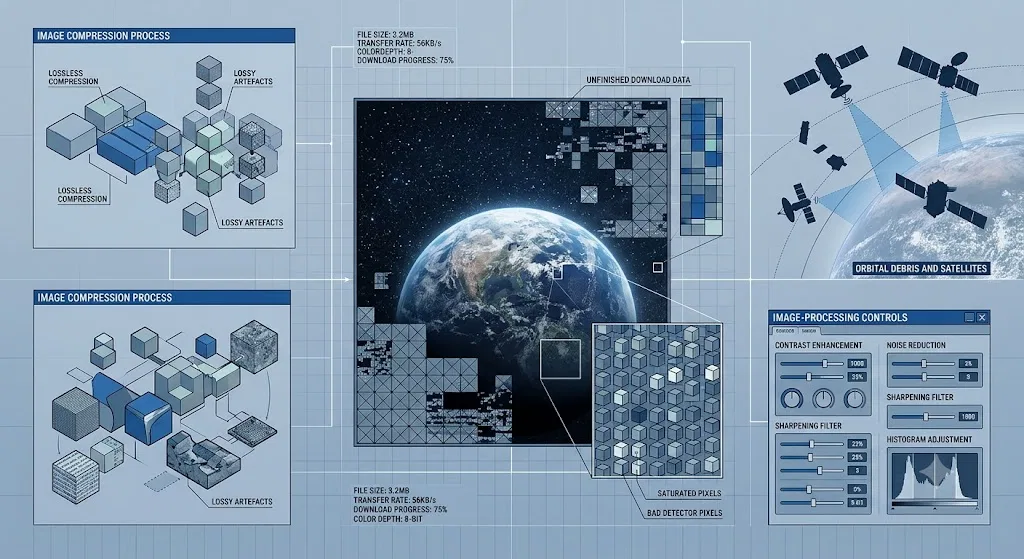
Space cameras do not produce simple snapshots in the same way as an ordinary phone. Their images may be assembled from detector readings, multiple exposures, spectral filters and data packets transmitted over immense distances. Each stage can introduce features that were not present as physical objects in front of the camera.
NASA’s STEREO Science Center maintains an entire guide to confusing features in images from the Solar Terrestrial Relations Observatory. It explains that apparent objects can arise from the telescope optics, camera electronics and the way the spacecraft is operated. The documented effects include cosmic-ray strikes, internal reflections, planets and stars, saturated pixels, background variations and compression artefacts.[STEREO Science Center]stereo-ssc.nascom.nasa.govSTEREO Science CenterImage artifacts - STEREO Science Center - NASA22 Jun 2011 — Some features are caused by the telescope optics, the ca…
Cosmic rays and charged particles. A high-energy particle hitting an electronic detector can deposit charge in one pixel or across a chain of pixels. Depending on its angle, brightness and subsequent compression, the result may resemble a dot, rod, streak or compact luminous object. NASA notes that heavy compression of STEREO’s low-bandwidth “beacon” images can distort cosmic-ray events substantially, making them appear larger or more structured than in full-resolution data.[STEREO Science Center]stereo-ssc.nascom.nasa.govSTEREO Science Center Image artifactsSTEREO Science CenterImage artifacts - cosmic rays - STEREO Science Center - NASA20 Jul 2011 — The high compression factors used for the…
Internal reflections and scattered light. Bright planets, the Sun or other strong sources can reflect between lenses, filters and detector surfaces. These reflections do not always look like familiar lens flare. They may appear as discs, arcs, rays or geometric patches displaced from the source that created them. In one documented STEREO example, bright Earth generated several internal reflections across the field of view.[STEREO Science Center]stereo-ssc.nascom.nasa.govSTEREO Science CenterImage artifacts - Internal reflections - STEREO Science Center6 Jun 2022 — Internal reflections of the planet Earth…
Detector defects and saturation. A very bright source may overwhelm pixels, causing charge to spread along detector columns or rows. Bad pixels, electronic cross-talk and readout errors can add sharp-edged spots or repeated structures. The Space Telescope Science Institute catalogues such effects in Hubble’s Advanced Camera for Surveys, including glints, trails and detector-specific anomalies that can remain visually striking even when their technical origin is understood.[Space Telescope Science Institute]stsci.eduanomalies and artifactsSpace Telescope Science InstituteAnomalies and Artifacts16 Apr 2026 — Learn about the various types of detector artifacts you may encount…
Compression artefacts. Spacecraft often have far less transmission capacity than their instruments can generate, so images may be compressed before downlink or before public distribution. Lossy compression discards information judged less important and reconstructs an approximation of the original. Around sharp contrasts, this can create blocks, ringing, false edges or apparently smooth contours. Scientific studies of solar imagery emphasise that stronger compression improves data throughput at the cost of distortion and can affect the interpretation of subtle structures.[arXiv]arxiv.orgarXiv Neural-based Compression Scheme for Solar Image DataNeural-based Compression Scheme for Solar Image DataNovember 6, 2023…
Satellites, asteroids and orbital debris. Some unfamiliar shapes are real physical objects, but not mysterious craft. Artificial satellites commonly cross astronomical exposures as bright, dotted or broken trails. Asteroids may also streak or shift position between frames, while discarded rocket stages and fragments can reflect sunlight briefly. The Rubin Observatory’s data documentation notes that satellites and debris can produce bright streaks whose length, width and changing brightness depend on their altitude and motion.[DP1]dp1.lsst.ioOpen source on lsst.io.
Dust and material close to the camera. A tiny particle near a lens can appear much larger than a distant spacecraft because an isolated image provides no reliable scale. Dust may be blurred, illuminated from behind or stretched by its motion during the exposure. Rosetta researchers used simultaneous observations from two cameras to measure the distance of dust grains near the spacecraft, demonstrating that apparently prominent image features could in fact be particles only hundreds or thousands of metres away rather than large bodies in deep space.[arXiv]arxiv.orgOpen source on arxiv.org.
How Partial Downloads Can Invent a Shape
An incomplete image is not necessarily a smaller but otherwise faithful version of the full picture. Depending on the file format and the location of the missing data, interruption can remove sections, scramble brightness values, shift image blocks or prevent the decoder from knowing where one part of the picture ends and the next begins.
This is especially important for McKinnon’s reported observation. He said the file itself had not finished downloading and that he altered the remote computer’s screen settings to obtain a glimpse. Four-bit colour allows only 16 colours at once, so subtle shading and curved surfaces would be reduced to abrupt bands. A low-resolution display would merge neighbouring pixels, erase fine detail and make block boundaries more prominent. Even if the underlying file had been intact on NASA’s machine, the view reaching McKinnon passed through remote-display software, a slow connection and an unusually restricted screen mode.[WIRED]wired.comUFO Hacker' Tells What He FoundWIRED'UFO Hacker' Tells What He FoundJune 21, 2006 — 21 Jun 2006 — It was a silvery, cigar-shaped object with geodesic spheres on either…
NASA’s archive documentation for the Mars Global Surveyor’s Mars Orbiter Camera provides a concrete example of how lost packets can transform imagery. It states that packet loss may follow uncorrectable bit errors, momentary receiver problems or failures in the Deep Space Network ground segment. In compressed data, the decompression software may then lose alignment with the pixel stream. The resulting area can contain random brightness variations, noise patterns, displaced blocks or apparently normal imagery shifted into the wrong position.[Planetary Data System]pds.nasa.govOpen source on nasa.gov.
The exact appearance depends on the compression method. In some Mars Orbiter Camera files, a lost packet could disrupt decoding until the next synchronisation marker, up to 128 lines later. In other compressed streams without such markers, all remaining blocks in a fragment could be decoded incorrectly. A viewer might therefore see a bounded, internally patterned form that looks like a discrete object even though it was created by misplaced or corrupted image information.[Planetary Data System]pds.nasa.govOpen source on nasa.gov.
Not every missing packet causes permanent loss. NASA explains that real-time scientific data are divided into time-stamped packets and that dropped packets may sometimes be retransmitted. Archived products can also contain quality flags or processing logs recording missing lines and corrupted data. But a fleeting screen view offers none of those safeguards: there is no opportunity to compare the partial rendering with the retransmitted or archival version.[Imagine the Universe]imagine.gsfc.nasa.govImagine the Universe Data ProcessingImagine the Universe Data Processing
A partial download therefore creates two separate uncertainties. First, it is unclear whether the displayed pixels represented the original image correctly. Secondly, even correctly displayed pixels cannot establish what an object is without scale, exposure information, camera orientation, adjacent frames and knowledge of nearby spacecraft hardware.
When Debris Looks Like Technology
Images sometimes contain genuine manufactured material that can be mistaken for an unknown vehicle. Space missions shed heat shields, parachutes, protective covers, insulation, cables and fragments from landing systems. These objects can appear unfamiliar because they were designed for engineering purposes rather than to resemble everyday machinery.
The Mars rovers provide a useful case family. During landing, equipment is deliberately separated across a large area. Later rover images may show pieces at odd angles, partly buried or altered by wind and dust. In early Mars Exploration Rover imagery, a brightly coloured, oddly shaped object attracted speculation before mission specialists identified plausible sources including airbag fabric, insulation and restraint materials from the spacecraft’s own landing system.
Such debris can look especially convincing when an image lacks scale. A folded sheet of thermal material may resemble a metallic hull; a bracket can look like a tower; a circular fitting can suggest a window or propulsion unit. Sunlight can also make thin foil appear solid by hiding its texture and casting a deep shadow.
Orbiting debris presents a related difficulty. The category includes obsolete spacecraft, spent rocket stages, detached components and fragments produced by break-ups or collisions. The Aerospace Corporation notes that space debris ranges from large former spacecraft to tiny paint flecks. A photograph alone may not reveal whether a luminous speck is a substantial object far away or a much smaller fragment close to the camera.[Aerospace Corporation]aerospace.orgbrief history space debrisbrief history space debris
Spacecraft parts can also enter a camera’s field of view during normal operations. Covers may be released, thrusters may dislodge particles and manoeuvres can alter the motion of nearby material. Without a sequence of frames or mission engineering records, a single unfamiliar silhouette may remain unidentified even though it is entirely human-made.
How Experts Authenticate Space Imagery
Experts do not normally decide what an apparent object is by enlarging a web image and judging its resemblance to a craft. They reconstruct the chain from instrument to published picture.
The first task is to locate the original data product. A reposted JPEG or screenshot may have been resized, sharpened, contrast-stretched or recompressed repeatedly. NASA distinguishes between compressed raw images made available rapidly to the public and later archival-quality products placed in the Planetary Data System. Mission scientists initially work with original science-quality data and use calibration software to remove known detector effects and represent brightness accurately.[NASA Science]science.nasa.govraw images faqraw images faq
Investigators then examine several forms of supporting information:
- Metadata: the exact camera, filter, exposure time, spacecraft position, pointing direction, data-compression mode and processing level.
- Neighbouring frames: a real moving object should behave consistently across a sequence, whereas a cosmic ray may appear in only one exposure and a fixed detector defect may recur at the same pixel coordinates.
- Independent exposures: multiple images of the same field can reveal whether a feature belongs to the sky, the spacecraft environment or the detector.
- Quality masks and logs: scientific archives often mark saturated pixels, missing lines, cosmic-ray hits and other compromised data.
- Predicted objects: satellite catalogues, spacecraft trajectories and mission timelines can identify known hardware passing through the field of view.
- Raw-to-processed comparison: analysts check whether the feature already exists in calibrated source data or appeared only after contrast enhancement, stitching or compression.
Multiple exposures are especially valuable. Hubble processing pipelines compare images to reject cosmic rays, bad pixels and satellite trails. Where a possible asteroid appears in only one exposure, researchers may inspect intermediate detector readouts to determine whether the signal changed progressively, as a moving object should, or appeared instantaneously like a particle strike.[MAST]archive.stsci.eduOpen source on stsci.edu.
Experts also test whether a feature follows the geometry of the detector rather than the photographed scene. A streak aligned exactly with a detector column, a repeated shape mirrored around a bright source or a grid of 8-by-8 or 16-by-16 blocks strongly suggests an instrumental or compression origin. By contrast, a credible physical object should preserve a consistent position and shape under independent processing and should move in a way compatible with orbital mechanics, parallax and the exposure timing.
This process does not mean that every anomaly can be identified immediately. Some remain unresolved because the signal is weak, only one frame exists or crucial metadata are missing. “Unresolved”, however, means that the available evidence is insufficient to select among ordinary possibilities. It does not establish an extraterrestrial explanation.
What Can Be Concluded About McKinnon’s Image?
McKinnon’s account cannot be directly tested because the alleged image has not been produced. There is no original file, image identifier, capture date, instrument name, sequence of adjacent frames or technical record connecting his description to a recoverable NASA dataset. His recollection is evidence that he believed he saw an unusual form, but it is not sufficient evidence of what generated that form.[WIRED]wired.comUFO Hacker' Tells What He FoundWIRED'UFO Hacker' Tells What He FoundJune 21, 2006 — 21 Jun 2006 — It was a silvery, cigar-shaped object with geodesic spheres on either…
The circumstances he described are also unusually vulnerable to misinterpretation: an unfinished transfer, remote viewing, low resolution, 16-colour display and only a brief opportunity to inspect the scene. Each condition removes information that would be needed to distinguish a physical object from block distortion, incomplete rendering, reflection, debris or familiar hardware viewed from an unfamiliar angle.
None of these mechanisms proves that the image was an artefact. Without the file, no specific explanation can be demonstrated. The responsible conclusion is narrower: established imaging and transmission failures provide several plausible ways for a spacecraft-like shape to appear, while the evidence needed to rule those explanations out no longer exists.
That is why the strongest UFO image cases depend not on how extraordinary one frame looks, but on whether the original data survive. A technically persuasive case would require a traceable source file, complete metadata, independent frames, consistent motion and examination by specialists familiar with the instrument. A remembered glimpse of a partly downloaded image cannot meet that standard.
Amazon book picks
Further Reading
Books and field guides related to Could a Space Image Create a False UFO?. Use these as the next step if you want deeper reading beyond the article.
Bad Astronomy
A clever, thought-provoking guide that attacks common astronomical misconceptions What is Bad Astronomy? Anything that accidentally or in...
The Demon-Haunted World
NEW YORK TIMES BESTSELLER • From the renowned astronomer and author of Cosmos comes a “powerful [and] stirring defense of informed ration...
The Handbook of Astronomical Image Processing
First published 2000. Subjects: CCD cameras, Imaging systems in astronomy, Data processing, Astronomical photography.
Digital Image Processing
This is the eBook of the printed book and may not include any media, website access codes, or print supplements that may come packaged wi...
eBay marketplace picks
Marketplace Samples
Live-tested eBay searches with available results related to this page.
Selected fromspace poster oneBay.co.uk.
Endnotes
1.
Source: wired.com
Title: ‘UFO Hacker’ Tells What He Found
Link:https://www.wired.com/2006/06/ufo-hacker-tells-what-he-found/
Source snippet
WIRED'UFO Hacker' Tells What He FoundJune 21, 2006 — 21 Jun 2006 — It was a silvery, cigar-shaped object with geodesic spheres on either...
Published: June 21, 2006
3.
Source: stereo-ssc.nascom.nasa.gov
Link:https://stereo-ssc.nascom.nasa.gov/artifacts/artifacts.shtml
Source snippet
STEREO Science CenterImage artifacts - STEREO Science Center - NASA22 Jun 2011 — Some features are caused by the telescope optics, the ca...
4.
Source: stereo-ssc.nascom.nasa.gov
Title: STEREO Science Center Image artifacts
Link:https://stereo-ssc.nascom.nasa.gov/artifacts/artifacts_cosmic_rays.shtml
Source snippet
STEREO Science CenterImage artifacts - cosmic rays - STEREO Science Center - NASA20 Jul 2011 — The high compression factors used for the...
5.
Source: stereo-ssc.nascom.nasa.gov
Link:https://stereo-ssc.nascom.nasa.gov/artifacts/artifacts_reflections.shtml
Source snippet
STEREO Science CenterImage artifacts - Internal reflections - STEREO Science Center6 Jun 2022 — Internal reflections of the planet Earth...
6.
Source: arxiv.org
Title: arXiv Neural-based Compression Scheme for Solar Image Data
Link:https://arxiv.org/abs/2311.02855
Source snippet
Neural-based Compression Scheme for Solar Image DataNovember 6, 2023...
Published: November 6, 2023
7.
Source: arxiv.org
Link:https://arxiv.org/abs/1702.01946
8.
Source: arxiv.org
Link:https://arxiv.org/abs/1705.03740
9.
Source: pds.nasa.gov
Link:https://pds.nasa.gov/ds-view/pds/viewProfile.jsp?dsid=MGS-M-MOC-NA%2FWA-2-SDP-L0-V1.0
10.
Source: imagine.gsfc.nasa.gov
Title: Imagine the Universe Data Processing
Link:https://imagine.gsfc.nasa.gov/observatories/data/data_processing.html
11.
Source: pds.nasa.gov
Link:https://pds.nasa.gov/ds-view/pds/viewProfile.jsp?dsid=CH1-ORB-L-M3-4-L1B-RADIANCE-V2.0
12.
Source: aerospace.org
Title: brief history space debris
Link:https://aerospace.org/article/brief-history-space-debris
13.
Source: science.nasa.gov
Title: raw images faq
Link:https://science.nasa.gov/solar-system/multimedia/raw-images-faq/
14.
Source: ntrs.nasa.gov
Link:https://ntrs.nasa.gov/api/citations/19700025111/downloads/19700025111.pdf
15.
Source: ntrs.nasa.gov
Link:https://ntrs.nasa.gov/citations/20100035204
16.
Source: earthdata.nasa.gov
Link:https://www.earthdata.nasa.gov/
17.
Source: ntrs.nasa.gov
Link:https://ntrs.nasa.gov/api/citations/19970026498/downloads/19970026498.pdf?attachment=true
18.
Source: image.gsfc.nasa.gov
Title: IMAGE FRB Final Report
Link:https://image.gsfc.nasa.gov/publication/document/IMAGE_FRB_Final_Report.pdf
19.
Source: science.nasa.gov
Title: how are webbs full color images made
Link:https://science.nasa.gov/mission/webb/science-overview/science-explainers/how-are-webbs-full-color-images-made/
20.
Source: science.nasa.gov
Title: PDEIRBFinal Report 1
Link:https://science.nasa.gov/wp-content/uploads/2023/05/PDEIRBFinalReport-1.pdf
21.
Source: pds-imaging.jpl.nasa.gov
Title: Cassini edrsis
Link:https://pds-imaging.jpl.nasa.gov/documentation/Cassini_edrsis.pdf
22.
Source: pds.nasa.gov
Link:https://pds.nasa.gov/ds-view/pds/viewProfile.jsp?dsid=CH1-ORB-L-M3-4-L1B-RADIANCE-V3.0
23.
Source: science.nasa.gov
Title: chapter10 1
Link:https://science.nasa.gov/learn/basics-of-space-flight/chapter10-1/
24.
Source: science.nasa.gov
Link:https://science.nasa.gov/wp-content/uploads/2023/04/BDTFMarch2017Minutes.pdf
25.
Source: science.nasa.gov
Title: BDTFJune2016 minutes finalTAGGED
Link:https://science.nasa.gov/wp-content/uploads/2023/05/BDTFJune2016_minutes_finalTAGGED.pdf
26.
Source: assets.science.nasa.gov
Title: fy 22 strategic plan tagged
Link:https://assets.science.nasa.gov/content/dam/science/cds/about-us/science-strategy/2022/fy_22_strategic_plan_tagged.pdf
27.
Source: s3vi.ndc.nasa.gov
Title: phoenix cdr shareable
Link:https://s3vi.ndc.nasa.gov/ssri-kb/static/resources/phoenix_cdr_-_shareable.pdf
28.
Source: ntrs.nasa.gov
Link:https://ntrs.nasa.gov/api/citations/20180004402/downloads/20180004402.pdf
29.
Source: jpl.nasa.gov
Title: pia16230 small debris on the ground beside curiosity
Link:https://www.jpl.nasa.gov/images/pia16230-small-debris-on-the-ground-beside-curiosity/
30.
Source: space.com
Title: 14283 nasa debunks mysterious triangular ufo
Link:https://www.space.com/14283-nasa-debunks-mysterious-triangular-ufo.html
31.
Source: arxiv.org
Link:https://arxiv.org/html/2506.08306v1
32.
Source: stsci.edu
Title: anomalies and artifacts
Link:https://www.stsci.edu/hst/instrumentation/acs/performance/anomalies-and-artifacts
Source snippet
Space Telescope Science InstituteAnomalies and Artifacts16 Apr 2026 — Learn about the various types of detector artifacts you may encount...
33.
Source: dp1.lsst.io
Link:https://dp1.lsst.io/overview/artifacts.html
34.
Source: archive.stsci.edu
Link:https://archive.stsci.edu/hlsp
35.
Source: stsci.edu
Link:https://www.stsci.edu/files/live/sites/www/files/home/hst/instrumentation/wfc3/documentation/instrument-science-reports-isrs/_documents/2017/WFC3-2017-18.pdf
36.
Source: stsci.edu
Link:https://www.stsci.edu/files/live/sites/www/files/home/hst/instrumentation/acs/documentation/instrument-science-reports-isrs/_documents/isr2208.pdf
37.
Source: stsci.edu
Link:https://www.stsci.edu/files/live/sites/www/files/home/hst/instrumentation/wfc3/documentation/instrument-science-reports-isrs/_documents/2017/WFC3-2017-22.pdf
38.
Source: archive.stsci.edu
Title: EPSC DPS2011 1290
Link:https://archive.stsci.edu/prepds/planetpipeline/EPSC-DPS2011-1290.pdf
39.
Source: hst-docs.stsci.edu
Title: acs dhb
Link:https://hst-docs.stsci.edu/acsdhb/files/147981972/226395169/3/1769626064477/acs_dhb.pdf
40.
Source: stsci.edu
Link:https://www.stsci.edu/files/live/sites/www/files/home/hst/instrumentation/wfc3/documentation/instrument-science-reports-isrs/_documents/2020/WFC3_IR_2020-04.pdf
41.
Source: hla.stsci.edu
Link:https://hla.stsci.edu/hlaisr0801.pdf
42.
Source: stsci.edu
Link:https://www.stsci.edu/files/live/sites/www/files/home/scientific-community/software/drizzlepac/_documents/drizzlepac-handbook.pdf
43.
Source: Wikipedia
Title: Gary Mc Kinnon
Link:https://en.wikipedia.org/wiki/Gary_McKinnon
Additional References
44.
Source: youtube.com
Title: UK Hacker extradition to US blocked
Link:https://www.youtube.com/watch?v=Y5jtyps4oaY
Source snippet
Gary [McKinnon NASA image]({{ 'mckinnon-nasa-image/' | relative_url }}) artifact UFO Hacking for UFOs and fighting for his life. Who is Gary McKinnon? | NordVPN NordVPN...
45.
Source: youtube.com
Title: Hacking for UFOs and fighting for his life. Who is Gary Mc Kinnon?
Link:https://www.youtube.com/watch?v=OImdnvQx7sQ
Source snippet
Gary Mckinnon: The Hacker Who Found UFOs...
46.
Source: reddit.com
Link:https://www.reddit.com/r/UFOs/comments/1var5ry/a_nasa_photo_near_the_international_space_station/
47.
Source: facebook.com
Link:https://www.facebook.com/deepuniversee/posts/a-strange-object-spotted-on-the-martian-surface-has-drawn-attention-after-scient/950857161045506/
48.
Source: facebook.com
Link:https://www.facebook.com/groups/FlatEarthGlobeDiscussion/posts/1868709513570938/
49.
Source: facebook.com
Link:https://www.facebook.com/deepuniversee/posts/a-widely-circulated-image-allegedly-linked-to-the-international-space-station-ha/948605791270643/
50.
Source: esa.int
Link:https://www.esa.int/gsp/ACT/doc/BIO/ACT-RPT-BIO-GSP-04L27a-BiomimeticsSpaceSystemDesign%20-%20CaseStudy1%20-%20MarsWalker.pdf
51.
Source: facebook.com
Link:https://www.facebook.com/UnexplainedMysteriousUniverse/posts/gary-mckinnon-said-he-didnt-break-into-nasa-for-money-or-espionage-he-was-search/1552576496873772/
52.
Source: instagram.com
Link:https://www.instagram.com/reel/DUBxlUbCCtE/
53.
Source: facebook.com
Link:https://www.facebook.com/NewsNationNow/posts/harvard-astronomer-avi-loeb-joins-newsnation-to-discuss-new-images-from-nasas-cu/965236239216727/