Within UFO Hackers
How the Media Turned Mc Kinnon Into a Symbol
Coverage often shifted between cybercrime, eccentric curiosity, government secrecy, and heroic disclosure, changing how audiences understood the case.
On this page
- Early crime reporting
- The disclosure seeker image
- Mythmaking through repetition
Page outline Jump by section
Introduction
Gary McKinnon became more than a defendant in a computer-misuse and extradition case. Through headlines, profiles and television interviews, he was turned into a recognisable cultural figure: the “UFO hacker” who crossed a digital boundary in pursuit of truths supposedly hidden by NASA and the Pentagon. That label made a technically complicated case instantly understandable, but it also fused several different questions—criminal responsibility, government secrecy, extraterrestrial claims, mental health and extradition fairness—into one dramatic story.
The resulting portrayals were sharply divided. US authorities presented a serious threat to military networks. Some journalists described an eccentric or obsessive computer enthusiast. Campaign coverage increasingly cast him as a vulnerable British underdog facing disproportionate American punishment, while UFO-oriented retellings elevated him into a disclosure seeker who had supposedly glimpsed a secret space programme. Public memory was therefore shaped less by tested technical evidence than by a contest between memorable character types.[justice.gov]justice.govDepartment of JusticeLondon, England Hacker Indicted Under Computer Fraud…Gary McKinnon, of London, England, was indicted in Alexandri…
Early reports framed a cybercrime spectacle
The first durable frame came largely from prosecutors. When the US Department of Justice announced McKinnon’s indictment in November 2002, it emphasised unauthorised access, intentional damage and the maximum penalties available under federal law. US Attorney Paul McNulty’s description of the episode as the “biggest military computer hack of all time” gave reporters a ready-made superlative that appeared repeatedly in subsequent coverage.[justice.gov]justice.govDepartment of JusticeLondon, England Hacker Indicted Under Computer Fraud…Gary McKinnon, of London, England, was indicted in Alexandri…
That language did important narrative work. It converted a dispersed series of intrusions into a single record-breaking event and encouraged readers to imagine an exceptionally capable attacker confronting the centre of American military power. The scale was expressed through striking numbers—dozens of government computers, large alleged repair costs and possible sentences measured in decades—rather than through detailed explanation of how the systems were entered or how each element of the claimed damage had been established.[WIRED]wired.comArrested on charges from 2002, Mckinnon allegedly infiltrated 97 U.S. government computers, including Pentagon and NASA systems, causing…
The timing intensified this security frame. Reports repeatedly noted alleged disruption to military systems after the attacks of 11 September 2001, placing McKinnon’s actions within a period of acute American anxiety about critical infrastructure and national defence. The associations were powerful even though the case was a computer-fraud prosecution, not a terrorism charge. A headline such as Wired’s “Terrorist or UFO Truth Seeker?” made that tension explicit by presenting the reader with two extreme identities before the underlying allegations had been adjudicated at trial.[WIRED]wired.comfor hacking into military and NASA systems. Labeled as committing the "biggest military computer hack of all time" by U.S. officials, McK…
Yet early reports also contained details that complicated the image of a master cybercriminal. McKinnon was commonly described as unemployed, working from a home computer and taking advantage of poorly secured machines rather than deploying an unprecedented technical weapon. One Wired account noted that US authorities had no evidence that he passed classified information to a foreign government. These qualifications weakened the implied picture of espionage, but the record-breaking slogan was far more portable than the caveats and consequently survived in headlines for years.[WIRED]wired.comArrested on charges from 2002, Mckinnon allegedly infiltrated 97 U.S. government computers, including Pentagon and NASA systems, causing…
This contrast created one of the case’s central media paradoxes. McKinnon could be portrayed simultaneously as the perpetrator of history’s greatest military hack and as a relatively unsophisticated intruder who exposed elementary security failures. The first interpretation magnified the threat; the second redirected embarrassment towards the institutions whose systems had been left vulnerable.
The “UFO hacker” supplied a stronger character
From 2005 and 2006 onwards, McKinnon’s own explanation increasingly organised the story. He said he had entered NASA and military systems while searching for evidence of UFO secrecy, antigravity technology and suppressed sources of energy. This motivation distinguished him from financially motivated criminals, spies and vandals, giving journalists a character whose stated purpose was unusual enough to carry a feature article by itself.[WIRED]wired.comufo hacker tells what he foundufo hacker tells what he found
The phrase “UFO hacker” was especially effective because it compressed method and motive into two words. It suggested that the hacking was not merely an offence followed by an eccentric excuse; it was an unauthorised investigation of a supposedly forbidden archive. The government server became the modern equivalent of the locked filing cabinet in older conspiracy stories, while McKinnon occupied the role of the lone seeker who had briefly entered it.
Interviews helped him replace the faceless image of a cyber-attacker with that of an ordinary, sometimes self-deprecating enthusiast. In Wired, he was presented as a man who considered himself a computer nerd rather than a dangerous adversary. Long-form profiles supplied domestic details, influences and personal remarks that made him appear fallible, obsessive and human. Such storytelling does not prove or disprove his claims, but it changes how alleged conduct is morally interpreted: intrusion committed for profit appears different from intrusion presented as curiosity pursued too far.[WIRED]wired.comterrorist or ufo truth seekerterrorist or ufo truth seeker
The disclosure-seeker image also benefited from McKinnon’s ability to describe memorable objects and phrases. He spoke of a high-resolution image showing what he believed was a smooth, cigar-shaped craft, a list labelled “Non-Terrestrial Officers”, and references to unusual ship-to-ship transfers. These claims were vivid, specific enough to visualise and connected to familiar ideas about secret space programmes. They were therefore repeatedly extracted from longer interviews and reproduced as the essence of what he had “found”.[WIRED]wired.comufo hacker tells what he foundufo hacker tells what he found
Their evidential limitations were less narratively satisfying. McKinnon did not preserve the alleged image, document or independently authenticated copy that would allow others to inspect the wording, metadata or context. The UFO claims consequently depended on his recollection. Responsible reports sometimes made that clear, but repetition gradually gave the alleged discoveries a documentary feel: readers encountered the same named items so often that the existence of an original verifiable file could seem implicit.[WIRED]wired.comufo hacker tells what he foundufo hacker tells what he found
Extradition coverage changed the moral centre
As the extradition dispute continued, the dominant British media question shifted. The story was no longer simply whether McKinnon had unlawfully entered US systems or whether his UFO claims were credible. It became whether a vulnerable British citizen should be sent to the United States to face potentially severe punishment for conduct carried out from London.
This change greatly expanded the coalition interested in the case. Civil-liberties campaigners focused on the UK–US extradition arrangements. Politicians questioned proportionality and jurisdiction. Autism advocates emphasised McKinnon’s diagnosis of Asperger’s syndrome and the medical evidence concerning his mental health. His mother, Janis Sharp, became a central public voice, translating legal arguments into the immediate language of family separation, vulnerability and suicide risk.[The Guardian]theguardian.comThe Guardian Asperger's syndrome hacker 'should not be extraditedThe Guardian Asperger's syndrome hacker 'should not be extradited
The emotional and political stakes increasingly displaced the UFO question. A BBC examination of how McKinnon had become a cause célèbre noted a spike in attention following his diagnosis and described the growing support of celebrities, campaign organisations and politicians. The Daily Mail mounted a prominent campaign against extradition, while figures from music, film and public life lent visibility to the cause. A supporting recording involving David Gilmour, Chrissie Hynde and Bob Geldof pushed the case beyond court reporting into popular campaigning.[www.aspie-editorial.com]aspie-editorial.comOpen source on aspie-editorial.com.
Political interventions reinforced the underdog frame. Boris Johnson characterised McKinnon as a harmless or inept computer enthusiast rather than a major security threat, while senior politicians from different parties argued that extradition would be excessive or that any prosecution should take place in Britain. By 2010, the issue was prominent enough to be raised publicly during a joint appearance by David Cameron and Barack Obama.[The Guardian]theguardian.comThe Guardian Boris Johnson slams US attempt to extradite hacker Gary Mc KinnonThe Guardian Boris Johnson slams US attempt to extradite hacker Gary Mc Kinnon
The campaign frame did not require audiences to believe in UFOs. A reader could consider McKinnon’s extraterrestrial interpretations implausible and still regard the threatened consequences as disproportionate. This separation was crucial to the campaign’s success: the eccentric motive made him memorable, but the humanitarian case made him broadly defendable.
When Home Secretary Theresa May blocked extradition in October 2012, her decision rested on the risk that McKinnon would end his life and on the resulting human-rights implications. It did not validate his account of hidden spacecraft or determine that the alleged intrusions were trivial. Nevertheless, the outcome retrospectively strengthened the public image of a man rescued from an excessive prosecution, because the most visible final act was ministerial intervention rather than a criminal trial testing the competing descriptions of his conduct.[GOV.UK]GOV.UKgary mckinnon extradition case home secretarys statementGary McKinnon extradition case: Home Secretary's statement16 Oct 2012 — I have concluded that Mr McKinnon's extradition would give rise t…
Rival archetypes replaced technical distinctions
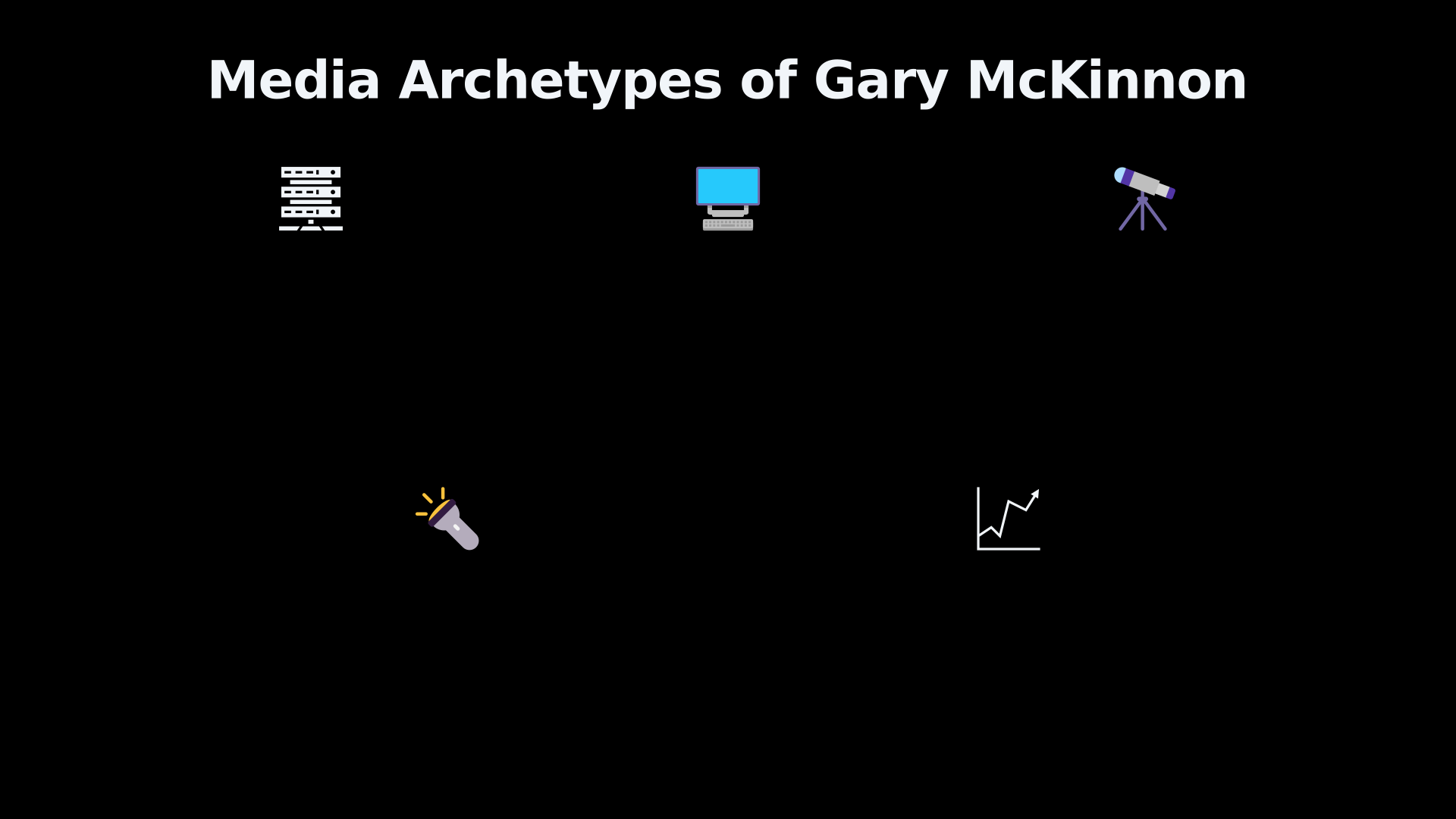
Media portrayals repeatedly organised McKinnon into a small set of recognisable roles. Each role highlighted genuine elements of the case but suppressed others.
The dangerous cyber-attacker reflected the indictment, alleged disruption and national-security setting. Its weakness was that prosecutorial allegations were frequently presented alongside maximum possible sentences and dramatic institutional language, making the harshest interpretation more prominent than the unresolved evidential questions.
The bumbling computer nerd emphasised weak passwords, ordinary equipment and McKinnon’s own lack of sophistication. This challenged official claims about an extraordinary attack, but could also minimise the seriousness of repeatedly entering systems without permission. Technical simplicity does not make sustained unauthorised access harmless.
The eccentric UFO obsessive made the story colourful and approachable. It sometimes carried a dismissive undertone, presenting extraterrestrial curiosity as evidence that McKinnon could not be a conventional security threat. That framing risked treating unusual beliefs as a substitute for examining conduct and intent.
The heroic disclosure seeker recast hacking as a public-interest mission. In its strongest form, McKinnon appeared as someone prepared to take personal risks to uncover technology or knowledge withheld from humanity. This portrayal depended heavily on accepting his stated motive while overlooking the absence of retrievable evidence from the alleged discoveries.
The vulnerable extradition victim centred his health, family and exposure to severe punishment. It was the most politically effective portrayal because it joined humanitarian concern with wider criticism of extradition law. Its potential distortion was to allow sympathy about punishment to stand in for a judgement about the underlying computer offences.
These frames were not mutually exclusive. Indeed, the story’s unusual endurance came from their collision. McKinnon could be eccentric enough to attract feature writers, technically capable enough to concern security officials, vulnerable enough to inspire campaigners and secretive enough about what he claimed to have seen to sustain UFO speculation.
Repetition turned recollection into folklore
The McKinnon narrative illustrates how public memory can become more definite as the supporting evidence becomes more distant. The original claims were usually phrased cautiously: McKinnon said he saw an image; he recalled a particular heading; he interpreted unexplained references as possible evidence of activity beyond Earth. Later summaries often shortened these into declarations that he “found a UFO”, “discovered non-terrestrial officers” or “uncovered a secret space fleet”.
Three processes encouraged that drift.
First, headline compression removed evidential verbs. “Claims to have seen” requires more space and offers less drama than “found”. Once the claim was placed in a headline or caption, the distinction between testimony and authenticated material could disappear.
Second, the same details circulated through different media formats. Newspaper interviews, technology profiles, television segments, campaign pages and later online videos repeatedly reproduced the cigar-shaped craft and the “Non-Terrestrial Officers” phrase. Cross-platform repetition made the story seem multiply sourced even when most versions ultimately traced back to McKinnon’s own interviews.[wired.com]wired.comufo hacker tells what he foundufo hacker tells what he found
Third, narrative completeness filled evidential gaps. A satisfying disclosure story needs a seeker, a secret archive, a discovery and an attempt at suppression. The McKinnon case supplied the seeker and the restricted networks, while his recollections supplied the discovery. The lengthy extradition effort could then be interpreted by sympathetic audiences as evidence that authorities feared what he knew, although the documented legal case concerned alleged computer offences and damage rather than possession of UFO evidence.[Department of Justice]justice.govDepartment of JusticeLondon, England Hacker Indicted Under Computer Fraud…Gary McKinnon, of London, England, was indicted in Alexandri…
This is a classic circular effect: the severity of the prosecution is treated as proof that the discovery was important, while the supposed importance of the discovery is used to explain the severity of the prosecution. The official record does not establish that connection.
Even sceptical coverage could strengthen the legend. Calling McKinnon a conspiracy theorist or joking about “little green men” repeated the same evocative claims and kept them central to his identity. Mockery and belief therefore circulated a shared story, differing mainly over whether its hero was courageous, deluded or merely eccentric.

The missing trial left the media frames unresolved
McKinnon admitted obtaining unauthorised access, but the competing accounts of damage, intent and proportionality were never resolved through a completed criminal trial. The House of Lords judgement recorded the US allegations and the history of plea discussions and extradition proceedings; it was not a verdict determining the truth of every technical allegation.[UK Parliament]publications.parliament.ukmckinn 1UK ParliamentHouse of Lords - Mckinnon V Government of The United…30 Jul 2008 — The appellant is a 42 year old British citizen, an une…
That distinction matters because many media narratives adopted the certainty of a verdict without the procedure of one. Supportive portrayals sometimes treated the damage allegations as obvious exaggerations. Hostile portrayals could speak as though the largest claimed losses and disruptions had been proved. The absence of a trial left both sides free to select the version most compatible with their wider argument.
The same asymmetry affected the UFO claims. The government possessed formal allegations, system records and legal documents concerning unauthorised access, while McKinnon supplied a personal narrative about what he believed he encountered. Yet the UFO details were often more culturally memorable because they were visual, mysterious and easy to retell. A lost image of a spacecraft has greater storytelling power than a dispute over network logs, repair calculations or the legal meaning of intentional damage.
The result was an unusual inversion. The best-documented part of the case—the extradition process and the allegation of computer intrusion—became background to the least verifiable part: what McKinnon thought he saw inside the systems.
Reading the narrative critically
The media did not invent McKinnon’s UFO motive, the extradition campaign or the US allegations. It selected, compressed and arranged them into stories that audiences could recognise. The problem arises when a useful frame becomes a substitute for distinctions that remain essential.
A careful reading separates at least four propositions:
- McKinnon entered US government systems without authorisation.
- US prosecutors alleged deliberate damage and serious disruption.
- McKinnon said his purpose was to locate evidence of UFO secrecy and suppressed technology.
- He later described discoveries that were not preserved in independently verifiable form.
The first proposition was admitted in broad terms. The second remained contested and was not tested in a completed trial. The third describes motivation, not proof. The fourth is testimony rather than recoverable documentary evidence. Combining all four into “a hacker uncovered alien secrets and was nearly imprisoned for it” produces a compelling legend, but not an accurate summary of the evidential record.[justice.gov]justice.govDepartment of JusticeLondon, England Hacker Indicted Under Computer Fraud…Gary McKinnon, of London, England, was indicted in Alexandri…
McKinnon’s lasting symbolic status therefore tells us less about whether governments possess extraterrestrial technology than about the media conditions under which such a claim becomes durable. Official hyperbole supplied scale, interviews supplied personality, UFO imagery supplied mystery and the extradition campaign supplied moral urgency. Together they transformed a disputed computer case into a modern disclosure myth—one in which the most memorable evidence is also the evidence the public cannot inspect.
Amazon book picks
Further Reading
Books and field guides related to How the Media Turned Mc Kinnon Into a Symbol. Use these as the next step if you want deeper reading beyond the article.
So You've Been Publicly Shamed
Celebrating Fifty Years of Picador Books Jon Ronson's captivating and brilliant exploration of one of our world's most underappreciated f...
Trust Me, I'm Lying: Confessions of a Media Manipulator
Recently, fake news has become real news, making headlines as its consequences become crushingly obvious in political upsets and global t...
Media and Crime
This book critically examines the complex interactions between media and crime. Written with an engaging and authoritative voice, it guid...
eBay marketplace picks
Marketplace Samples
Live-tested eBay searches with available results related to this page.
Selected fromUFO poster oneBay.co.uk.

Current eBay listing
VINTAGE UFO FLYING SAUCERS COMIC ADVERTISING A2 POSTER PRINT

Current eBay listing
I Want To Believe UFO Poster Giclée Fine Art Heavyweight Print


Endnotes
1.
Source: justice.gov
Link:https://www.justice.gov/archive/criminal/cybercrime/press-releases/2002/mckinnonIndict.htm
Source snippet
Department of JusticeLondon, England Hacker Indicted Under Computer Fraud...Gary McKinnon, of London, England, was indicted in Alexandri...
2.
Source: publications.parliament.uk
Title: mckinn 1
Link:https://publications.parliament.uk/pa/ld200708/ldjudgmt/jd080730/mckinn-1.htm
Source snippet
UK ParliamentHouse of Lords - Mckinnon V Government of The United...30 Jul 2008 — The appellant is a 42 year old British citizen, an une...
3.
Source: GOV.UK
Title: gary mckinnon extradition case home secretarys statement
Link:https://www.gov.uk/government/speeches/gary-mckinnon-extradition-case-home-secretarys-statement
Source snippet
Gary McKinnon extradition case: Home Secretary's statement16 Oct 2012 — I have concluded that Mr McKinnon's extradition would give rise t...
4.
Source: wired.com
Link:https://www.wired.com/2005/06/accused-pentagon-hacker-in-court
Source snippet
Arrested on charges from 2002, Mckinnon allegedly infiltrated 97 U.S. government computers, including Pentagon and NASA systems, causing...
5.
Source: wired.com
Link:https://www.wired.com/2002/11/brit-fights-hacking-extradition
Source snippet
attempts to extradite him for charges related to what is described as the largest successful hacking effort against American military net...
6.
Source: wired.com
Link:https://www.wired.com/2006/04/terrorist-or-ufo-truth-seeker
Source snippet
for hacking into military and NASA systems. Labeled as committing the "biggest military computer hack of all time" by U.S. officials, McK...
7.
Source: wired.com
Link:https://www.wired.com/2002/11/brit-accused-of-hacking-pentagon
Source snippet
federal authorities of hacking into 92 computer networks operated by the U.S. military and NASA, causing $900,000 in damages across 14 st...
8.
Source: wired.com
Title: ufo hacker tells what he found
Link:https://www.wired.com/2006/06/ufo-hacker-tells-what-he-found/
10.
Source: time.com
Title: hack attack 2
Link:https://time.com/archive/6943962/hack-attack-2/
12.
Source: aspie-editorial.com
Link:https://www.aspie-editorial.com/2009/07/
13.
Source: Wikipedia
Title: Gary Mc Kinnon
Link:https://en.wikipedia.org/wiki/Gary_McKinnon
14.
Source: GOV.UK
Title: latest on [gary mckinnon case]({{ ‘mc-kinnon-case/’ | relative_url }})
Link:https://www.gov.uk/government/news/latest-on-gary-mckinnon-case
15.
Source: Wikipedia
Title: غاري ماكينون
Link:https://ar.wikipedia.org/wiki/%D8%BA%D8%A7%D8%B1%D9%8A_%D9%85%D8%A7%D9%83%D9%8A%D9%86%D9%88%D9%86
16.
Source: parliament.uk
Title: SELECT COMMITTEE ON EXTRADITION LAW
Link:https://www.parliament.uk/globalassets/documents/lords-committees/extradition-law/SELECT-COMMITTEE-ON-EXTRADITION-LAW.pdf
17.
Source: justice.gov
Link:https://www.justice.gov/archive/usao/nj/Press/files/pdffiles/Older/edva_mckinnon_indictment.pdf
18.
Source: assets.publishing.service.gov.uk
Title: public views 4
Link:https://assets.publishing.service.gov.uk/media/5a7aaeb5e5274a34770e661b/public-views-4.pdf
19.
Source: theguardian.com
Title: The Guardian Asperger’s syndrome hacker ‘should not be extradited’
Link:https://www.theguardian.com/technology/2009/jul/14/gary-mckinnon-aspergers-hacking
20.
Source: theguardian.com
Link:https://www.theguardian.com/politics/2009/sep/09/alan-johnson-meet-gary-mckinnon-campaigners
21.
Source: theguardian.com
Title: The Guardian Boris Johnson slams US attempt to extradite hacker Gary Mc Kinnon
Link:https://www.theguardian.com/politics/2009/jan/27/boris-johnson-slams-extradition-decision
22.
Source: theguardian.com
Title: gary mckinnon hacking prosecution us
Link:https://www.theguardian.com/world/2012/jul/10/gary-mckinnon-hacking-prosecution-us
23.
Source: theguardian.com
Link:https://www.theguardian.com/theguardian/2005/jul/09/weekend7.weekend2
24.
Source: theguardian.com
Link:https://www.theguardian.com/technology/2008/aug/28/hacking.security
25.
Source: uapmurders.com
Title: Gary Mc Kinnon
Link:https://uapmurders.com/uaps/Details/Gary_McKinnon/
Additional References
26.
Source: youtube.com
Title: Ancient Aliens: Hacking NASA Secrets (Season 12, Episode 9)
Link:https://www.youtube.com/watch?v=20rWFDfh68Y
Source snippet
PM Discusses The Fate Of Hacker Gary McKinnon...
27.
Source: facebook.com
Link:https://www.facebook.com/SchattenderVergangenheit/posts/david-gilmour-the-iconic-guitarist-of-pink-floyd-known-for-his-soulful-playing-a/122178114782157604/
28.
Source: facebook.com
Link:https://www.facebook.com/groups/spherefanclub/posts/7403017926473042/
29.
Source: reddit.com
Link:https://www.reddit.com/r/UFOs/comments/k534bw/gary_mckinnon_bbc_interview_about_what_he/
30.
Source: facebook.com
Link:https://www.facebook.com/MysteriousSociety/posts/twenty-years-ago-the-united-states-was-confronted-with-the-largest-hacking-of-mi/1139651233127427/
31.
Source: podmust.com
Link:https://podmust.com/ep/?epis=R2FyeSBNY0tpbm5vbjogVGhlIEhhY2tlciBXaG8gRm91bmQgTkFTQSdzIFVGTyAmIE5vbi1UZXJyZXN0cmlhbCBPZmZpY2Vycw%3D%3D&podcast=the-daily-conspiracy
32.
Source: reddit.com
Link:https://www.reddit.com/r/UFOs/comments/16uujkn/gary_mckinnon_talks_about_finding_the/
33.
Source: reddit.com
Link:https://www.reddit.com/r/hacking/comments/1etqs6b/how_gary_mckinnon_did_what_he_did/
34.
Source: medium.com
Link:https://medium.com/the-lindberg-interviews/interview-with-ufo-hacker-gary-mckinnon-5aa5d366828b
35.
Source: cybereason.com
Link:https://www.cybereason.com/blog/malicious-life-podcast-the-u.s-vs.-gary-mckinnon