What Did the UFO Hackers Actually Find?
“UFO hackers” are people who broke into government or defence computer systems partly to search for concealed information about unidentified flying objects, extraterrestrial technology or secret space programmes.
Page outline Jump by section
Introduction
The hacking itself is well documented. The alleged discoveries are not. McKinnon produced no original files, screenshots or independently verifiable records of the supposed UFO material he described. His story is therefore most useful as two distinct cases: a confirmed and consequential cyber intrusion, and an unconfirmed account of what the intruder believed he saw. Mathew Bevan, another British hacker associated with UFO-motivated intrusions during the 1990s, presents a similar divide between demonstrable security breaches and claims that cannot now be tested.
Gary McKinnon’s search for hidden UFO files
McKinnon, who used the online name “Solo”, acknowledged gaining unauthorised access to numerous United States government computers. He said hacking was a means to investigate his belief that officials were concealing UFOs, antigravity research and potentially revolutionary energy technologies. In a 2006 interview, he identified the Disclosure Project—a campaign built around testimony from former military and government personnel—as an important influence on his thinking.[WIRED]wired.comUFO Hacker' Tells What He Found | WIREDWIRED'UFO Hacker' Tells What He Found | WIRED…
According to the US Department of Justice, McKinnon scanned large portions of the .mil network, obtained administrator privileges and used compromised machines to locate further targets. Prosecutors alleged that he installed remote-administration and hacking tools, copied files and password databases, deleted user accounts and removed critical system files. The indictment covered 92 military and NASA computers, plus six privately operated systems.[Department of Justice]justice.govDepartment of JusticeLondon, England Hacker Indicted Under Computer Fraud and Abuse Act For Accessing Military Computers (November 12, 2002)…
McKinnon portrayed the intrusions as technically simple rather than sophisticated. Contemporary accounts describe him searching for poorly secured machines, including computers whose administrator accounts had weak or blank passwords. That distinction matters: the case exposed basic security failures across interconnected government networks, even though it did not demonstrate that McKinnon penetrated the most highly classified systems.
US authorities alleged consequences far beyond passive browsing. The Justice Department said one affected network lost internet and email service for roughly 2,000 users for three days and placed the overall losses at about $900,000. Those were prosecution allegations rather than findings reached after a completed criminal trial, because McKinnon was never tried in the United States.[Department of Justice]justice.govDepartment of JusticeLondon, England Hacker Indicted Under Computer Fraud and Abuse Act For Accessing Military Computers (November 12, 2002)…
What McKinnon said he discovered
McKinnon’s UFO claims developed through interviews rather than through released data. He described three principal discoveries.
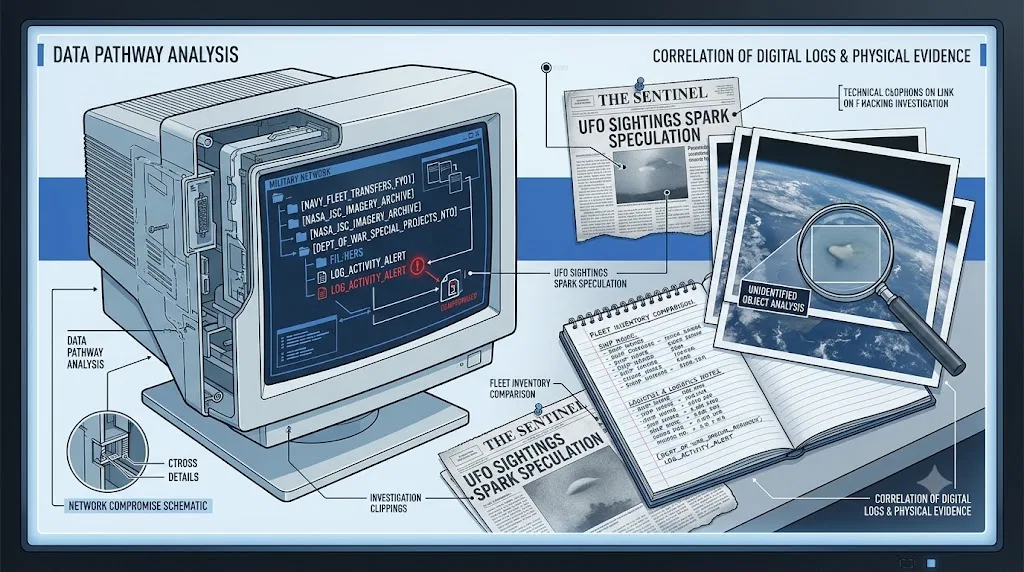
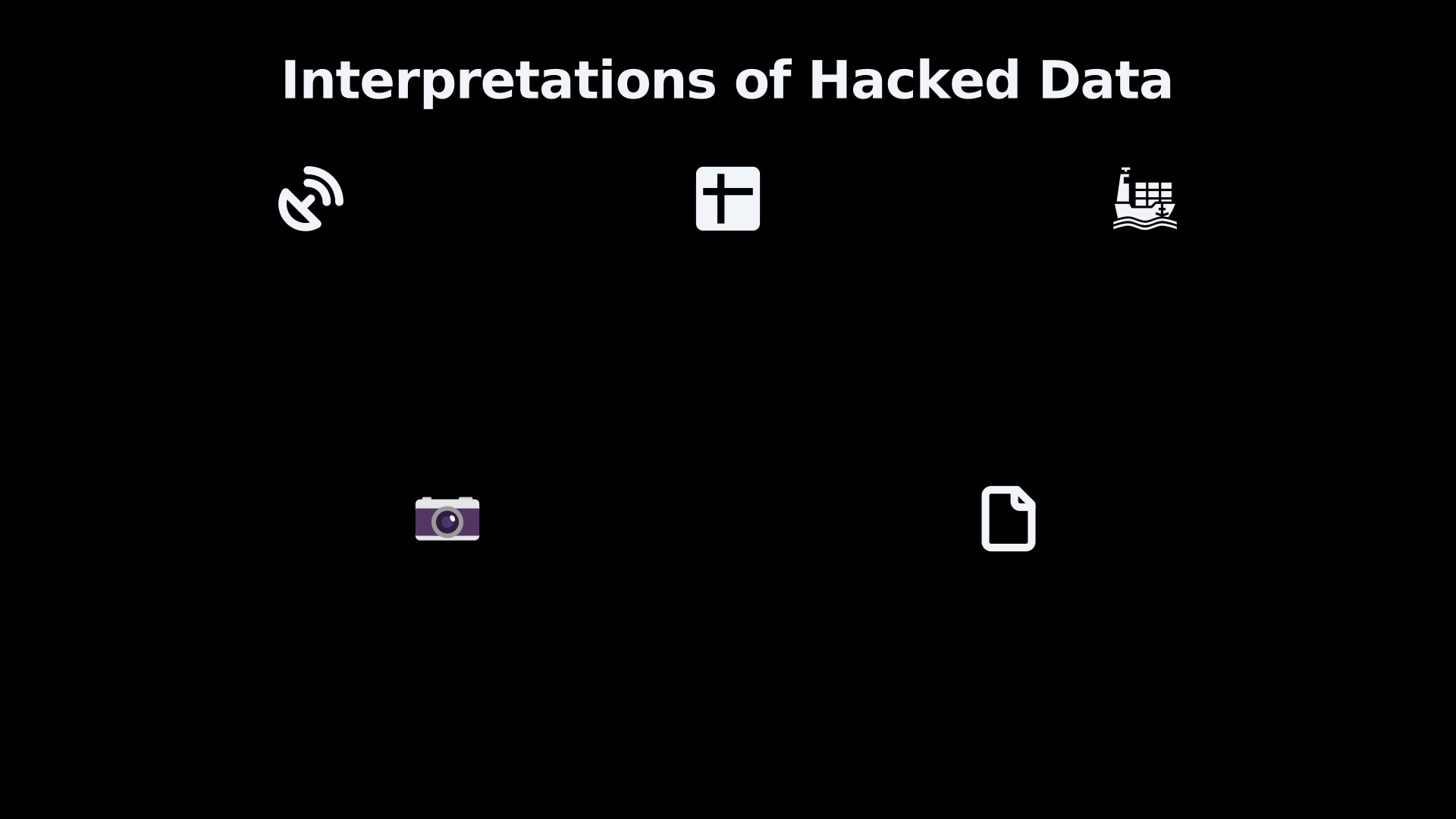
First, he said he accessed material at NASA’s Johnson Space Center connected with high-resolution satellite imagery. He claimed to have viewed a large image of a smooth, pale or silvery object above the Earth that did not resemble a conventional aircraft. Because he was using a slow dial-up connection, he said the full-resolution image appeared gradually and that his session was interrupted before he could save it.[WIRED]wired.comUFO Hacker' Tells What He Found | WIREDWIRED'UFO Hacker' Tells What He Found | WIRED…
Second, he said he found a document containing the phrase “non-terrestrial officers”. He interpreted this as a possible reference to personnel serving somewhere beyond Earth, rather than officers posted outside the continental United States or assigned to another terrestrial category.
Third, he recalled lists referring to ship names and “fleet-to-fleet transfers”. He said the names did not appear to correspond to vessels he could identify in the publicly known US Navy fleet. This contributed to his suspicion that he had encountered records connected with a classified space force or off-world logistical operation.[Project Camelot]projectcamelot.org>> Kerry Cassidy: I'm here with Gary McKinnon, and we're here to talk about his possible extradition to the United States for some hackin…
These descriptions are intriguing but evidentially weak. No copy of the image, personnel list or transfer document has been made public. No contemporaneous notes containing enough detail to identify the underlying systems or records have been independently authenticated. There is also no known evidence that other people who had legitimate access to those systems recognised McKinnon’s descriptions as records of an extraterrestrial programme.
The terminology itself is not conclusive. “Non-terrestrial” can mean outside the terrestrial environment without implying extraterrestrial beings; it might refer to space-related duties, maritime forces or a classification label whose context is missing. “Fleet-to-fleet transfers” could similarly describe ordinary naval logistics. Without the original records, their headings, surrounding text and metadata, an exotic interpretation cannot be distinguished from a mundane one.
Why his account is not proof of a secret space fleet
A credible digital discovery normally depends on an evidence chain: preserved files, system logs, metadata, screenshots, corroborating witnesses and a documented route showing where the material came from. McKinnon’s UFO account lacks that chain. It rests largely on memories of material briefly viewed during unlawful remote sessions, followed by interpretations shaped by beliefs he already held.
This does not establish that he invented the experience. He may accurately remember seeing an unfamiliar image and unusual terminology. The problem is that an unidentified object in an image is not automatically an extraterrestrial craft, just as an unexplained database label does not reveal the purpose of the underlying programme.
Several alternative explanations remain possible:
- The image could have shown a spacecraft component, imaging artefact, ice, debris, glare or another object whose scale and distance were unclear.
- The files could have contained speculative material, training data, unofficial presentations or correspondence rather than operational evidence.
- Words encountered without their surrounding context may have been interpreted too literally.
- Memory may have altered details during years of interviews, publicity and legal stress.
- A compromised computer might not have contained information appropriate to the institution named in its address or network location.
Official UAP research has repeatedly emphasised precisely this problem: unusual observations often remain unexplained because the available data are too limited, not because an extraordinary origin has been established. NASA’s independent study found no conclusive evidence in peer-reviewed literature that UAP have an extraterrestrial origin and argued that such an explanation should be considered only after ordinary possibilities have been ruled out.[NASA Science]science.nasa.govNASA Science…
The Pentagon’s All-domain Anomaly Resolution Office, or AARO, likewise reported in 2024 that it had found no empirical evidence of American government or private-sector programmes reverse-engineering extraterrestrial technology. It concluded that some claims had arisen when genuine but unrelated classified projects were mistakenly associated with alien activity.[U.S. Department of War]media.defense.govU.S. Department of War AARO Historical Record Report Volume 1U.S. Department of War AARO Historical Record Report Volume 1(https://media.defense.gov/2024/Mar/08/2003409233/-1/-1/0/DOPSR-2024-0263-AARO-HISTORICAL-RECORD-REPORT-VOLUME-1-2024.PDF)
Those findings do not directly disprove what McKinnon remembers seeing. NASA and AARO did not conduct a public forensic reconstruction of his individual sessions. They do, however, show that his interpretation is not supported by the broader official record currently available.
Mathew Bevan and the earlier UFO-hacking case
Gary McKinnon was not the first British intruder reported to have searched American defence networks while interested in UFO secrecy. During 1994, Welsh hacker Mathew Bevan, known as “Kuji”, and London teenager Richard Pryce, known as “Datastream Cowboy”, penetrated systems connected with the US Air Force’s Rome Laboratory in New York.
The Rome Laboratory episode was operationally serious. The intruders used compromised systems as stepping stones into other networks, including NASA facilities, Wright-Patterson Air Force Base and defence contractors. Investigators said the attackers accessed intelligence-related messages and research information, while the response required parts of the laboratory network to be isolated or taken offline.[ISC2]isc2.orgCISSP30 30 Years After 2 Kids Broke into the Air ForceISC2#CISSP30: 30 Years After Two Kids Broke into the Air Force12 Sept 2024 — 21-year-old Mathew Bevan, called “Kuji”, attacked the U.S. A…
Accounts of Bevan’s motive say he was looking for evidence of UFO technology and focused particularly on Wright-Patterson, a base long associated in UFO folklore with claims about recovered craft. Specialist histories report that he later said he encountered material he interpreted as plans for an antigravity device. However, no authenticated copy of such a document has emerged, and the claim remains dependent on Bevan’s account rather than recoverable evidence.[ufohackers.org]ufohackers.org* 1994 Mathew "Kuji" Bevan Inspired by the articles in Phrack, (and a rumor about Project Green Cheese being a group of 40 hackers who we…
The Rome Laboratory case also illustrates why dramatic descriptions require care. At the time, investigators feared that the intrusions might be foreign espionage because the attackers routed connections through multiple countries and used military systems to reach other targets. In reality, the identified perpetrators were young British hackers. The episode demonstrated how incomplete information can cause defenders—and intruders—to place mistaken meanings on activity seen inside complex networks.
Pryce was convicted in Britain of offences under the Computer Misuse Act and fined. Bevan was arrested in 1996, but the prosecution against him was eventually discontinued. The absence of a completed trial meant that many contested details were never tested through full adversarial proceedings.[ISC2]isc2.orgCISSP30 30 Years After 2 Kids Broke into the Air ForceISC2#CISSP30: 30 Years After Two Kids Broke into the Air Force12 Sept 2024 — 21-year-old Mathew Bevan, called “Kuji”, attacked the U.S. A…
The extradition battle eclipsed the UFO question
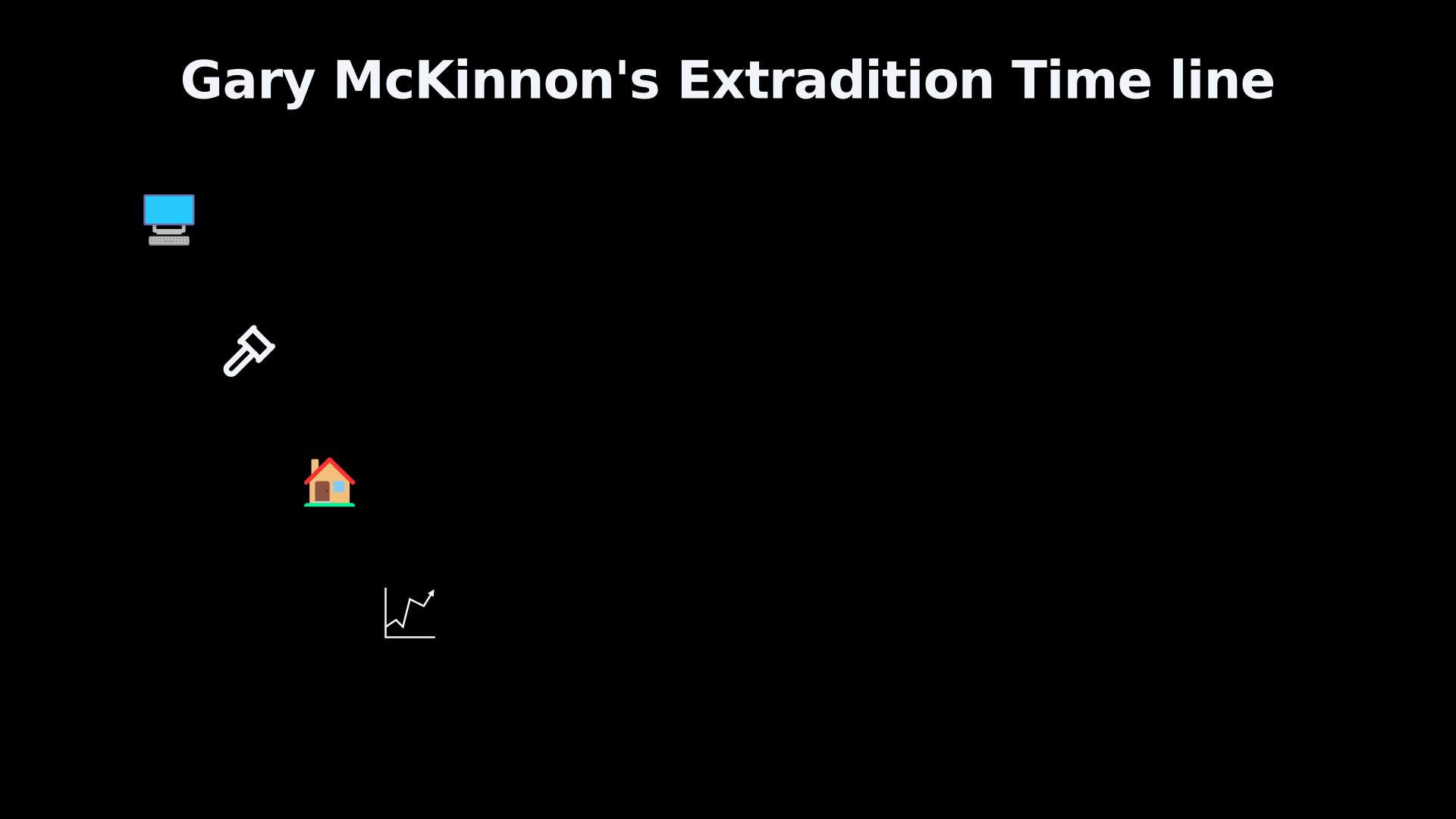
McKinnon’s legal case became far more consequential than his claimed discoveries. US prosecutors indicted him in 2002 on seven counts of computer fraud and sought his extradition from Britain. The legal battle then continued through magistrates’ proceedings, appeals, human-rights arguments and disputes over the sentences he might face if convicted.
In 2008, the House of Lords rejected an appeal concerning US plea-bargaining representations and the extradition process. Its judgment recorded that American prosecutors alleged losses within a $400,000-to-$1 million range even on the lower basis contemplated during plea discussions, with possible additional allegations relating to disrupted government functions and national-security harm.[UK Parliament]publications.parliament.ukUK Parliament House of LordsUK Parliament House of Lords
The case changed direction after medical evidence focused attention on McKinnon’s mental health, his autism diagnosis and the danger that extradition could lead to suicide. On 16 October 2012, Home Secretary Theresa May withdrew the extradition order, concluding that the risk of McKinnon ending his life was so high that extradition would be incompatible with his human rights.[GOV.UK]GOV.UKTheresa May statement on Gary Mc Kinnon extraditionTheresa May statement on Gary Mc Kinnon extradition
That decision was not an endorsement of his UFO claims, nor a ruling that the alleged hacking had not occurred. It was a decision about the human consequences and legality of extradition. British prosecutors subsequently decided not to bring domestic charges, citing difficulties surrounding evidence, witnesses and the prospects of conviction.[The Guardian]theguardian.comgary mckinnon no uk chargesgary mckinnon no uk charges
The case nevertheless had a lasting political impact. It became a prominent example in British debates about the balance of the UK–US extradition relationship, prosecutorial bargaining and the treatment of vulnerable defendants. In public memory, those issues frequently became entangled with speculation that the severity of the US response proved McKinnon had found something extraordinary. The documented allegations offer a more direct explanation: he had repeatedly penetrated military networks during an exceptionally sensitive period following the attacks of 11 September 2001.
What these cases actually demonstrate
The strongest conclusion from the McKinnon and Bevan episodes concerns cyber security, not extraterrestrial visitation. Both cases showed that interconnected military and scientific networks could be exposed through weak passwords, inconsistent administration, insecure remote access and insufficient monitoring. An intruder did not need to break advanced encryption if a trusted account or poorly configured machine provided a simpler route.
They also reveal a recurring feature of UFO culture: secrecy creates an evidential paradox. Military organisations genuinely possess classified aerospace programmes, unusual imagery and terminology that outsiders may not understand. That makes an exotic interpretation appear plausible. Yet the same secrecy prevents the context, provenance and technical details needed to test that interpretation.
A responsible assessment therefore separates four questions:
- Did an intrusion occur? In McKinnon’s case, unauthorised access was admitted and extensively documented.
- Did the intruder encounter unfamiliar material? That is plausible, particularly inside large military and NASA networks.
- Was the material connected with secret technology? Possibly, but no preserved evidence establishes what it represented.
- Did it prove extraterrestrial craft or an off-world military fleet? No publicly verifiable evidence supports that conclusion.
The continuing fascination of UFO hackers comes from the collision of two real phenomena: governments do keep aerospace secrets, and computer networks have often been badly secured. Those facts make the stories credible enough to endure. They do not, by themselves, validate the extraordinary interpretations attached to them.

Conclusion
Gary McKinnon is accurately described as a hacker who searched American government networks for UFO information. He is not accurately described as someone proven to have discovered a secret extraterrestrial fleet. The cyber intrusion, indictment and extradition battle are supported by official records. The cigar-shaped object, “non-terrestrial officers” and fleet-transfer lists survive only through his recollections and interviews.
Mathew Bevan’s earlier case follows much the same pattern: a substantial and historically important military-network intrusion combined with an alleged search for UFO or antigravity secrets, but no surviving evidence capable of confirming the claimed discovery.
Their stories deserve attention because they expose genuine security failures, the personal risks of unauthorised investigation and the difficulty of interpreting fragmentary information taken from secretive systems. As UFO evidence, however, they remain uncorroborated testimony rather than demonstrable proof.
Amazon book picks
Further Reading
Books and field guides related to What Did the UFO Hackers Actually Find?. Use these as the next step if you want deeper reading beyond the article.
The UFO Experience: A Scientific Inquiry
Cited by the New York Review of Books as "the best brief for visitation," this classic study presents an analysis of UFO reports and conc...
UFOs: Generals, Pilots, and Government Officials Go on the Re...
NEW YORK TIMES BESTSELLER • Impeccably researched, this riveting journalistic investigation separates fact from fiction, and documents th...
The Hacker and the State
Rating: 5.0/5 from 18 Google Books ratings
“A must-read...It reveals important truths.” —Vint Cerf, Internet pioneer “One of the finest books on information security published so f...
The Cuckoo's Egg
This is the true story of how a systems manager at Lawrence Berkeley Lab singlehandedly tracked down and helped capture a computer hacker...
eBay marketplace picks
Marketplace Samples
Live-tested eBay searches with available results related to this page.
Selected fromUFO poster oneBay.co.uk.
Current eBay listing
VINTAGE UFO FLYING SAUCERS COMIC ADVERTISING A2 POSTER PRINT


Current eBay listing
I Want To Believe UFO Poster Giclée Fine Art Heavyweight Print

Endnotes
1.
Source: wired.com
Title: ‘UFO Hacker’ Tells What He Found | WIRED
Link:https://www.wired.com/2006/06/ufo-hacker-tells-what-he-found
Source snippet
WIRED'UFO Hacker' Tells What He Found | WIRED...
2.
Source: justice.gov
Link:https://www.justice.gov/archive/criminal/cybercrime/press-releases/2002/mckinnonIndict.htm
Source snippet
Department of JusticeLondon, England Hacker Indicted Under Computer Fraud and Abuse Act For Accessing Military Computers (November 12, 2002)...
Published: November 12, 2002
3.
Source: science.nasa.gov
Link:https://science.nasa.gov/wp-content/uploads/2023/09/uap-independent-study-team-final-report.pdf
Source snippet
NASA Science...
4.
Source: isc2.org
Title: CISSP30 30 Years After 2 Kids Broke into the Air Force
Link:https://www.isc2.org/Insights/2024/09/CISSP30-30-Years-After-2-Kids-Broke-into-the-Air-Force
Source snippet
ISC2#CISSP30: 30 Years After Two Kids Broke into the Air Force12 Sept 2024 — 21-year-old Mathew Bevan, called “Kuji”, attacked the U.S. A...
5.
Source: ufohackers.org
Link:https://www.ufohackers.org/hackers/mathew-bevan/bevan-overview
Source snippet
* 1994 Mathew "Kuji" Bevan Inspired by the articles in Phrack, (and a rumor about Project Green Cheese being a group of 40 hackers who we...
6.
Source: ufohackers.org
Link:https://www.ufohackers.org/hackers
Source snippet
* 1999 Interview of Bevan by Matthew WilliamsPeriodicals, newspapers, and the media covered Bevan's case extensively, along with other so...
7.
Source: publications.parliament.uk
Title: UK Parliament House of Lords
Link:https://publications.parliament.uk/pa/ld200708/ldjudgmt/jd080730/mckinn-1.htm
8.
Source: GOV.UK
Title: Theresa May statement on Gary Mc Kinnon extradition
Link:https://www.gov.uk/government/news/theresa-may-statement-on-gary-mckinnon-extradition
9.
Source: GOV.UK
Title: www.gov.uk Latest on Gary [Mc Kinnon case]({{ ‘mc-kinnon-case/’ | relative_url }})
Link:https://www.gov.uk/government/news/latest-on-gary-mckinnon-case
10.
Source: ufohackers.org
Link:https://www.ufohackers.org/hackers/gary-mckinnon/mckinnon-overview
11.
Source: ufohackers.org
Title: 2017 mufon symposium
Link:https://www.ufohackers.org/hackers/gary-mckinnon/2017-mufon-symposium
12.
Source: democracy.swansea.gov.uk
Title: CSJJ5157 Homelessness report 070317 WEB
Link:https://democracy.swansea.gov.uk/documents/s44132/CSJJ5157_Homelessness_report_070317_WEB.pdf
13.
Source: science.nasa.gov
Link:https://science.nasa.gov/uap/
14.
Source: science.nasa.gov
Link:https://science.nasa.gov/uap/faqs/
15.
Source: nationalarchives.gov.uk
Title: UF O reports
Link:https://www.nationalarchives.gov.uk/explore-the-collection/explore-by-time-period/postwar/ufo-reports/
16.
Source: aaro.mil
Link:https://www.aaro.mil/UAP-Cases/Official-UAP-Imagery/
17.
Source: GOV.UK
Title: gary mckinnon extradition case home secretarys statement
Link:https://www.gov.uk/government/speeches/gary-mckinnon-extradition-case-home-secretarys-statement
18.
Source: space.com
Title: nasa ufo uap study team first results revealed
Link:https://www.space.com/nasa-ufo-uap-study-team-first-results-revealed
19.
Source: projectcamelot.org
Link:https://projectcamelot.org/lang/en/gary_mckinnon_interview_transcript_en.html
Source snippet
>> Kerry Cassidy: I'm here with Gary McKinnon, and we're here to talk about his possible extradition to the United States for some hackin...
20.
Source: theguardian.com
Link:https://www.theguardian.com/theguardian/2005/jul/09/weekend7.weekend2
Source snippet
In 1983, when Gary McKinnon was 17, he went to see the movie WarGames at his local cinema in Crouch End, north London.This is Gary's firs...
21.
Source: media.defense.gov
Title: U.S. Department of War AARO Historical Record Report Volume 1
Link:https://media.defense.gov/2024/Mar/08/2003409233/-1/-1/0/DOPSR-2024-0263-AARO-HISTORICAL-RECORD-REPORT-VOLUME-1-2024.PDF
22.
Source: theguardian.com
Title: gary mckinnon no uk charges
Link:https://www.theguardian.com/world/2012/dec/14/gary-mckinnon-no-uk-charges
23.
Source: projectcamelotportal.com
Title: gary mckinnon hacking the pentagon re release copy 2
Link:https://projectcamelotportal.com/2024/08/21/gary-mckinnon-hacking-the-pentagon-re-release-copy-2/
24.
Source: theguardian.com
Link:https://www.theguardian.com/world/2009/oct/09/hacker-gary-mckinnon-supreme-court-extradition
25.
Source: theguardian.com
Title: Profile: Gary Mc Kinnon | Gary Mc Kinnon | The Guardian
Link:https://www.theguardian.com/technology/2009/jul/31/gary-mckinnon-hacking-extradition
26.
Source: theguardian.com
Link:https://www.theguardian.com/technology/2008/jul/30/gary.mckinnon
27.
Source: theguardian.com
Link:https://www.theguardian.com/technology/2008/jun/16/hacking.internationalcrime
28.
Source: theguardian.com
Title: Briton loses extradition fight over US military hacking | UK news | The Guardian
Link:https://www.theguardian.com/uk/2007/apr/03/politics.usa1
29.
Source: theguardian.com
Link:https://www.theguardian.com/technology/2006/jul/07/news.usnews
30.
Source: Wikipedia
Title: Mathew Bevan
Link:https://en.wikipedia.org/wiki/Mathew_Bevan
31.
Source: Wikipedia
Title: Gary Mc Kinnon
Link:https://en.wikipedia.org/wiki/Gary_McKinnon
32.
Source: theguardian.com
Link:https://www.theguardian.com/technology/2008/aug/28/hacking.security
33.
Source: kujimedia.com
Title: Richard Pryce
Link:https://www.kujimedia.com/tag/richard-pryce/page/2/
34.
Source: itv.com
Title: gary mckinnon
Link:https://www.itv.com/news/story/2012-12-14/gary-mckinnon
35.
Source: scribd.com
Link:https://www.scribd.com/document/83849328/Project-Camelot-Gary-McKinnon-Transcript
Additional References
36.
Source: facebook.com
Link:https://www.facebook.com/LADbibleTV/posts/chris-accidentally-hacked-into-top-secret-fbi-files-at-just-10-years-old-/1391312285683995/
37.
Source: computing.co.uk
Link:https://www.computing.co.uk/news/1834341/hacked-court-frees-air-force
38.
Source: libertyhumanrights.org.uk
Link:https://www.libertyhumanrights.org.uk/wp-content/uploads/2020/04/Libertys-submission-to-the-JCHR-extradition-inquiry-Jan-2011.pdf
39.
Source: reddit.com
Link:https://www.reddit.com/r/EverythingScience/comments/16ithu9/nasa_ufo_report_finds_no_evidence_of/
40.
Source: facebook.com
Link:https://www.facebook.com/groups/2127373170805852/posts/2186396468236855/
41.
Source: trulyadventure.us
Link:https://www.trulyadventure.us/the-hacker
42.
Source: facebook.com
Link:https://www.facebook.com/nbc10/posts/the-latest-aaro-report-on-uaps-which-was-released-in-late-2024-touched-on-hundre/1403981808439501/
43.
Source: singjupost.com
Link:https://singjupost.com/transcript-the-lone-hacker-that-found-nasas-secret-ufo-fleet-american-alchemy/
44.
Source: cybernews.com
Link:https://cybernews.com/news/nasa-gary-mckinnon-hacking-ufo/
45.
Source: youtube.com
Title: Gary Mc Kinnon wins extradition battle
Link:https://www.youtube.com/watch?v=y4lecD44F5E
Source snippet
Ancient Aliens: Hacking NASA Secrets (Season 12, Episode 9)...