Within File Context
What Vanishes When a File Loses Its Context?
Without authorship, dates, folder paths and revision history, even an authentic file may be impossible to interpret reliably.
On this page
- The metadata needed to establish provenance
- How folder structure and document history shape meaning
- Why screenshots and copied fragments weaken verification
Page outline Jump by section
Introduction
When discussions of UFO-related hacking, including the claims made by Gary McKinnon, focus on a single document, spreadsheet or image, an important question is often overlooked: what information about that file has been lost? A digital document rarely stands on its visible text alone. Its authorship, creation date, modification history, folder location, linked records and system metadata all help establish what the file actually represents. Without that context, even a genuine government file can be misunderstood.
This matters because government computer systems are working environments rather than curated archives. Records management standards treat metadata—the descriptive and technical information surrounding a file—as essential evidence of provenance. Once that evidence disappears, it becomes much harder to determine whether a document was a final decision, an abandoned draft, an external attachment, a copied reference, a training exercise or something else entirely.[archives.gov]archives.govNational ArchivesMetadata Requirements for Permanent Electronic Records | National ArchivesApril 10, 2025…
What metadata establishes a file’s provenance?
Metadata is often described simply as “data about data”, but for investigators it serves a more practical role: it explains where a file came from and how it reached its present form.
For government records, particularly electronic records intended for long-term preservation, archivists commonly seek information including:
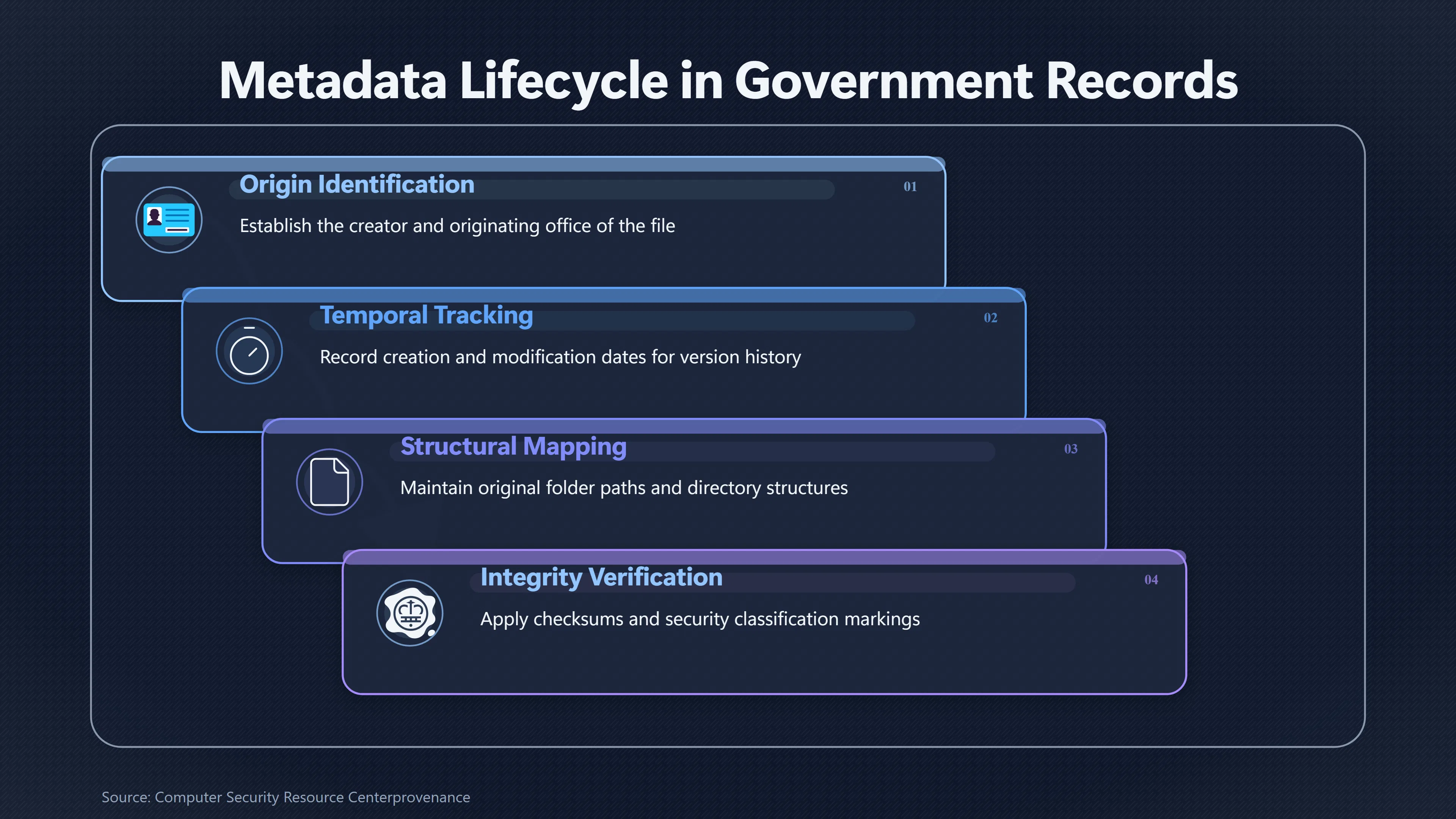
- the creator or originating office
- creation and modification dates
- document identifier
- security classification and handling markings
- file path or original folder structure
- version or revision history
- relationships to other records
- checksums or other integrity information
- access restrictions and retention history.[National Archives]archives.govNational ArchivesMetadata Requirements for Permanent Electronic Records | National ArchivesApril 10, 2025…
NIST defines provenance as the chronology of a system or data’s origin, ownership, location and changes over time. In other words, provenance records the history needed to explain why a digital object exists in its current state rather than merely proving that it exists.[NIST Computer Security Resource Center]csrc.nist.govComputer Security Resource CenterprovenanceNIST Computer Security Resource Centerprovenance - Glossary | CSRC…
In the context of alleged discoveries on government networks, that distinction is crucial. A copied spreadsheet with an unusual title may be authentic as a file, yet still impossible to interpret correctly if its provenance has been stripped away.
How folder structure and document history shape meaning
A file’s location within an organisation frequently conveys information that disappears once the file is copied elsewhere.
For example, the same document could have very different meanings depending on whether it originally resided in:
- a user’s temporary working folder
- a contractor submission directory
- an intelligence analysis workspace
- a legal review folder
- a software testing environment
- an archive of incoming correspondence.
Removing only the folder path eliminates evidence about the file’s role in organisational work.
The UK National Archives explicitly preserves parent folder names for born-digital records because otherwise many filenames become almost meaningless. Recording the original directory structure allows future researchers to reconstruct relationships between documents and understand how records were organised when actively used.[National Archives]nationalarchives.gov.ukNational Archives Our digital cataloguing practicesNational ArchivesOur digital cataloguing practices - The National Archives…
Document history provides similar context. A visible sentence in a Word document may have been inserted yesterday, deleted the following week, or heavily qualified in later revisions. If only one extracted version survives, readers cannot determine whether they are seeing an early proposal, a heavily edited compromise or the final approved wording.
Why screenshots and copied fragments weaken verification
One recurring difficulty in disputed government-document claims is that the public often sees only screenshots, excerpts or recollections rather than the original digital record.
A screenshot usually preserves only visual appearance. It often omits:
- embedded metadata
- document properties
- creation timestamps
- revision history
- digital signatures
- hyperlinks
- hidden comments
- associated attachments
- surrounding directory structure.
Likewise, copied text pasted into another document loses much of the contextual information needed to authenticate and interpret it.
Even where screenshots are genuine, they answer only limited questions:
- Was these words displayed?
- Did the screen resemble an official system?
They generally cannot answer equally important questions:
- Who authored the document?
- Was it ever approved?
- Was it later corrected?
- Was it received from another organisation?
- What documents surrounded it?[prov.vic.gov.au]prov.vic.gov.auarchival control modelarchival control model
- Did other records contradict it?
Government guidance on metadata consistently treats this contextual information as necessary for future interpretation and validation rather than optional administrative detail.[gov.uk]GOV.UKRecord information about data sets you share with othersRecord information about data sets you share with others
Why this matters when assessing McKinnon’s reported discoveries
Gary McKinnon has consistently described observing material including high-resolution imagery and a spreadsheet referring to “non-terrestrial officers” while accessing NASA and US military computers. Because he did not retain complete copies together with their associated metadata, independent researchers cannot reconstruct the original context of the material he reported seeing.[National Archives]archives.govNational Archives Records Basics | National ArchivesNational ArchivesRecords Basics | National ArchivesJuly 28, 2025…
That absence of context leaves multiple plausible interpretations open.
The spreadsheet, if accurately remembered, might theoretically have been:
- an operational document;
- an imported database from another source;
- a draft;
- a test dataset;
- an administrative list using terminology meaningful only within a local workflow; or
- something else entirely.
Without authorship, document history, neighbouring files and provenance metadata, there is no reliable way to distinguish among those possibilities.
Similarly, an image viewed on a government workstation cannot be fully interpreted from recollection alone. Investigators would ideally want to know its original filename, storage location, acquisition date, associated project, related documentation, embedded metadata and whether subsequent versions existed. Those contextual records frequently carry as much evidential value as the visible image itself.
This limitation does not prove that McKinnon’s recollections were wrong. Nor does it validate them. Instead, it explains why the available evidence cannot easily establish the meaning of the reported files with confidence.

Authenticity is only the starting point
A common misunderstanding is to equate authenticity with interpretation.
Several separate questions must be answered before a government file can support a significant claim:
QuestionWhy it mattersIs the file genuine?Confirms it existed.Who created it?Establishes responsibility and authority.When was it created and revised?Places it within organisational events.Where was it stored?Reveals organisational context.How did it relate to other records?Shows whether it supported, contradicted or supplemented other material.Was it final or preliminary?Determines institutional weight.
Metadata provides much of the evidence needed to answer these questions. Once that metadata is stripped away, investigators are left interpreting isolated words rather than documented organisational activity.
For this reason, archivists, digital forensic specialists and records managers consistently emphasise provenance and contextual metadata as essential components of a trustworthy electronic record. A document without its surrounding history may still be genuine, but its meaning can change dramatically once the information explaining its origin, relationships and evolution has vanished.[nist.gov]csrc.nist.govComputer Security Resource CenterprovenanceNIST Computer Security Resource Centerprovenance - Glossary | CSRC…
Amazon book picks
Further Reading
Books and field guides related to What Vanishes When a File Loses Its Context?. Use these as the next step if you want deeper reading beyond the article.
File System Forensic Analysis
The Definitive Guide to File System Analysis: Key Concepts and Hands-on Techniques Most digital evidence is stored within the computer's...
Practical Digital Forensics
Get started with the art and science of digital forensics with this practical, hands-on guide! Key Features Champion the skills of digita...
Fundamentals of Digital Forensics: Theory, Methods, and Real-...
This practical and accessible textbook/reference describes the theory and methodology of digital forensic examinations, presenting exampl...
Archives: Principles and Practices
This new and extensively revised second edition offers an international perspective on archives management, providing authoritative guida...
eBay marketplace picks
Marketplace Samples
Example marketplace items related to this page. Use the search link to explore similar finds on eBay.
Selected fromUFO decal oneBay.co.uk.

Current eBay listing
Alien UFO Glow In The Dark Sticker (Small) - Peel and Stick!
Endnotes
1.
Source: archives.gov
Link:https://www.archives.gov/records-mgmt/policy/metadata-compiled
Source snippet
National ArchivesMetadata Requirements for Permanent Electronic Records | National ArchivesApril 10, 2025...
Published: April 10, 2025
2.
Source: csrc.nist.gov
Title: Computer Security Resource Centerprovenance
Link:https://csrc.nist.gov/glossary/term/provenance
Source snippet
NIST Computer Security Resource Centerprovenance - Glossary | CSRC...
3.
Source: nationalarchives.gov.uk
Title: National Archives Born-digital records and metadata
Link:https://www.nationalarchives.gov.uk/information-management/manage-information/digital-records-transfer/what-are-born-digital-records/
Source snippet
National ArchivesBorn-digital records and metadata - The National Archives...
4.
Source: archives.gov
Link:https://www.archives.gov/records-mgmt/bulletins/2025/2025-01
Source snippet
National ArchivesNARA Bulletin 2025-01 | National Archives...
5.
Source: nationalarchives.gov.uk
Title: National Archives Our digital cataloguing practices
Link:https://www.nationalarchives.gov.uk/professional-guidance-and-services/cataloguing-practices/digital-cataloguing-practices/
Source snippet
National ArchivesOur digital cataloguing practices - The National Archives...
6.
Source: nationalarchives.gov.uk
Title: National Archives2. Understanding the records
Link:https://www.nationalarchives.gov.uk/archives-sector/advice-and-guidance/managing-your-collection/preserving-digital-collections/line-of-business-systems/2-understanding-the-records/
Source snippet
Archives sector...
7.
Source: GOV.UK
Title: Record information about data sets you share with others
Link:https://www.gov.uk/guidance/record-information-about-data-sets-you-share-with-others
8.
Source: nationalarchives.gov.uk
Title: National Archives Digitisation
Link:https://www.nationalarchives.gov.uk/information-management/manage-information/preserving-digital-records/digitisation/
Source snippet
National ArchivesDigitisation - The National Archives...
9.
Source: archives.gov
Title: National Archives Records Basics | National Archives
Link:https://www.archives.gov/records-mgmt/scheduling/basics
Source snippet
National ArchivesRecords Basics | National ArchivesJuly 28, 2025...
Published: July 28, 2025
10.
Source: GOV.UK
Title: Acknowledgements 2
Link:https://www.gov.uk/government/publications/disclosure-in-the-digital-age/disclosure-in-the-digital-age-independent-review-of-disclosure-and-fraud-offences-accessible
Source snippet
in the Digital Age: Independent Review of Disclosure and Fraud Offences (accessible) - GOV.UKJuly 14, 2026 — DISCLOSURE IN THE DIGITAL AG...
Published: July 14, 2026
11.
Source: GOV.UK
Title: www.gov.uk Recording metadata to describe critical data assets
Link:https://www.gov.uk/government/publications/record-metadata-to-describe-critical-data-assets/recording-metadata-to-describe-critical-data-assets
12.
Source: GOV.UK
Title: www.gov.uk Record metadata to describe critical data assets
Link:https://www.gov.uk/government/publications/record-metadata-to-describe-critical-data-assets
13.
Source: ncsc.gov.uk
Link:https://www.ncsc.gov.uk/collection/public-content-provenance-for-organisations/the-challenge-of-securing-digital-trust
14.
Source: archives.gov
Title: Archival Materials and Related Elements | National Archives
Link:https://www.archives.gov/research/catalog/lcdrg/archival-materials
15.
Source: archives.gov
Title: NAR A Transfer Guidance | National Archives
Link:https://www.archives.gov/records-mgmt/policy/transfer-guidance.html
16.
Source: prov.vic.gov.au
Title: archival control model
Link:https://prov.vic.gov.au/recordkeeping-government/a-z-topics/archival-control-model
17.
Source: archives.gov
Link:https://www.archives.gov/records-mgmt/bulletins/2015/2015-04.html
18.
Source: archives.gov
Link:https://www.archives.gov/records-mgmt/policy/pki.html
19.
Source: archives.gov
Title: Implementing Electronic Signature Technologies | National Archives
Link:https://www.archives.gov/records-mgmt/policy/electronic-signature-technology.html
20.
Source: nationalarchives.gov.uk
Link:https://www.nationalarchives.gov.uk/help/pronom/detailreportformat.htm
21.
Source: csrc.nist.gov
Link:https://csrc.nist.gov/glossary/term/records
22.
Source: naa.gov.au
Link:https://www.naa.gov.au/information-management/describing-information/metadata
Additional References
23.
Source: reddit.com
Link:https://www.reddit.com/r/UFOs/comments/t0imdw
Source snippet
Hi, i'm Gary Mckinnon. I was in the news for a decade after getting caught 'hacking' mil/gov systems looking for evidence of UFO/UA...
24.
Source: justice.gov
Link:https://www.justice.gov/oip/foiapost/2013foiapost03.html
25.
Source: youtube.com
Title: Hacking for UFOs and fighting for his life. Who is Gary Mc Kinnon?
Link:https://www.youtube.com/watch?v=OImdnvQx7sQ
Source snippet
Theresa May blocks Gary McKinnon's extradition to US...
26.
Source: youtube.com
Title: Ancient Aliens: Hacking NASA Secrets (Season 12, Episode 9)
Link:https://www.youtube.com/watch?v=20rWFDfh68Y
Source snippet
Ancient Aliens: TOP 10 ALIEN ENCOUNTERS OF 2023 | PART 2...
27.
Source: ico.org.uk
Link:https://ico.org.uk/for-organisations/foi/freedom-of-information-and-environmental-information-regulations/determining-whether-we-hold-information/
28.
Source: youtube.com
Title: UK blocks hacker extradition to U.S
Link:https://www.youtube.com/watch?v=xudYoyi_JSY
Source snippet
Ancient Aliens: Hacking NASA Secrets (Season 12, Episode 9)...
29.
Source: tagovcloud.com
Title: Spotlight: NARA’s Metadata Requirements for Electronic Records
Link:https://www.tagovcloud.com/2019/07/spotlight-nara-metadata-requirements-for-electronic-records/
30.
Source: youtube.com
Title: Theresa May blocks Gary Mc Kinnon’s extradition to US
Link:https://www.youtube.com/watch?v=5MEQVo8ENC8
Source snippet
UK blocks hacker extradition to U.S...
31.
Source: ico.org.uk
Title: determining whether we hold environmental information
Link:https://ico.org.uk/for-organisations/foi/freedom-of-information-and-environmental-information-regulations/determining-whether-we-hold-environmental-information/
32.
Source: govinfo.gov
Title: Content Details | Gov Info
Link:https://www.govinfo.gov/help/content-details