Within Rome Laboratory
Could a Teen Hacker Look Like the US Government?
An attack launched from a US Air Force computer briefly appeared capable of being mistaken for American espionage against a Korean nuclear institute.
On this page
- What happened on 15 April 1994
- Why North or South Korea was initially unclear
- How network origin can misrepresent state responsibility
Page outline Jump by section
Introduction
One of the most alarming moments during the 1994 Rome Laboratory hacking incident did not involve the theft of US military data. Instead, it arose when investigators watched an intruder use a compromised US Air Force computer to access a Korean atomic research system on 15 April 1994. For several hours, officials could not determine whether the target belonged to North or South Korea. That uncertainty created a genuine diplomatic and security concern: if the system were North Korean, the activity could appear to Pyongyang as an American cyber-espionage operation conducted directly from a US Air Force network during an exceptionally sensitive period of negotiations over North Korea’s nuclear programme. Although investigators soon established that the victim was a South Korean research institute, the episode became an influential early example of how cyber intrusions can blur responsibility and risk unintended international escalation.[Intelligence Resource Program]irp.fas.orgIntelligence Resource Program Security in Cyberspace APPENDIX BIntelligence Resource ProgramSecurity in Cyberspace APPENDIX B - Case Study Rome Laboratory, Griffiss Air Force Base, NY IntrusionJune 5…
What happened on 15 April 1994?
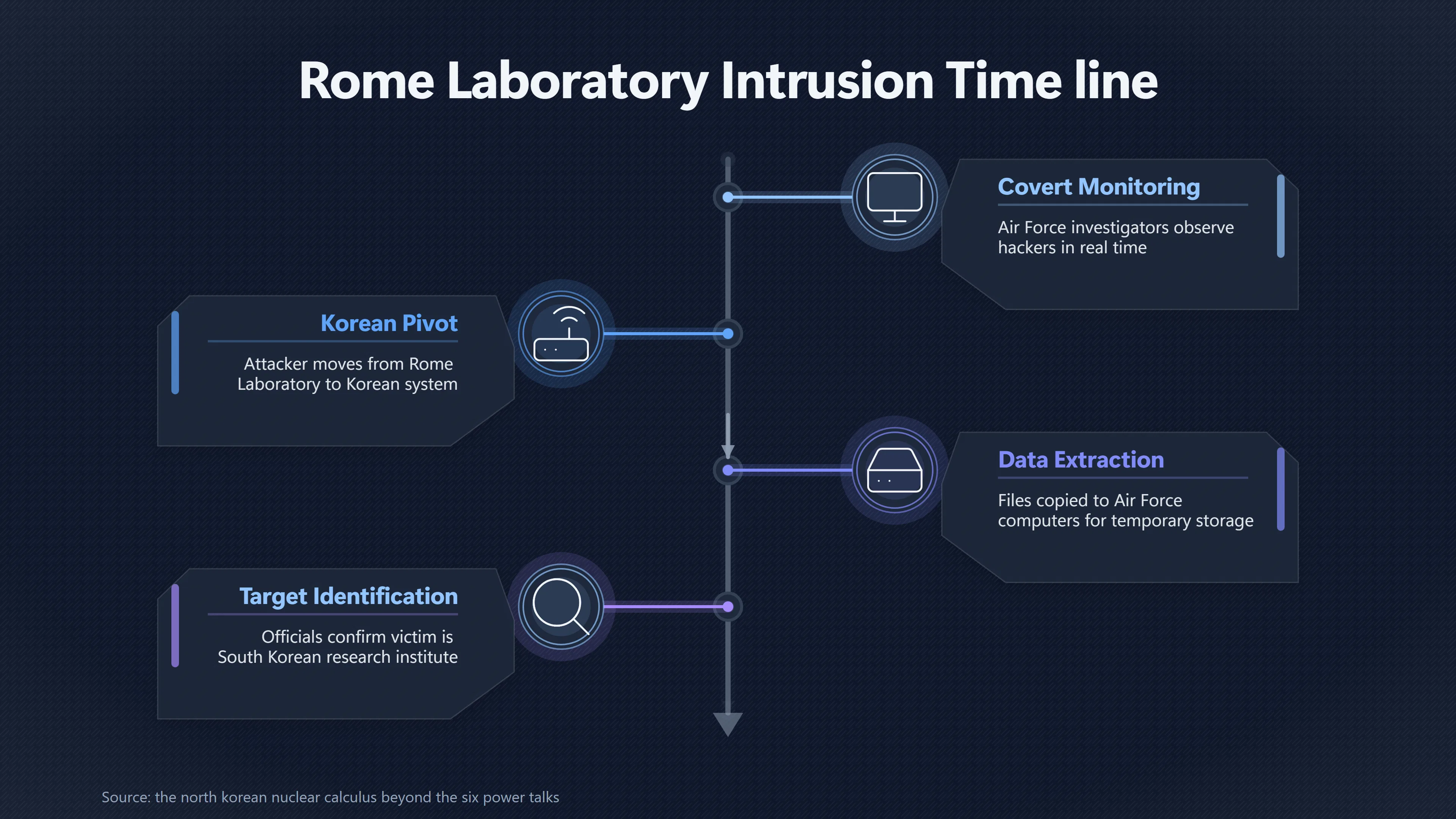
By mid-April, Air Force investigators were already covertly monitoring the attackers rather than immediately shutting them out. This strategy allowed investigators to gather evidence while observing the hackers’ behaviour in real time.
On 15 April, the attacker known as “Datastream Cowboy” connected to the compromised Rome Laboratory systems and then pivoted into a computer identified as belonging to a Korean Atomic Research Institute. Investigators watched as files were copied from the Korean system and temporarily stored on the Air Force computers at Rome Laboratory before being transferred elsewhere. Because the attack originated from an official US Air Force network, anyone examining only the immediate source of the connection would have seen what appeared to be a US military computer conducting the intrusion.[airandspaceforces.com]airandspaceforces.comAir & Space Forces Magazine AIR FORCEPUBLISHED BY THE AIR FORCE ASSOCIATION M…
The incident differed from ordinary hacking because it involved a research organisation associated with nuclear science. Even though publicly available accounts do not indicate that classified nuclear weapons information was obtained, the apparent targeting of an atomic research institution dramatically raised the perceived stakes.[catless.ncl.ac.uk]catless.ncl.ac.ukThe RISKS Digest Volume 16 Issue 53November 6, 1994…
Why North or South Korea was initially unclear
The immediate problem for investigators was identification, not attribution.
Early reports available to the Air Force identified the destination only as a “Korean Atomic Research Institute”. From that information alone, investigators could not immediately determine whether the system belonged to North Korea or South Korea. That distinction mattered enormously in April 1994.
At the time, relations between Washington and Pyongyang were under severe strain because of the first North Korean nuclear crisis. The United States was engaged in difficult diplomatic negotiations over North Korea’s nuclear programme, and military confrontation was considered a genuine possibility. Against that backdrop, an apparent intrusion into a North Korean nuclear-related network originating from a US Air Force computer could have been interpreted as deliberate American intelligence collection rather than criminal hacking.[Intelligence Resource Program]irp.fas.orgIntelligence Resource Program Security in Cyberspace APPENDIX BIntelligence Resource ProgramSecurity in Cyberspace APPENDIX B - Case Study Rome Laboratory, Griffiss Air Force Base, NY IntrusionJune 5…
Within hours, investigators determined that the compromised system belonged to South Korea’s atomic research institute rather than a North Korean organisation. That discovery substantially reduced the immediate geopolitical danger, although it did not eliminate the seriousness of the incident.[Intelligence Resource Program]irp.fas.orgIntelligence Resource Program Security in Cyberspace APPENDIX BIntelligence Resource ProgramSecurity in Cyberspace APPENDIX B - Case Study Rome Laboratory, Griffiss Air Force Base, NY IntrusionJune 5…
How network origin can misrepresent state responsibility
The Korean episode illustrates one of the defining characteristics of cyber operations: the apparent source of an attack is often not the true origin.
The intruder did not attack directly from Britain. Instead, the hacker routed activity through multiple intermediary systems before ultimately using compromised Rome Laboratory computers as the launch point. As a result:
- Network logs at the Korean institute would primarily record a US Air Force computer.
- The Air Force itself was simultaneously both a victim and an unwilling platform for attacks on others.
- Initial technical evidence therefore pointed towards the wrong actor.
This distinction between originating infrastructure and actual operator has since become a central concept in cyber-security investigations. Compromised systems can be used as “stepping stones”, allowing attackers to disguise their location while causing suspicion to fall on innocent organisations or governments. The Rome Laboratory incident demonstrated this problem years before the idea of “false flag” cyber operations became widely discussed.[Intelligence Resource Program]irp.fas.orgIntelligence Resource Program GAOIntelligence Resource ProgramGAO - Information Security: Computer Attacks at Department of Defense Pose Increasing RisksMay 22, 1996…
Why officials treated the incident so seriously
Several factors combined to make the Korean intrusion unusually alarming.
First, the apparent source was a military network belonging to the United States Air Force rather than a civilian internet provider. That increased the risk that the activity could be interpreted as an official government operation.
Second, the target concerned atomic research. Even without evidence that sensitive nuclear weapons data had been compromised, any intrusion involving nuclear institutions carries greater political significance than attacks on ordinary commercial networks.[Air & Space Forces Magazine]airandspaceforces.comAir & Space Forces Magazine AIR FORCEPUBLISHED BY THE AIR FORCE ASSOCIATION M…
Third, timing mattered. The incident occurred during one of the most delicate phases of the 1994 North Korean nuclear crisis. US policymakers were attempting to resolve disputes over Pyongyang’s nuclear activities through diplomacy while simultaneously considering military contingencies. In that environment, even a mistaken perception of American cyber espionage could have complicated negotiations or heightened tensions.[Intelligence Resource Program]irp.fas.orgIntelligence Resource Program Security in Cyberspace APPENDIX BIntelligence Resource ProgramSecurity in Cyberspace APPENDIX B - Case Study Rome Laboratory, Griffiss Air Force Base, NY IntrusionJune 5…
Finally, investigators were forced to balance two competing objectives. They wanted to continue monitoring the hackers to identify them and gather evidence, yet every additional minute that the attackers operated through Air Force systems increased the possibility of further damage or diplomatic misunderstanding. According to the Senate investigation, after the Korean target was confirmed to be in South Korea, British authorities decided to postpone execution of a planned search warrant so investigators could continue collecting evidence.[Intelligence Resource Program]irp.fas.orgIntelligence Resource Program Security in Cyberspace APPENDIX BIntelligence Resource ProgramSecurity in Cyberspace APPENDIX B - Case Study Rome Laboratory, Griffiss Air Force Base, NY IntrusionJune 5…

The lasting lesson from the Korean scare
Within the broader Rome Laboratory incident, the Korean intrusion became one of the clearest demonstrations that cyber attacks can create international crises without any government intending them.
The central lesson was not that the hacker possessed extraordinary technical capabilities, but that compromised government systems could make an individual’s actions resemble those of a nation-state. Investigators recognised that attribution based solely on the visible source of network traffic could be dangerously misleading.
This episode therefore anticipated problems that would become familiar decades later: attackers using third-party infrastructure, uncertainty over responsibility, and the possibility that technical misidentification could produce diplomatic or even military consequences. In the context of the Rome Laboratory breach—and later discussions of hackers such as Gary McKinnon—the Korean incident stands as an early warning that in cyberspace, appearances can be strategically deceptive.[fas.org]irp.fas.orgIntelligence Resource Program Security in Cyberspace APPENDIX BIntelligence Resource ProgramSecurity in Cyberspace APPENDIX B - Case Study Rome Laboratory, Griffiss Air Force Base, NY IntrusionJune 5…
Amazon book picks
Further Reading
Books and field guides related to Could a Teen Hacker Look Like the US Government?. Use these as the next step if you want deeper reading beyond the article.
Cybersecurity and Cyberwar
A generation ago, "cyberspace" was just a term from science fiction, used to describe the nascent network of computers linking a few univ...
Sandworm
"With the nuance of a reporter and the pace of a thriller writer, Andy Greenberg gives us a glimpse of the cyberwars of the future while...
This Is How They Tell Me the World Ends
WINNER OF THE FT & McKINSEY BUSINESS BOOK OF THE YEAR AWARD 2021 The instant New York Times bestseller A Financial Times and The Times Bo...
eBay marketplace picks
Marketplace Samples
Live-tested eBay searches with available results related to this page.
Selected fromhacker sticker oneBay.co.uk.
Endnotes
1.
Source: catless.ncl.ac.uk
Link:https://catless.ncl.ac.uk/Risks/16/53
Source snippet
The RISKS Digest Volume 16 Issue 53November 6, 1994...
Published: November 6, 1994
2.
Source: foreign.senate.gov
Title: the north korean nuclear calculus beyond the six power talks
Link:https://www.foreign.senate.gov/hearings/the-north-korean-nuclear-calculus-beyond-the-six-power-talks
3.
Source: intelligence.senate.gov
Link:https://www.intelligence.senate.gov/1997/01/22/publications-committee-activities-special-report-select-committee-intelligence-january-4-1995/
4.
Source: intelligence.senate.gov
Title: hearings nro headquarters project august 10 1994
Link:https://www.intelligence.senate.gov/1994/08/10/hearings-nro-headquarters-project-august-10-1994/
5.
Source: intelligence.senate.gov
Title: hearings counterintelligence may 3 1994
Link:https://www.intelligence.senate.gov/1994/05/03/hearings-counterintelligence-may-3-1994/
6.
Source: intelligence.senate.gov
Title: hearings joint security commission march 3 1994
Link:https://www.intelligence.senate.gov/1994/03/03/hearings-joint-security-commission-march-3-1994/
7.
Source: intelligence.senate.gov
Link:https://www.intelligence.senate.gov/1994/01/25/hearings-current-and-projected-national-security-threats-united-states-and-its-interests-abroad/
8.
Source: history.state.gov
Title: two koreas
Link:https://history.state.gov/milestones/1993-2000/two-koreas
9.
Source: irp.fas.org
Title: Intelligence Resource Program Security in Cyberspace APPENDIX B
Link:https://irp.fas.org/congress/1996_hr/s960605b.htm
Source snippet
Intelligence Resource ProgramSecurity in Cyberspace APPENDIX B - Case Study Rome Laboratory, Griffiss Air Force Base, NY IntrusionJune 5...
10.
Source: airandspaceforces.com
Title: Air & Space Forces Magazine AIR FORCE
Link:https://www.airandspaceforces.com/app/uploads/1997/03/0397_March1997.pdf
Source snippet
PUBLISHED BY THE AIR FORCE ASSOCIATION M...
11.
Source: irp.fas.org
Title: Intelligence Resource Program GAO
Link:https://irp.fas.org/gao/aim96084.htm
Source snippet
Intelligence Resource ProgramGAO - Information Security: Computer Attacks at Department of Defense Pose Increasing RisksMay 22, 1996...
Published: May 22, 1996
12.
Source: airandspaceforces.com
Title: Air & Space Forces Magazine A Presidential commission warns that we
Link:https://www.airandspaceforces.com/PDF/MagazineArchive/Documents/1998/January%201998/0198cyber.pdf
Additional References
13.
Source: nti.org
Title: Atomic Energy Research Institute | North Korea’s Nuclear R&D Hub
Link:https://www.nti.org/education-center/facilities/atomic-energy-research-institute/
Source snippet
As of April 6 2026, it is no longer being updated. North Korea ATOMIC ENERGY RESEARCH INSTITUTE * Location Bungang-jigu (분강지구), Y...
14.
Source: youtube.com
Title: UFO Hackers Claim Government Coverup | Thom Hastings
Link:https://www.youtube.com/watch?v=Knj9TplZ158
Source snippet
Gary McKinnon hacker interview UFO Hacker Shares New Secrets | Gary McKinnon Tim Ventura...
15.
Source: youtube.com
Title: Hacking for UFOs and fighting for his life. Who is Gary Mc Kinnon? | Nord VPN
Link:https://www.youtube.com/watch?v=OImdnvQx7sQ
Source snippet
UFO Hackers Claim Government Coverup | Thom Hastings...
16.
Source: youtube.com
Title: A Tale of Two UFO Hackers: Matthew Bevan & Gary Mc Kinnon | True Crime
Link:https://www.youtube.com/watch?v=rksYZZgSPcY
Source snippet
UFO Hacker Shares New Secrets | Gary McKinnon...
17.
Source: youtube.com
Title: Gary Mckinnon: The Hacker Who Found UFOs
Link:https://www.youtube.com/watch?v=8_1DuqeU8hw
Source snippet
Hacking for UFOs and fighting for his life. Who is Gary McKinnon? | NordVPN...
18.
Source: all.net
Link:https://all.net/books/iw/iwarstuff/www.af.mil/news/airman/0496/hacker.htm
19.
Source: nti.org
Link:https://www.nti.org/education-center/treaties-and-regimes/joint-declaration-south-and-north-korea-denuclearization-korean-peninsula/
20.
Source: kujimedia.com
Link:https://www.kujimedia.com/articles/
21.
Source: isis-online.org
Link:https://isis-online.org/isis-reports/the-north-korean-nuclear-program-unresolved-iussues
22.
Source: independent.co.uk
Link:https://www.independent.co.uk/news/world/satellite-adds-to-evidence-of-n-korean-bomb-plans-1431506.html