Within File Context
A Government Server Is Not a Seal of Truth
A genuine government server can hold outside attachments, staff suggestions and rejected material without adopting any of their claims.
On this page
- What kinds of files share official networks
- Why authenticity differs from institutional authority
- Which contextual records are needed before drawing conclusions
Page outline Jump by section
Introduction
In discussions of UFO-related claims, including those associated with Gary McKinnon’s reported discoveries on United States government systems, one of the most common reasoning errors is to assume that a file’s location on an official server proves that its contents represent an official government position. It does not. Government networks are working environments that preserve correspondence, drafts, incoming submissions, reference material, contractor documents, rejected proposals and historical records alongside final policy documents. A genuine government file can therefore be authentic in the sense that it genuinely existed on a government system while still lacking institutional authority or evidential weight. Understanding this distinction is essential when evaluating extraordinary claims drawn from government computer systems.
What kinds of files share official networks?
Government information systems exist to support administration, collaboration and recordkeeping rather than to publish only approved conclusions. As a result, many different categories of material coexist within the same infrastructure.
These commonly include:
- Draft reports awaiting review or approval.
- Email attachments received from other agencies, contractors or members of the public.
- Staff recommendations that senior officials later reject.
- Background research collected for evaluation.
- Working copies containing comments and tracked changes.
- Training material and hypothetical scenarios.
- Reference documents originating outside the agency.
The US National Archives distinguishes between official records, non-record materials and personal papers, noting that a document’s presence within an agency does not by itself determine its official status. Record status depends on how the organisation controls, uses and preserves the material, not simply where it is stored.[National Archives]archives.govNational ArchivesIdentification of Records, Nonrecord Materials, and Personal Papers | National ArchivesJune 6, 2019…
Likewise, long-established government records-management policies define records broadly enough to include material created or received during official business while also recognising the existence of non-record copies retained merely for reference or convenience.[CIA]cia.govAGENCY REGULATIONS RECORDS MANAGEMENT AND DISTRIBUTION BRANCH | CIA FOIA (foia.cia.gov)December 19, 2016…
This means that finding an unusual document on an official network demonstrates only that the organisation possessed or handled that document at some point. It does not establish that the organisation endorsed its contents.
Why authenticity differs from institutional authority
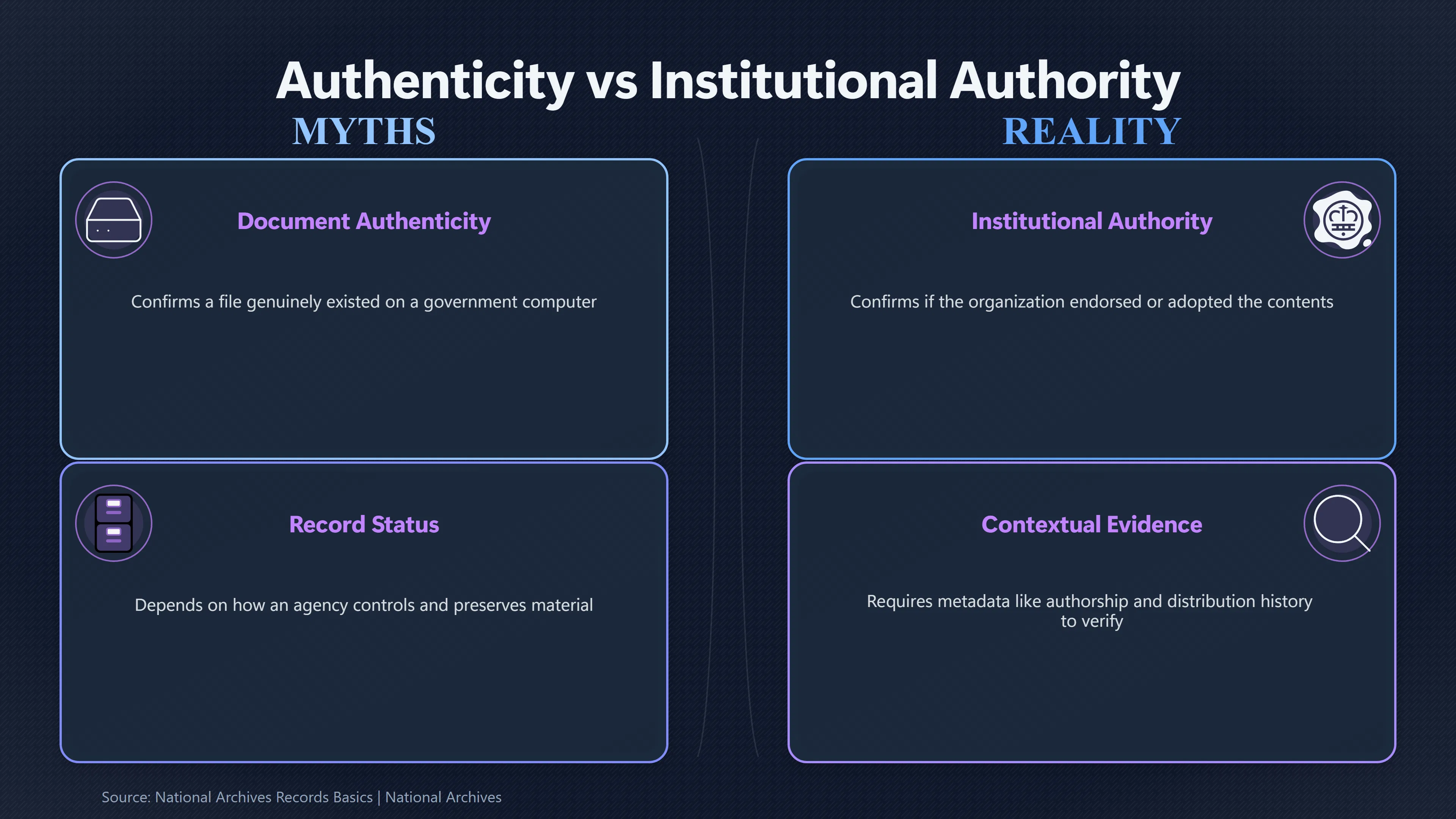
Authenticity and authority answer different questions.
A document may be authentic because:
- it genuinely existed on a government computer;
- it was genuinely created or received by government personnel; or
- it genuinely formed part of an agency’s recordkeeping process.
Authority asks something different:
- Was the document approved?
- Did it become official policy?
- Was it supported by evidence?
- Did the responsible organisation adopt its conclusions?
These questions require contextual information that cannot be answered merely from the server on which a file resided.
Government agencies themselves recognise this distinction. For example, the National Geospatial-Intelligence Agency notes that only full and final material is eligible for public-release review, and explicitly warns that official information appearing publicly should not automatically be regarded as approved for public release or as unclassified simply because it exists outside restricted systems.[National Geospatial-Intelligence Agency]nga.milNational Geospatial-Intelligence AgencyPublic Release | National Geospatial-Intelligence AgencyJune 25, 2026…
The same principle applies internally. Drafts often circulate through official systems precisely because they are still under discussion.

Government archives preserve the decision-making process
Modern records management is designed to preserve how decisions were made, not merely the final outcome.
This means archival collections routinely contain:
- competing versions of the same document;
- staff comments;
- recommendations;
- memoranda requesting approval;
- proposed revisions;
- rejected alternatives.
Historical CIA records illustrate this process. Numerous documents preserved in the CIA Reading Room are explicitly identified as regulations, reports, draft handbooks or administrative material documenting ongoing internal processes rather than final agency positions. Their preservation reflects records-management requirements, not automatic institutional endorsement of every statement they contain.[CIA]cia.govAGENCY REGULATIONS RECORDS MANAGEMENT AND DISTRIBUTION BRANCH | CIA FOIA (foia.cia.gov)December 19, 2016…
For historians, this is valuable because it reveals how government organisations worked. For readers searching for extraordinary claims, however, it creates a significant risk of mistaking process documents for authoritative conclusions.
Why this matters when interpreting UFO-related material
The distinction becomes especially important in discussions surrounding Gary McKinnon.
McKinnon has stated that during his unauthorised access to US military and NASA systems he encountered material suggesting hidden space programmes and unidentified craft. Because the alleged material was reportedly located on genuine government computers, some commentators have argued that this alone validates the underlying claims.
That conclusion does not follow.
Even assuming a file genuinely existed on an official system, several alternative explanations remain possible:
- it may have been an incoming attachment from another organisation;
- it may have represented one employee’s working notes;
- it may have summarised a claim for evaluation rather than acceptance;
- it may have been incomplete or taken out of context;
- it may have been superseded or rejected.
Without metadata identifying the document’s author, approval history, distribution, surrounding correspondence and relationship to other records, the organisational meaning of an isolated file cannot be reliably determined.
This limitation is one reason investigators and archivists place substantial emphasis on provenance—the documented history of a record—rather than on server location alone.
Which contextual records are needed before drawing conclusions?
Determining whether a government document represents institutional authority requires more than verifying that it came from an official system.
Useful contextual evidence includes:
- Authorship: Who created the document?
- Purpose: Was it informational, advisory, administrative or operational?
- Approval history: Was it signed, approved or formally adopted?
- Version history: Is it an early draft or the final version?
- Related correspondence: Do emails or memoranda explain how it was received or evaluated?
- Distribution: Who received it, and why?
- Subsequent actions: Did later documents implement, revise or reject its recommendations?
Without this surrounding record, an isolated file can easily be misunderstood.
Archives preserve relationships between documents because meaning often emerges only when the complete documentary chain is examined rather than a single page viewed in isolation.
A genuine server is not a seal of truth
Official computer systems authenticate location, not conclusions.
A document stored on a government server may indeed be genuine in the narrow sense that it really formed part of an agency’s digital environment. However, that authenticity does not establish that the government accepted its claims, regarded them as accurate or incorporated them into official policy.
For controversial subjects such as alleged UFO evidence, this distinction is fundamental. The strongest historical and archival practice is to evaluate not only where a document was found, but also who wrote it, why it existed, how it moved through institutional processes and whether the organisation ultimately endorsed its contents. Only by examining that broader context can researchers distinguish authentic government records from authoritative government positions.
Amazon book picks
Further Reading
Books and field guides related to A Government Server Is Not a Seal of Truth. Use these as the next step if you want deeper reading beyond the article.
Calling Bullshit: The Art of Skepticism in a Data-Driven World
Bullshit isn’t what it used to be. Now, two science professors give us the tools to dismantle misinformation and think clearly in a world...
Archives: Principles and Practices
This new and extensively revised second edition offers an international perspective on archives management, providing authoritative guida...
The Fifth Risk
'Will set your hair on end' Telegraph, Top 50 Books of the Year 'I forgot to breathe while reading The Fifth Risk' Michael Hofmann, TLS,...
Records and Information Management
Benefiting LIS students and professionals alike, Franks presents complete coverage of the records and information lifecycle model.
eBay marketplace picks
Marketplace Samples
Live-tested eBay searches with available results related to this page.
Selected fromdata center sign oneBay.co.uk.



Endnotes
1.
Source: archives.gov
Link:https://www.archives.gov/records-mgmt/scheduling/id
Source snippet
National ArchivesIdentification of Records, Nonrecord Materials, and Personal Papers | National ArchivesJune 6, 2019...
Published: June 6, 2019
2.
Source: archives.gov
Title: National Archives Records Basics | National Archives
Link:https://www.archives.gov/records-mgmt/scheduling/basics
Source snippet
Records Basics | National ArchivesJuly 28, 2025 — RECORDS BASICS Quick Links Definition of a Record * Breaking down the definition of a r...
Published: July 28, 2025
3.
Source: cia.gov
Link:https://www.cia.gov/readingroom/document/cia-rdp70-00211r000300330039-9
Source snippet
AGENCY REGULATIONS RECORDS MANAGEMENT AND DISTRIBUTION BRANCH | CIA FOIA (foia.cia.gov)December 19, 2016...
Published: December 19, 2016
4.
Source: cia.gov
Title: TASK FORCE REPORT ON RECORDS MANAGEMENT | CIA FOIA (foia.cia.gov)
Link:https://www.cia.gov/readingroom/document/cia-rdp78-04718a002700210006-5
Source snippet
January 1, 1949 — TASK FORCE REPORT ON RECORDS MANAGEMENT Document Type: CREST Collection: General CIA Records Document Number (FOIA) /ES...
Published: January 1, 1949
5.
Source: cia.gov
Link:https://www.cia.gov/readingroom/document/cia-rdp74-00390r000300140009-1
Source snippet
September 9, 1970 — PROJECT FOR IMPROVING FEDERAL REPORTING AND REDUCING RELATED PAPERWORK Document Type: CREST Collection: General CIA R...
Published: September 9, 1970
6.
Source: cia.gov
Title: DISCLOSUR E OF AIR FORCE RECORDS TO THE PUBLIC | CIA FOIA (foia.cia.gov)
Link:https://www.cia.gov/readingroom/document/cia-rdp90b00170r000200230018-9
Source snippet
DISCLOSURE OF AIR FORCE RECORDS TO THE PUBLIC | CIA FOIA (foia.cia.gov)February 19, 1975 — DISCLOSURE OF AIR FORCE RECORDS TO THE PUBLIC...
Published: February 19, 1975
7.
Source: cia.gov
Title: Frequently Asked Questions
Link:https://www.cia.gov/faqs/
Source snippet
Yes. CIA releases millions of pages of documents each year. Much of this is material of historical significance or personal interest that...
8.
Source: nga.mil
Link:https://www.nga.mil/resources/Public_Release.html
Source snippet
National Geospatial-Intelligence AgencyPublic Release | National Geospatial-Intelligence AgencyJune 25, 2026...
Published: June 25, 2026
Additional References
9.
Source: gao.gov
Title: GA O-05-35G, GAO’s Agency Protocols
Link:https://www.gao.gov/assets/a76877.html
Source snippet
These standards require that analysts and financial auditors promptly obtain sufficient, competent, and relevant evidence to afford a rea...
10.
Source: gao.gov
Title: OI G Records Requests | U.S
Link:https://www.gao.gov/ig/oig-records-requests
Source snippet
HOW TO REQUEST RECORDS FROM GAO OIG For requesting records from GAO, OIG's parent agency, see GAO's FOIA page. Make your request by em...
11.
Source: nist.gov
Title: freedom information act
Link:https://www.nist.gov/director/freedom-information-act
Source snippet
Freedom of Information Act | NISTAugust 3, 2009 — FREEDOM OF INFORMATION ACT The Freedom of Information Act, enacted in 1966, provides th...
Published: August 3, 2009
12.
Source: gao.gov
Title: FOI A Requests | U.S
Link:https://www.gao.gov/foia-requests
Source snippet
FOIA REQUESTS The Government Accountability Office (GAO) is not subject to the Freedom of Information Act (FOIA) (5 USC 552). However...
13.
Source: youtube.com
Title: The Man Who Hacked the U.S. Government
Link:https://www.youtube.com/watch?v=ND0zQX1rGdg
Source snippet
Hacking for UFOs and fighting for his life. Who is Gary McKinnon?...
14.
Source: youtube.com
Title: UK hacker’s extradition to US blocked
Link:https://www.youtube.com/watch?v=v4Js8DF80HY
Source snippet
[Gary McKinnon Case]({{ 'mc-kinnon-case/' | relative_url }}) (Interview from 2009)...
15.
Source: youtube.com
Title: Hacking for UFOs and fighting for his life. Who is Gary Mc Kinnon?
Link:https://www.youtube.com/watch?v=OImdnvQx7sQ
Source snippet
UK hacker's extradition to US blocked...
16.
Source: youtube.com
Link:https://www.youtube.com/watch?v=b5afwWUYWVQ
Source snippet
Gary McKinnon wins extradition battle...
17.
Source: youtube.com
Title: Gary Mc Kinnon wins extradition battle
Link:https://www.youtube.com/watch?v=y4lecD44F5E
Source snippet
The Man Who Hacked the U.S. Government...