Within UFO Hackers
Why Did UFO Hackers Target NASA?
McKinnon said NASA systems attracted him because he expected to find hidden imagery, space records, and evidence of suppressed technology.
On this page
- NASA as a focus of disclosure beliefs
- Photographic and technical systems
- What network access could realistically reveal
Page outline Jump by section
Introduction
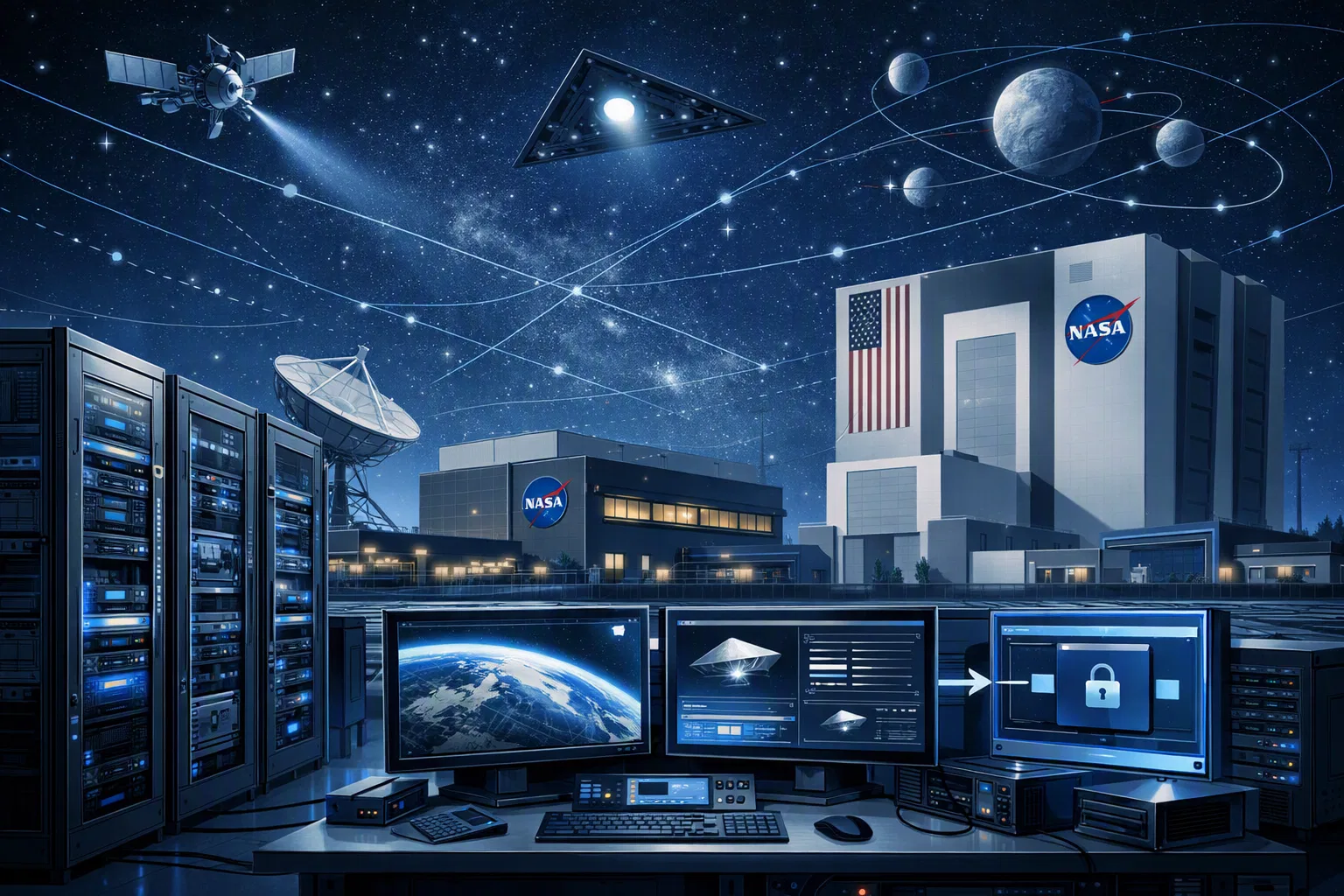
NASA became a central target for UFO-motivated hackers because it appeared to combine three things disclosure believers expected a secretive state institution to possess: original photographs from space, technical records about unusual objects and access to advanced aerospace research. Gary McKinnon said that he entered NASA systems not simply because they belonged to the US government, but because claims circulating in the UFO disclosure movement suggested that the agency altered space imagery before public release and concealed technology recovered from unidentified craft.[WIRED]wired.comUFO Hacker' Tells What He FoundHe claims to have discovered a NASA department that airbrushes UFO images from high-resolution photos and an Excel spreadsheet titled "No…
The documented intrusion and the alleged discovery must nevertheless be separated. NASA’s inspector general confirmed that a British intruder identified as McKinnon compromised 15 NASA computers at five centres, while McKinnon said he remotely viewed image files and administrative documents. What has never emerged is a preserved photograph, downloaded file, system log or independently authenticated record showing that those systems contained evidence of extraterrestrial vehicles.[NASA Office of Inspector General]oig.nasa.govNASA Office of Inspector GeneralStatement of…
Why NASA fitted the disclosure narrative
NASA’s attraction was partly symbolic. Unlike a conventional defence department, the agency publicly collected and distributed images of Earth, the Moon and deep space. It operated laboratories, mission centres, photographic archives and computer systems containing scientific and engineering data. For someone convinced that anomalous objects had been photographed beyond the atmosphere, NASA seemed a more promising destination than an ordinary military personnel or financial network.
McKinnon said his immediate inspiration was testimony promoted by the Disclosure Project, whose participants alleged that governments possessed information about UFOs, antigravity and reverse-engineered technology. One allegation particularly relevant to his NASA search claimed that workers at Johnson Space Center’s Building 8 removed unexplained objects from high-resolution imagery. McKinnon later told Wired that he sought the department described in that account and believed he found directories containing both processed and unprocessed pictures.[WIRED]wired.comUFO Hacker' Tells What He FoundHe claims to have discovered a NASA department that airbrushes UFO images from high-resolution photos and an Excel spreadsheet titled "No…
Building 8 was not an invented location. Johnson Space Center’s photographic infrastructure included an archive in that building holding original Apollo flight film, and NASA and Arizona State University later undertook a programme to scan those films for wider access. The existence of original film, duplicate products and subsequent digital versions helps explain why references to “original” and “processed” imagery sounded credible to UFO researchers. It does not, however, establish that anomalous objects were being deliberately erased. Ordinary photographic work routinely produces multiple versions through scanning, calibration, cropping, colour correction, annotation and preparation for publication.[Apollo Digital Image Archive]apollo.im-ldi.comApollo Digital Image Archive ScansDue to the importance in preserving these films…Read more…
NASA’s public identity strengthened the suspicion. Its images were spectacular but often reached the public after technical handling that was poorly understood outside scientific and photographic communities. Within a disclosure framework, the difference between a source image and a publication-ready image could be interpreted as evidence of censorship rather than routine processing. That inference converted a real institutional workflow into a presumed mechanism for concealment.
Which NASA systems were actually reached?
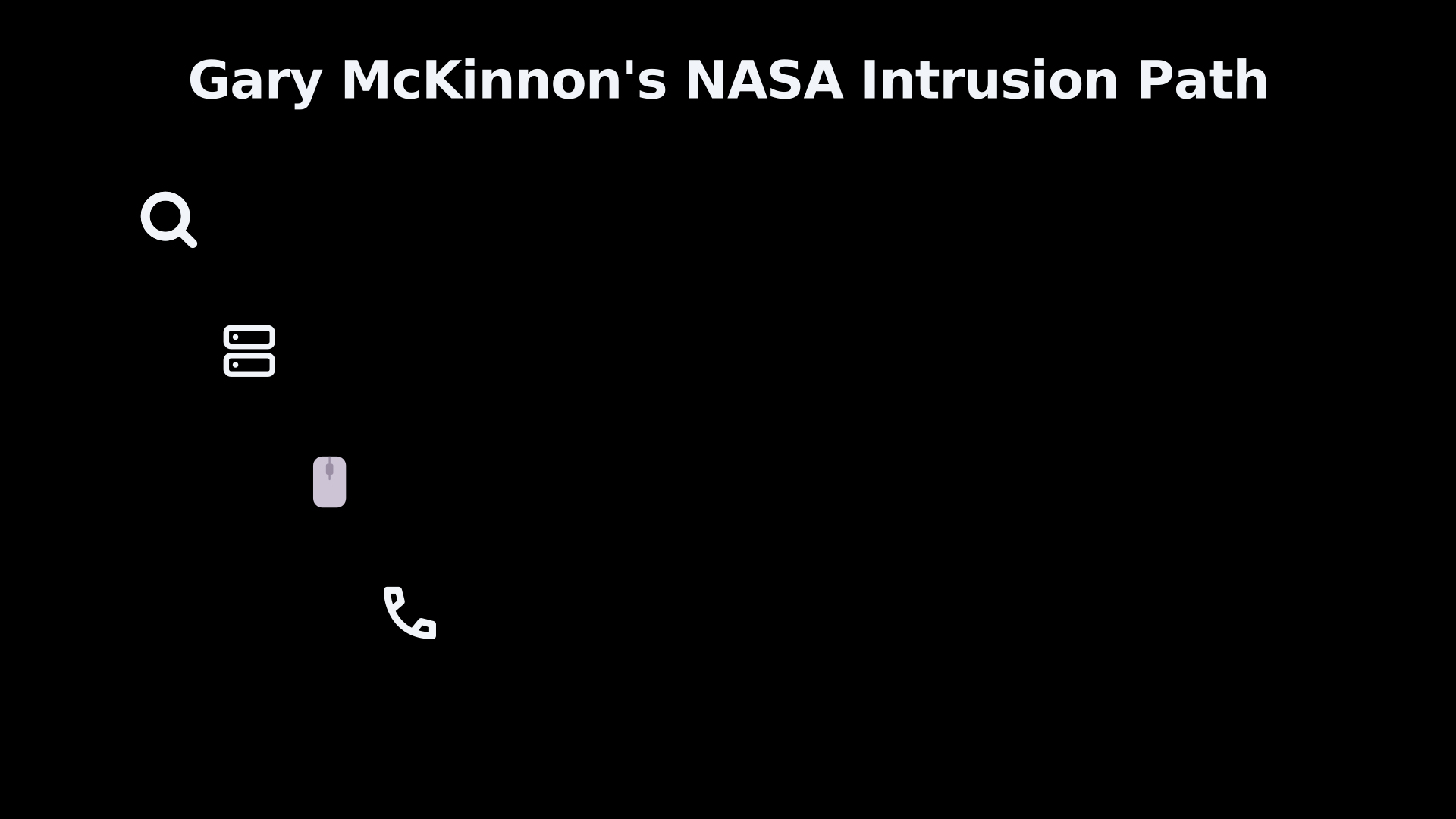
The official record is much less specific than popular retellings. A 2003 NASA inspector-general statement said that 15 computers across five NASA centres had been compromised and that investigators linked the attacks to McKinnon after correlating NASA and Department of Defense intrusion data. It did not identify the individual machines, their scientific functions or the particular files opened on each system.[NASA Office of Inspector General]oig.nasa.govNASA Office of Inspector GeneralStatement of…
That distinction matters because “hacking NASA” can misleadingly suggest access to a single central vault containing the agency’s most sensitive material. NASA was, and remains, a distributed organisation whose centres operated many separate systems for administration, research, mission support, engineering, communications and public information. Access to a vulnerable workstation or server at a NASA facility did not automatically confer access to every archive, spacecraft operation or classified government programme.
The indictment described the use of RemotelyAnywhere, a legitimate remote-administration program that could allow a user to control a host computer, transfer or delete files and exercise administrative functions. McKinnon also described searching for Windows machines with weak or blank passwords. The practical mechanism was therefore opportunistic: find an exposed computer, gain control and examine whatever directories or connected resources that particular account could reach.[Department of Justice]justice.govDepartment of JusticeIndictmentDefendant GARY MCKINNON was an unemployed computer system administrator living in London, England. h. The…
Contemporary oversight findings make that account technically plausible without validating the UFO claims. NASA’s inspector general reported decentralised security management, inconsistent application of host and network protections, inadequate administrator training, weaknesses in firewall filtering and monitoring, and cases in which weak password controls enabled unauthorised access to substantial quantities of sensitive but unclassified data.[NASA Office of Inspector General]oig.nasa.govNASA Office of Inspector GeneralStatement of…
The agency’s open scientific culture also created tension with strict network security. NASA’s inspector general noted that scientists and engineers commonly worked with universities and other external partners, while contractors managed many systems. The same connectivity that supported collaboration enlarged the number of machines, accounts and administrative practices an intruder might encounter.[NASA Office of Inspector General]oig.nasa.govNASA Office of Inspector GeneralStatement of…
The photographic systems at the centre of the story
McKinnon’s best-known NASA account concerns a large image that he said he viewed remotely over a 56-kilobit-per-second dial-up connection. He claimed that the remote desktop was reduced to low colour depth and resolution so the file would render more quickly. According to his description, the visible portion showed a silvery, cigar-like object with rounded or geodesic features, apparently above Earth. He said the session ended before he preserved the image.[WIRED]wired.comUFO Hacker' Tells What He FoundHe claims to have discovered a NASA department that airbrushes UFO images from high-resolution photos and an Excel spreadsheet titled "No…
Several aspects of this story correspond to real technical conditions of the period. High-resolution space images could be extremely large relative to dial-up bandwidth. Remote-control software could display another computer’s desktop without automatically copying the viewed file to the visitor’s machine. Reducing colour depth and screen resolution could make remote interaction more responsive. A user might therefore see an image briefly while failing to acquire the original data.
Those details establish plausibility for the viewing method, not the interpretation of the picture. Without the original file, its filename, metadata, mission identifier, directory path or a screenshot, it is impossible to determine whether the object was a spacecraft, part of a spacecraft, a photographic artefact, ice or debris near a vehicle, an image-processing defect, a test graphic or something else. The lack of scale and provenance is especially serious: an unfamiliar shape in a cropped frame cannot be reliably classified from appearance alone.
The claimed presence of “processed” and “unprocessed” versions is similarly ambiguous. Scientific images are rarely self-explanatory photographs. Processing can include correction for sensor noise, geometric distortion, exposure, colour response and transmission errors. Images may also be cropped, assembled into mosaics or enhanced so that relevant features become visible. Public access to modern NASA collections, including the Johnson Space Center gallery and extensive astronaut-photography databases, demonstrates how the same observation can exist in several sizes and technical forms without implying deceptive alteration.[nasa.gov]nasa.govOpen source on nasa.gov.
Apollo imagery provides a concrete example. Original flight films were preserved at Johnson Space Center, while duplicate film products and later high-resolution scans were supplied for research and public use. Thousands of high-resolution Apollo frames have subsequently circulated in archives described as raw or unprocessed, although even a digital scan necessarily reflects choices about equipment, resolution and file preparation.[im-ldi.com]apollo.im-ldi.comOpen source on im-ldi.com.
What access could realistically reveal
Unauthorised access to a NASA workstation could reveal information that was not displayed on the public website. Depending on the machine and account, that might include working copies of photographs, internal filenames, draft products, staff correspondence, technical notes, software, directory structures and locally stored administrative records. NASA’s inspector general explicitly acknowledged that weak controls had exposed significant quantities of sensitive but unclassified information in some incidents.[NASA Office of Inspector General]oig.nasa.govNASA Office of Inspector GeneralStatement of…
Yet “not publicly posted” is not synonymous with “classified”, still less “evidence of extraterrestrial technology”. Scientific organisations retain intermediate files for numerous mundane reasons: unfinished analysis, quality-control checks, storage limitations, licensing questions, privacy concerns, export controls or simple lack of resources to catalogue everything. A remotely accessed folder could therefore contain unfamiliar or unpublished material without being part of a concealment programme.
Network boundaries impose another limitation. Classified national-security information is generally separated from ordinary unclassified institutional systems, although implementation is never perfect. The NASA computers described in public records were part of a broader set of compromised government machines, but no official record produced in the case says that McKinnon reached a classified NASA repository holding recovered-craft material. The inspector-general testimony instead characterised known exposure in terms of sensitive but unclassified data.[NASA Office of Inspector General]oig.nasa.govNASA Office of Inspector GeneralStatement of…
Even administrator privileges on one computer would not prove that a user had found the authoritative version of a record. Files may be copied between machines, renamed, detached from their metadata or placed in personal directories. A document title can also be misleading when removed from organisational context. This is why digital evidence normally depends on preserved files, hashes, timestamps, access logs and corroborating records rather than a later recollection of words or images seen during an intrusion.
Why the NASA claim remains unverified
The weakness of McKinnon’s NASA account is not that remote viewing was technically impossible. Official sources confirm both the intrusions and the existence of serious NASA security weaknesses at the time. The problem is that the extraordinary part of the story rests solely on his testimony.
No copy of the cigar-shaped image has been produced. No matching frame has been identified in a NASA archive. No employee has authenticated the particular directory he described, and no forensic record released publicly shows that he accessed paired images in which a supposed craft appeared in one and had been removed from another. His account therefore cannot establish either what the object was or whether two versions differed because of deliberate censorship.
The absence of a saved file is particularly consequential because image interpretation depends heavily on context. NASA’s 2023 independent study of unidentified anomalous phenomena emphasised that eyewitness reports may be compelling but are usually insufficient for firm conclusions when calibrated sensor data and metadata are missing. It found no conclusive peer-reviewed evidence that UAP have an extraterrestrial origin and stressed the need for reproducible observations, transparent analysis and multiple forms of supporting data.[NASA Science]science.nasa.govOpen source on nasa.gov.
NASA’s present position is also explicit: the agency says it has found no credible evidence of extraterrestrial life and no evidence that UAP are extraterrestrial. Its recent UAP work has focused not on confirming historic cover-up allegations but on improving data collection, sensor calibration and scientific methods for assessing future reports.[NASA Science]science.nasa.govScience UAP FAQsScience UAP FAQs
The real significance of the NASA targets
The NASA element of the McKinnon case reveals how a disclosure belief can guide technical target selection. He did not search the internet at random. He followed a theory of where evidence would enter an institution: cameras would collect an image, a photographic unit would retain originals, technicians would generate altered versions, and internal computers would hold both. The theory supplied a map linking a public agency, a physical building, an image-processing workflow and vulnerable networked machines.
Parts of that map were grounded in reality. NASA did possess enormous photographic collections; Building 8 held important original film; image processing generated multiple products; and the agency’s early-2000s computer security contained documented weaknesses.[Apollo Digital Image Archive]apollo.im-ldi.comApollo Digital Image Archive ScansDue to the importance in preserving these films…Read more…
The unsupported leap was from those facts to the conclusion that differing image versions concealed extraterrestrial craft. The systems McKinnon targeted could plausibly contain unpublished space imagery and technical records, but access alone could not establish the meaning of what he encountered. Without preserved evidence, the NASA episode remains a well-documented computer intrusion attached to an unverified UFO discovery claim—not proof that the agency’s networks held a hidden archive of alien technology.
Amazon book picks
Further Reading
Books and field guides related to Why Did UFO Hackers Target NASA?. Use these as the next step if you want deeper reading beyond the article.
UFO: The Inside Story of the US Government's Search for Alien...
"The full story of our national obsession with UFOs--and the covert, decades-long search by scientists, the United States military, and t...
Saving Gary McKinnon: A Mother's Story
Inspirational story of how a British mother fought to save her autistic computer hacker son from being extradited to America.
Ghost in the Wires
In this "intriguing, insightful and extremely educational" novel, the world's most famous hacker teaches you easy cloaking and counter-me...
eBay marketplace picks
Marketplace Samples
Live-tested eBay searches with available results related to this page.
Selected fromNASA mission patch oneBay.co.uk.
Endnotes
1.
Source: wired.com
Title: ‘UFO Hacker’ Tells What He Found
Link:https://www.wired.com/2006/06/ufo-hacker-tells-what-he-found
Source snippet
He claims to have discovered a NASA department that airbrushes UFO images from high-resolution photos and an Excel spreadsheet titled "No...
3.
Source: oig.nasa.gov
Link:https://oig.nasa.gov/docs/testimony062403.pdf
Source snippet
NASA Office of Inspector GeneralStatement of...
4.
Source: justice.gov
Link:https://www.justice.gov/archive/usao/nj/Press/files/pdffiles/Older/edva_mckinnon_indictment.pdf
Source snippet
Department of JusticeIndictmentDefendant GARY MCKINNON was an unemployed computer system administrator living in London, England. h. The...
5.
Source: wired.com
Link:https://www.wired.com/2006/04/terrorist-or-ufo-truth-seeker
6.
Source: nasa.gov
Link:https://www.nasa.gov/gallery/johnson-space-center/
7.
Source: eol.jsc.nasa.gov
Link:https://eol.jsc.nasa.gov/SearchPhotos/photo.pl?frame=2329&mission=AS08&roll=13
8.
Source: nasa.gov
Link:https://www.nasa.gov/nasa-brand-center/images-and-media/
9.
Source: wired.com
Link:https://www.wired.com/story/the-best-images-from-nasas-apollo-missions
10.
Source: science.nasa.gov
Link:https://science.nasa.gov/wp-content/uploads/2023/09/uap-independent-study-team-final-report.pdf
11.
Source: science.nasa.gov
Title: Science UAP FAQs
Link:https://science.nasa.gov/uap/faqs/
12.
Source: nasa.gov
Title: update nasa shares uap independent study report names director
Link:https://www.nasa.gov/news-release/update-nasa-shares-uap-independent-study-report-names-director/
14.
Source: oig.nasa.gov
Link:https://oig.nasa.gov/docs/IG-19-022.pdf
15.
Source: science.nasa.gov
Link:https://science.nasa.gov/uap/
16.
Source: oig.nasa.gov
Link:https://oig.nasa.gov/wp-content/uploads/2024/06/ig-10-018-r.pdf?emrc=670950f9274a0
17.
Source: nasa.gov
Title: to release discuss unidentified anomalous phenomena report
Link:https://www.nasa.gov/news-release/nasa-to-release-discuss-unidentified-anomalous-phenomena-report/
18.
Source: oig.nasa.gov
Link:https://oig.nasa.gov/docs/IG-20-017.pdf
19.
Source: oig.nasa.gov
Link:https://oig.nasa.gov/docs/IG-12-006.pdf
20.
Source: smd-cms.nasa.gov
Title: 2020 2024 nasa science plan yr 23 update final
Link:https://smd-cms.nasa.gov/wp-content/uploads/2023/09/2020-2024-nasa-science-plan-yr-23-update-final.pdf
21.
Source: oig.nasa.gov
Link:https://oig.nasa.gov/docs/IG-18-003-R.pdf
22.
Source: nasa.gov
Title: 2021 agency foia log 0.xlsx
Link:https://www.nasa.gov/wp-content/uploads/2017/12/2021_agency_foia_log_0.xlsx
23.
Source: oig.nasa.gov
Link:https://oig.nasa.gov/docs/IG-16-016.pdf
24.
Source: nasa.gov
Title: announces unidentified aerial phenomena study team members
Link:https://www.nasa.gov/general/nasa-announces-unidentified-aerial-phenomena-study-team-members/
25.
Source: oig.nasa.gov
Link:https://oig.nasa.gov/docs/IG-23-017.pdf
26.
Source: nasa.gov
Link:https://www.nasa.gov/wp-content/uploads/2025/08/2022-agency-foia-log.xlsx?emrc=93a4ff
27.
Source: oig.nasa.gov
Link:https://oig.nasa.gov/docs/IG-17-002A.pdf
28.
Source: nasa.gov
Link:https://www.nasa.gov/wp-content/uploads/2025/08/2023-agency-foia-log.xlsx?emrc=54069a
29.
Source: oig.nasa.gov
Link:https://oig.nasa.gov/docs/IG-17-010.pdf
30.
Source: media.defense.gov
Title: Mc Kinnon comphacker
Link:https://media.defense.gov/2002/Nov/12/2001711901/-1/-1/1/McKinnon_comphacker.pdf
31.
Source: archives.gov
Link:https://www.archives.gov/research/still-pictures/nasa
32.
Source: archive.org
Link:https://archive.org/details/as08
33.
Source: oversight.gov
Link:https://www.oversight.gov/sites/default/files/documents/reports/2018-10/IG-10-019.pdf
34.
Source: apollo.im-ldi.com
Title: Apollo Digital Image Archive Scans
Link:https://apollo.im-ldi.com/ABOUT_SCANS/index.html
Source snippet
Due to the importance in preserving these films...Read more...
35.
Source: apollo.im-ldi.com
Link:https://apollo.im-ldi.com/
36.
Source: Wikipedia
Title: Gary Mc Kinnon
Link:https://en.wikipedia.org/wiki/Gary_McKinnon
37.
Source: media.techtarget.com
Link:https://media.techtarget.com/rms/computerweekly/DowntimePDF/pdf/mckinnon.pdf
38.
Source: film-authority.com
Link:https://film-authority.com/2026/05/12/gary/
Additional References
39.
Source: medium.com
Link:https://medium.com/the-lindberg-interviews/interview-with-ufo-hacker-gary-mckinnon-5aa5d366828b
Source snippet
Interview with UFO hacker Gary McKinnonInterview with UFO hacker Gary McKinnon He says all he wanted to do was find evidence of sup...
40.
Source: youtube.com
Link:https://www.youtube.com/watch?v=6Ka4l7jdeQw
Source snippet
This video provides direct context on how Gary McKinnon infiltrated NASA's networks at Johnson Space Center to search for evidence of uni...
41.
Source: lpi.usra.edu
Title: LPITHE APOLLO DIGITAL IMAGE ARCHIVE
Link:https://www.lpi.usra.edu/meetings/lpsc2008/pdf/1515.pdf
Source snippet
M. S. Robinson1...These photographs are of profound historical and scientific importance. The original flight films were processed, ana...
42.
Source: youtube.com
Title: Hacking for UFOs and fighting for his life. Who is Gary Mc Kinnon? | Nord VPN
Link:https://www.youtube.com/watch?v=OImdnvQx7sQ
Source snippet
Ancient Aliens: Hacking NASA Secrets (Season 12, Episode 9) | History...
43.
Source: gao.gov
Link:https://www.gao.gov/assets/a323432.html
44.
Source: gao.gov
Link:https://www.gao.gov/assets/gao-08-1029g.pdf
45.
Source: gao.gov
Link:https://www.gao.gov/assets/a277718.html
46.
Source: gao.gov
Link:https://www.gao.gov/assets/a235486.html
47.
Source: gao.gov
Link:https://www.gao.gov/assets/a77155.html
48.
Source: youtube.com
Link:https://www.youtube.com/watch?v=b5afwWUYWVQ
Source snippet
The Most Dangerous File the Hacker Found on NASA Servers... (Aliens?!)...