Within NASA Image
Could an Unfinished Image Have Looked Like a Craft?
An incomplete transfer or progressive render could have produced temporary outlines that did not match the finished full-resolution image.
On this page
- How large images load over slow remote sessions
- What missing regions can do to apparent outlines
- Why the original file format would matter
Page outline Jump by section
Introduction
One of the most technically plausible non-exotic explanations for Gary McKinnon’s reported sighting of a cigar-shaped object is that he viewed an image before it had finished rendering. According to his own account, the picture was extremely large, was being accessed over a 56 kbps dial-up connection through a remote desktop session, and disappeared before it fully loaded. Under those conditions, an incomplete image could temporarily display shapes, missing regions or low-detail approximations that differed from the finished photograph. That possibility does not prove that McKinnon misidentified the image, but it does mean that his description cannot be treated as equivalent to a completed, full-resolution photograph.
The key question is therefore not whether an unfinished image must create a false object, but whether the technical circumstances made such a visual misinterpretation realistically possible. The answer is yes: depending on the file format, viewing software and remote desktop protocol, incomplete rendering could have altered the apparent outline of the scene.
How Large Images Loaded Over Slow Remote Sessions
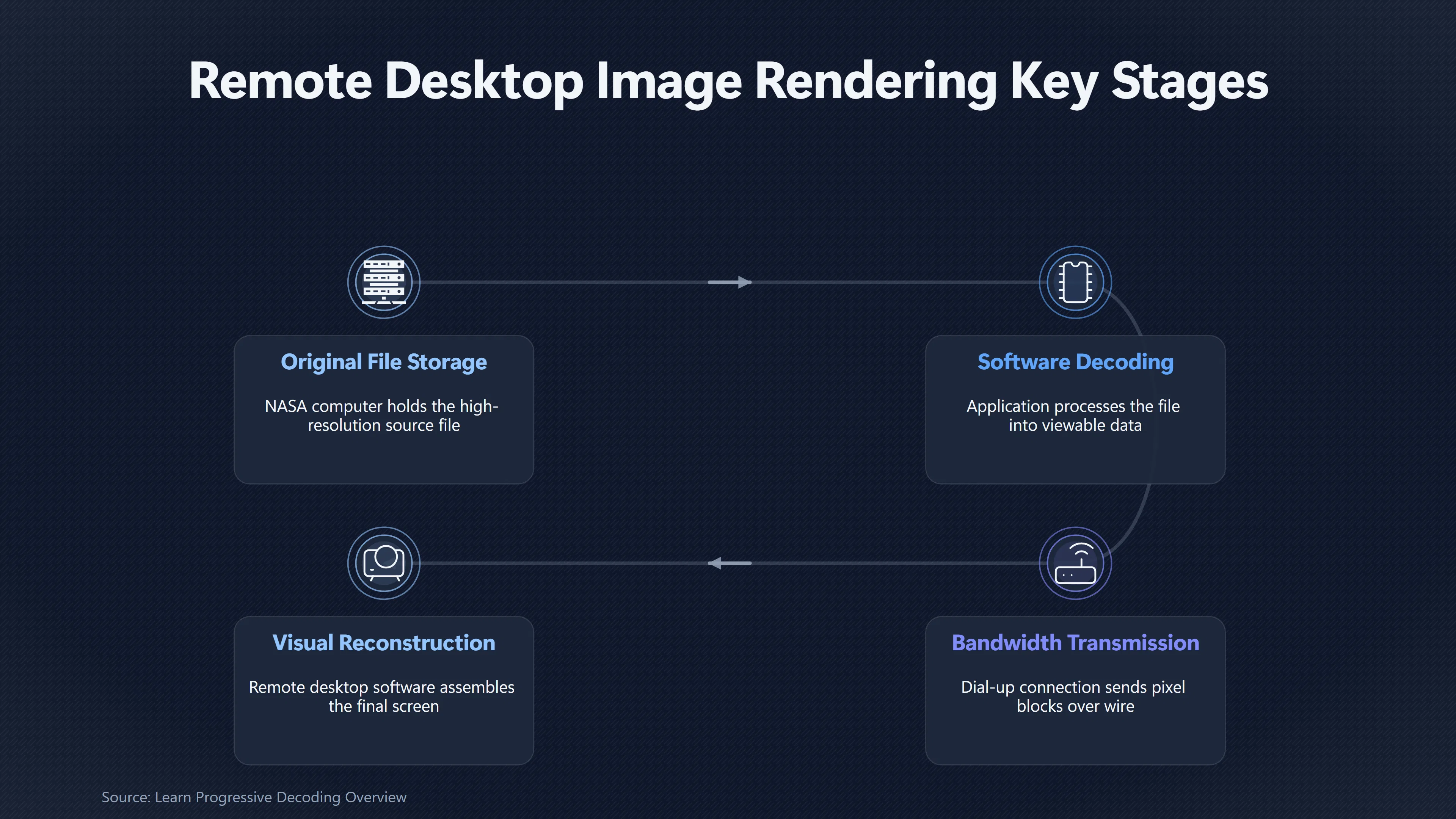
The alleged NASA image was reportedly viewed through a remote desktop application rather than by downloading the original file directly. That distinction matters because several layers of image processing were involved simultaneously:
- the original image file on the NASA computer;
- the application displaying that file;[commons.wikimedia.org]commons.wikimedia.orgwikimedia.orgHelp:JPEG - Wikimedia CommonsJanuary 29, 2026 — LARGE JPEGS [edit] The text below is copied from Commons:File types #Size an…
- the remote desktop software transmitting screen updates;
- the limited bandwidth of a dial-up Internet connection.
Each stage could introduce partial updates before the complete picture became available.
During the late 1990s and early 2000s, opening a very large image across a slow connection often meant waiting many seconds—or even minutes—for the display to stabilise. Remote desktop software commonly refreshed only changed portions of the screen, sending blocks of pixels as bandwidth allowed rather than transmitting the entire display at once. A user could therefore see incomplete regions, temporarily blank areas or partially updated sections while the image was still being decoded and transmitted.
McKinnon himself described reducing display quality and colour depth to make remote viewing practical. Lower colour depth decreases bandwidth but also removes subtle shading and fine texture, making silhouettes and boundaries appear simpler than they really are.
What Missing Regions Can Do to Apparent Outlines
Human vision naturally completes incomplete shapes. When parts of an image are absent or only roughly represented, the brain tends to infer continuous objects from disconnected fragments.
In practice, several rendering behaviours can temporarily exaggerate unusual-looking forms:
- Missing background detail. If Earth, clouds or surrounding structures have not yet appeared, a bright object can seem sharply isolated against empty space.
- Incomplete edges. Portions of a spacecraft, satellite or camera structure may appear disconnected until later image tiles arrive.
- Reduced tonal information. Four-bit colour and heavy compression merge subtle gradients into flatter regions, making curved metallic surfaces appear smoother than they actually are.
- Block-by-block updates. Remote desktop protocols frequently update rectangular screen regions independently, meaning neighbouring parts of an image may represent different stages of loading.
These effects do not create entirely fictional objects from nothing, but they can temporarily simplify or distort genuine structures enough that an observer forms an early interpretation before seeing the finished image.
Why the Original File Format Would Matter
Whether an incomplete download could significantly alter appearance depends heavily on the image format.
A traditional baseline JPEG normally renders from top to bottom as data becomes available. Progressive JPEGs instead display the entire image in multiple increasingly detailed passes, initially producing a blurred but recognisable version that gradually sharpens. PNG and GIF can also use interlaced loading schemes that reveal the whole image in several stages.[microsoft.com]learn.microsoft.comLearn Progressive Decoding OverviewMicrosoft LearnProgressive Decoding Overview - Win32 apps | Microsoft LearnJune 3, 2021…
Without knowing the original NASA file, it is impossible to determine which behaviour occurred.
Several possibilities therefore remain open:
- If the image was a baseline JPEG or TIFF, only part of the frame may have been visible when the session ended.
- If it was a progressive JPEG, McKinnon may initially have seen a low-detail approximation whose edges later would have become more complex.
- If NASA used a scientific or specialised imaging format, the application’s own rendering process may have differed again.
Because no filename, metadata or recovered image exists, none of these scenarios can be confirmed or excluded.
Remote Desktop Rendering Adds Another Layer of Uncertainty
Even if the original image had already been fully decoded on the NASA computer, McKinnon still may not have seen a faithful representation immediately.
Remote desktop systems operating over slow links typically prioritise responsiveness over visual perfection. Screen regions may be transmitted in separate updates, compressed independently and refreshed asynchronously. The user therefore sees a reconstruction of the remote display rather than the display itself.
This distinction is important because any apparent anomaly might arise from:
- delayed transmission of one screen region;
- compression artefacts introduced by the remote software;
- temporary colour quantisation;
- incomplete repainting after zooming or scrolling;
- interruption before the final screen update completed.
These effects become more noticeable when viewing very large images over extremely limited bandwidth.

Could This Produce a Convincing “Craft”?
The circumstances described by McKinnon make it technically plausible that an unfinished render influenced what he perceived. However, the strength of that explanation should not be overstated.
A partial render is unlikely to manufacture a detailed, internally consistent spacecraft where none exists. More commonly, it would simplify outlines, remove contextual information or delay the appearance of neighbouring structures. If an ordinary satellite, spacecraft component or image feature already possessed an elongated shape, incomplete rendering could make that outline appear cleaner, more isolated or more “cigar-shaped” than the completed image eventually would have shown.
Equally, if the image genuinely contained an unusual object, a partial render would not necessarily eliminate it. The problem is that the interrupted viewing prevents either possibility from being tested.
What This Means for Assessing McKinnon’s Account
The incomplete loading of the alleged NASA image represents an important source of uncertainty rather than a definitive explanation.
The known technical conditions—a slow dial-up connection, remote desktop viewing, reduced display quality and an interrupted session—are all compatible with temporary visual distortions during rendering. Modern documentation on progressive decoding also demonstrates that some image formats intentionally present incomplete versions before full detail becomes available.[microsoft.com]learn.microsoft.comLearn Progressive Decoding OverviewMicrosoft LearnProgressive Decoding Overview - Win32 apps | Microsoft LearnJune 3, 2021…
Because the original image was never preserved, investigators cannot compare McKinnon’s memory with the completed file. As a result, the “partially loaded image” hypothesis remains one of the most technically credible reasons why an ordinary image might have appeared extraordinary, while stopping well short of proving that this is what actually occurred.
Amazon book picks
Further Reading
Books and field guides related to Could an Unfinished Image Have Looked Like a Craft?. Use these as the next step if you want deeper reading beyond the article.
Digital Image Processing
This is the eBook of the printed book and may not include any media, website access codes, or print supplements that may come packaged wi...
Computer Vision: Algorithms and Applications
Computer Vision: Algorithms and Applications explores the variety of techniques used to analyze and interpret images. It also describes c...

Packing for Mars
Rating: 3.9/5 from 19 Google Books ratings
What happens to you when you can't walk for a year? When you can't have sex? Or smell flowers? What happens if you vomit in your helmet d...
Programming Computer Vision with Python
If you want a basic understanding of computer vision’s underlying theory and algorithms, this hands-on introduction is the ideal place to...
eBay marketplace picks
Marketplace Samples
Live-tested eBay searches with available results related to this page.
Selected fromspace image print oneBay.co.uk.
Endnotes
1.
Source: learn.microsoft.com
Title: Learn Progressive Decoding Overview
Link:https://learn.microsoft.com/en-us/windows/win32/wic/-wic-progressive-decoding
Source snippet
Microsoft LearnProgressive Decoding Overview - Win32 apps | Microsoft LearnJune 3, 2021...
Published: June 3, 2021
2.
Source: web.dev
Title: Image formats: JPEG | web.dev
Link:https://web.dev/learn/images/jpeg
Source snippet
JPEG is the most common type of image used on the web, and with good reason: for decades, J...
3.
Source: ntrs.nasa.gov
Link:https://ntrs.nasa.gov/citations/20110012218
4.
Source: ntrs.nasa.gov
Link:https://ntrs.nasa.gov/citations/20110013047
5.
Source: ntrs.nasa.gov
Link:https://ntrs.nasa.gov/citations/19960022224
6.
Source: ntrs.nasa.gov
Link:https://ntrs.nasa.gov/citations/19980037437
7.
Source: pds.nasa.gov
Link:https://pds.nasa.gov/datastandards/documents/dd/common/current/ch03s39.html
8.
Source: pds.nasa.gov
Link:https://pds.nasa.gov/datastandards/documents/dd/current/PDS4_PDS_DD_1J00/webhelp/all/ch03s36.html
9.
Source: skyview.gsfc.nasa.gov
Link:https://skyview.gsfc.nasa.gov/jar/javadocs.v2.02/ij/io/Opener.html
10.
Source: pds.nasa.gov
Link:https://pds.nasa.gov/datastandards/documents/dd/all/current/ch43s194.html
11.
Source: skyview.gsfc.nasa.gov
Title: PGM Reader
Link:https://skyview.gsfc.nasa.gov/jar/javadocs.v2.3/ij/plugin/PGM_Reader.html
12.
Source: oreilly.com
Title: Progressive JPEGs
Link:https://www.oreilly.com/library/view/web-design-in/0596001967/ch20s04.html
13.
Source: docs.oracle.com
Title: JPEGImage Read Param
Link:https://docs.oracle.com/en/java/javase/26/docs/api/java.desktop/javax/imageio/plugins/jpeg/JPEGImageReadParam.html
Additional References
14.
Source: developer.mozilla.org
Title: MDN Web Docs Handling media support issues in web content
Link:https://developer.mozilla.org/en-US/docs/Web/Media/Guides/Formats/Support_issues
Source snippet
media support issues in web content - Media | MDNFebruary 3, 2025 — HANDLING MEDIA SUPPORT ISSUES IN WEB CONTENT One of the realities of...
Published: February 3, 2025
15.
Source: computergraphics.stackexchange.com
Title: comimage processing
Link:https://computergraphics.stackexchange.com/questions/13214/how-to-decode-a-jpeg-file-which-is-not-fully-loaded-yet
Source snippet
Computer Graphics Stack ExchangeJanuary 14, 2023 — HOW TO DECODE A JPEG FILE WHICH IS NOT FULLY LOADED YET? Ask Question Asked 3 years, 6...
Published: January 14, 2023
16.
Source: helpx.adobe.com
Title: Help Center Save files in graphics formats in Photoshop
Link:https://helpx.adobe.com/ie/photoshop/using/saving-files-graphics-formats.html
Source snippet
JPEG compresses file size by selectively discarding data. You can also save an imag...
17.
Source: youtube.com
Title: Loading Image Preview
Link:https://www.youtube.com/watch?v=vFA6O7SHAgs
Source snippet
This selection of videos explains both the context of Gary McKinnon's hacking claims and the technical concepts behind progressive image...
18.
Source: youtube.com
Title: Ancient Aliens: Hacking NASA Secrets (Season 12, Episode 9) | History
Link:https://www.youtube.com/watch?v=20rWFDfh68Y
Source snippet
Interlaced vs. Progressive Scan - 1080i vs. 1080p...
19.
Source: commons.wikimedia.org
Link:https://commons.wikimedia.org/wiki/Help%3AJPEG
Source snippet
wikimedia.orgHelp:JPEG - Wikimedia CommonsJanuary 29, 2026 — LARGE JPEGS [edit] The text below is copied from Commons:File types #Size an...
Published: January 29, 2026
20.
Source: youtube.com
Title: The Man Who Hacked the U.S. Government
Link:https://www.youtube.com/watch?v=ND0zQX1rGdg
Source snippet
Ancient Aliens: Hacking NASA Secrets (Season 12, Episode 9) | History...
21.
Source: libpng.org
Link:https://www.libpng.org/pub/png/book/chapter08.html
22.
Source: flylib.com
Link:https://flylib.com/books/en/4.439.1.223/1/
23.
Source: youtube.com
Title: Interlaced vs. Progressive Scan
Link:https://www.youtube.com/watch?v=6DvLBsLb3CQ
Source snippet
What Is An Interlaced PNG? - Graphic Design Nerd...