Within Motive and Law
Can a Public Interest Claim Ever Justify Hacking?
A public-interest claim is strongest when suspicion is credible, lawful routes have failed and the intrusion is narrow, necessary and restrained.
On this page
- The conditions a credible public interest claim would need
- Why broad searches for hidden proof are hard to justify
- How restraint, necessity and responsible reporting matter
Page outline Jump by section
Introduction
Can a public-interest claim ever justify hacking? In legal terms, the answer is usually no. In ethical and policy debates, however, the answer is more nuanced. A person may genuinely believe that unauthorised access is necessary to expose wrongdoing, protect public safety or reveal concealed information, yet most criminal laws judge the act primarily by whether the access was authorised rather than by the actor’s personal belief. Courts and prosecutors may consider motive when deciding whether prosecution or punishment is appropriate, but a sincere conviction that the public would benefit does not normally create a legal defence.[Crown Prosecution Service]cps.gov.ukCrown Prosecution Service Computer Misuse Act | The Crown Prosecution ServiceCrown Prosecution ServiceComputer Misuse Act | The Crown Prosecution ServiceAugust 3, 2023…
This distinction is particularly relevant to curiosity-driven cases such as Gary McKinnon’s. His claim that he searched military systems for evidence of UFO secrecy and suppressed technology has often prompted debate over whether a perceived public interest should reduce criminal responsibility. That debate turns less on whether the belief was sincerely held than on whether the intrusion was necessary, proportionate and capable of being justified when lawful alternatives existed.
What Would Make a Public-Interest Claim Credible?
Across legal systems, journalism ethics and public-interest disclosure frameworks, several recurring principles appear when judging whether unlawful conduct can ever be excused or mitigated. While they do not normally create a defence to hacking offences, they provide a useful framework for assessing the strength of a public-interest argument.
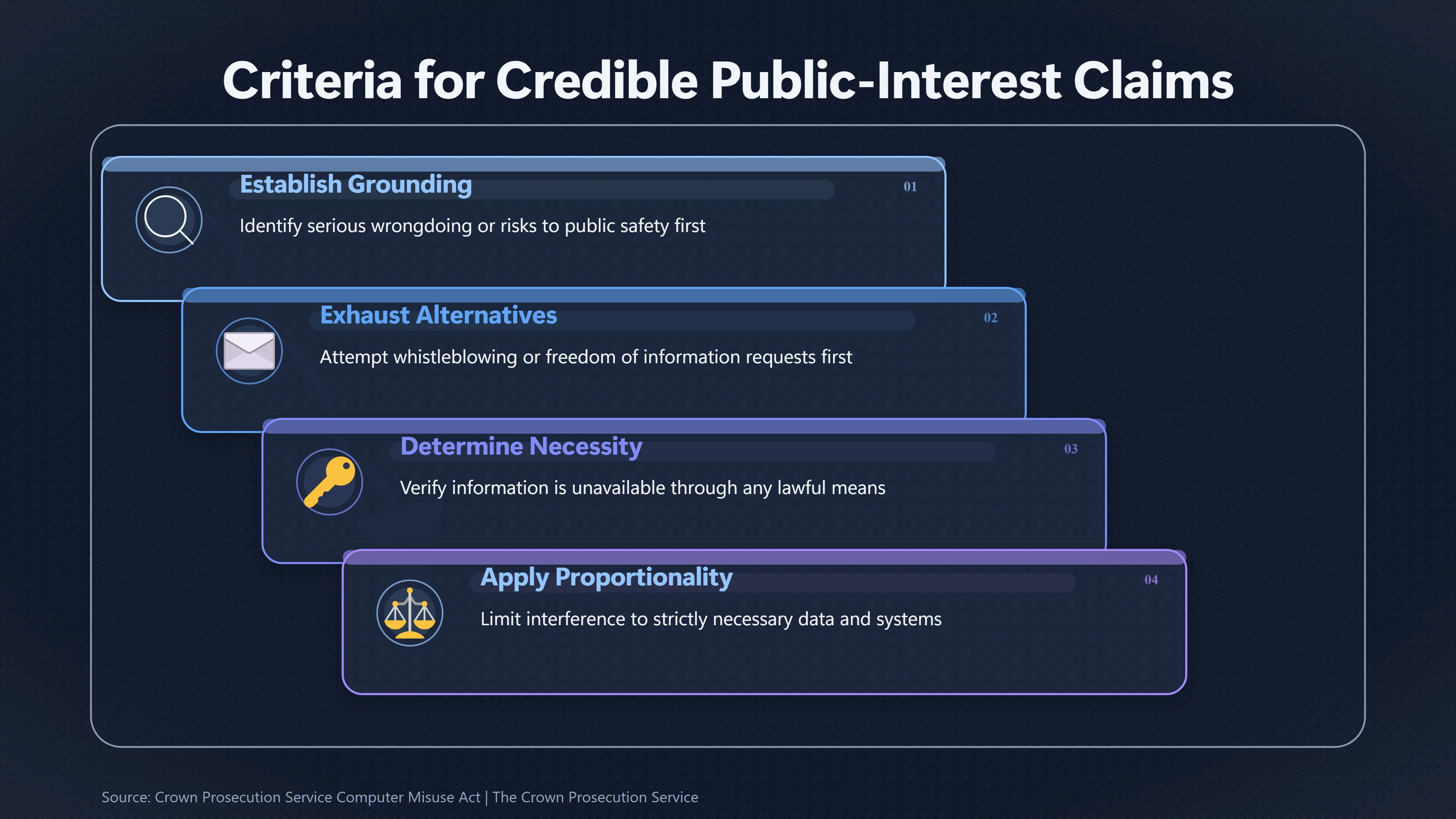
A credible claim would generally require:
- A genuine public interest rather than personal curiosity. The objective should concern matters such as serious wrongdoing, corruption, risks to life or public safety, rather than satisfying private beliefs or seeking sensational material.
- Reasonable grounds for suspicion. There should be evidence suggesting misconduct before any extraordinary action is contemplated, rather than a speculative search hoping that incriminating material might exist.
- Failure of lawful alternatives. If whistleblowing procedures, freedom of information requests, regulatory complaints or investigative journalism could realistically address the issue, those routes would normally be expected first.
- Necessity. The intrusion would need to be genuinely required to obtain information unavailable by lawful means.
- Proportionality. Any interference should be limited to what is strictly necessary, avoiding unnecessary access to unrelated systems or personal information.
These principles appear widely in public-law decision-making and prosecutorial practice, where necessity and proportionality are used to judge whether intrusive conduct can ever be justified in pursuit of legitimate aims.[Crown Prosecution Service]cps.gov.ukCrown Prosecution Service Disclosure Manual: Chapter 30Crown Prosecution ServiceDisclosure Manual: Chapter 30 - Digital Material | The Crown Prosecution ServiceJune 18, 2026…
Why Broad Searches for Hidden Proof Are Difficult to Defend
Public-interest arguments become much weaker when the hacking resembles an open-ended search for evidence rather than a targeted effort to expose a specific, well-supported concern.
Searching government or military systems because one suspects they may contain evidence of UFO programmes illustrates this problem. Even if the individual sincerely believes disclosure would benefit society, several difficulties arise:
- The suspected information may not exist.
- The search may require examining large quantities of unrelated classified or personal material.
- Sensitive systems may be disrupted merely through unauthorised access.
- The intrusion affects many people whose information has no connection to the alleged public interest.
This creates a mismatch between the scale of the intrusion and the speculative nature of the expected benefit. Ethical theories that allow civil disobedience or exceptional disclosure usually expect a far narrower relationship between the suspected wrongdoing and the information sought.
In McKinnon’s case, his stated objective of finding evidence of UFO secrecy explained his motivation but did not eliminate the fact that prosecutors alleged repeated unauthorised access to numerous United States military and government systems over an extended period. The legal issue therefore remained the unauthorised access itself rather than the truth or falsity of his beliefs.[Crown Prosecution Service]cps.gov.ukCrown Prosecution Service Computer Misuse Act | The Crown Prosecution ServiceCrown Prosecution ServiceComputer Misuse Act | The Crown Prosecution ServiceAugust 3, 2023…

Why Restraint Matters More Than Motive
Where a public-interest argument carries any persuasive force, it is often because the individual’s conduct demonstrates restraint rather than unrestricted exploration.
Important indicators include:
- limiting access to the minimum information necessary;
- avoiding alteration or deletion of data;
- avoiding interference with operational systems;
- not exploiting the information for personal gain;
- disclosing findings responsibly to appropriate authorities or journalists instead of indiscriminate publication.
These factors do not necessarily prevent criminal liability, but they can influence how conduct is viewed ethically and, in some jurisdictions, prosecutorial decisions about whether proceedings are in the public interest.
Conversely, prolonged exploration across multiple systems, concealment of activity, copying unrelated information or causing operational disruption makes it increasingly difficult to argue that the conduct was narrowly directed towards protecting the public.
Public Interest and the Decision to Prosecute
An important distinction exists between a public-interest defence and the public-interest test for prosecution.
In the United Kingdom, the Computer Misuse Act does not contain a general defence allowing defendants to avoid liability simply because they believed they acted for the public good. Instead, prosecutors first decide whether there is sufficient evidence and then consider whether prosecution itself serves the public interest. Factors include the seriousness of the harm, financial motivation, sophistication, impact on victims, and characteristics of the defendant.[Crown Prosecution Service]cps.gov.ukCrown Prosecution Service Computer Misuse Act | The Crown Prosecution ServiceCrown Prosecution ServiceComputer Misuse Act | The Crown Prosecution ServiceAugust 3, 2023…
This means that motive can influence prosecutorial discretion without transforming unauthorised access into lawful conduct. A security researcher acting responsibly may be treated differently from someone seeking financial gain, yet both may technically satisfy the statutory elements of unauthorised access.
The distinction explains why debates about reform of computer misuse laws often focus on creating clearer protections for good-faith security research rather than introducing a broad public-interest exemption for hacking.
The Special Position of Security Research
Modern cybersecurity creates situations that differ significantly from curiosity-driven searches of government systems.
Security researchers sometimes discover vulnerabilities while testing systems in good faith, often with permission or under coordinated vulnerability disclosure programmes. Many organisations now provide formal reporting channels precisely because identifying security flaws can benefit the public without requiring broad unauthorised intrusion.
Campaigners have argued that computer misuse laws should better distinguish responsible vulnerability research from malicious hacking, noting that current offences can potentially capture conduct intended to improve security. Those reform discussions, however, generally concern narrowly targeted testing and prompt reporting rather than exploratory searches for hidden government secrets.[The Guardian]theguardian.comBadenoch confessed to guessing the website credentials and posting a hoax blog. The admission during a TV interview has sparked debate am…
What the Debate Means for UFO-Related Hacking
Within the context of UFO-related hacking claims, the public-interest argument faces particularly demanding scrutiny.
A claim that hidden government information would benefit society if revealed does not, by itself, satisfy the conditions usually associated with legitimate public-interest intervention. The suspicion must be supported by credible evidence, lawful avenues should be inadequate, the intrusion should be narrowly confined to what is genuinely necessary, and the resulting harm must be proportionate to the expected benefit.
Broad searches through military networks for evidence that may or may not exist struggle to meet those standards because they involve speculative objectives combined with potentially significant security risks. As a result, the public-interest argument in cases such as Gary McKinnon’s is generally discussed as a factor relevant to motive, proportionality and sentencing rather than as a legal justification for the underlying unauthorised access.[Crown Prosecution Service]cps.gov.ukCrown Prosecution Service Computer Misuse Act | The Crown Prosecution ServiceCrown Prosecution ServiceComputer Misuse Act | The Crown Prosecution ServiceAugust 3, 2023…
Amazon book picks
Further Reading
Books and field guides related to Can a Public Interest Claim Ever Justify Hacking?. Use these as the next step if you want deeper reading beyond the article.
The Hacker and the State: Cyber Attacks and the New Normal of...
Rating: 5.0/5 from 18 Google Books ratings
“A must-read...It reveals important truths.” —Vint Cerf, Internet pioneer “One of the finest books on information security published so f...
The Hacker and the State
Rating: 5.0/5 from 18 Google Books ratings
“A must-read...It reveals important truths.” —Vint Cerf, Internet pioneer “One of the finest books on information security published so f...
Cyberethics: Morality and Law in Cyberspace
Cyberethics: Morality and Law in Cyberspace, Seventh Edition provides a comprehensive and up-to-date investigation of the internet’s infl...
Permanent Record
NEW YORK TIMES BESTSELLER Edward Snowden, the man who risked everything to expose the US government’s system of mass surveillance, reveal...
eBay marketplace picks
Marketplace Samples
Live-tested eBay searches with available results related to this page.
Selected fromcomputer security t shirt oneBay.co.uk.




Endnotes
1.
Source: cps.gov.uk
Title: Crown Prosecution Service Computer Misuse Act | The Crown Prosecution Service
Link:https://www.cps.gov.uk/prosecution-guidance/computer-misuse-act
Source snippet
Crown Prosecution ServiceComputer Misuse Act | The Crown Prosecution ServiceAugust 3, 2023...
Published: August 3, 2023
2.
Source: cps.gov.uk
Title: Crown Prosecution Service Disclosure Manual: Chapter 30
Link:https://www.cps.gov.uk/prosecution-guidance/disclosure-manual-chapter-30-digital-material
Source snippet
Crown Prosecution ServiceDisclosure Manual: Chapter 30 - Digital Material | The Crown Prosecution ServiceJune 18, 2026...
Published: June 18, 2026
3.
Source: GOV.UK
Link:https://www.gov.uk/hmrc-internal-manuals/information-disclosure-guide/idg60220
Source snippet
Public Interest Disclosures: principles to follow: necessity and proportionality - HMRC internal manual - GOV.UK...
4.
Source: theguardian.com
Link:https://www.theguardian.com/technology/2018/apr/09/bafflement-over-tory-mps-admission-she-hacked-harriet-harmans-website
Source snippet
Badenoch confessed to guessing the website credentials and posting a hoax blog. The admission during a TV interview has sparked debate am...
5.
Source: cps.gov.uk
Title: Crown Prosecution Service Cybercrime
Link:https://www.cps.gov.uk/prosecution-guidance/cybercrime-prosecution-guidance
Source snippet
Crown Prosecution ServiceCybercrime - prosecution guidance | The Crown Prosecution Service...
6.
Source: cps.gov.uk
Title: Disclosure Manual: Chapter 5
Link:https://www.cps.gov.uk/prosecution-guidance/disclosure-manual-chapter-5-reasonable-lines-enquiry-and-third-parties
Source snippet
Reasonable Lines of Enquiry and Third Parties | The Crown Prosecution ServiceJanuary 14, 2026 — DISCLOSURE MANUAL: CHAPTER 5 - REASONABLE...
Published: January 14, 2026
7.
Source: cps.gov.uk
Title: Private Prosecutions | The Crown Prosecution Service
Link:https://www.cps.gov.uk/prosecution-guidance/private-prosecutions
8.
Source: cps.gov.uk
Title: CP S Vulnerability Disclosure Policy | The Crown Prosecution Service
Link:https://www.cps.gov.uk/publication/cps-vulnerability-disclosure-policy
9.
Source: cps.gov.uk
Link:https://www.cps.gov.uk/prosecution-guidance/media-assessing-public-interest-cases-affecting-media
10.
Source: cps.gov.uk
Link:https://www.cps.gov.uk/prosecution-guidance/media-prosecuting-cases-where-public-servants-have-disclosed-confidential
11.
Source: cps.gov.uk
Title: The Code for Crown Prosecutors | The Crown Prosecution Service
Link:https://www.cps.gov.uk/publication/code-crown-prosecutors
12.
Source: cps.gov.uk
Title: code crown prosecutors 2018 consultation
Link:https://www.cps.gov.uk/publication/code-crown-prosecutors-2018-consultation
13.
Source: GOV.UK
Link:https://www.gov.uk/hmrc-internal-manuals/information-disclosure-guide/idg60252
14.
Source: GOV.UK
Link:https://www.gov.uk/hmrc-internal-manuals/information-disclosure-guide/idg60200
15.
Source: GOV.UK
Link:https://www.gov.uk/hmrc-internal-manuals/information-disclosure-guide/idg60233
16.
Source: GOV.UK
Title: www.gov.uk Latest on Gary [Mc Kinnon case]({{ ‘mc-kinnon-case/’ | relative_url }})
Link:https://www.gov.uk/government/news/latest-on-gary-mckinnon-case
17.
Source: cps.gov.uk
Link:https://www.cps.gov.uk/prosecution-guidance/prosecution-guidance-search?subject_area=2344
18.
Source: cps.gov.uk
Link:https://www.cps.gov.uk/types-crime/cyber-online-crime
19.
Source: cps.gov.uk
Link:https://www.cps.gov.uk/prosecution-guidance-library
Additional References
20.
Source: legalclarity.org
Title: computer misuse act 1990 offences penalties and defences
Link:https://legalclarity.org/computer-misuse-act-1990-offences-penalties-and-defences/
Source snippet
Computer Misuse Act 1990: Offences, Penalties and Defences - LegalClarityMay 13, 2026 — COMPUTER MISUSE ACT 1990: OFFENCES, PENALTIES AND...
Published: May 13, 2026
21.
Source: questions-statements.parliament.uk
Title: uk Written questions and answers
Link:https://questions-statements.parliament.uk/written-questions/detail/2026-01-27/108847/
Source snippet
questions and answers - Written questions, answers and statements - UK ParliamentFebruary 3, 2026 — Written questions, answers and statem...
Published: February 3, 2026
22.
Source: youtube.com
Title: British ‘UFO’ hacker loses extradition battle
Link:https://www.youtube.com/watch?v=CKxQ7XVntIA
Source snippet
This list provides directly relevant reporting and documentary coverage detailing Gary McKinnon's computer hacking case, his stated curio...
23.
Source: zoomlaw.co.uk
Link:https://zoomlaw.co.uk/1999UKHL31.html
24.
Source: youtube.com
Title: The Man Who Hacked the U.S. Government
Link:https://www.youtube.com/watch?v=ND0zQX1rGdg
Source snippet
Hacking for UFOs and fighting for his life. Who is Gary McKinnon?...
25.
Source: youtube.com
Title: UK blocks hacker extradition to U.S
Link:https://www.youtube.com/watch?v=xudYoyi_JSY
Source snippet
British 'UFO' hacker loses extradition battle...
26.
Source: youtube.com
Title: Hacking for UFOs and fighting for his life. Who is Gary Mc Kinnon?
Link:https://www.youtube.com/watch?v=OImdnvQx7sQ
Source snippet
UK Hacker extradition to US blocked...
27.
Source: youtube.com
Title: UK Hacker extradition to US blocked
Link:https://www.youtube.com/watch?v=Y5jtyps4oaY
Source snippet
UK blocks hacker extradition to U.S...
28.
Source: vlex.co.uk
Title: Mc Kinnon v United States of America
Link:https://vlex.co.uk/vid/mckinnon-v-united-states-793612009
29.
Source: vlex.co.uk
Title: Mc Kinnon v United States of America
Link:https://vlex.co.uk/vid/mckinnon-v-usa-818719549