Within Motive and Law
Why Mc Kinnon's UFO Motive Was Not a Defence
Gary McKinnon's search for hidden UFO material explained his purpose but did not turn admitted unauthorised access into lawful investigation.
On this page
- What Mc Kinnon said he was searching for
- Why sincere belief does not create permission
- How courts separated motive from unlawful conduct
Page outline Jump by section
Introduction
Gary McKinnon consistently maintained that he accessed United States military and NASA computers because he believed they contained evidence of hidden UFO programmes, anti-gravity technology and suppressed energy research. That explanation became one of the defining features of his case, but it never operated as a legal defence to the alleged computer intrusions. Courts, prosecutors and government authorities drew a clear distinction between why he said he entered the systems and whether he was entitled to enter them at all. Under computer misuse law, a sincere purpose—even one presented as exposing information of public importance—does not create permission to access protected computer systems.[Crown Prosecution Service]cps.gov.ukCrown Prosecution Service Computer Misuse Act | The Crown Prosecution ServiceCrown Prosecution ServiceComputer Misuse Act | The Crown Prosecution ServiceAugust 3, 2023…
Understanding that distinction is important because McKinnon’s case is often discussed alongside debates about whistleblowing, public-interest investigations and UFO disclosure. His motivations influenced public perceptions of proportionality and punishment, but they did not alter the basic legal question of unauthorised access.
What McKinnon Said He Was Searching For
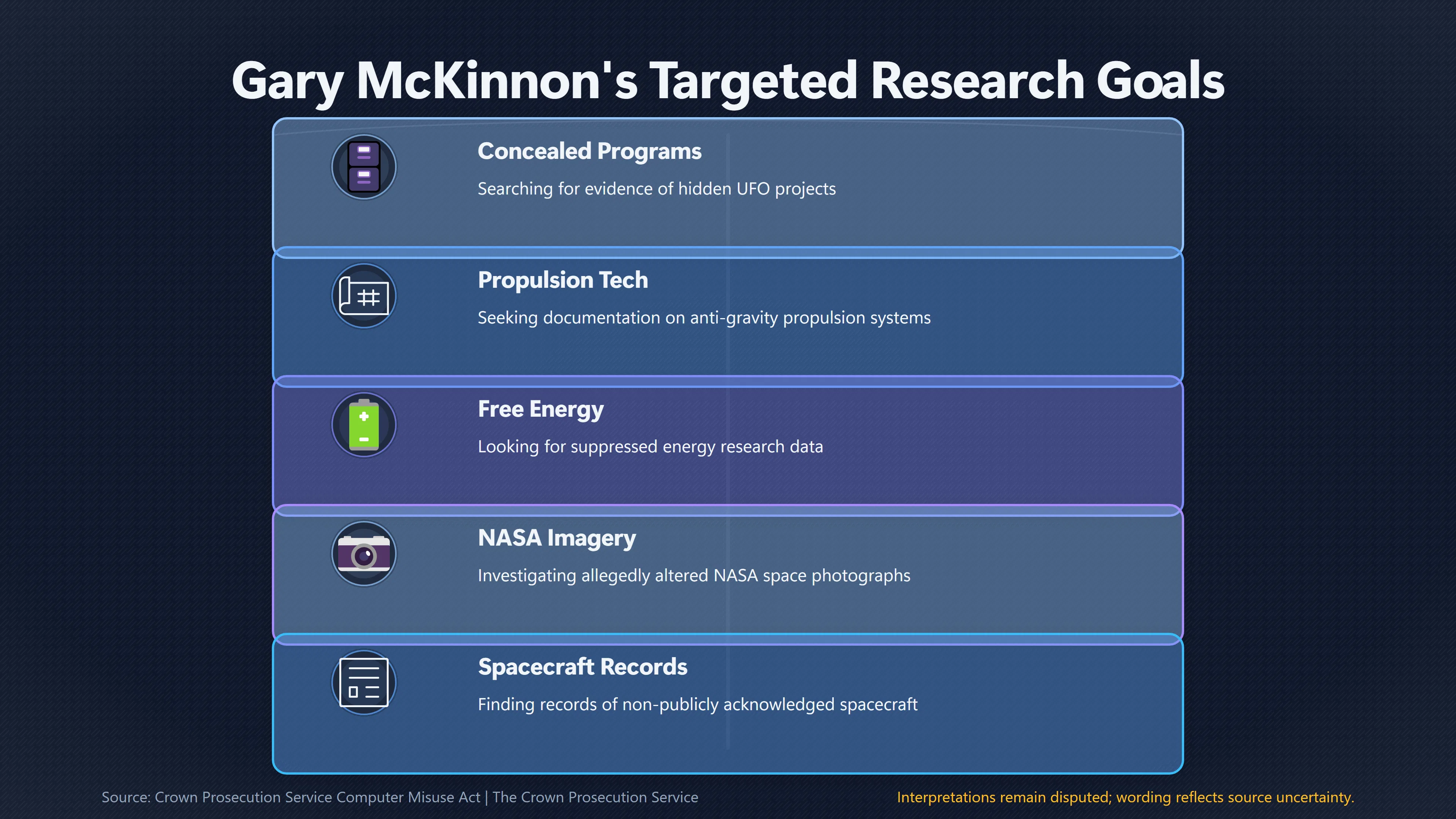
McKinnon has repeatedly acknowledged that he deliberately entered US government computer systems while searching for evidence supporting claims made by the Disclosure Project and other UFO-related sources. According to his own public accounts, he hoped to find documentation relating to:
- concealed UFO programmes;
- anti-gravity propulsion;
- suppressed “free energy” technologies;
- allegedly altered NASA imagery; and
- records of spacecraft not publicly acknowledged.
He has argued in interviews and later public discussions that his objective was investigative rather than financial or destructive. He also claimed that he believed governments were withholding information of major public importance.[Wikipedia]WikipediaGary Mc KinnonGary Mc Kinnon
Those statements explain his personal motivation, but they do not establish that the underlying claims were verified. The legal proceedings did not require courts to determine whether UFO-related allegations were true or false. Instead, the proceedings focused on the admitted acts of accessing protected computer systems without authorisation.
Why Sincere Belief Does Not Create Permission
Computer misuse offences generally distinguish between intent and motive.[health-ni.gov.uk]health-ni.gov.ukcomputer misuse act 1990computer misuse act 1990
The required intent concerns whether someone knowingly sought unauthorised access to computer material. Motive explains why they wanted that access. A person may be motivated by curiosity, political activism, journalism, research, profit or personal grievance, yet still intentionally commit the same underlying offence if they knowingly bypass access controls without permission.[Crown Prosecution Service]cps.gov.ukCrown Prosecution Service Computer Misuse Act | The Crown Prosecution ServiceCrown Prosecution ServiceComputer Misuse Act | The Crown Prosecution ServiceAugust 3, 2023…
This distinction exists for practical reasons.
If a person’s own belief that information ought to be public automatically authorised entry into protected systems, almost any unauthorised intrusion could be reframed as an investigation. Governments, companies and individuals would have no clear legal boundary protecting confidential systems, because the legality of access would depend largely on the intruder’s subjective justification rather than objective authorisation.
Accordingly, the law asks questions such as:
- Was the computer accessed without permission?[nicybersecuritycentre.gov.uk]nicybersecuritycentre.gov.ukCyber Law and Your Responsibilities | NI Cyber Security CentreCyber Law and Your Responsibilities | NI Cyber Security Centre
- Did the person know the access was unauthorised?
- Was the access deliberate?
Whether the person hoped to expose wrongdoing or uncover hidden UFO information is generally considered separately from those core elements.
How Courts Separated Motive from Unlawful Conduct
The litigation surrounding McKinnon’s extradition was dominated by issues including extradition law, proportionality, human rights and his mental health, particularly later evidence relating to Asperger syndrome and depression. However, the courts did not treat his UFO-related objective as creating a legal justification for the alleged hacking.
Judicial decisions repeatedly proceeded from the basis that McKinnon admitted obtaining unauthorised access to US government systems while disputing other matters such as the extent of damage and appropriate prosecution. His explanation of why he entered those systems formed part of the factual background rather than a defence that erased criminal liability.[Wikipedia]WikipediaGary Mc KinnonGary Mc Kinnon
This reflects a broader legal principle: courts may consider motive when evaluating sentencing, public interest or proportionality, but motive does not ordinarily convert prohibited conduct into authorised conduct.
Why Public Interest and Whistleblowing Were Different Questions
McKinnon’s supporters often portrayed him as someone searching for hidden truths rather than personal gain. That characterisation influenced public debate over whether extradition to the United States would have been proportionate.
However, that debate differed from a legal claim of permission.
Recognised whistleblowing frameworks usually involve individuals who already possess lawful access to information through their employment or official role and disclose evidence of wrongdoing under specified legal protections. McKinnon, by contrast, did not claim authorised access to the government systems he entered. His case therefore centred on obtaining access first, rather than disclosing information acquired through an authorised position.[Crown Prosecution Service]cps.gov.ukCrown Prosecution Service Computer Misuse Act | The Crown Prosecution ServiceCrown Prosecution ServiceComputer Misuse Act | The Crown Prosecution ServiceAugust 3, 2023…
For that reason, arguments about transparency or government secrecy could influence public opinion without establishing a legal defence to the alleged computer misuse.
Why the Nature of the Target Mattered
The systems McKinnon admitted accessing were associated with military and government organisations rather than publicly available databases.
That distinction increased the legal significance of the alleged intrusions because government and defence networks contain information whose confidentiality is protected regardless of the intruder’s personal intentions. Authorities argued that unauthorised exploration of such systems creates risks extending beyond any files actually viewed, including operational disruption, exposure of sensitive information and potential security vulnerabilities.[Crown Prosecution Service]cps.gov.ukCrown Prosecution Service Computer Misuse Act | The Crown Prosecution ServiceCrown Prosecution ServiceComputer Misuse Act | The Crown Prosecution ServiceAugust 3, 2023…
Consequently, the seriousness of the alleged conduct was assessed primarily by reference to the protected nature of the systems and the deliberate unauthorised access, not by whether the intruder hoped to discover UFO evidence instead of military secrets.
The Lasting Legal Lesson
McKinnon’s case remains one of the best-known examples of curiosity-driven hacking because it illustrates a principle that extends well beyond UFO claims.
A genuinely held belief that important information is being concealed may explain why someone chooses to access protected systems. It may also affect how the public judges the person’s character or whether punishment appears proportionate. But it does not itself supply legal authority to bypass computer security.
For that reason, discussions of McKinnon’s case continue to distinguish between two separate questions: whether his search for hidden UFO material was sincere, and whether that sincerity excused unauthorised access. The first concerns motive; the second concerns legality. In both UK computer misuse law and the legal treatment of McKinnon’s case, those questions remained fundamentally separate.[Crown Prosecution Service]cps.gov.ukCrown Prosecution Service Computer Misuse Act | The Crown Prosecution ServiceCrown Prosecution ServiceComputer Misuse Act | The Crown Prosecution ServiceAugust 3, 2023…

Amazon book picks
Further Reading
Books and field guides related to Why Mc Kinnon's UFO Motive Was Not a Defence. Use these as the next step if you want deeper reading beyond the article.
UFOs: Generals, Pilots, and Government Officials Go on the Re...
NEW YORK TIMES BESTSELLER • Impeccably researched, this riveting journalistic investigation separates fact from fiction, and documents th...
The Hacker and the State
Rating: 5.0/5 from 18 Google Books ratings
“A must-read...It reveals important truths.” —Vint Cerf, Internet pioneer “One of the finest books on information security published so f...
The Hacker and the State: Cyber Attacks and the New Normal of...
Rating: 5.0/5 from 18 Google Books ratings
“A must-read...It reveals important truths.” —Vint Cerf, Internet pioneer “One of the finest books on information security published so f...
eBay marketplace picks
Marketplace Samples
Live-tested eBay searches with available results related to this page.
Selected fromUFO poster oneBay.co.uk.



Current eBay listing
VINTAGE UFO FLYING SAUCERS COMIC ADVERTISING A2 POSTER PRINT

Current eBay listing
I Want To Believe UFO Poster Giclée Fine Art Heavyweight Print
Endnotes
1.
Source: cps.gov.uk
Title: Crown Prosecution Service Computer Misuse Act | The Crown Prosecution Service
Link:https://www.cps.gov.uk/prosecution-guidance/computer-misuse-act
Source snippet
Crown Prosecution ServiceComputer Misuse Act | The Crown Prosecution ServiceAugust 3, 2023...
Published: August 3, 2023
2.
Source: cps.gov.uk
Title: Crown Prosecution Service Cybercrime
Link:https://www.cps.gov.uk/prosecution-guidance/cybercrime-prosecution-guidance
Source snippet
Crown Prosecution ServiceCybercrime - prosecution guidance | The Crown Prosecution Service...
3.
Source: Wikipedia
Title: Gary Mc Kinnon
Link:https://en.wikipedia.org/wiki/Gary_McKinnon
4.
Source: cps.gov.uk
Title: The Court summed up its
Link:https://www.cps.gov.uk/prosecution-guidance/rape-and-sexual-offences-prosecution-guidance-full-page-version
Source snippet
Rape and Sexual Offences Prosecution Guidance - Full Page Version | The Crown Prosecution ServiceJune 24, 2026 — The Court quashed a numb...
Published: June 24, 2026
5.
Source: GOV.UK
Link:https://www.gov.uk/government/consultations/unauthorised-access-to-online-accounts-and-personal-data/call-for-information-unauthorised-access-to-online-accounts-and-personal-data
Source snippet
The Computer Misuse Act 1990 makes accessing online accounts and computer systems without authorisation a...
6.
Source: nicybersecuritycentre.gov.uk
Title: Cyber Law and Your Responsibilities | NI Cyber Security Centre
Link:https://www.nicybersecuritycentre.gov.uk/articles/cyber-law-and-your-responsibilities
7.
Source: GOV.UK
Link:https://www.gov.uk/government/publications/child-safety-online-a-practical-guide-for-providers-of-social-media-and-interactive-services/child-safety-online-a-practical-guide-for-providers-of-social-media-and-interactive-services
8.
Source: health-ni.gov.uk
Title: computer misuse act 1990
Link:https://www.health-ni.gov.uk/articles/computer-misuse-act-1990
9.
Source: GOV.UK
Title: www.gov.uk Latest on Gary [Mc Kinnon case]({{ ‘mc-kinnon-case/’ | relative_url }})
Link:https://www.gov.uk/government/news/latest-on-gary-mckinnon-case
10.
Source: cps.gov.uk
Link:https://www.cps.gov.uk/prosecution-guidance/prosecution-guidance-search?subject_area=2344
11.
Source: cps.gov.uk
Link:https://www.cps.gov.uk/types-crime/cyber-online-crime
Additional References
12.
Source: reddit.com
Link:https://www.reddit.com/r/UFOs/comments/t0imdw
Source snippet
Hi, i'm Gary Mckinnon. I was in the news for a decade after getting caught 'hacking' mil/gov systems looking for evidence of UFO/UA...
13.
Source: thegalacticmind.com
Title: He became infamous because of what he said he was looking for: UFO files, suppr
Link:https://www.thegalacticmind.com/the-ufo-hacker-gary-mckinnon/
Source snippet
Gary McKinnon and the Search Inside the MachineApril 13, 2026 — GARY MCKINNON AND THE SEARCH INSIDE THE MACHINE Gary McKinnon did not bec...
Published: April 13, 2026
14.
Source: legalclarity.org
Title: computer misuse act 1990 offences penalties and defences
Link:https://legalclarity.org/computer-misuse-act-1990-offences-penalties-and-defences/
Source snippet
Computer Misuse Act 1990: Offences, Penalties and Defences - LegalClarityMay 13, 2026 — COMPUTER MISUSE ACT 1990: OFFENCES, PENALTIES AND...
Published: May 13, 2026
15.
Source: commonslibrary.parliament.uk
Title: cdp 2022 0082
Link:https://commonslibrary.parliament.uk/research-briefings/cdp-2022-0082/
Source snippet
Hall debate on the Computer Misuse Act 1990 - House of Commons LibraryApril 17, 2022 — Sections 1 to 3A create five criminal offences to...
Published: April 17, 2022
16.
Source: theguardian.com
Link:https://www.theguardian.com/technology/2008/jul/30/gary.mckinnon
17.
Source: the-independent.com
Link:https://www.the-independent.com/news/people/profiles/gary-mckinnon-they-can-t-return-me-to-a-place-i-wasn-t-in-1974573.html
18.
Source: computing.co.uk
Link:https://www.computing.co.uk/news/1946046/mckinnon-makes-stand-extradition
19.
Source: theguardian.com
Link:https://www.theguardian.com/world/2008/jul/27/internationalcrime.hacking
20.
Source: theguardian.com
Link:https://www.theguardian.com/technology/2008/jun/16/hacking.internationalcrime
21.
Source: youtube.com
Title: What Does Keir Starmer ACTUALLY Believe?
Link:https://www.youtube.com/watch?v=H7gqvdJSOBw
Source snippet
Gary McKinnon will not face prosecution in the UK...