Within Image Artefacts
When Cosmic Rays Look Like Tiny Spacecraft
Charged particles can leave dots, rods and streaks that compression makes look larger, brighter and more structured.
On this page
- How charged particles mark electronic detectors
- Why compression changes particle strike shapes
- How adjacent frames reveal transient detector events
Page outline Jump by section
Introduction
Unusual bright dots, rods and streaks in space images are often interpreted online as fast-moving craft or distant structures. In many cases, however, the feature never existed in front of the camera at all. Instead, it was created when a high-energy charged particle passed directly through the electronic detector, depositing charge into one or more pixels. The resulting signal can look remarkably object-like, especially after image compression, smoothing or enlargement. NASA has documented this effect extensively for the Solar Terrestrial Relations Observatory (STEREO), noting that compression can transform simple particle strikes into shapes that appear much larger and more structured than the underlying detector event.[STEREO Science Center]stereo-ssc.nascom.nasa.govJuly 20, 2011…
This distinction is particularly relevant when evaluating claims based on a single unexplained frame, including discussions surrounding alleged NASA imagery associated with Gary McKinnon’s account. A detector artefact can produce an apparently solid object even though nothing physically crossed the telescope’s field of view.
How Charged Particles Mark Electronic Detectors
Space telescopes operate outside much of Earth’s atmospheric shielding and are constantly exposed to energetic particles from the Sun and from beyond the Solar System. These particles, commonly called cosmic rays or solar energetic particles, travel through camera electronics at high speed.
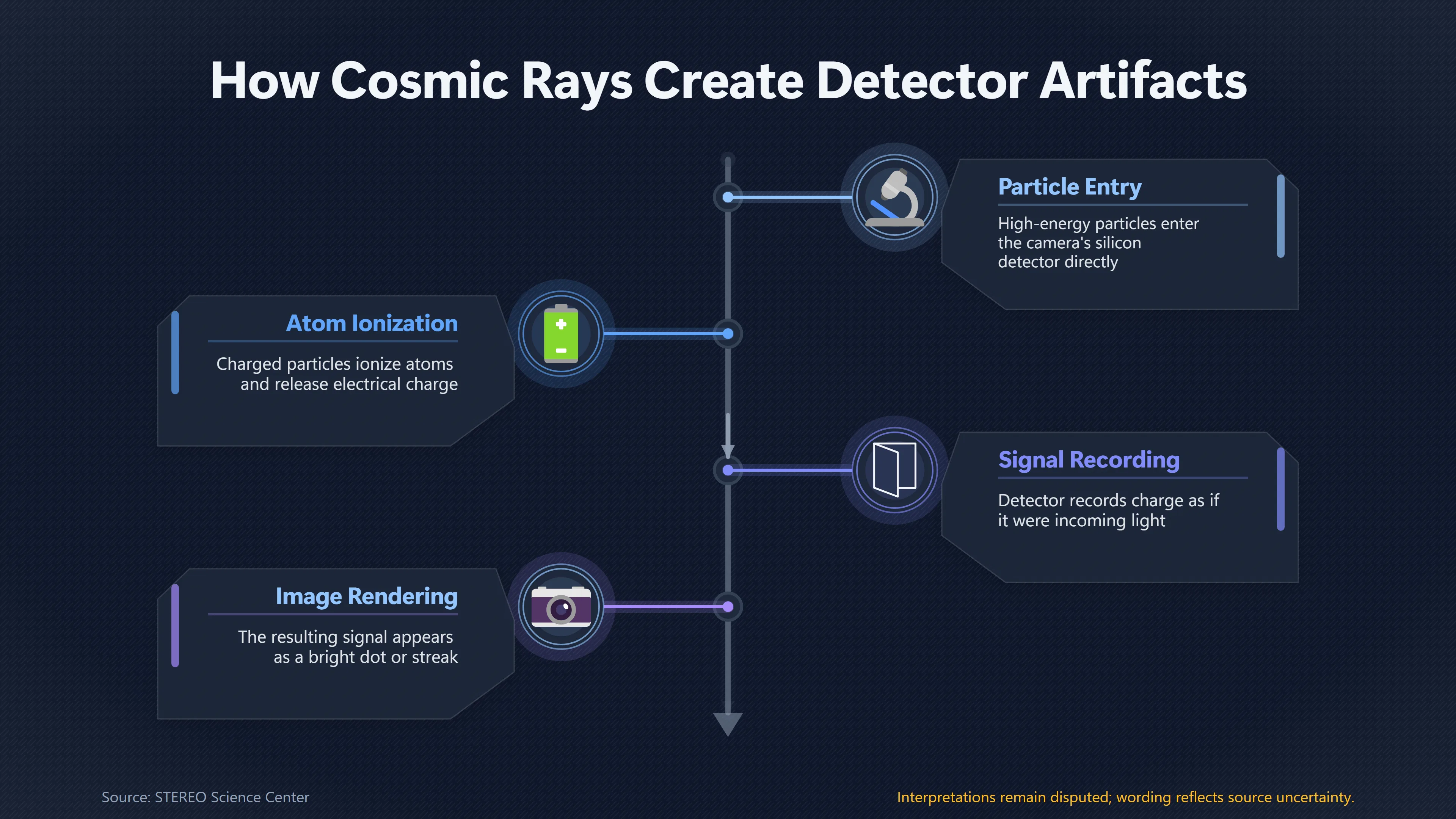
Unlike visible light, which is focused by the telescope’s optics onto the detector, a charged particle may enter the detector directly. As it passes through the silicon, it ionises atoms and releases a trail of electrical charge. The detector records this charge exactly as it would record incoming light because it has no way to distinguish whether the electrons were produced by photons or by a particle impact.[STEREO Science Center]stereo-ssc.nascom.nasa.govJuly 20, 2011…
The visible result depends on several factors:
- Near-vertical impacts often create a bright point affecting only one or a few pixels.
- Shallow-angle impacts can spread charge across many pixels, producing elongated streaks or rod-like shapes.
- Higher-energy particles may leave brighter or longer tracks.
- Detector design influences how charge spreads between neighbouring pixels.
Because these events originate inside the detector itself, they are unrelated to the telescope’s focus, viewing direction or the apparent distance of astronomical objects.
Why Compression Changes Particle-Strike Shapes
Raw scientific images are often much larger than spacecraft can transmit immediately. Missions therefore create compressed “browse” or “beacon” images that sacrifice detail to reduce transmission time.
This processing can unintentionally make cosmic-ray strikes appear far more dramatic than they really are.
NASA’s STEREO Science Center demonstrates this effect using side-by-side comparisons of compressed and full-resolution images. In heavily compressed beacon images, isolated particle hits become enlarged, smoother and more geometrically defined. Bright edges may appear rounded, while compression algorithms introduce ringing and interpolation that can make a tiny detector event resemble a structured object rather than a single saturated pixel.[STEREO Science Center]stereo-ssc.nascom.nasa.govJuly 20, 2011…
NASA also reports that an earlier smoothing step used when producing JPEG browse images exaggerated these artificial shapes even further. In 2011 the processing software was changed specifically because the smoothing caused cosmic-ray features to resemble artificial structures more closely than the underlying scientific data justified.[STEREO Science Center]stereo-ssc.nascom.nasa.govJuly 20, 2011…
This is an important example of an image-processing decision affecting visual interpretation without altering the underlying measurements.
Why Some Particle Hits Look Like Small Spacecraft
Humans naturally search for recognisable patterns, especially in unfamiliar imagery. A compressed particle strike can accidentally possess features commonly associated with engineered objects:
- apparent symmetry
- a bright central “body”
- rounded or cigar-like outlines
- glowing edges
- isolated position against dark space
These characteristics arise from detector physics and image reconstruction rather than from an external object.
The effect becomes even more convincing when viewers examine only enlarged JPEGs rather than the original scientific FITS data, where the event typically appears as a much smaller cluster of saturated pixels. NASA explicitly notes that many cosmic-ray artefacts visible in compressed browse images either become much less striking or disappear entirely when the corresponding full-resolution science data are examined.[STEREO Science Center]stereo-ssc.nascom.nasa.govJuly 20, 2011…
How Adjacent Frames Reveal Transient Detector Events
One of the strongest pieces of evidence that a feature is a particle strike is its behaviour over time.
A genuine spacecraft moving through the telescope’s field would normally show some consistent progression between consecutive exposures. Its position, brightness or trajectory should evolve in a physically plausible manner.
A detector hit behaves differently:
- it usually appears in only one exposure;
- it does not move smoothly across successive frames;
- nearby stars and background features remain unchanged;
- the apparent object vanishes completely in the next image.
Astronomers routinely exploit this behaviour when processing observations. Multiple exposures of the same scene are compared, and features appearing in only one frame are automatically identified as likely cosmic-ray events and removed. This approach has been standard practice in professional CCD image reduction for decades because particle strikes are expected to occur randomly and independently from one exposure to the next.[ESO]eso.orgArtifactsJune 15, 1999…
Why Space Missions Expect These Artefacts
Cosmic-ray contamination is not an unusual failure mode but an anticipated operating condition for astronomical instruments.
Professional observatories build dedicated software to detect and reject these events, while calibration programmes continuously measure cosmic-ray behaviour across detectors. Studies using Hubble Space Telescope calibration frames have catalogued well over a billion cosmic-ray impacts, allowing researchers to characterise their frequency, energy distribution and variation with the space environment.[arXiv]arxiv.orgHSTCosmicrays: A Python Package for Analyzing Cosmic Rays in HST Calibration DataNovember 23, 2020…
Similarly, detector-processing guides from observatories explain that cosmic rays produce extremely sharp, localised features distinct from ordinary astronomical sources, even though under some observing conditions they can initially resemble stars or compact objects before calibration removes them.[ESO]eso.orgCCD artifactsCCD artifacts…
What This Means for Alleged UFO Images
Within discussions of alleged unidentified objects in NASA imagery, cosmic-ray strikes provide a well-documented mechanism for creating visually compelling but non-physical shapes. Their appearance can become especially misleading when viewers examine compressed previews, screenshots, partially rendered downloads or isolated single frames without access to the original data.
For that reason, image analysts normally seek several forms of confirmation before treating an unusual feature as a real object: the original uncompressed image, neighbouring exposures, instrument metadata, and evidence that the feature persists consistently across multiple frames. When an apparent object exists only as a single detector event and disappears in subsequent observations, the evidence is generally more consistent with a transient cosmic-ray impact than with a physical spacecraft.[STEREO Science Center]stereo-ssc.nascom.nasa.govSTEREO Science CenterJuly 20, 2011…
Amazon book picks
Further Reading
Books and field guides related to When Cosmic Rays Look Like Tiny Spacecraft. Use these as the next step if you want deeper reading beyond the article.
Astrophotography
Today's photographic equipment allows amateurs to take pictures of the stars that far surpass images taken just a few decades ago by even...
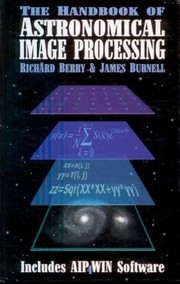
The Handbook of Astronomical Image Processing
First published 2000. Subjects: CCD cameras, Imaging systems in astronomy, Data processing, Astronomical photography.
Digital Image Processing
This is the eBook of the printed book and may not include any media, website access codes, or print supplements that may come packaged wi...
Bad Astronomy
A clever, thought-provoking guide that attacks common astronomical misconceptions What is Bad Astronomy? Anything that accidentally or in...
eBay marketplace picks
Marketplace Samples
Live-tested eBay searches with available results related to this page.
Selected fromspace photo print oneBay.co.uk.

Endnotes
1.
Source: stereo-ssc.nascom.nasa.gov
Title: STEREO Science Center
Link:https://stereo-ssc.nascom.nasa.gov/artifacts/artifacts_cosmic_rays.shtml
Source snippet
July 20, 2011...
Published: July 20, 2011
2.
Source: stereo-ssc.nascom.nasa.gov
Title: STEREO Science Center
Link:https://stereo-ssc.nascom.nasa.gov/artifacts/artifacts.shtml
3.
Source: eso.org
Title: CCD artifacts
Link:https://www.eso.org/~ohainaut/ccd/CCD_artifacts.html
Source snippet
CCD artifacts...
4.
Source: stereo-ssc.nascom.nasa.gov
Title: STEREO Science Center
Link:https://stereo-ssc.nascom.nasa.gov/artifacts/artifacts_beacon.shtml
5.
Source: eso.org
Link:https://www.eso.org/sci/software/esomidas/doc/user/98NOV/volb/node16.html
Source snippet
ArtifactsJune 15, 1999...
Published: June 15, 1999
6.
Source: arxiv.org
Title: arXiv Detection and Removal of Artifacts in Astronomical Images
Link:https://arxiv.org/abs/1601.07182
7.
Source: arxiv.org
Link:https://arxiv.org/abs/2011.11604
Source snippet
HSTCosmicrays: A Python Package for Analyzing Cosmic Rays in HST Calibration DataNovember 23, 2020...
Published: November 23, 2020
8.
Source: arxiv.org
Link:https://arxiv.org/abs/2006.00909
9.
Source: eso.org
Title: EEV report
Link:https://www.eso.org/sci/facilities/develop/detectors/optdet/docs/reports/EEV-report.html
Source snippet
ESO - EEV Report...
10.
Source: stereo.gsfc.nasa.gov
Title: artifacts beacon.shtml
Link:https://stereo.gsfc.nasa.gov/artifacts/artifacts_beacon.shtml
Source snippet
"With a few exceptions for out-of-date material, all resources have been copied to [https://stereo-ssc.nascom.nasa.gov/..."](https://stereo-ssc.nascom.nasa.gov/...")...
11.
Source: stereo.gsfc.nasa.gov
Title: beacon insitu.shtml
Link:https://stereo.gsfc.nasa.gov/beacon/beacon_insitu.shtml
12.
Source: stereo-ssc.nascom.nasa.gov
Link:https://stereo-ssc.nascom.nasa.gov/artifacts/wheel/
13.
Source: science.nasa.gov
Title: voyager 2 crs data
Link:https://science.nasa.gov/photojournal/voyager-2-crs-data/
14.
Source: jpl.nasa.gov
Title: pia22916 voyager 2 crs data
Link:https://www.jpl.nasa.gov/images/pia22916-voyager-2-crs-data/
15.
Source: nasa.gov
Title: Microscopic “Timers” Reveal Likely Source of Galactic Space Radiation
Link:https://www.nasa.gov/news-release/microscopic-timers-reveal-likely-source-of-galactic-space-radiation/
16.
Source: nasa.gov
Title: lorri 2015 06 10 014016 utc
Link:https://www.nasa.gov/image-article/lorri-2015-06-10-014016-utc/
17.
Source: science.nasa.gov
Title: cosmic rays near mercury
Link:https://science.nasa.gov/photojournal/cosmic-rays-near-mercury/
18.
Source: eso.org
Title: c30 wfpc2calib.fm4
Link:https://www.eso.org/~amicol/HST/stis/c30_wfpc2calib.fm4.html
19.
Source: eso.org
Title: Basic CCD image processing
Link:https://www.eso.org/~ohainaut/ccd/
20.
Source: stereo-ssc.nascom.nasa.gov
Title: beacon secchi.shtml
Link:https://stereo-ssc.nascom.nasa.gov/beacon/beacon_secchi.shtml?links=false
21.
Source: stsci.recollectcms.com
Link:https://stsci.recollectcms.com/nodes/view/3030
Additional References
22.
Source: youtube.com
Title: Ancient Aliens: Hacking NASA Secrets (Season 12, Episode 9)
Link:https://www.youtube.com/watch?v=20rWFDfh68Y
Source snippet
Cosmic rays space images camera artifacts STEREO NASA Top 5 Scariest Space Sounds from NASA Q Lambda - Space Explained...
23.
Source: academic.oup.com
Title: We track the degra
Link:https://academic.oup.com/mnras/article/546/2/staf2186/8376646
Source snippet
damage to the Hubble Space Telescope during two solar cycles, and correction of charge transfer inefficiency using ArCTIc | Monthly Notic...
24.
Source: youtube.com
Link:https://www.youtube.com/watch?v=QUCNvDfcQ1E
Source snippet
Hacking for UFOs and fighting for his life. Who is Gary McKinnon? | NordVPN...
25.
Source: youtube.com
Title: Hacking for UFOs and fighting for his life. Who is Gary Mc Kinnon? | Nord VPN
Link:https://www.youtube.com/watch?v=OImdnvQx7sQ
Source snippet
Gary Mckinnon: The Hacker Who Found UFOs...
26.
Source: youtube.com
Title: UFO Hacker Shares New Secrets | Gary Mc Kinnon
Link:https://www.youtube.com/watch?v=_SOTGFj7BwI
Source snippet
Ancient Aliens: Hacking NASA Secrets (Season 12, Episode 9)...
27.
Source: xmm-tools.cosmos.esa.int
Link:https://xmm-tools.cosmos.esa.int/external/xmm_user_support/documentation/sas_usg/USG/MOSevtlist.html
28.
Source: youtube.com
Title: Gary Mckinnon: The Hacker Who Found UFOs
Link:https://www.youtube.com/watch?v=8_1DuqeU8hw
Source snippet
UFO Hacker Shares New Secrets | Gary McKinnon...
29.
Source: researchgate.net
Title: (PDF) ACS calibration pipeline testing: cosmic ray rejection
Link:https://www.researchgate.net/publication/241600909_ACS_calibration_pipeline_testing_cosmic_ray_rejection
30.
Source: sciencedirect.com
Title: Detection and removal of artifacts in astronomical images
Link:https://www.sciencedirect.com/science/article/pii/S2213133716300233
31.
Source: oro.open.ac.uk
Link:https://oro.open.ac.uk/107751/