Within British Connection
When Distance Stopped Protecting US Defence Networks
The Bevan, Pryce and McKinnon cases showed that overseas civilians could threaten US defence systems without approaching a military site.
On this page
- How dial up and internet access erased physical barriers
- Why overseas intrusions challenged older security assumptions
- What the British cases revealed about remote defence risk
Page outline Jump by section
Introduction
The British cases involving Mathew Bevan, Richard Pryce and Gary McKinnon marked an important shift in how the United States understood the security of military computer networks. Their significance was not simply that British civilians gained unauthorised access to American systems, but that they demonstrated how geography had ceased to be a meaningful security barrier. A person sitting at a home computer in Britain could probe, enter and sometimes move across networks supporting US defence and aerospace organisations without ever approaching a military installation. Official investigations treated this as more than an isolated criminal problem. It exposed weaknesses in authentication, network trust and international law that forced governments to rethink how defence systems should be secured in an era of global connectivity.[UK Parliament]publications.parliament.ukUK Parliament House of LordsUK ParliamentHouse of Lords - Mckinnon V Government of The United States of America and AnotherJuly 30, 2008…
When Distance Stopped Protecting US Defence Networks
For much of the Cold War, defence planners naturally focused on protecting physical facilities. Military bases, research laboratories and command centres relied on perimeter security, guarded access and classified workspaces. As computers became interconnected through dial-up links and the early internet, many organisations retained this physical mindset even though their networks could now be reached remotely.
The British hacking cases demonstrated that these assumptions no longer held. Once an attacker found an exposed service or weakly protected administrative account, the internet eliminated the importance of national borders. The Atlantic Ocean no longer separated a civilian hobbyist in Britain from military computers in Virginia, New Jersey or Washington, DC. Instead, the limiting factor became the quality of authentication and network management rather than physical distance.
This represented a profound governance challenge. Defence organisations had invested heavily in protecting buildings while many network services still relied on weak passwords, poorly configured remote administration software and trust relationships between connected systems. The attacks illustrated that security policy had failed to evolve as quickly as network technology.[UK Parliament]publications.parliament.ukUK Parliament House of LordsUK ParliamentHouse of Lords - Mckinnon V Government of The United States of America and AnotherJuly 30, 2008…
How Dial-up and Internet Access Erased Physical Barriers
The Bevan, Pryce and McKinnon cases emerged during a transitional period when government organisations increasingly depended on internet-connected Windows systems.
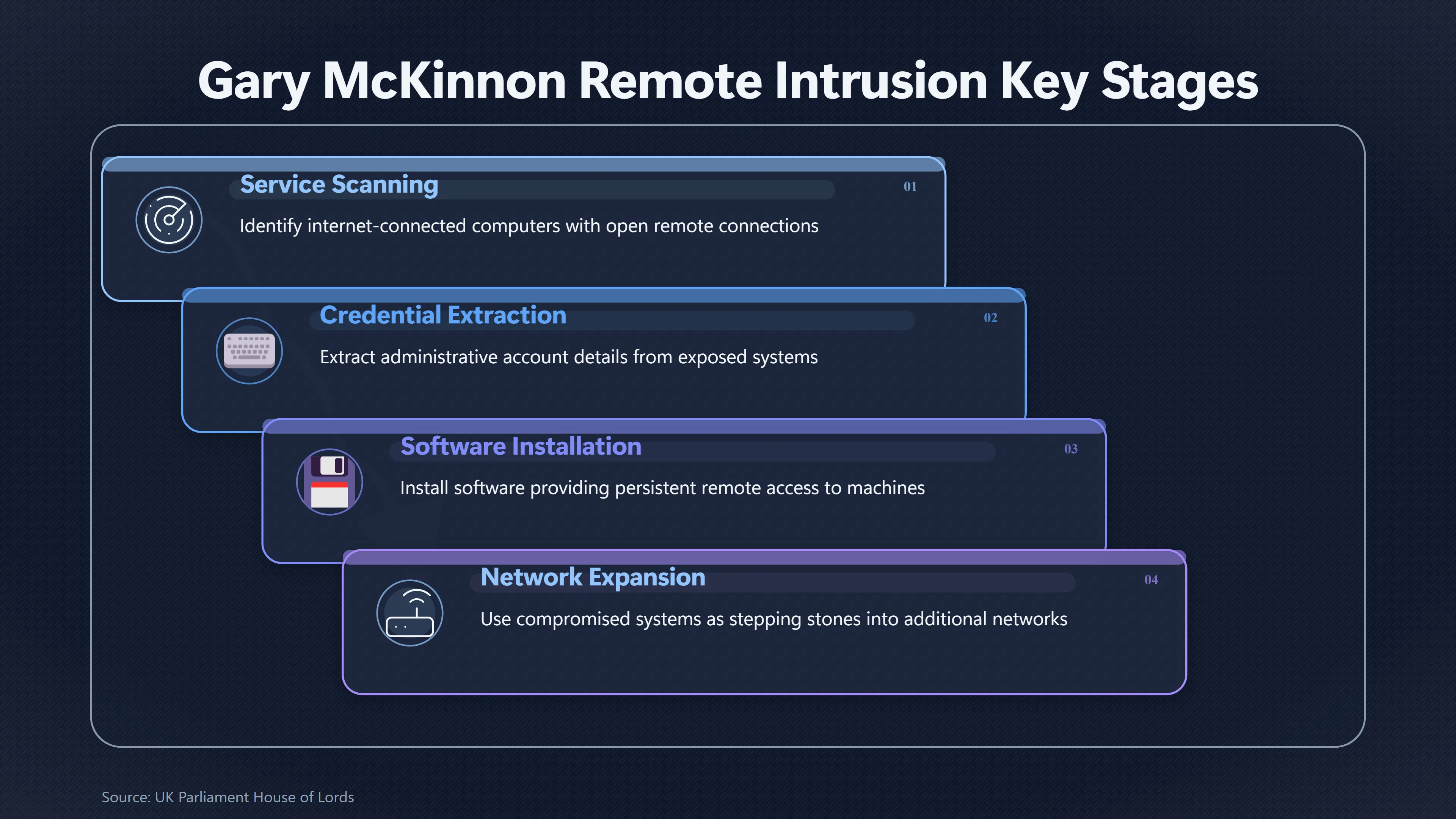
Rather than requiring sophisticated physical infiltration, attackers could:
- scan large numbers of internet-connected computers from home;
- identify systems exposing remote administration services;
- exploit accounts protected by weak or absent passwords;
- install software providing persistent remote access; and
- use one compromised computer as a stepping stone into additional networks.
The House of Lords judgment in the McKinnon case describes allegations that he identified Windows computers with open remote connections, extracted administrative account details, installed remote-access software and then used those systems to scan tens of thousands of additional government computers for similar weaknesses. Whether motivated by UFO searches or curiosity, the technical lesson was that compromise could spread through interconnected systems rather than remaining confined to one machine.[UK Parliament]publications.parliament.ukUK Parliament House of LordsUK ParliamentHouse of Lords - Mckinnon V Government of The United States of America and AnotherJuly 30, 2008…
The earlier Rome Laboratory intrusion associated with Richard Pryce and linked through related investigations to Mathew Bevan demonstrated similar problems. Attackers allegedly installed password-sniffing software and Trojan horse programs while routing activity through other compromised machines, making attribution significantly harder. Investigators initially struggled to determine whether they faced ordinary hackers or foreign intelligence services because the technical evidence concealed the attackers’ true location.[UK Parliament]publications.parliament.ukUK Parliament House of LordsUK ParliamentHouse of Lords - Mckinnon V Government of The United States of America and AnotherJuly 30, 2008…
Why Overseas Intrusions Challenged Older Security Assumptions
The British cases undermined several assumptions that had influenced defence security planning.
Nationality no longer predicted threat location. American military networks could be reached from friendly allied countries as easily as from hostile states. A civilian in London posed a technical risk that previously might have been associated only with foreign intelligence agencies.
Physical security no longer guaranteed information security. Sensitive facilities remained heavily guarded, yet vulnerable network services could effectively bypass those physical controls.
Network trust became a vulnerability. Once inside one trusted computer, attackers could often move into connected systems because internal authentication was weaker than external defences.
Attribution became uncertain. Because attackers routed connections through multiple compromised computers, investigators could initially mistake amateur hacking for organised espionage. During the Rome Laboratory investigation, US officials reportedly considered whether the activity might represent state-sponsored intelligence collection before identifying individual British hackers.[Hansard]hansard.parliament.ukHansard ExtraditionExtradition - Hansard - UK Parliament…
These problems altered how defence organisations evaluated cyber risk. The concern was no longer merely preventing entry but also detecting, containing and accurately attributing remote intrusions.

What the British Cases Revealed About Remote Defence Risk
Although Bevan, Pryce and McKinnon differed in motivation and circumstances, together they exposed recurring weaknesses.
Remote attackers could exploit routine administrative failures
None of the cases demonstrated an ability to defeat advanced cryptographic protections or revolutionary military technology. Instead, they highlighted the cumulative consequences of weak passwords, exposed remote-access software and inconsistent system administration.
This became an uncomfortable lesson because it suggested that expensive defence infrastructure could be undermined by comparatively ordinary operational mistakes rather than sophisticated technical breakthroughs.
Civilian curiosity could generate strategic consequences
McKinnon consistently maintained that his interest centred on UFOs, suppressed technologies and free-energy claims rather than military espionage. Whatever his stated motivation, US authorities argued that unauthorised access affected systems connected with national defence and critical military operations. The practical security problem therefore became independent of intent: even non-state actors pursuing unconventional interests could create operational disruption or consume significant investigative resources.[UK Parliament]publications.parliament.ukUK Parliament House of LordsUK ParliamentHouse of Lords - Mckinnon V Government of The United States of America and AnotherJuly 30, 2008…
International investigations became unavoidable
Because the alleged offences crossed national borders, investigation depended upon cooperation between British and American authorities. Search warrants, evidence collection, extradition proceedings and mutual legal assistance became integral parts of cyber defence rather than purely criminal justice matters.
The lengthy McKinnon extradition litigation highlighted that network attacks could rapidly evolve into complex questions involving jurisdiction, human rights and diplomatic relations, illustrating that cyber security increasingly required legal as well as technical governance.[UK Parliament]publications.parliament.ukUK Parliament House of LordsUK ParliamentHouse of Lords - Mckinnon V Government of The United States of America and AnotherJuly 30, 2008…
How Defence Security Changed Afterwards
The broader significance of these cases lay in what they encouraged defence organisations to prioritise.
Greater emphasis was placed on stronger authentication, removal of unnecessary remote services, improved password policies and more systematic patch management. Network monitoring also became increasingly important because preventing every intrusion proved unrealistic; detecting unusual activity quickly became equally critical.
Equally important was the gradual move away from assuming that users or systems inside a trusted network deserved automatic confidence. Later defence security strategies increasingly favoured segmented networks, layered access controls and continuous verification rather than broad trust based simply on network location.
The British incidents were not the sole reason for these changes, but they became highly visible examples demonstrating why traditional perimeter-based thinking had become inadequate for globally connected military systems.
The Lasting Governance Lesson
The enduring lesson from the Bevan, Pryce and McKinnon cases is not primarily about UFO beliefs or individual hackers. It is that the internet fundamentally altered the relationship between geography and national security.
Before widespread networking, protecting military facilities largely meant protecting places. After networked computing became central to defence operations, protecting military capability increasingly meant protecting identities, authentication systems, software configuration and international investigative cooperation.
The Britain-to-America hacking cases helped make that transition unmistakable. They showed that strategic vulnerabilities could emerge from ordinary internet connections thousands of miles away, forcing defence institutions to recognise that cyber security had become a global governance problem rather than merely a matter of guarding military installations.[parliament.uk]publications.parliament.ukUK Parliament House of LordsUK ParliamentHouse of Lords - Mckinnon V Government of The United States of America and AnotherJuly 30, 2008…
Amazon book picks
Further Reading
Books and field guides related to When Distance Stopped Protecting US Defence Networks. Use these as the next step if you want deeper reading beyond the article.
Cyber War
Rating: 3.0/5 from 96 Google Books ratings
An essential, eye-opening book about cyberterrorism, cyber war, and the next great threat to our national security. " Cyber War may be th...
Countdown to Zero Day
Top cybersecurity journalist Kim Zetter tells the story behind the virus that sabotaged Iran’s nuclear efforts and shows how its existenc...
Sandworm
"With the nuance of a reporter and the pace of a thriller writer, Andy Greenberg gives us a glimpse of the cyberwars of the future while...
eBay marketplace picks
Marketplace Samples
Live-tested eBay searches with available results related to this page.
Selected fromUS Air Force patch oneBay.co.uk.




Endnotes
1.
Source: publications.parliament.uk
Title: UK Parliament House of Lords
Link:https://publications.parliament.uk/pa/ld200708/ldjudgmt/jd080730/mckinn-1.htm
Source snippet
UK ParliamentHouse of Lords - Mckinnon V Government of The United States of America and AnotherJuly 30, 2008...
Published: July 30, 2008
2.
Source: hansard.parliament.uk
Title: Hansard Extradition
Link:https://hansard.parliament.uk/lords/2012-10-16/debates/12101643000907/Extradition
Source snippet
Extradition - Hansard - UK Parliament...
3.
Source: hansard.parliament.uk
Title: Hansard Extradition
Link:https://hansard.parliament.uk/Commons/2012-10-16/debates/12101642000005/Extradition
Source snippet
UK ParliamentOctober 16, 2012 — 12.35pm The Secretary of State for the Home Department (Mrs Theresa May) With permission, Mr Sp...
Published: October 16, 2012
4.
Source: parliament.uk
Link:https://www.parliament.uk/external/committees/committee-news-pre-oct-2020/2015/march/extradition-report-publication/
Source snippet
UK cannot be confident its extradition regime is protecting human rights, says Lords - UK ParliamentMarch 10, 2015 — report publication...
Published: March 10, 2015
5.
Source: parliament.uk
Title: Statement on Gary Mc Kinnon
Link:https://www.parliament.uk/business/news/news-by-year/2012/october/statement-on-gary-mckinnon/
Source snippet
Statement on Gary McKinnon - UK ParliamentOctober 17, 2012 — STATEMENT ON GARY MCKINNON 17 October 2012 Oct 17 2012 Image: Image of UK Pa...
Published: October 17, 2012
6.
Source: GOV.UK
Link:https://www.gov.uk/government/speeches/gary-mckinnon-extradition-case-home-secretarys-statement
Source snippet
McKinnon extradition case: Home Secretary's statement - GOV.UKOctober 16, 2012 — Oral statement to Parliament GARY MCKINNON EXTRADITION C...
Published: October 16, 2012
7.
Source: parliament.uk
Title: Extradition Review
Link:https://www.parliament.uk/external/committees/committee-news-pre-oct-2020/2011/december/111216-extradition-review/
Source snippet
UK ParliamentDecember 16, 2011 — UK Parliament EXTRADITION REVIEW 16 December 2011 Dec 16 2011 Tuesday 20 December 2011 Thatcher Room 11...
Published: December 16, 2011
8.
Source: hansard.parliament.uk
Title: uk Extradition: Gary Mc Kinnon
Link:https://hansard.parliament.uk/Lords/2010-12-16/debates/10121652000726/ExtraditionGaryMckinnon
Source snippet
parliament.ukExtradition: Gary McKinnon - Hansard - UK ParliamentDecember 16, 2010 — Skip to main content HANSARD Question 11.29am Asked...
Published: December 16, 2010
9.
Source: hansard.parliament.uk
Title: uk Gary Mc Kinnon (Extradition)
Link:https://hansard.parliament.uk/Commons/2009-12-01/debates/09120144000002/GaryMckinnon%28Extradition%29
Source snippet
David Burrowes (Enfield, Southgate) (Con) (Urgent Question): To ask the Secretary of State for the Home Department if he will make a stat...
10.
Source: publications.parliament.uk
Link:https://publications.parliament.uk/pa/cm200910/cmhansrd/cm091201/debtext/91201-0004.htm
Source snippet
David Burrowes (Enfield, Southgate) (Con) (Urgent Question): To ask the Secretary of State for the Home Department if he will make a stat...
11.
Source: youtube.com
Title: British Hacker Escapes Trial after hacking Military and NASA Computers
Link:https://www.youtube.com/watch?v=jWitx2r3Pmk
Source snippet
Gary McKinnon | UK Computer Hacker Who Was Accused Of The Biggest US Military Hack Of All Time...
12.
Source: youtube.com
Link:https://www.youtube.com/watch?v=FIlHu3YUBN4
Source snippet
UK hacker's extradition to US blocked...
Additional References
13.
Source: theguardian.com
Link:https://www.theguardian.com/technology/2008/jun/16/hacking.internationalcrime
Source snippet
June 16, 2008 — This article is more than 18 years old BRITISH HACKER SHOULD NOT BE EXTRADITED TO US, LORDS TOLD This article is more tha...
Published: June 16, 2008
14.
Source: youtube.com
Title: Hacking for UFOs and fighting for his life. Who is Gary Mc Kinnon?
Link:https://www.youtube.com/watch?v=OImdnvQx7sQ
Source snippet
British Hacker Escapes Trial after hacking Military and NASA Computers...
15.
Source: youtube.com
Title: The Man Who Hacked the U.S. Government
Link:https://www.youtube.com/watch?v=ND0zQX1rGdg
Source snippet
Hacking for UFOs and fighting for his life. Who is Gary McKinnon?...
16.
Source: GOV.UK
Title: Latest on Gary [Mc Kinnon case]({{ ‘mc-kinnon-case/’ | relative_url }})
Link:https://www.gov.uk/government/news/latest-on-gary-mckinnon-case
Source snippet
From: Home Office and The Rt Hon Theresa May...
17.
Source: youtube.com
Title: UK hacker’s extradition to US blocked
Link:https://www.youtube.com/watch?v=v4Js8DF80HY
Source snippet
The Man Who Hacked the U.S. Government...