Within Case Comparison
Why Their Hacking Cases Ended So Differently
Pryce was fined, Bevan's prosecution collapsed and McKinnon spent years fighting extradition before the British government halted the process.
On this page
- Pryce's conviction and modest domestic penalty
- Why the case against Bevan was abandoned
- Mc Kinnon's decade long extradition battle
Page outline Jump by section
Introduction
Richard Pryce, Mathew Bevan and Gary McKinnon all gained unauthorised access to American government or military computer systems from the United Kingdom, yet their legal cases ended in strikingly different ways. Pryce received a domestic conviction and financial penalty, the prosecution against Bevan was abandoned before trial, and McKinnon spent nearly a decade contesting extradition to the United States before the British government blocked his removal on human rights grounds. These contrasting outcomes were not the result of one simple factor. They reflected differences in the available evidence, the seriousness and timing of the alleged offences, the prosecutors’ legal options, the evolution of UK–US extradition arrangements, and, in McKinnon’s case, exceptional medical evidence that fundamentally altered the legal analysis.[GOV.UK]GOV.UKTheresa May statement on Gary Mc Kinnon extraditionTheresa May statement on Gary McKinnon extradition - GOV.UKOctober 16, 2012…
Why similar hacking cases produced different legal results
Although the three men are often grouped together because they targeted American systems from Britain and became linked in popular culture with UFO-related hacking, their cases unfolded in different legal environments.
The mid-1990s Rome Laboratory investigation involving Bevan and Pryce occurred before the modern UK–US extradition framework introduced by the Extradition Act 2003. Investigators were primarily deciding whether domestic prosecutions could be sustained with the evidence available. By contrast, McKinnon’s intrusions took place in 2001–02, after which the United States sought to prosecute him directly in an American federal court, leading to a lengthy extradition dispute rather than an ordinary British criminal trial.[GOV.UK]GOV.UKLatest on Gary Mc Kinnon caseLatest on Gary McKinnon case - GOV.UK…
The practical questions also differed:
- Could prosecutors prove the alleged offences beyond reasonable doubt?
- Was a domestic prosecution preferable to an overseas one?
- Was extradition legally available?
- Were there exceptional human rights considerations preventing removal?
Each case produced different answers.
Pryce’s conviction and modest domestic penalty
Richard Pryce, known online as “Datastream Cowboy”, ultimately received a domestic conviction in the United Kingdom. He was fined rather than imprisoned, reflecting both the legal framework of the time and the charges successfully pursued against him.
Several factors contributed to this comparatively modest outcome:
- British authorities were able to prosecute him within the UK rather than relying on extradition.
- The prosecution proceeded on offences that could be established under the computer misuse laws then in force.
- The case arose during the early years of widespread internet intrusion, when sentencing practice for computer crime was still developing and courts had relatively limited precedents for dealing with large-scale network intrusions.
Although the Rome Laboratory breach caused significant concern within the United States, not every participant received identical treatment. Domestic prosecutorial discretion, the evidence against each defendant and the charges ultimately brought all influenced the sentence actually imposed.

Why the case against Bevan was abandoned
Mathew Bevan’s legal outcome differed even more dramatically. Despite being identified as a principal participant in the Rome Laboratory intrusion, the prosecution against him eventually collapsed before trial.
The decision reflected evidential and prosecutorial difficulties rather than a judicial declaration that no hacking had occurred. Contemporary reporting and later accounts indicate that the authorities encountered problems assembling a prosecution likely to succeed under the available evidence. Computer forensic practice was still developing during the mid-1990s, international digital evidence was more difficult to obtain than it later became, and prosecutors had to assess whether continuing the case remained in the public interest.
Bevan’s age at the time of the offences has also been noted in discussions of the case. While youth alone did not determine the outcome, it formed part of the broader context in which prosecutors exercised their discretion.
As a result, unlike Pryce, Bevan was never convicted, and unlike McKinnon, he never became the subject of a prolonged extradition battle. His case effectively ended because the prosecution did not proceed.
McKinnon’s decade-long extradition battle
Gary McKinnon’s case followed a fundamentally different path because the United States sought to prosecute him in an American federal court rather than relying on British criminal proceedings.
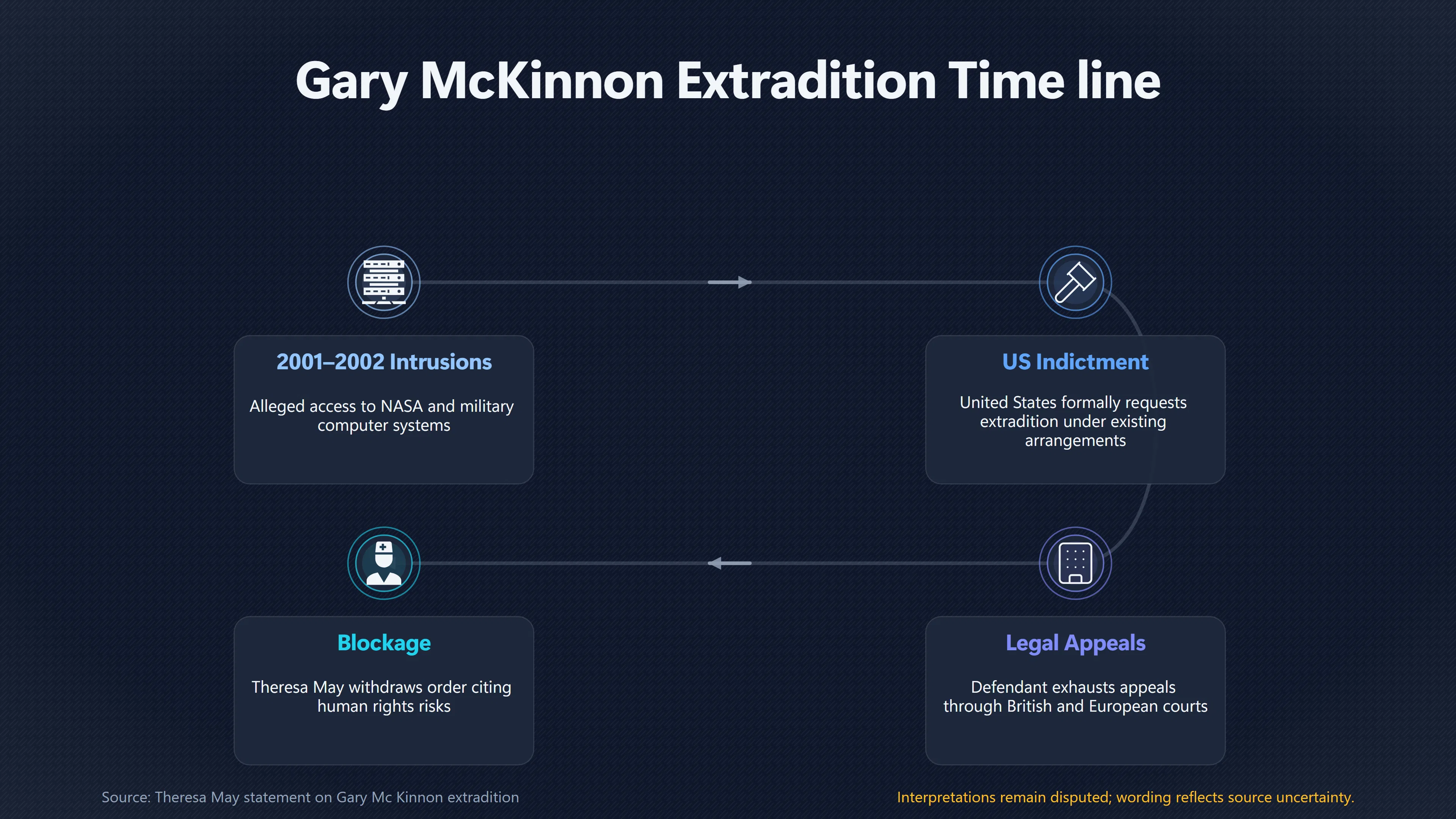
American prosecutors alleged that McKinnon had accessed dozens of US military, NASA and government computers during 2001 and 2002. After indictment in the United States, Washington formally requested his extradition under the UK–US extradition arrangements. That transformed the case from a straightforward hacking prosecution into one of Britain’s most controversial extradition disputes.[GOV.UK]GOV.UKLatest on Gary Mc Kinnon caseLatest on Gary McKinnon case - GOV.UK…
For many years McKinnon exhausted appeals through the British courts and the European Court of Human Rights. The principal legal issue eventually ceased to be whether there was evidence of hacking; instead, it became whether extradition itself would be compatible with the United Kingdom’s obligations under the Human Rights Act.
In October 2012, Home Secretary Theresa May concluded that extraditing McKinnon would create such a high risk of suicide, given his Asperger’s syndrome and depressive illness, that removal would violate his human rights. She therefore withdrew the extradition order. Importantly, this was presented as an exceptional decision based on medical evidence rather than a rejection of the American allegations or of extradition as a legal process generally.[GOV.UK]GOV.UKTheresa May statement on Gary Mc Kinnon extraditionTheresa May statement on Gary McKinnon extradition - GOV.UKOctober 16, 2012…
Following that decision, the Crown Prosecution Service reviewed whether McKinnon should instead face prosecution in Britain. It concluded that a UK prosecution was unlikely to achieve a realistic prospect of conviction because most of the evidence, witnesses and alleged harm were located in the United States. Consequently, no British prosecution followed.[The Guardian]theguardian.comThe GuardianGary McKinnon will face no charges in UK | Gary McKinnon | The GuardianDecember 14, 2012…
The decisive differences between the three cases
Looking across all three cases, the differing outcomes can be traced to several concrete legal and practical distinctions rather than to any common narrative about UFO investigations.
FactorRichard PryceMathew BevanGary McKinnonPrimary legal routeUK prosecutionUK prosecution attemptedUS indictment followed by extradition requestFinal outcomeConvicted and finedProsecution abandonedExtradition blocked; no UK prosecutionMain deciding factorDomestic conviction on available chargesEvidential and prosecutorial difficultiesHuman rights assessment and medical evidenceRole of extraditionNoneNoneCentral issue for nearly a decade
The comparison also illustrates how cybercrime law evolved over time. Pryce and Bevan were prosecuted during the relatively early years of internet-related criminal enforcement, when investigators and prosecutors were still adapting to cross-border digital evidence. McKinnon’s alleged offences occurred after international cybercrime enforcement and extradition cooperation had become considerably more developed, making an American prosecution both legally and politically feasible.[GOV.UK]GOV.UKLatest on Gary Mc Kinnon caseLatest on Gary McKinnon case - GOV.UK…
What these cases demonstrate
The three cases are often grouped together because each involved British hackers accessing American systems and because both Bevan and McKinnon became associated with searches for hidden UFO information. Legally, however, they represent three distinct outcomes.
Pryce’s case demonstrates a conventional domestic prosecution ending in conviction. Bevan’s illustrates how serious investigations can nevertheless collapse when prosecutors conclude that a successful trial is unlikely. McKinnon’s became a landmark extradition case in which the decisive issue was neither computer security nor UFO claims, but whether extradition would breach fundamental human rights in light of exceptional medical evidence. Those legal differences—not any shared interest in alleged government secrecy—best explain why three superficially similar hacking cases reached such different conclusions.[gov.uk]GOV.UKTheresa May statement on Gary Mc Kinnon extraditionTheresa May statement on Gary McKinnon extradition - GOV.UKOctober 16, 2012…

Amazon book picks
Further Reading
Books and field guides related to Why Their Hacking Cases Ended So Differently. Use these as the next step if you want deeper reading beyond the article.
The Hacker Crackdown: Law and Disorder on the Electronic Fron...
The bestselling cyberpunk author "has produced by far the most stylish report from the computer outlaw culture since Steven Levy's Hacker...

Cybercrime: The Transformation of Crime in the Information Age
First published 2007. Subjects: Computer related crime, Computer crimes, Computer security, Informatiemaatschappij, Databrott.
No Place to Hide: Edward Snowden, the NSA, and the U.S. Surve...
THE INSIDE ACCOUNT OF THE EVENTS DOCUMENTED IN LAURA POITRAS'S CITIZENFOUR Glenn Greenwald's No Place to Hide is the story of one of the...
eBay marketplace picks
Marketplace Samples
Live-tested eBay searches with available results related to this page.
Selected fromUFO poster oneBay.co.uk.



Current eBay listing
I Want To Believe UFO Poster Giclée Fine Art Heavyweight Print

Current eBay listing
VINTAGE UFO FLYING SAUCERS COMIC ADVERTISING A2 POSTER PRINT
Endnotes
1.
Source: GOV.UK
Title: Theresa May statement on Gary Mc Kinnon extradition
Link:https://www.gov.uk/government/news/theresa-may-statement-on-gary-mckinnon-extradition
Source snippet
Theresa May statement on Gary McKinnon extradition - GOV.UKOctober 16, 2012...
Published: October 16, 2012
2.
Source: GOV.UK
Title: Latest on Gary [Mc Kinnon case]({{ ‘mc-kinnon-case/’ | relative_url }})
Link:https://www.gov.uk/government/news/latest-on-gary-mckinnon-case
Source snippet
Latest on Gary McKinnon case - GOV.UK...
3.
Source: hansard.parliament.uk
Title: Hansard Extradition
Link:https://hansard.parliament.uk/Commons/2012-10-16/debates/12101642000005/Extradition
Source snippet
Extradition - Hansard - UK Parliament...
4.
Source: theguardian.com
Link:https://www.theguardian.com/world/2012/dec/14/gary-mckinnon-no-uk-charges
Source snippet
The GuardianGary McKinnon will face no charges in UK | Gary McKinnon | The GuardianDecember 14, 2012...
Published: December 14, 2012
5.
Source: theguardian.com
Link:https://www.theguardian.com/world/2012/oct/19/gary-mckinnon-theresa-may-claims
Source snippet
Theresa May accused of taking 'easy way out' over Gary McKinnon case | Gary McKinnon | The GuardianOctober 18, 2012 — Image: Gary McKinno...
Published: October 18, 2012
6.
Source: theguardian.com
Link:https://www.theguardian.com/world/2012/oct/16/gary-mckinnon-not-extradited-may
7.
Source: theguardian.com
Link:https://www.theguardian.com/world/2012/oct/16/gary-mckinnon-extradition-key-questions
8.
Source: hansard.parliament.uk
Title: uk Extradition
Link:https://hansard.parliament.uk/lords/2012-10-16/debates/12101643000907/Extradition
9.
Source: hansard.parliament.uk
Title: uk Commons Chamber
Link:https://hansard.parliament.uk/Commons/2012-10-16/debates/9d1d96d7-c03f-4ba1-b1ca-35b28e84da42/CommonsChamber
Additional References
10.
Source: itv.com
Title: The CPS reviewed his case after the Government bloc
Link:https://www.itv.com/news/update/2012-12-14/cps-have-declared-decision-not-to-prosecute-mckinnon/
Source snippet
'CPS have declared decision not to prosecute McKinnon' - ITV NewsDecember 14, 2012 — NO CHARGES AGAINST US HACKER Gary McKinnon, who is w...
Published: December 14, 2012
11.
Source: itv.com
Title: No charges against US hacker
Link:https://www.itv.com/news/story/2012-12-14/gary-mckinnon
Source snippet
5 updates 2. 14 December 2012 NO CHARGES AGAINST US HACKER Gary McKinnon, who is wanted in the US after hacking into the Pentagon's compu...
Published: December 2012
12.
Source: youtube.com
Title: Hacking for UFOs and fighting for his life. Who is Gary Mc Kinnon? | Nord VPN
Link:https://www.youtube.com/watch?v=OImdnvQx7sQ
Source snippet
Matthew Bevan y Richard Pryce- Hackers Famosos...
13.
Source: youtube.com
Title: Theresa May blocks Gary Mc Kinnon’s extradition to US
Link:https://www.youtube.com/watch?v=5MEQVo8ENC8
Source snippet
Hacking for UFOs and fighting for his life. Who is Gary McKinnon? | NordVPN...
14.
Source: itv.com
Title: XPolice and CPS explain Mc Kinnon decision
Link:https://www.itv.com/news/update/2012-12-14/police-and-cps-explain-mckinnon-decision/
Source snippet
XPolice and CPS explain McKinnon decision - ITV News...
15.
Source: youtube.com
Title: Gary Mc Kinnon wins extradition battle
Link:https://www.youtube.com/watch?v=y4lecD44F5E
Source snippet
Theresa May blocks Gary McKinnon's extradition to US...
16.
Source: youtube.com
Title: UK hacker’s extradition to US blocked
Link:https://www.youtube.com/watch?v=v4Js8DF80HY
Source snippet
Gary McKinnon wins extradition battle...
17.
Source: youtube.com
Title: Matthew Bevan y Richard Pryce- Hackers Famosos
Link:https://www.youtube.com/watch?v=A0sCmWAUaZo