Within Disclosure Culture
Public Interest Mission or Unauthorized Intrusion?
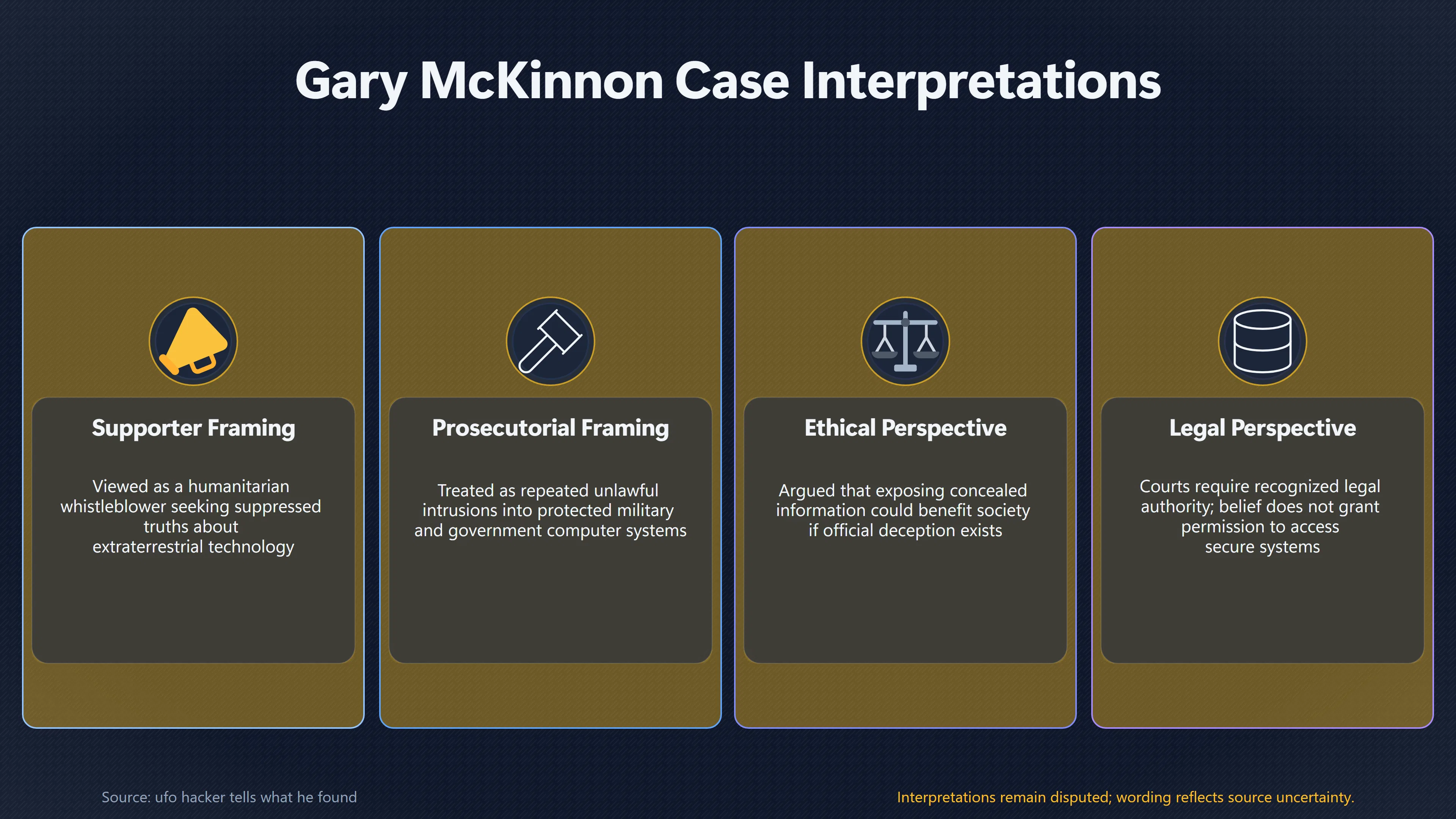
Supporters described a public-service search for hidden knowledge, while prosecutors described intentional access and damage to protected defence systems.
On this page
- How supporters framed Mc Kinnon's purpose
- How US prosecutors characterized the conduct
- Why motive and legality remained separate questions
Page outline Jump by section
Introduction
Gary McKinnon’s case became a defining example of the gap between a hacker’s claimed moral purpose and the way cybercrime law evaluates unauthorised access. Within UFO disclosure culture, McKinnon argued that he was searching for evidence of concealed extraterrestrial technology, antigravity research and suppressed “free energy” that he believed should belong to humanity. His supporters therefore portrayed him as a whistleblower without an insider position—a curious investigator acting in what he saw as the public interest rather than for financial gain or espionage. US authorities, however, treated the same conduct as repeated unlawful intrusions into protected military and government computer systems. Under cybercrime law, the decisive issue was not why he entered the networks but that he intentionally entered them without authorisation and allegedly caused significant damage.[wired.com]wired.comufo hacker tells what he foundWIRED'UFO Hacker' Tells What He Found | WIREDJune 21, 2006…
The resulting conflict illustrates a broader governance question raised by UFO-motivated hacking: can a sincere belief that governments are concealing important truths ever justify breaking into secure national-security systems? McKinnon’s case showed that the legal answer remained firmly negative.
How supporters framed McKinnon’s purpose
Supporters argued that McKinnon did not fit the public image of a profit-driven cybercriminal. In interviews, he consistently said that hacking was merely “a means to an end” and that he was looking for evidence supporting long-standing claims of UFO secrecy and hidden energy technologies. He maintained that governments were suppressing discoveries that could benefit ordinary people, giving his actions what he regarded as a humanitarian purpose rather than a criminal one.[WIRED]wired.comufo hacker tells what he foundWIRED'UFO Hacker' Tells What He Found | WIREDJune 21, 2006…
Within disclosure circles, this argument rested on several connected ideas:
- Government agencies allegedly possessed evidence hidden from the public.
- Conventional transparency mechanisms had supposedly failed to uncover it.
- Technical intrusion therefore became, in supporters’ eyes, an unconventional form of investigation.
- Because the intended goal was disclosure rather than personal enrichment, some sympathisers viewed the conduct as ethically different from theft, fraud or commercial hacking.[WIRED]wired.comufo hacker tells what he foundWIRED'UFO Hacker' Tells What He Found | WIREDJune 21, 2006…
This framing also explained why many supporters described McKinnon as a campaigner or truth seeker instead of a malicious attacker. The emphasis remained on his stated beliefs about secrecy rather than on financial motives or geopolitical objectives.
How US prosecutors characterised the conduct
The legal framing adopted by US prosecutors was fundamentally different. The indictment alleged repeated unauthorised access to military, NASA and Department of Defense systems, installation of remote administration tools, copying password files, deletion of user accounts and system files, and disruption affecting government networks. Prosecutors argued that these acts violated the Computer Fraud and Abuse Act regardless of McKinnon’s personal motivations.[Department of Justice]justice.govDepartment of JusticeLondon, England Hacker Indicted Under Computer Fraud and Abuse Act For Accessing Military Computers (November 12, 2002)…
Government statements described conduct that allegedly included:
- unauthorised access to dozens of military and civilian government computers;
- obtaining administrative privileges;
- installation of software to maintain access;
- deletion of critical files and accounts;
- disruption of network operations;
- substantial financial costs associated with investigation and recovery.[Department of Justice]justice.govDepartment of JusticeLondon, England Hacker Indicted Under Computer Fraud and Abuse Act For Accessing Military Computers (November 12, 2002)…
US authorities further alleged that one military network serving approximately 2,000 users lost internet and email services after system files were deleted, while other systems connected with defence logistics became unavailable during a period shortly after the September 2001 attacks. These allegations reinforced the government’s view that the case involved risks to national security rather than merely curiosity about classified information.[justice.gov]justice.govDepartment of JusticeLondon, England Hacker Indicted Under Computer Fraud and Abuse Act For Accessing Military Computers (November 12, 2002)…
Why motive and legality remained separate questions
McKinnon’s case illustrates an important principle found across modern cybercrime law: motive may influence sentencing or public opinion, but it generally does not determine whether the underlying offence occurred.
Computer misuse offences typically focus on questions such as:
- Was access authorised?
- Did the individual intentionally bypass access controls?
- Was protected information or infrastructure accessed?
- Was damage or impairment caused?
Whether the individual hoped to expose corruption, satisfy curiosity, seek UFO evidence or obtain financial gain usually comes only after those legal elements have been established.[Department of Justice]justice.govDepartment of JusticeLondon, England Hacker Indicted Under Computer Fraud and Abuse Act For Accessing Military Computers (November 12, 2002)…
This distinction reflects a governance concern. National-security computer systems exist to protect defence operations, personnel and sensitive information. Allowing individuals to decide unilaterally that their personal moral beliefs justify entering those systems would undermine the legal framework intended to protect them. The law therefore separates the sincerity of a person’s beliefs from the legality of their methods.
The public-interest argument met a legal dead end
One reason the debate became so polarised was that “public interest” carries different meanings in ethics and criminal law.
From an ethical perspective, supporters argued that exposing concealed information could benefit society if extraordinary technologies or official deception truly existed.
From a legal perspective, however, courts generally require recognised legal authority for disclosure. Protected systems cannot ordinarily be accessed simply because an individual believes important information might be hidden inside them. Whistleblower protections, where they exist, are generally designed for insiders acting through specified legal channels rather than outsiders who obtain access unlawfully.
Consequently, even if McKinnon genuinely believed he was acting for humanity’s benefit, that belief did not create legal permission to access military networks without authorisation.[Department of Justice]justice.govDepartment of JusticeLondon, England Hacker Indicted Under Computer Fraud and Abuse Act For Accessing Military Computers (November 12, 2002)…

Why the case continues to matter
The McKinnon case remains significant because it exposed a recurring tension between transparency movements and cybersecurity governance.
For UFO disclosure advocates, it demonstrated how deeply held convictions about government secrecy could encourage people to view digital intrusion as investigative activism rather than criminal conduct.
For governments and cybersecurity professionals, it reinforced the opposite lesson: intentions cannot substitute for authorisation when protected defence systems are involved. If legal standards depended upon each individual’s claimed moral purpose, enforcement of cybersecurity laws would become unpredictable and national-security protections substantially weaker.
The enduring importance of the case therefore lies less in whether McKinnon’s UFO claims were correct than in the precedent it illustrates. His prosecution highlighted that cybercrime law judges unauthorised access primarily by the act itself, while debates about public interest, belief and motive remain largely separate questions considered outside the core determination of criminal liability.
Amazon book picks
Further Reading
Books and field guides related to Public Interest Mission or Unauthorized Intrusion?. Use these as the next step if you want deeper reading beyond the article.
The Hacker Crackdown: Law and Disorder on the Electronic Fron...
The bestselling cyberpunk author "has produced by far the most stylish report from the computer outlaw culture since Steven Levy's Hacker...
Ghost in the Wires: My Adventures as the World's Most Wanted...
In this "intriguing, insightful and extremely educational" novel, the world's most famous hacker teaches you easy cloaking and counter-me...
Permanent Record
NEW YORK TIMES BESTSELLER Edward Snowden, the man who risked everything to expose the US government’s system of mass surveillance, reveal...
Data and Goliath: The Hidden Battles to Collect Your Data and...
You are under surveillance right now. Your cell phone provider tracks your location and knows who’s with you. Your online and in-store pu...
eBay marketplace picks
Marketplace Samples
Live-tested eBay searches with available results related to this page.
Selected fromufo pin oneBay.co.uk.

Endnotes
1.
Source: wired.com
Title: ufo hacker tells what he found
Link:https://www.wired.com/2006/06/ufo-hacker-tells-what-he-found/
Source snippet
WIRED'UFO Hacker' Tells What He Found | WIREDJune 21, 2006...
Published: June 21, 2006
2.
Source: justice.gov
Link:https://www.justice.gov/archive/criminal/cybercrime/press-releases/2002/mckinnonIndict.htm
Source snippet
Department of JusticeLondon, England Hacker Indicted Under Computer Fraud and Abuse Act For Accessing Military Computers (November 12, 2002)...
Published: November 12, 2002
3.
Source: wired.com
Title: Terrorist or UFO Truth Seeker? | WIRED
Link:https://www.wired.com/2006/04/terrorist-or-ufo-truth-seeker/
Source snippet
Terrorist or UFO Truth Seeker? | WIRED...
4.
Source: wired.com
Title: British Pentagon Hacker Loses Extradition Appeals | WIRED
Link:https://www.wired.com/2009/07/mckinnon/
Source snippet
British Pentagon Hacker Loses Extradition Appeals | WIRED...
5.
Source: wired.com
Title: mckinnon extradition win
Link:https://www.wired.com/2012/10/mckinnon-extradition-win/
6.
Source: wired.com
Title: aclu mckinnon
Link:https://www.wired.com/2009/08/aclu-mckinnon/
7.
Source: wired.com
Title: british ufo hac
Link:https://www.wired.com/2008/07/british-ufo-hac/
8.
Source: wired.com
Title: accused pentagon hacker in court
Link:https://www.wired.com/2005/06/accused-pentagon-hacker-in-court/
9.
Source: wired.com
Title: brit fights hacking extradition
Link:https://www.wired.com/2002/11/brit-fights-hacking-extradition/
10.
Source: GOV.UK
Title: Latest on Gary [Mc Kinnon case]({{ ‘mc-kinnon-case/’ | relative_url }})
Link:https://www.gov.uk/government/news/latest-on-gary-mckinnon-case
Source snippet
Latest on Gary McKinnon case - GOV.UK...
Additional References
11.
Source: reddit.com
Link:https://www.reddit.com/r/UFOs/comments/t0imdw
Source snippet
Hi, i'm Gary Mckinnon. I was in the news for a decade after getting caught 'hacking' mil/gov systems looking for evidence of UFO/UA...
12.
Source: tandfonline.com
Link:https://www.tandfonline.com/doi/full/10.1080/13600869.2022.2061888
Source snippet
This is because they are particularly amenable to giving rise to transnational effects and...
13.
Source: thelifehacker.org
Title: There are a lot of interesting stories, far-out fears,
Link:https://thelifehacker.org/2022/12/19/this-man-hacked-nasa-and-describes-what-he-found-in-interview/
Source snippet
This Man Hacked NASA And Describes What He Found in InterviewDecember 19, 2022 — THIS MAN HACKED NASA AND DESCRIBES WHAT HE FOUND IN INTE...
Published: December 19, 2022
14.
Source: shura.shu.ac.uk
Title: shu.ac.uk Hackers beware: the cautionary story of Gary Mc Kinnon
Link:https://shura.shu.ac.uk/22672/
Source snippet
Hackers beware: the cautionary story of Gary McKinnon. Information and communications technology law, 18 (1)...
15.
Source: youtube.com
Title: Gary Mc Kinnon will not face prosecution in the UK
Link:https://www.youtube.com/watch?v=viLcoe_xPMU
Source snippet
Gary McKinnon wins extradition battle This video provides contemporary reporting on the UK decision regarding Gary McKinnon's extradition...
16.
Source: tandfonline.com
Link:https://www.tandfonline.com/doi/full/10.1080/13600830902727822
17.
Source: youtube.com
Title: British ‘UFO’ hacker loses extradition battle
Link:https://www.youtube.com/watch?v=CKxQ7XVntIA
Source snippet
Gary McKinnon will not face prosecution in the UK...
18.
Source: theguardian.com
Link:https://www.theguardian.com/technology/2008/jun/16/hacking.internationalcrime
19.
Source: youtube.com
Title: Hacking for UFOs and fighting for his life. Who is Gary Mc Kinnon? | Nord VPN
Link:https://www.youtube.com/watch?v=OImdnvQx7sQ
Source snippet
UK hacker's extradition to US blocked...
20.
Source: parliament.uk
Title: U K-US Extradition Treaty in the spotlight as Lords question US legal experts
Link:https://www.parliament.uk/business/lords/media-centre/house-of-lords-media-notices/2014/july-2014/uk-us-extradition/