Within Claim Checklist
Can Metadata Reveal a Fake UFO File?
Dates, software fields, revision traces and hidden content can strengthen a claimed origin, but metadata alone cannot prove authenticity.
On this page
- Which metadata fields matter most
- How metadata can be altered or lost
- Why surrounding files and systems still matter
Page outline Jump by section
Introduction
When evaluating a claimed UFO-related file recovered through hacking or an alleged government leak, metadata can either strengthen confidence in the file’s history or raise serious doubts about it. Metadata includes information such as creation dates, modification times, software used, author fields, camera information, file-system timestamps and revision histories. These details help investigators reconstruct how a file moved through digital systems, but they do not prove that its contents are true or that an extraordinary interpretation is correct. Digital forensics treats metadata as one source of evidence that must be tested alongside provenance, system logs, surrounding files and the broader technical environment.[NIST Computer Security Resource Center]csrc.nist.govComputer Security Resource Centerdigital forensicsNIST Computer Security Resource Centerdigital forensics - Glossary | CSRC…
Within the context of UFO hacking claims such as those associated with Gary McKinnon, metadata is therefore most valuable as a mechanism for evaluating authenticity rather than validating extraordinary conclusions. Even apparently convincing timestamps or document properties must be considered together with independent evidence showing where the file came from and whether it has remained unaltered.
Which metadata fields matter most?
Different file types preserve different forms of metadata, and each answers a different investigative question.
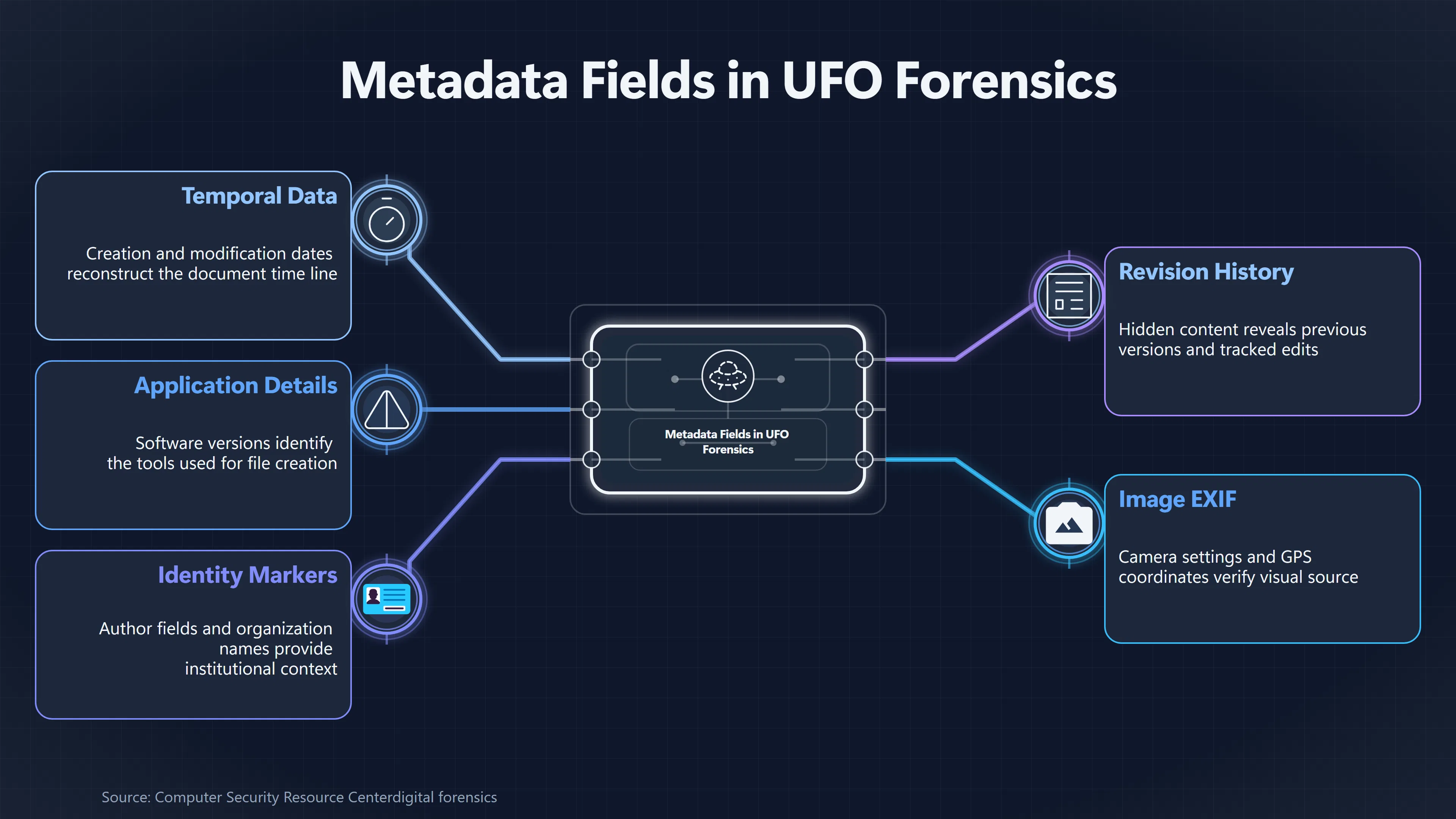
Creation, modification and access timestamps help reconstruct a timeline. If a document claimed to have originated on a government network was supposedly created years after the relevant system had been retired, or shows impossible sequences of events, credibility is reduced. Conversely, timestamps that match independently documented system activity can support a file’s provenance, although they still do not prove its contents are genuine. Modern forensic research also shows that investigators compare multiple timestamp records because different file systems often maintain several independent time values.[DOI]doi.orgConnecting File Timestamps: A Formal Approach | Proceedings of the Digital Forensics Doctoral SymposiumMarch 23, 2026…
Application metadata can identify the software that created or edited a file. Microsoft Office documents, PDFs and image editors frequently record program names, version numbers, template identifiers and save histories. If a purportedly classified document claims to date from 1998 but contains metadata showing it was last saved with software first released many years later, the claimed origin becomes doubtful.
Author and organisation fields sometimes preserve usernames, department names or computer identifiers. These can occasionally match known naming conventions inside an organisation. However, such fields are easily edited and should never be treated as proof by themselves.
Revision history and hidden content may reveal previous document versions, tracked edits, comments or deleted text. These artefacts can expose fabrication if they show modern editing of a supposedly historical document, or they may provide useful corroboration if they align with a documented workflow.
Image metadata, particularly EXIF (Exchangeable Image File Format) information, may record camera model, lens, exposure settings, GPS coordinates or editing software. For satellite imagery or exported scientific images, other embedded metadata may identify processing pipelines or instrument details. Consistency between these fields and the claimed source can increase confidence that an image has not simply been invented.[NIST]tsapps.nist.govget pdf.cfmNIST Trustworthy and Responsible AIOctober 19, 2025…
How metadata can be altered or lost
One of the biggest misconceptions in UFO document discussions is that metadata is either perfectly trustworthy or completely meaningless. In reality, it occupies the middle ground.
Metadata can disappear during perfectly ordinary handling. Saving a document into another format, exporting a PDF, copying files between operating systems, uploading images to social media or extracting files from archives may remove or rewrite timestamps and embedded properties. Missing metadata therefore does not automatically imply deliberate concealment.
Likewise, much metadata can be deliberately modified. Numerous legitimate administrative tools—and many forensic or anti-forensic utilities—allow timestamps, author names and document properties to be changed. Researchers studying timestamp manipulation have shown that individual metadata fields are vulnerable to alteration, making it dangerous to rely on a single timestamp or property without corroboration.[arXiv]arxiv.orgStrategies and Challenges of Timestamp Tampering for Improved Digital Forensic Event Reconstruction (extended version)December 30, 2024…
Even apparently suspicious metadata may have innocent explanations. For example:
- File copies often receive new creation dates while preserving modification dates.
- Restored backups may inherit filesystem timestamps from the restoration process.
- Cloud synchronisation services can rewrite metadata during migration.
- Image-editing software frequently updates modification times while preserving original capture information.
Forensic practice therefore emphasises identifying patterns across many metadata elements rather than treating one field as decisive.
Why surrounding files and systems still matter
Metadata becomes much more persuasive when it fits into a larger technical picture.
Suppose someone claims that a spreadsheet mentioning unidentified spacecraft originated from a government server. Metadata indicating an early-2000s version of Microsoft Excel is interesting, but investigators would also ask:
- Does the filename follow the organisation’s naming conventions?
- Are neighbouring files consistent with the same department and period?
- Do server logs or backup records show the file existed?
- Do directory structures and permissions match the claimed location?
- Does the document reference projects, people or systems known to have existed at that time?
Digital forensics defines provenance as the documented history of a file’s origin, handling and modification. Metadata contributes to provenance, but provenance also depends on chain of custody, acquisition methods and independent records describing how the evidence moved from the original system to investigators.[NIST Computer Security Resource Center]csrc.nist.govComputer Security Resource CenterprovenanceNIST Computer Security Resource Centerprovenance - Glossary | CSRC…
This distinction is particularly important when evaluating files allegedly recovered during unauthorised access. A copied document with intact metadata is still less persuasive than one whose existence is independently confirmed by server logs, backup media or multiple consistent forensic artefacts.
Applying metadata analysis to UFO hacking claims
Gary McKinnon’s account illustrates the limits of metadata-based arguments. He has consistently stated that he viewed unusual images and spreadsheets while accessing NASA and United States military systems, but publicly available evidence does not include the original files with preserved metadata that independent analysts could examine. His claims therefore rely primarily on testimony rather than metadata-supported digital evidence.[Reddit]reddit.comHi, i'm Gary Mckinnon. I was in the news for a decade after getting caught 'hacking' mil/gov systems looking for evidence of UFO/UA…
If original files had been preserved, investigators would want to examine far more than the visible content. Questions would include:
- Were document timestamps internally consistent?
- Did software versions match the claimed time period?
- Did embedded author fields correspond to known institutional practices?
- Was there evidence of repeated editing or later modification?
- Did metadata agree with server logs, directory structures and related files?
Only after these questions were answered would it become reasonable to discuss what the files might actually mean.

What metadata can—and cannot—tell you
Metadata is best understood as evidence about a file’s history rather than evidence about extraordinary events.
It can strengthen authenticity when multiple independent metadata fields align with known technical facts, organisational practices and forensic records. It can undermine authenticity when timestamps conflict, software versions are impossible, revision histories reveal later editing or embedded properties contradict the claimed origin.
However, metadata alone cannot establish that a UFO image depicts a genuine unidentified craft, that a spreadsheet describes a secret space programme or that a document reflects official policy. Those conclusions require corroboration from the surrounding digital environment, preserved provenance and independent technical evidence. Digital forensic methodology is built on precisely this principle: no single artefact, including metadata, should be interpreted in isolation.
Amazon book picks
Further Reading
Books and field guides related to Can Metadata Reveal a Fake UFO File?. Use these as the next step if you want deeper reading beyond the article.
File System Forensic Analysis
The Definitive Guide to File System Analysis: Key Concepts and Hands-on Techniques Most digital evidence is stored within the computer's...
Digital Evidence and Computer Crime
Digital Evidence and Computer Crime, Second Edition, is a hands-on resource that aims to educate students and professionals in the law en...
Windows Forensic Analysis Toolkit
Harlan Carvey has updated Windows Forensic Analysis Toolkit, now in its fourth edition, to cover Windows 8 systems. The primary focus of...
Metadata
First published 2015. Subjects: Metadata, Information organization, Information science.
eBay marketplace picks
Marketplace Samples
Live-tested eBay searches with available results related to this page.
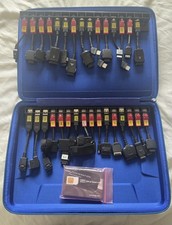
Selected fromdigital forensics kit oneBay.co.uk.

Endnotes
1.
Source: csrc.nist.gov
Title: Computer Security Resource Centerdigital forensics
Link:https://csrc.nist.gov/glossary/term/digital_forensics
Source snippet
NIST Computer Security Resource Centerdigital forensics - Glossary | CSRC...
2.
Source: csrc.nist.gov
Title: Computer Security Resource Centermetadata
Link:https://csrc.nist.gov/glossary/term/metadata
Source snippet
NIST Computer Security Resource Centermetadata - Glossary | CSRC...
3.
Source: csrc.nist.gov
Title: Computer Security Resource Centerprovenance
Link:https://csrc.nist.gov/glossary/term/Provenance
Source snippet
NIST Computer Security Resource Centerprovenance - Glossary | CSRC...
4.
Source: doi.org
Link:https://doi.org/10.1145/3785318.3785319
Source snippet
Connecting File Timestamps: A Formal Approach | Proceedings of the Digital Forensics Doctoral SymposiumMarch 23, 2026...
Published: March 23, 2026
5.
Source: nist.gov
Link:https://www.nist.gov/publications/provenience-based-cross-verification-digital-forensic-artifacts-applied-ntfs
Source snippet
Provenience-based cross-verification of digital forensic artifacts applied to NTFS | NIST...
6.
Source: tsapps.nist.gov
Title: get pdf.cfm
Link:https://tsapps.nist.gov/publication/get_pdf.cfm?pub_id=959123
Source snippet
NIST Trustworthy and Responsible AIOctober 19, 2025...
Published: October 19, 2025
7.
Source: arxiv.org
Link:https://arxiv.org/abs/2501.00175
Source snippet
Strategies and Challenges of Timestamp Tampering for Improved Digital Forensic Event Reconstruction (extended version)December 30, 2024...
Published: December 30, 2024
8.
Source: csrc.nist.gov
Title: Computer Security Resource Centerdata provenance
Link:https://csrc.nist.gov/glossary/term/data_provenance
Source snippet
NIST Computer Security Resource Centerdata provenance - Glossary | CSRC...
9.
Source: csrc.nist.gov
Title: Computer Security Resource Centerchain of custody
Link:https://csrc.nist.gov/glossary/term/chain_of_custody
Source snippet
NIST Computer Security Resource Centerchain of custody - Glossary | CSRC...
10.
Source: reddit.com
Link:https://www.reddit.com/r/UFOs/comments/t0imdw
Source snippet
Hi, i'm Gary Mckinnon. I was in the news for a decade after getting caught 'hacking' mil/gov systems looking for evidence of UFO/UA...
11.
Source: reddit.com
Title: Finding Leaked Gary Mckinnon documents
Link:https://www.reddit.com/r/UFOs/comments/15d4dzr
Source snippet
Finding Leaked Gary Mckinnon documents...
12.
Source: youtube.com
Title: UFO Hacker Shares New Secrets | Gary Mc Kinnon
Link:https://www.youtube.com/watch?v=_SOTGFj7BwI
Source snippet
Digital Forensics - Metadata Analysis #1 - Exiftool...
13.
Source: youtube.com
Title: Digital Forensics
Link:https://www.youtube.com/watch?v=HU_euJyxYB4
Source snippet
OSINT At Home #2 - Five ways to find EXIF/metadata in a photo or video...
Additional References
14.
Source: youtube.com
Title: How to view hidden picture metadata in a computer forensics case
Link:https://www.youtube.com/watch?v=pum8OW5Ecqc
Source snippet
Photo metadata image forensics digital evidence How Digital Forensics Exposes Deepfake AI Videos, Audio & Images Warrior Advocates | LOWMH...
15.
Source: youtube.com
Title: 5 Reasons Metadata Can’t Prove Your Photo—Or Any File—Is Real
Link:https://www.youtube.com/watch?v=Z4xP1gQNTNw
Source snippet
UFO Hacker Shares New Secrets | Gary McKinnon...
16.
Source: youtube.com
Title: OSINT At Home #2
Link:https://www.youtube.com/watch?v=d3NsT8lJRlE
Source snippet
How to view hidden picture metadata in a computer forensics case...