Within Mental Health
What Mental Health Evidence Should Courts Actually Trust?
Courts need more than a diagnosis; they must assess clinical quality, personal history, likely deterioration and the reality of available care.
On this page
- Independent diagnosis and clinical credibility
- Past self harm, intent and patterns of deterioration
- Treatment availability versus treatment in practice
Page outline Jump by section
Introduction
The legal significance of cases such as Gary McKinnon is not that mental illness or autism excuses cybercrime. Rather, they illustrate how courts test whether medical evidence is sufficiently reliable and closely connected to the legal decision before them. In cybercrime cases involving extradition, sentencing or trial, judges require more than a diagnostic label. They examine whether independent clinical evidence shows that the specific legal process would create a serious, foreseeable risk that cannot be adequately managed through ordinary safeguards. This distinction explains why some claims succeed while others fail: the court is evaluating evidence of risk, not simply recognising the existence of a medical condition.[GOV.UK]GOV.UKTheresa May statement on Gary Mc Kinnon extraditionTheresa May statement on Gary McKinnon extradition - GOV.UKOctober 16, 2012…
What Mental Health Evidence Should Courts Actually Trust?
Independent diagnosis and clinical credibility
The first question is not whether a defendant has a recognised psychiatric or neurodevelopmental condition, but whether the diagnosis is clinically robust and relevant to the legal issue.
Courts generally place greatest weight on evidence that demonstrates:
- assessment by appropriately qualified psychiatrists or psychologists;
- examination based on recognised diagnostic methods rather than brief opinion;
- consistency across multiple independent experts;
- explanation of functional effects rather than diagnostic labels alone; and
- a clear connection between the condition and the specific legal risk under consideration.
The McKinnon proceedings demonstrate this progression. Early challenges relied on evidence that courts considered insufficient to prevent extradition. Over time, additional psychiatric assessments, including independent medical advice obtained by the Home Secretary from specialists recommended through the Chief Medical Officer, produced a more comprehensive picture of McKinnon’s Asperger’s syndrome, depressive illness and suicide risk. The decision ultimately rested not on accepting a diagnosis alone but on evaluating the quality, consistency and independence of the clinical evidence.[GOV.UK]GOV.UKTheresa May statement on Gary Mc Kinnon extraditionTheresa May statement on Gary McKinnon extradition - GOV.UKOctober 16, 2012…
This approach also reflects a broader principle in forensic psychiatry: courts expect experts to explain why a condition affects legal risk. Simply stating that someone has autism, depression or anxiety provides little assistance unless the report explains how those conditions influence coping ability, decision-making, vulnerability to detention or risk of self-harm.
Past self-harm, intent and patterns of deterioration
Perhaps the most influential evidence concerns what the individual has actually done in the past rather than what they might theoretically do.
Courts commonly examine:
- previous suicide attempts or episodes of self-harm;
- longstanding suicidal ideation;
- psychiatric admissions;
- deterioration during earlier legal proceedings;
- reactions to stress, isolation or uncertainty; and
- evidence that risk increases in predictable circumstances.
This emphasis reflects an implementation question rather than a diagnostic one. Judges must decide whether a forecast of future harm is credible. A history showing repeated deterioration during periods of legal uncertainty generally carries more evidential weight than speculative predictions unsupported by previous behaviour.
In McKinnon’s case, ministers ultimately accepted that extradition created an exceptionally high risk that he would end his own life. That assessment emerged from multiple psychiatric evaluations and evidence linking his condition to the anticipated effects of extradition, separation from family support and prolonged proceedings abroad. The accepted risk was therefore individualised rather than based on general assumptions about autism or depression.[GOV.UK]GOV.UKTheresa May statement on Gary Mc Kinnon extraditionTheresa May statement on Gary McKinnon extradition - GOV.UKOctober 16, 2012…
The importance of documented deterioration can also be seen in cases where courts reject mental health arguments. Tribunals have declined to halt removal where they concluded that previous life events did not support predictions of suicide or where expert reports lacked a sufficiently persuasive factual foundation. In such cases, diagnosis alone proved inadequate because the evidence did not demonstrate a likely progression from mental illness to imminent catastrophic harm.[Tribunals Decisions]tribunalsdecisions.service.gov.ukTribunals Decisions Tribunal decisionsTribunals DecisionsTribunal decisionsJuly 15, 2019…
Why a Diagnosis Alone Is Never Enough
One of the strongest themes emerging from cybercrime extradition litigation is that courts resist treating medical labels as automatic legal outcomes.
A diagnosis may establish that someone is autistic or suffers from depression, but judges still ask:
- How severe is the condition?
- Is it stable or deteriorating?
- Does it impair everyday functioning?
- Would the proposed legal process materially worsen it?
- Can identified risks realistically be reduced?
This distinction prevents two opposite errors.
First, it avoids assuming that every defendant with autism or depression should escape prosecution. Autism spectrum conditions vary enormously in presentation, support needs and vulnerability.
Second, it prevents courts from dismissing genuine psychiatric evidence merely because many prisons offer mental health services. Availability of treatment does not necessarily establish that treatment will prevent predictable deterioration in a particular individual.
The later High Court decision concerning Lauri Love reinforced these principles. The court examined extensive forensic psychiatric evidence concerning autism spectrum disorder, depression, physical illness and suicide risk while considering whether extradition would become oppressive. The judgment illustrates that courts assess the interaction between clinical evidence, personal vulnerability and the realities of prosecution rather than relying on diagnosis in isolation.[PubMed]pubmed.ncbi.nlm.nih.govAutism spectrum disorder and suitability for extradition: Love v the Government of the United States [2018] 1 WLR 2889; [2018] EWHC…
Treatment Availability Versus Treatment in Practice
A recurring judicial question is whether adequate care genuinely exists after extradition or imprisonment.
This involves a practical assessment rather than an abstract one.
Courts consider factors such as:
- whether specialist psychiatric treatment will actually be accessible;
- likely waiting times;
- continuity of existing medication;
- access to clinicians familiar with complex conditions;
- family contact and informal support networks;
- prison conditions, including isolation; and
- whether supervision merely contains suicide risk rather than reducing it.
The McKinnon decision illustrates this distinction. The issue was not whether psychiatric services existed somewhere within the United States prison system. The Home Secretary concluded that, despite potential safeguards, the available evidence established such a high risk of suicide that extradition would breach his human rights. The analysis therefore focused on practical effectiveness for this individual rather than the theoretical existence of treatment facilities.[GOV.UK]GOV.UKTheresa May statement on Gary Mc Kinnon extraditionTheresa May statement on Gary McKinnon extradition - GOV.UKOctober 16, 2012…
Subsequent cybercrime extradition litigation has continued to examine this difference between treatment “on paper” and treatment likely to be delivered in reality. Courts increasingly scrutinise how vulnerable defendants would experience prolonged foreign detention, unfamiliar legal systems and separation from established support networks when evaluating whether protective measures are genuinely sufficient.[PubMed]pubmed.ncbi.nlm.nih.govAutism spectrum disorder and suitability for extradition: Love v the Government of the United States [2018] 1 WLR 2889; [2018] EWHC…
The Implementation Test Applied by Courts
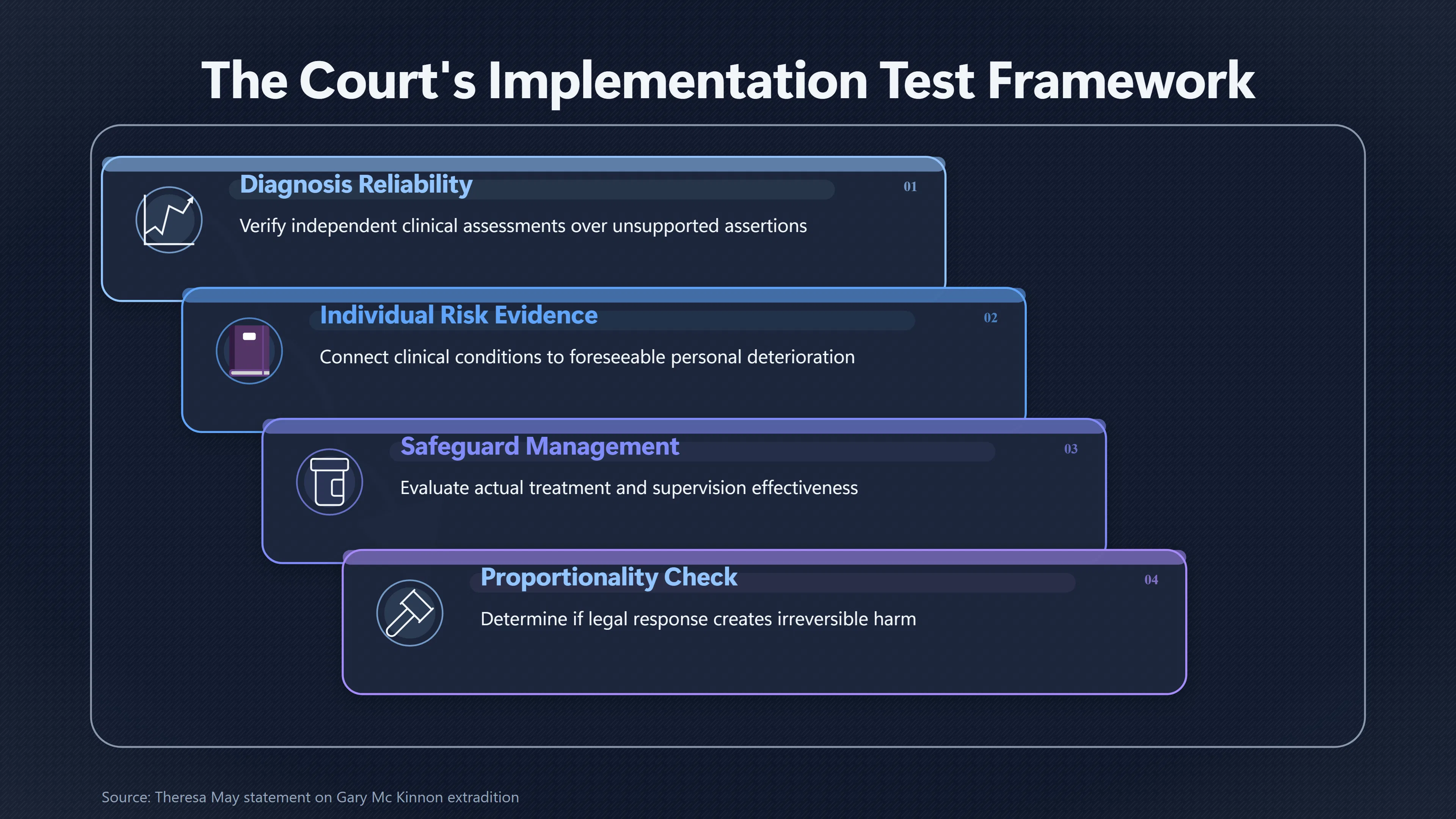
Across cybercrime proceedings, a consistent evidential framework has emerged. Courts tend to ask four linked questions:
- Is the diagnosis reliable? Independent, well-supported clinical assessments are generally preferred over unsupported assertions.
- Does the evidence demonstrate individual risk? The court looks for a documented history and clinically reasoned explanation connecting the condition to foreseeable deterioration.
- Can realistic safeguards manage that risk? Judges examine actual treatment, supervision and support rather than relying on general assurances.
- Is the legal response proportionate? Even where prosecution is justified, extradition or a particular procedure may become disproportionate if the evidence establishes an exceptional risk of irreversible harm.
The result is a demanding evidential standard. Mental health evidence succeeds not because a defendant belongs to a diagnostic category but because credible clinical evidence demonstrates that the proposed legal process creates a specific, foreseeable and inadequately manageable risk. Cases such as Gary McKinnon’s therefore remain important not as precedents for avoiding criminal responsibility, but as illustrations of how courts distinguish medical diagnosis from legally persuasive evidence.[GOV.UK]GOV.UKTheresa May statement on Gary Mc Kinnon extraditionTheresa May statement on Gary McKinnon extradition - GOV.UKOctober 16, 2012…
Amazon book picks
Further Reading
Books and field guides related to What Mental Health Evidence Should Courts Actually Trust?. Use these as the next step if you want deeper reading beyond the article.
Forensic Psychiatry
Forensic Psychiatry is the first book to cover the clinical, legal and ethical issues for the treatment of mentally disordered offenders...
An Expert Witness: Forensic Science on Trial
From the UK’s leading forensic scientist and Sunday Times bestselling author of All That Remains and Written in Bone: a gripping explorat...
The Oxford Handbook of Forensic Psychiatry
This book covers the basic science and neurobiology of violence and integrates this with clinical, legal, and ethical aspects of forensic...
Rix's Expert Psychiatric Evidence
Rix's Expert Psychiatric Evidence is a resource manual and guide for psychiatrists who provide expert testimony. It covers the entire exp...
eBay marketplace picks
Marketplace Samples
Live-tested eBay searches with available results related to this page.
Selected frommental health awareness pin oneBay.co.uk.




Endnotes
1.
Source: GOV.UK
Title: Theresa May statement on Gary Mc Kinnon extradition
Link:https://www.gov.uk/government/news/theresa-may-statement-on-gary-mckinnon-extradition
Source snippet
Theresa May statement on Gary McKinnon extradition - GOV.UKOctober 16, 2012...
Published: October 16, 2012
2.
Source: tribunalsdecisions.service.gov.uk
Title: Tribunals Decisions Tribunal decisions
Link:https://tribunalsdecisions.service.gov.uk/utiac/pa-03840-2015
Source snippet
Tribunals DecisionsTribunal decisionsJuly 15, 2019...
Published: July 15, 2019
3.
Source: pubmed.ncbi.nlm.nih.gov
Link:https://pubmed.ncbi.nlm.nih.gov/32944120/
Source snippet
Autism spectrum disorder and suitability for extradition: Love v the Government of the United States [2018] 1 WLR 2889; [2018] EWHC...
Additional References
4.
Source: independent.co.uk
Link:https://www.independent.co.uk/news/uk/home-news/gary-mckinnon-extradition-decision-due-by-midoctober-7972826.html
Source snippet
Gary McKinnon extradition decision due by mid-October | The Independent | The IndependentJuly 24, 2012 — GARY MCKINNON EXTRADITION DECISI...
Published: July 24, 2012
5.
Source: wired.com
Link:https://www.wired.com/story/lauri-love-hacker-appeal-decision-extradition-court-uk
Source snippet
Love, accused of hacking US government bodies and facing up to 99 years in prison and significant fines, suffers from Asperger's Syndrome...
6.
Source: independent.co.uk
Link:https://www.independent.co.uk/news/uk/home-news/gary-mckinnon-medical-report-offers-hope-against-extradition-8209736.html
Source snippet
News 2. UK 3. Home News GARY MCKINNON MEDICAL REPORT OFFERS HOPE AGAINST EXTRADITION Martin Hickman Friday 12 October 2012 19:18 BST * *...
Published: October 2012
7.
Source: iclr.co.uk
Title: Polom v Regional Court in Bydgoszcz, Poland
Link:https://www.iclr.co.uk/document/2024006290/2024ewhc2708admin_TNA/html
Source snippet
Otherwise, the principal factors against extradition remain, as they did at the time of the extradition hearing, Mr Polom’s mental ill-he...
8.
Source: youtube.com
Title: Theresa May blocks Gary Mc Kinnon’s extradition to US
Link:https://www.youtube.com/watch?v=5MEQVo8ENC8
Source snippet
The Man Who Hacked the U.S. Government This video provides comprehensive context on Gary McKinnon's case, detailing how independent psych...
9.
Source: independent.co.uk
Link:https://www.independent.co.uk/news/uk/crime/computer-hacker-gary-mckinnon-refuses-more-medical-tests-7959448.html
10.
Source: independent.co.uk
Link:https://www.independent.co.uk/news/uk/home-news/hacker-refused-right-to-appeal-extradition-to-us-1800184.html
11.
Source: independent.co.uk
Link:https://www.independent.co.uk/news/uk/home-news/fresh-move-to-save-gary-mckinnon-from-us-trial-1837807.html
12.
Source: independent.co.uk
Link:https://www.independent.co.uk/news/uk/crime/hacker-wins-permission-to-challenge-extradition-1513970.html
13.
Source: independent.co.uk
Link:https://www.independent.co.uk/news/uk/home-news/hacker-declared-fit-to-stand-trial-in-us-court-7595111.html