Within Motive and Law
Where Security Research Ends and Intrusion Begins
Limited testing, avoidance of private data and prompt confidential reporting distinguish responsible security research from prolonged exploration.
On this page
- Authorisation and restraint in legitimate testing
- Why data avoidance and prompt reporting matter
- Conduct that weakens a research justification
Page outline Jump by section
Introduction
Curiosity about hidden information, including claims of secret UFO programmes such as those associated with Gary McKinnon’s stated motivations, does not by itself distinguish legitimate security research from unlawful intrusion. The critical distinction is not whether someone believes they are serving the public interest, but whether they have authorisation, limit their actions to what is necessary, avoid exposing or collecting private information, and promptly report any genuine security weakness through an appropriate disclosure process. Modern vulnerability disclosure frameworks were developed precisely to encourage responsible reporting while reducing harm. They recognise that security research can improve resilience, but they do not treat curiosity or good intentions as a substitute for permission or legal authority.[National Cyber Security Centre]ncsc.gov.ukNational Cyber Security CentreVulnerability reporting & disclosure | National Cyber Security CentreNovember 28, 2024…
Where Security Research Ends and Intrusion Begins
Responsible disclosure is built around restraint. A researcher who discovers a potential vulnerability is expected to gather only enough evidence to demonstrate that the problem exists, minimise any interaction with sensitive systems, and stop once the issue has been confirmed. The objective is to help the system owner fix a security weakness, not to explore the network, search for unrelated information or satisfy personal curiosity.[National Cyber Security Centre]ncsc.gov.ukNational Cyber Security Centre The NCSC's Vulnerability Disclosure ToolkitNational Cyber Security Centre The NCSC's Vulnerability Disclosure Toolkit
Intrusion follows a different pattern. It commonly involves continuing beyond what is necessary, accessing systems without permission, examining information unrelated to the original discovery or deliberately bypassing security controls. Even where no financial motive exists, prolonged exploration weakens any claim that the activity was limited to responsible research. This distinction is particularly relevant when considering curiosity-driven hacking cases, where the stated purpose may differ sharply from the conduct actually carried out.
Authorisation and Restraint in Legitimate Testing
Responsible security research depends first on authorisation. That authorisation may come through:
- A published vulnerability disclosure policy.[ncsc.gov.uk]ncsc.gov.ukNational Cyber Security CentreVulnerability reporting & disclosure | National Cyber Security CentreNovember 28, 2024…
- A bug bounty programme.
- A contractual penetration-testing engagement.
- Explicit written permission from the system owner.
Without one of these, researchers enter legally uncertain territory, especially if they deliberately test security controls rather than merely observing an obvious flaw. Government guidance increasingly encourages organisations to publish vulnerability disclosure policies so researchers know both what testing is permitted and how findings should be reported.[National Cyber Security Centre]ncsc.gov.ukNational Cyber Security Centre The NCSC's Vulnerability Disclosure ToolkitNational Cyber Security Centre The NCSC's Vulnerability Disclosure Toolkit
Importantly, many disclosure policies also define clear limits. Researchers are commonly instructed not to:
- Escalate privileges.
- Access unnecessary data.
- Modify or delete information.
- Disrupt services.
- Conduct destructive or high-volume testing.
- Continue exploring after confirming a vulnerability.
These restrictions exist because every additional step increases potential harm and makes the activity resemble unauthorised intrusion rather than careful validation.[GOV.UK]GOV.UKVulnerability disclosure policy: MHCLG19, 2021…
Why Data Avoidance and Prompt Reporting Matter
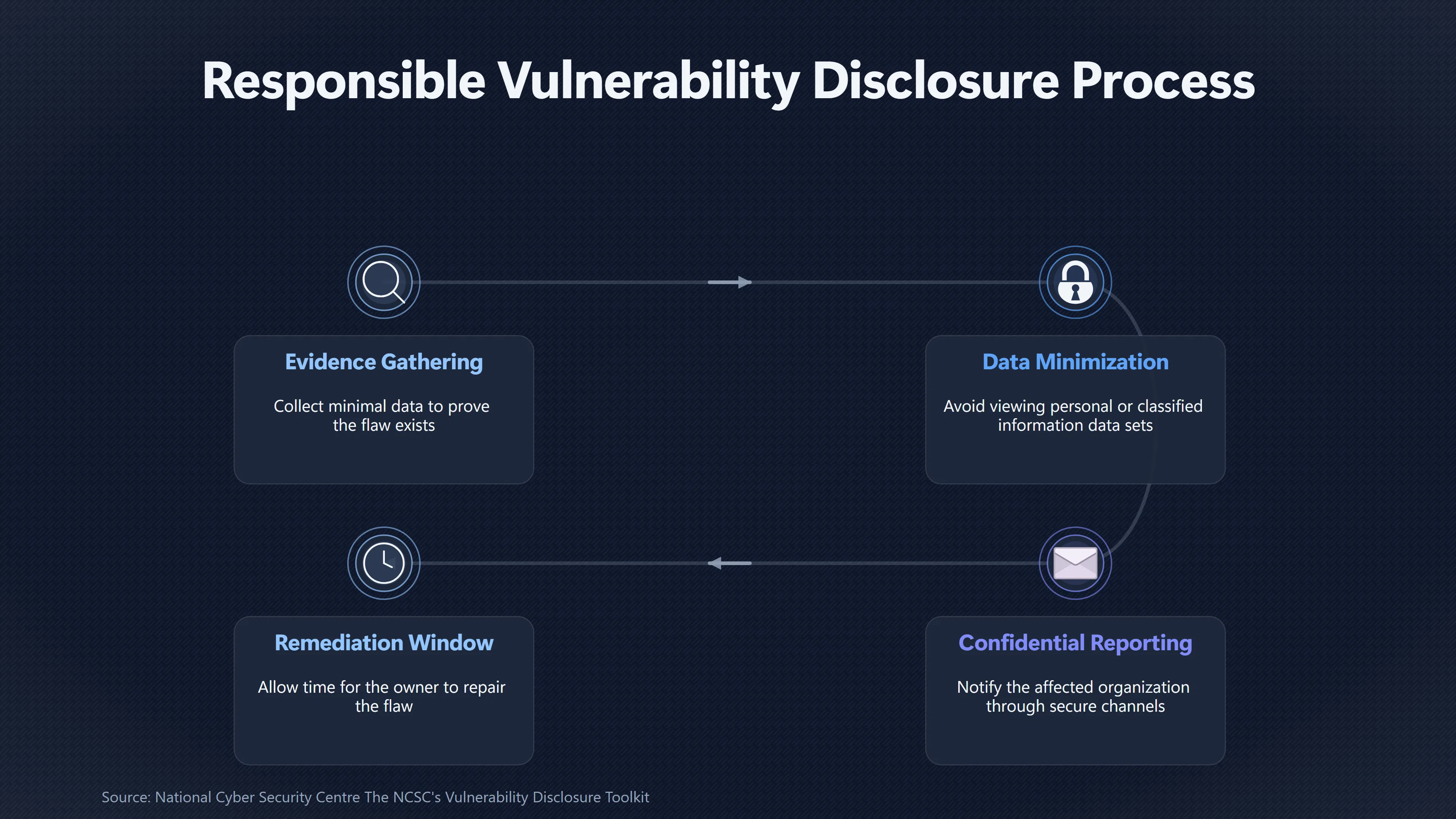
Responsible disclosure seeks to reduce both security risk and privacy harm. For that reason, experienced researchers typically demonstrate a vulnerability using the smallest amount of evidence possible instead of collecting extensive datasets or copying confidential material.
Good disclosure practice generally includes:
- Demonstrating only enough evidence to prove the vulnerability exists.
- Avoiding viewing personal or classified information whenever possible.
- Securely handling and deleting any data that is inadvertently encountered.
- Reporting the issue confidentially to the affected organisation.
- Allowing time for remediation before public disclosure.
These expectations appear repeatedly in government vulnerability disclosure programmes. NHS England, for example, instructs researchers not to violate users’ privacy, not to redistribute retrieved data and not to treat participation as permission for broader system access. Similar guidance appears across UK government disclosure policies.[nhs.uk]england.nhs.ukEngland NHS England » Security vulnerability disclosure policyNHS EnglandNHS England » Security vulnerability disclosure policy…
Prompt confidential reporting also serves an important practical purpose. It gives the affected organisation an opportunity to investigate, validate and repair the vulnerability before attackers can exploit it. Coordinated disclosure frameworks are intended to balance transparency with public safety rather than encourage immediate publication.[govt.nz]ncsc.govt.nzNCSC NZCoordinated vulnerability disclosure policyNCSC NZCoordinated vulnerability disclosure policy
Conduct That Weakens a Research Justification
Courts and investigators rarely assess only what someone claims they intended. They also examine what the person actually did.
Several forms of conduct tend to undermine a claim of responsible research:
- Continuing to browse unrelated systems after identifying the original flaw.
- Searching for confidential documents instead of validating the vulnerability.
- Downloading or retaining large quantities of data.
- Attempting privilege escalation or lateral movement.
- Concealing activity through persistence or extensive evasion techniques.
- Delaying disclosure while continuing exploration.
Each of these actions suggests that the activity moved beyond minimal verification into broader unauthorised investigation. A researcher may begin with a legitimate observation but lose the benefit of that explanation if their subsequent conduct expands significantly beyond what was necessary to identify and report the issue.
This distinction helps explain why lengthy intrusions are viewed differently from limited security testing. In cases involving prolonged access to government or military systems, the issue is not merely that vulnerabilities were encountered, but that the individual continued exploring protected networks for purposes unrelated to responsible remediation.
Why This Matters in Curiosity-Driven Hacking
Gary McKinnon consistently maintained that he was searching for evidence relating to UFOs, advanced technology and government secrecy rather than seeking financial gain. Even accepting that explanation as describing his motive, it differs fundamentally from recognised responsible disclosure practices.
Responsible disclosure would ordinarily involve identifying a vulnerability, limiting interaction with affected systems, avoiding sensitive information and notifying the owner. McKinnon’s publicly described conduct, by contrast, involved repeated unauthorised access across numerous US government and defence computers over an extended period while searching for information unrelated to the existence of a security flaw. Those characteristics align far more closely with unauthorised intrusion than with coordinated vulnerability research.
The comparison illustrates an important legal and ethical principle. Responsible disclosure is defined less by a person’s stated intentions than by disciplined, authorised and carefully limited behaviour designed to reduce harm. Once exploration becomes prolonged, searches extend into confidential material or access continues without permission, the justification shifts away from security research and towards unauthorised intrusion, regardless of whether the underlying motivation was curiosity, ideology or personal belief.[National Cyber Security Centre]ncsc.gov.ukNational Cyber Security CentreVulnerability reporting & disclosure | National Cyber Security CentreNovember 28, 2024…
Amazon book picks
Further Reading
Books and field guides related to Where Security Research Ends and Intrusion Begins. Use these as the next step if you want deeper reading beyond the article.
Bug Bounty Bootcamp: The Guide to Finding and Reporting Web V...
Bug Bounty Bootcamp teaches you how to hack web applications. You will learn how to perform reconnaissance on a target, how to identify v...
Real-World Bug Hunting: A Field Guide to Web Hacking
Learn how people break websites and how you can, too. Real-World Bug Hunting is the premier field guide to finding software bugs. Whether...
The Web Application Hacker's Handbook: Finding and Exploiting...
The highly successful security book returns with a new edition, completely updated Web applications are the front door to most organizati...
The Hacker and the State
Rating: 5.0/5 from 18 Google Books ratings
“A must-read...It reveals important truths.” —Vint Cerf, Internet pioneer “One of the finest books on information security published so f...
eBay marketplace picks
Marketplace Samples
Live-tested eBay searches with available results related to this page.
Selected fromcomputer security poster oneBay.co.uk.

Endnotes
1.
Source: ncsc.gov.uk
Link:https://www.ncsc.gov.uk/collection/vulnerability-management/reporting-disclosure
Source snippet
National Cyber Security CentreVulnerability reporting & disclosure | National Cyber Security CentreNovember 28, 2024...
Published: November 28, 2024
2.
Source: ncsc.gov.uk
Title: National Cyber Security Centre The NCSC’s Vulnerability Disclosure Toolkit
Link:https://www.ncsc.gov.uk/information/vulnerability-disclosure-toolkit
3.
Source: england.nhs.uk
Title: England NHS England » Security vulnerability disclosure policy
Link:https://www.england.nhs.uk/security-vulnerability-disclosure/
Source snippet
NHS EnglandNHS England » Security vulnerability disclosure policy...
4.
Source: ncsc.gov.uk
Link:https://www.ncsc.gov.uk/information/vulnerability-reporting
Source snippet
Do you believe you have found a vulnerability with a UK government online service? Please try to contact...
5.
Source: GOV.UK
Title: Vulnerability disclosure policy: MHCLG
Link:https://www.gov.uk/guidance/vulnerability-disclosure-policy-mhclg
Source snippet
19, 2021...
6.
Source: GOV.UK
Title: Report a vulnerability on a DBT system
Link:https://www.gov.uk/guidance/report-a-vulnerability-on-a-dbt-system
7.
Source: fcdoservices.gov.uk
Title: FCDO Services Vulnerability reporting
Link:https://www.fcdoservices.gov.uk/vulnerability-reporting/
Source snippet
We recommend reading this disclosure policy document fully...
8.
Source: ncsc.govt.nz
Title: NCSC NZCoordinated vulnerability disclosure policy
Link:https://www.ncsc.govt.nz/report/how-to-report-a-vulnerability/coordinated-vulnerability-disclosure-policy/
9.
Source: gca.gov.uk
Link:https://www.gca.gov.uk/about-gca/vulnerability-disclosure-policy
10.
Source: ncsc.nl
Title: De vinde
Link:https://www.ncsc.nl/cvd-beleid/in-vijf-stappen-naar-cvd-beleid
Source snippet
In vijf stappen naar CVD-beleid | NCSCIN VIJF STAPPEN NAAR CVD-BELEID * Publicatie * Leestijd: * CVD-beleid * Groeien Regelmatig worden n...
11.
Source: nls.uk
Title: Vulnerability disclosure policy | National Library of Scotland
Link:https://www.nls.uk/about-us/plans-and-policies/corporate-documents/vulnerability-disclosure-policy/
Source snippet
January 23, 2026 — VULNERABILITY DISCLOSURE POLICY Last updated 23 January 2026 Estimated reading time 3 minutes Vulnerability disclosure...
Published: January 23, 2026
Additional References
12.
Source: youtube.com
Title: How Can Ethical Disclosure Of Security Vulnerabilities Prevent Unintended Harm?
Link:https://www.youtube.com/watch?v=DMo4jAhC9tY
Source snippet
Responsible vulnerability disclosure vs hacking ethics Why Is Responsible Disclosure An Ethical Challenge In Cybersecurity? - Moral Polit...
13.
Source: ukfinance.org.uk
Title: We are committed to thoroughly invest
Link:https://www.ukfinance.org.uk/responsible-disclosure-policy
Source snippet
Responsible Disclosure Policy | Policy and Guidance | UK FinanceOur Promise UK Finance appreciates the investigative work into security v...
14.
Source: youtube.com
Title: DEF CON 30
Link:https://www.youtube.com/watch?v=duz7UXxR7tc
Source snippet
How Can Ethical Disclosure Of Security Vulnerabilities Prevent Unintended Harm?...
15.
Source: youtube.com
Title: Why Is Responsible Disclosure An Ethical Challenge In Cybersecurity?
Link:https://www.youtube.com/watch?v=X2UqVNtX1IU
Source snippet
Dos and Don'ts for Security Research and Disclosure with Kurt Opsahl...
16.
Source: youtube.com
Title: Dos and Don’ts for Security Research and Disclosure with Kurt Opsahl
Link:https://www.youtube.com/watch?v=ghc2iyDafb0
Source snippet
Ethical Vulnerability Disclosure - Daily Security Byte...
17.
Source: youtube.com
Title: Ethical Vulnerability Disclosure
Link:https://www.youtube.com/watch?v=l-AkwldvXOo
Source snippet
DEF CON 30 - Harley Geiger, Leonard Bailey - Hacking Law is for Hackers...
18.
Source: youtu.be
Title: What is cybersecurity?
Link:https://youtu.be/G1HOxaZvx5o
Source snippet
CompTIA Security+ SY0-701: Responsible Disclosure Programs (Ethical Hacking & Bug Bounty) CertPro Hub...