Within Access vs Proof
What Prosecutors Must Prove in Government Hacking Cases
UK and US computer crime laws focus on unauthorised access, obtained information, system impairment and damage rather than the truth of a hacker's beliefs.
On this page
- Unauthorised access under UK law
- Protected computers and damage under US law
- Why extraordinary content is legally irrelevant to the offence
Page outline Jump by section
Introduction
When governments prosecute computer intrusion cases, they are not required to prove that the defendant’s beliefs about the information they hoped to find were true. In cases such as Gary McKinnon’s, where the stated motivation was to search for evidence of UFOs or advanced technology, the legal questions are much narrower: did the accused intentionally gain unauthorised access, did they know they lacked permission, did they obtain information or interfere with protected systems, and, where alleged, did their actions cause damage or create a legally recognised risk of damage? The truth or falsity of any claimed discovery is generally irrelevant to establishing the offence itself.[Crown Prosecution Service]cps.gov.ukCrown Prosecution Service Computer Misuse Act | The Crown Prosecution ServiceCrown Prosecution ServiceComputer Misuse Act | The Crown Prosecution ServiceAugust 3, 2023…
This distinction explains why a prosecution for hacking cannot be treated as indirect proof that extraordinary material existed on the targeted computers. Criminal liability focuses on the conduct of accessing and affecting protected computer systems rather than on whether the defendant’s reasons for doing so were correct.
Unauthorised access under UK law
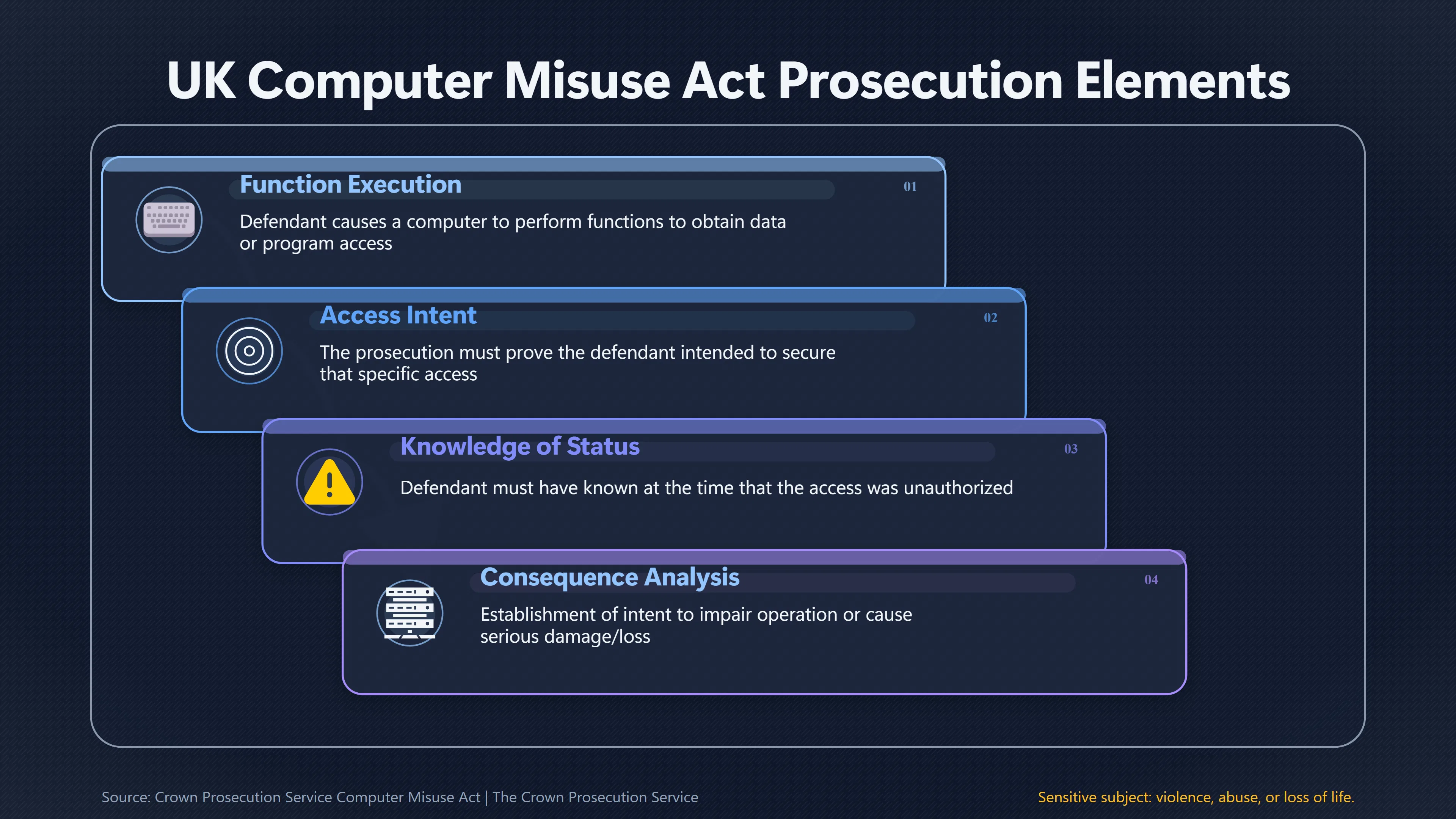
The principal UK legislation is the Computer Misuse Act 1990. For the basic offence of unauthorised access, prosecutors must establish several specific elements rather than proving anything about the contents of the computer.
They must show that the defendant:
- caused a computer to perform a function in order to obtain access to programs or data;
- intended to secure that access;
- knew at the time that the access was unauthorised.
Importantly, the prosecution does not have to prove that the defendant was looking for any particular file or that the sought-after information actually existed. The legislation deliberately covers situations where someone hacks into a system without knowing precisely what they expect to find. CPS guidance notes that the intention need only be to obtain access to “any” program or data, provided the access was known to be unauthorised.[Crown Prosecution Service]cps.gov.ukCrown Prosecution Service Computer Misuse Act | The Crown Prosecution ServiceCrown Prosecution ServiceComputer Misuse Act | The Crown Prosecution ServiceAugust 3, 2023…
For more serious offences under the Act, prosecutors must additionally prove matters such as:
- intent to commit another offence after gaining access;
- unauthorised acts intended to impair computer operation; or
- knowledge or recklessness regarding impairment or serious damage.
Again, these are questions about conduct and consequences rather than about the factual accuracy of the hacker’s beliefs.[Crown Prosecution Service]cps.gov.ukCrown Prosecution Service Computer Misuse Act | The Crown Prosecution ServiceCrown Prosecution ServiceComputer Misuse Act | The Crown Prosecution ServiceAugust 3, 2023…
Why concealment is not a required element
Readers sometimes assume that if prosecutors do not attempt to disprove claims of hidden UFO files, the claims must have some legal significance. That is not how criminal proceedings work.
A Computer Misuse Act prosecution does not require proof that:[cps.gov.uk]cps.gov.ukCrown Prosecution Service Computer Misuse Act | The Crown Prosecution ServiceCrown Prosecution ServiceComputer Misuse Act | The Crown Prosecution ServiceAugust 3, 2023…
- government agencies were concealing information;
- classified files contained evidence of extraterrestrial technology;
- officials lied about the existence of particular records.
Those issues simply are not elements of the offence. Even if a defendant sincerely believed that secret UFO evidence existed, that belief neither establishes nor negates criminal liability. The court instead asks whether the access was unauthorised and whether the statutory requirements have been met.[Crown Prosecution Service]cps.gov.ukCrown Prosecution Service Computer Misuse Act | The Crown Prosecution ServiceCrown Prosecution ServiceComputer Misuse Act | The Crown Prosecution ServiceAugust 3, 2023…

Protected computers and damage under US law
The US prosecution of Gary McKinnon relied primarily on the Computer Fraud and Abuse Act (CFAA), which similarly concentrates on unauthorised computer access rather than on the truth of a defendant’s motivations.
Under Department of Justice guidance, prosecutors must be prepared to prove that the defendant knowingly accessed a protected computer or a part of a computer system that they were not authorised to enter. They must also establish that the defendant knew the access was unauthorised. Evidence commonly includes authentication barriers, password protections, warning notices, system permissions or the defendant’s own statements demonstrating awareness that permission was lacking.[Department of Justice]justice.govDepartment of JusticeJustice Manual | 9-48.000 - Computer Fraud and Abuse Act | United States Department of Justice…
Depending on the particular CFAA charge, prosecutors may also need to prove that the defendant:
- obtained protected information;
- caused damage or loss recognised by the statute;
- transmitted malicious code;
- exceeded authorised access in a legally significant way.
These elements concern the intrusion itself and its effects on protected computer systems, not the validity of any underlying theory about secret government programmes.[Department of Justice]justice.govDepartment of JusticeJustice Manual | 9-48.000 - Computer Fraud and Abuse Act | United States Department of Justice…
Why a UFO motive does not change the legal analysis
Gary McKinnon consistently stated that he was searching for evidence relating to UFOs and advanced technology. That explanation may help explain why he says he carried out the intrusions, but it is not an element that either side is required to prove or disprove.
From a prosecutor’s perspective, several practical considerations matter far more:
- whether defence or NASA systems were entered without authority;
- what information was accessed or copied;
- whether passwords or accounts were compromised;
- whether files were altered or deleted;
- whether systems suffered disruption or required costly remediation.
Whether the defendant hoped to uncover extraterrestrial evidence, military secrets or financial information does not alter the legal requirements for proving unauthorised access. Motive may occasionally become relevant at sentencing or in explaining conduct, but it is distinct from the statutory elements of the offence.[Department of Justice]justice.govDepartment of JusticeJustice Manual | 9-48.000 - Computer Fraud and Abuse Act | United States Department of Justice…
Why extraordinary content is legally irrelevant to the offence
This separation between criminal conduct and claimed discoveries is a feature of evidence law as well as computer-crime legislation.
Suppose a defendant argues that they hacked into a government network because they believed it contained evidence of hidden spacecraft. The prosecution does not have to demonstrate that spacecraft records do not exist. Instead, it only has to prove the elements specified by statute.
Likewise, if the defendant claimed to have found extraordinary material, that assertion would require independent evidence if it were to support a broader claim about government concealment. A successful hacking prosecution neither confirms nor refutes what was allegedly stored on the system. It establishes only that the prosecution proved the required elements of the relevant computer-crime offences beyond the applicable standard.
This distinction is particularly important when interpreting the McKinnon case. The seriousness with which US authorities treated the alleged intrusions reflects the protected nature of military and government computer systems and the alleged unauthorised access to them. It does not amount to judicial recognition that the systems contained evidence supporting McKinnon’s UFO-related beliefs.[Department of Justice]justice.govDepartment of JusticeJustice Manual | 9-48.000 - Computer Fraud and Abuse Act | United States Department of Justice…
The key legal takeaway
Computer-crime prosecutions in both the United Kingdom and the United States are designed to protect the confidentiality, integrity and availability of computer systems. The prosecution’s burden centres on proving unauthorised access, the defendant’s knowledge, any information obtained, and any legally relevant damage or impairment. Neither the Computer Misuse Act nor the Computer Fraud and Abuse Act requires prosecutors to establish whether the defendant’s beliefs about hidden UFO evidence were true, false or even reasonable. Those claims belong to a separate evidential question, not to the legal definition of the computer-crime offences themselves.
Amazon book picks
Further Reading
Books and field guides related to What Prosecutors Must Prove in Government Hacking Cases. Use these as the next step if you want deeper reading beyond the article.
The Cuckoo's Egg
This is the true story of how a systems manager at Lawrence Berkeley Lab singlehandedly tracked down and helped capture a computer hacker...
Digital Evidence and Computer Crime: Forensic Science, Comput...
Digital Evidence and Computer Crime, Third Edition, provides the knowledge necessary to uncover and use digital evidence effectively in a...
Cybercrime and the Law: Challenges, Issues, and Outcomes
The first full-scale overview of cybercrime, law, and policy
Ghost in the Wires: My Adventures as the World's Most Wanted...
In this "intriguing, insightful and extremely educational" novel, the world's most famous hacker teaches you easy cloaking and counter-me...
eBay marketplace picks
Marketplace Samples
Live-tested eBay searches with available results related to this page.
Selected fromcomputer crime poster oneBay.co.uk.


Related eBay result
ANONYMOUS COMPUTER HACKER POSTER CRIME PRINT WALL ART A3 A4 SIZE

Related eBay result
ANONYMOUS COMPUTER HACKER POSTER CRIME PRINT WALL ART A3 A4 SIZE
Endnotes
1.
Source: cps.gov.uk
Title: Crown Prosecution Service Computer Misuse Act | The Crown Prosecution Service
Link:https://www.cps.gov.uk/prosecution-guidance/computer-misuse-act
Source snippet
Crown Prosecution ServiceComputer Misuse Act | The Crown Prosecution ServiceAugust 3, 2023...
Published: August 3, 2023
2.
Source: justice.gov
Link:https://www.justice.gov/jm/jm-9-48000-computer-fraud
Source snippet
Department of JusticeJustice Manual | 9-48.000 - Computer Fraud and Abuse Act | United States Department of Justice...
3.
Source: cps.gov.uk
Title: Crown Prosecution Service Cybercrime
Link:https://www.cps.gov.uk/prosecution-guidance/cybercrime-prosecution-guidance
Source snippet
Crown Prosecution ServiceCybercrime - prosecution guidance | The Crown Prosecution Service...
4.
Source: youtube.com
Title: Computer Misuse Act
Link:https://www.youtube.com/watch?v=ws4CrncWEwE
Source snippet
Van Buren v. United States Case Brief Summary | Law Case Explained...
Additional References
5.
Source: youtube.com
Title: Hacking for UFOs and fighting for his life. Who is Gary Mc Kinnon?
Link:https://www.youtube.com/watch?v=OImdnvQx7sQ
Source snippet
This selection provides analysis of computer crime legislation and prosecution requirements, including the UK Computer Misuse Act and US...
6.
Source: youtube.com
Title: Unpacking Van Buren v. US: Did the Supreme Court just redefine computer hacking?
Link:https://www.youtube.com/watch?v=23va1vj41Zc
Source snippet
Recent DOJ Policy for Charging Cases under the Computer Fraud and Abuse Act: Fair or Foul?...
7.
Source: youtube.com
Link:https://www.youtube.com/watch?v=Zd38V5M3KQo
Source snippet
Hacking for UFOs and fighting for his life. Who is Gary McKinnon?...
8.
Source: youtube.com
Title: Van Buren v. United States Case Brief
Link:https://www.youtube.com/watch?v=QowPVtdDR_I
Source snippet
Unpacking Van Buren v. US: Did the Supreme Court just redefine computer hacking?...