Within UFO Hackers
Why Military Networks Drew UFO Hackers
Military systems appealed to UFO hackers because classified defence programmes seemed like plausible hiding places for extraordinary records.
On this page
- Defence secrecy and public suspicion
- Systems reached by early intruders
- Classified programmes versus alien claims
Page outline Jump by section
Introduction
US military networks attracted UFO-focused hackers because they appeared to sit at the intersection of three powerful ideas: genuine defence secrecy, poorly protected early computer systems and decades of claims that extraordinary aerospace evidence was being withheld. For intruders such as Gary McKinnon, the logic was straightforward. If recovered craft, unconventional propulsion or secret space operations existed, records might be found not on public websites but inside Air Force, Navy, Pentagon or NASA systems.
That reasoning rested on a real historical foundation but made an unsupported leap. The United States did conceal advanced aircraft, reconnaissance satellites and compartmented research programmes, sometimes allowing misleading public explanations to protect them. Yet confirmed secrecy about military technology is not evidence of an extraterrestrial programme. The most important distinction is therefore between networks that genuinely contained sensitive defence information and claims that those networks contained proof of alien technology. The former is well documented; the latter remains unverified.[AARO]aaro.milAARO Historical Record Report VolAARO Historical Record Report Vol
Why defence secrecy looked like a map to hidden UFO records
The appeal of military systems did not arise solely from science fiction. During the Cold War, the United States operated highly classified aircraft and surveillance programmes whose existence could not be acknowledged publicly. The CIA’s U-2 and OXCART reconnaissance aircraft flew at heights and in configurations unfamiliar to most observers. A later CIA historical assessment concluded that these flights accounted for more than half of investigated UFO reports during parts of the 1950s and 1960s. Officials could not explain such sightings fully without revealing intelligence capabilities, so genuine witnesses were often left with incomplete or unsatisfactory answers.[CIA]cia.govcia rdp80b01676r004000110001 7U-2S, UFOS, AND OPERATION BLUE BOOKU-2 and later OXCART flights accounted for more than one-half of all UFO reports during the late 19…
That pattern created a durable suspicion: when officials denied knowledge of an unusual object, the denial might be protecting something real. In many cases, however, the hidden reality was a reconnaissance aircraft, satellite programme or experimental vehicle rather than extraterrestrial machinery. Project AQUATONE produced the U-2; OXCART produced the A-12; CORONA placed classified imaging satellites in orbit; and projects such as the disc-shaped Avrocar tested unconventional-looking designs. These programmes demonstrate why military secrecy and unusual aerial sightings became entangled without demonstrating an alien connection.[AARO]aaro.milAARO Historical Record Report VolAARO Historical Record Report Vol
The structure of classified work added another layer of mystery. Sensitive projects are often compartmented, meaning that information is restricted not merely by security clearance but by a specific need to know. A person working in one classified programme may have little knowledge of another operating nearby. To an outsider, that fragmentation can resemble a deliberately hidden organisation within the government. It also permits rumours to flourish among military personnel themselves, because partial access can be mistaken for evidence that still more extraordinary information exists beyond the next compartment.
Official investigations have acknowledged this mechanism while rejecting the extraterrestrial conclusion. The Pentagon’s All-domain Anomaly Resolution Office, or AARO, reported in 2024 that it had reviewed classified and unclassified archives, interviewed officials and consulted personnel responsible for controlled and special-access programme oversight. It found no empirical evidence that the US government possessed off-world technology or ran an unreported alien reverse-engineering programme. It also concluded that some allegations arose from the misinterpretation of genuine sensitive programmes and from claims repeatedly circulating within a relatively small network of believers.[AARO]aaro.milAARO Historical Record Report VolAARO Historical Record Report Vol
This does not mean that every unexplained military sighting has been solved. It means that “unidentified” describes the limits of available information, not the origin of an object. AARO continues to publish cases in which imagery is insufficient for a firm identification, alongside cases resolved as birds or other ordinary phenomena. An unresolved recording may justify further analysis, but it does not by itself establish a classified extraterrestrial programme.[AARO]aaro.milUAP ImageryThis unresolved report contributes to AARO's historical and locational trend analyses. PR-017, Unresolved UAP Report, Euro…
The networks reached by early intruders
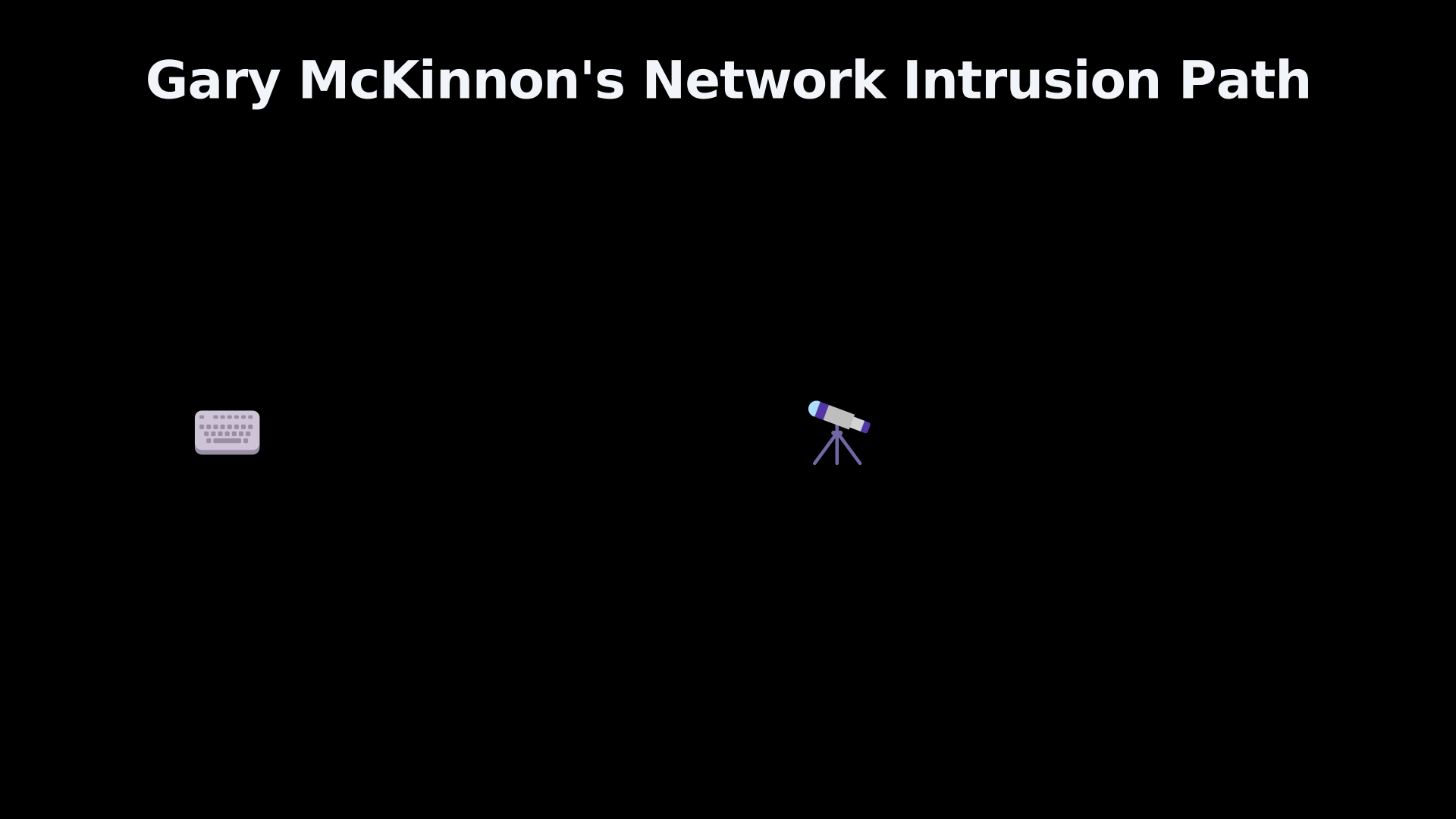
The military systems targeted by UFO-motivated hackers were not a single secret archive. They formed a sprawling and uneven collection of research computers, administrative machines, operational networks and internet-connected servers belonging to different commands and agencies. Early intruders frequently moved through systems that were sensitive because of their institutional location, even when the particular machine was unclassified.
A revealing precursor was the 1994 intrusion into the US Air Force’s Rome Laboratory in New York. British hackers Richard Pryce, using the name “Datastream Cowboy”, and Mathew Bevan, known as “Kuji”, penetrated Air Force computers and used them as stepping stones into other networks. The incident continued for weeks, involved roughly 150 known intrusions and gave access to about 30 Rome Laboratory systems. Compromised machines were then used to reach approximately 100 further systems, including computers associated with NASA, the Jet Propulsion Laboratory and the Goddard Space Flight Center.[Air & Space Forces Magazine]airandspaceforces.comAir & Space Forces Magazine War in CyberspaceAir & Space Forces Magazine War in Cyberspace
The episode showed how an ordinary-looking entry point could provide access to a much wider government network. Investigators initially feared that the activity might represent foreign espionage because the intruders searched sensitive systems and routed connections through multiple countries. The attackers were eventually traced to Britain. Bevan’s reported interest in UFO information later made the case part of the genealogy of UFO hacking, although accounts of exactly what he sought and found are less complete than the technical record of the intrusion itself.[The Guardian]theguardian.comThe Guardian US seeks extradition of Briton accused of hacking intoThe Guardian US seeks extradition of Briton accused of hacking into
Gary McKinnon entered a similar environment between 2001 and 2002. US indictments alleged that he accessed 92 computers belonging to the Army, Navy, Air Force, Department of Defense and NASA, as well as several private systems. British court proceedings later described a wider total of 97 US government computers. The variation reflects the way different charges and legal summaries counted the affected machines, rather than evidence that all systems belonged to one network.[Department of Justice]justice.govDepartment of JusticeLondon, England Hacker Indicted Under Computer Fraud…Gary McKinnon accessed and damaged without authorization 92…
The institutions named in the case explain why the intrusion acquired such a dramatic reputation. They included military and space organisations associated in popular culture with classified aircraft, surveillance, weapons research and anomalous imagery. McKinnon said he searched them after encountering claims from the UFO disclosure movement that governments had recovered advanced technology and concealed its potential applications. His target selection therefore followed a cultural theory of secrecy: NASA for imagery, the Air Force for unconventional aircraft, the Navy for unusual fleet activity and the Pentagon for overarching classified programmes.[WIRED]wired.comUFO Hacker' Tells What He FoundUFO Hacker' Tells What He Found
The actual access method was far less exotic. McKinnon described scanning large ranges of network addresses for Windows machines with weak or blank administrator passwords. Such accounts are credible in the broader cybersecurity environment of the period. In 2001, a congressional assessment gave the US federal government an overall failing grade for computer security, while the Defense Department itself received a failing mark and NASA was rated only slightly better. The attraction of military networks was therefore intensified by a striking contradiction: institutions associated with the most closely guarded national secrets sometimes exposed ordinary, badly configured machines to the public internet.[WIRED]wired.comgovt networks get an fgovt networks get an f
Access to one such computer did not imply access to the government’s most sensitive holdings. Highly classified information would normally be kept on restricted networks, protected facilities or isolated systems rather than every internet-facing workstation. Nevertheless, weak perimeter security could still expose operational data, credentials, internal directories and machines useful for moving deeper into an organisation. Later government audits continued to find inadequate network boundaries and access controls at NASA, confirming that large scientific and defence organisations struggled to secure complex, interconnected environments.[GAO]gao.govgaogao
Why access was mistaken for proof
The central evidential problem in UFO hacking is the gap between demonstrating unauthorised access and demonstrating an extraordinary discovery. Court documents and indictments establish that McKinnon entered numerous government computers. They do not authenticate his claims about what he saw while inside them.
McKinnon later described several alleged discoveries, including an image of an unusual craft, a document containing the phrase “Non-Terrestrial Officers” and references to transfers between vessels whose names he did not recognise. He said that a slow connection prevented him from saving the large image before his access was interrupted. No original file, complete screenshot, directory record or independently verified copy has been produced publicly. The claims therefore remain testimony about information viewed during an illegal session, not inspectable documentary evidence.[WIRED]wired.comUFO Hacker' Tells What He FoundUFO Hacker' Tells What He Found
The phrase “non-terrestrial” is particularly vulnerable to interpretation. In defence and space language, “terrestrial” can distinguish Earth-based duties from activities involving space systems, satellites or commands operating beyond the conventional land environment. A suggestive label, viewed without its surrounding document, classification guide or organisational context, cannot establish that the personnel concerned were extraterrestrial beings or members of a secret off-world fleet.
The same problem applies to unfamiliar ship names. Military databases contain project identifiers, exercise names, logistical labels, call signs and vessels unknown to the general public. The absence of a recognisable match in an internet search would not demonstrate that a ship operated in space. Verification would require the original record, its metadata, the fields surrounding the entry and an explanation of the database in which it appeared. None is available for independent examination.
McKinnon’s unusual-image account also illustrates why provenance matters. NASA and military systems process enormous quantities of raw, compressed, calibrated and partially rendered imagery. A single frame can show sensor artefacts, incomplete mosaics, spacecraft components, ice particles, glare or distorted geometry. Without the file, capture date, instrument, processing history and neighbouring frames, neither an alien interpretation nor an ordinary explanation can be tested properly.
This is not a claim that McKinnon necessarily fabricated his recollections. He may have encountered material that appeared remarkable when viewed briefly, remotely and without technical context. The narrower conclusion is that the evidence preserved from the incident cannot support the meaning later attached to it. His access is documented; his interpretation is not independently reproducible.
Classified programmes and alien claims are not equivalent
The strongest reason military networks drew UFO hackers is also the reason their discoveries are difficult to interpret: secret defence programmes unquestionably exist. Some produced aircraft that looked radically unfamiliar before their public disclosure. Others generated unexplained sightings because officials concealed their performance, locations or even their existence. Historical examples include the U-2, A-12, stealth aircraft and experimental unmanned platforms.[AARO]aaro.milAARO Historical Record Report VolAARO Historical Record Report Vol
That history supports a limited proposition: some UFO reports have been associated with classified human technology. It does not support the broader proposition that classified programmes involve recovered alien vehicles. Moving from one claim to the other requires direct evidence such as authenticated programme records, physical materials with demonstrably non-human properties, traceable imagery or corroborated testimony from people with documented access.
The US government’s secrecy has at times made that distinction harder to maintain. Officials protecting reconnaissance or weapons programmes have withheld explanations, issued incomplete accounts or permitted observers to remain mistaken. These practices preserved operational security but also taught the public that an official denial could coexist with a hidden aerospace project. Each later revelation about a stealth aircraft or spy plane strengthened the popular expectation that today’s alien story might become tomorrow’s declassified programme.
The official record nevertheless contains a substantial difference between hidden technology and hidden extraterrestrial technology. Declassified documents identify the names, budgets, aircraft, contractors, test sites and operational purposes of programmes such as AQUATONE, OXCART and CORONA. No comparable documentary chain has emerged for an alien retrieval or reverse-engineering effort. AARO’s historical review stated that it found neither empirical evidence of off-world technology nor evidence of a classified extraterrestrial programme concealed from Congress. It assessed that most named programmes cited by witnesses were genuine national-security activities misidentified as alien-related work.[AARO]aaro.milAARO Historical Record Report VolAARO Historical Record Report Vol
AARO is itself a Defense Department office, so its conclusions do not compel universal trust. Critics can reasonably ask whether classification, limited access or institutional self-interest restricts any government review. That concern makes independent evidence more important, not less. An allegation that every absence of proof demonstrates successful concealment becomes impossible to test and cannot distinguish a real programme from a durable rumour.
The surviving evidence therefore supports a more grounded explanation for the attraction of US military networks. They were appealing targets because real secrets were stored within the defence establishment, early network security was often poor, and decades of unexplained sightings had created a ready-made theory about what those secrets might contain. Hackers could reach sensitive institutions and encounter ambiguous material, but institutional sensitivity was repeatedly treated as a substitute for proof of alien origin.
The lasting lesson of the military targets
UFO hacking turned the computer network into a modern version of the locked archive. Instead of waiting for declassification or filing records requests, intruders attempted to bypass the public boundary and inspect the institutions they believed were withholding the truth. Their actions exposed genuine weaknesses in US government cybersecurity and forced agencies to confront the risks posed by poorly secured, internet-connected systems.
They did not resolve the UFO secrecy question. The best-documented outcomes concern compromised computers, disrupted operations, investigative costs and international legal disputes. The alleged alien evidence remains fragmentary, second-hand and detached from the technical context needed to authenticate it.
The cases are most revealing when read not as proof of an extraterrestrial conspiracy but as a mechanism through which suspicion reproduced itself. Military secrecy generated uncertainty; real hidden aircraft made extraordinary rumours seem plausible; weak networks offered a path inside; and ambiguous files could then be interpreted through the beliefs that motivated the intrusion. Each stage reinforced the next, even when no verifiable alien record emerged.
US military networks drew UFO hackers because they represented plausible repositories of extraordinary secrets. They were indeed repositories of secrets. The unsupported step was assuming that the secrecy itself identified what those secrets were.

Amazon book picks
Further Reading
Books and field guides related to Why Military Networks Drew UFO Hackers. Use these as the next step if you want deeper reading beyond the article.
UFOs: Generals, Pilots, and Government Officials Go on the Re...
NEW YORK TIMES BESTSELLER • Impeccably researched, this riveting journalistic investigation separates fact from fiction, and documents th...
The Hacker and the State
Rating: 5.0/5 from 18 Google Books ratings
“A must-read...It reveals important truths.” —Vint Cerf, Internet pioneer “One of the finest books on information security published so f...
Sandworm
"With the nuance of a reporter and the pace of a thriller writer, Andy Greenberg gives us a glimpse of the cyberwars of the future while...
eBay marketplace picks
Marketplace Samples
Live-tested eBay searches with available results related to this page.
Selected fromUFO wall art oneBay.co.uk.



Endnotes
1.
Source: aaro.mil
Title: AARO Historical Record Report Vol 1 2024
Link:https://www.aaro.mil/Portals/136/PDFs/AARO_Historical_Record_Report_Vol_1_2024.pdf
2.
Source: justice.gov
Link:https://www.justice.gov/archive/criminal/cybercrime/press-releases/2002/mckinnonIndict.htm
Source snippet
Department of JusticeLondon, England Hacker Indicted Under Computer Fraud...Gary McKinnon accessed and damaged without authorization 92...
3.
Source: cia.gov
Title: cia rdp80b01676r004000110001 7
Link:https://www.cia.gov/readingroom/document/cia-rdp80b01676r004000110001-7
Source snippet
U-2S, UFOS, AND OPERATION BLUE BOOKU-2 and later OXCART flights accounted for more than one-half of all UFO reports during the late 19...
4.
Source: cia.gov
Title: ask molly what really went on at area 51
Link:https://www.cia.gov/stories/story/ask-molly-what-really-went-on-at-area-51/
Source snippet
Ask Molly: What really went on at Area 51?1 Jul 2022 — According to CIA investigators, “U-2 and later OXCART flights accounted for mor...
5.
Source: cia.gov
Link:https://www.cia.gov/resources/csi/static/Archangel-CIAs-Supersonic-A-12-Reconnaissance-Aircraft.pdf
Source snippet
ARCHANGEL:by D ROBARGE · Cited by 25 — With U-2 overflights of the Soviet Union no longer possible after Francis Gary Powers's aircraf...
6.
Source: aaro.mil
Link:https://www.aaro.mil/UAP-Cases/Official-UAP-Imagery/
Source snippet
UAP ImageryThis unresolved report contributes to AARO's historical and locational trend analyses. PR-017, Unresolved UAP Report, Euro...
7.
Source: aaro.mil
Link:https://www.aaro.mil/
Source snippet
AARO HomeHas the Department found any evidence of extraterrestrial technology? No. Examination of UAP sightings is ongoing. AARO uses...
8.
Source: justice.gov
Link:https://www.justice.gov/archive/usao/nj/Press/files/pdffiles/Older/edva_mckinnon_indictment.pdf
9.
Source: wired.com
Title: ‘UFO Hacker’ Tells What He Found
Link:https://www.wired.com/2006/06/ufo-hacker-tells-what-he-found/
10.
Source: wired.com
Title: govt networks get an f
Link:https://www.wired.com/2001/11/govt-networks-get-an-f
11.
Source: gao.gov
Title: gao 10 4
Link:https://www.gao.gov/products/gao
12.
Source: cyberdefensereview.army.mil
Title: the number one vulnerability in the future of cyber security a critical lesson
Link:https://cyberdefensereview.army.mil/CDR-Content/Articles/Article-View/Article/1136118/the-number-one-vulnerability-in-the-future-of-cyber-security-a-critical-lesson/
13.
Source: war.gov
Link:https://www.war.gov/ufo/
14.
Source: aaro.mil
Link:https://www.aaro.mil/Submit-A-Report/
15.
Source: aaro.mil
Title: UAP Records
Link:https://www.aaro.mil/UAP-Records/
16.
Source: cia.gov
Title: DOC 0005517742
Link:https://www.cia.gov/readingroom/docs/DOC_0005517742.pdf
17.
Source: cia.gov
Title: DOC 0000838057
Link:https://www.cia.gov/readingroom/docs/DOC_0000838057.pdf
18.
Source: cia.gov
Link:https://www.cia.gov/readingroom/document/07083374
19.
Source: cia.gov
Link:https://www.cia.gov/readingroom/docs/1992-04-01A.pdf
20.
Source: cia.gov
Link:https://www.cia.gov/readingroom/home
21.
Source: cia.gov
Link:https://www.cia.gov/readingroom/collection/ufos-fact-or-fiction
22.
Source: cia.gov
Link:https://www.cia.gov/readingroom/docs/CY%202007%20CASE%20LOG%5B15829352%5D.pdf
23.
Source: justice.gov
Link:https://www.justice.gov/archive/criminal/cybercrime/press-releases/2002/mckinnonIndict2.htm
24.
Source: justice.gov
Link:https://www.justice.gov/d9/2023-05/03.10.23.%20–%20Incidents%20With%20Migrants%20and%20USCBP%20-%20Part%201.pdf
25.
Source: justice.gov
Title: 06.30.23. – Mar-a-Lago Search Warrant
Link:https://www.justice.gov/d9/2023-07/06.30.23.%20–%20Mar-a-Lago%20Search%20Warrant%20-%20Interim.pdf
26.
Source: justice.gov
Link:https://www.justice.gov/archive/oip/lawrevart.pdf
27.
Source: justice.gov
Link:https://www.justice.gov/sites/default/files/usao/legacy/2007/01/11/usab4601.pdf
28.
Source: justice.gov
Link:https://www.justice.gov/file/909921/dl?inline=
29.
Source: justice.gov
Title: 02.14.23. Protests Supreme Court Residences Part 1
Link:https://www.justice.gov/d9/2023-02/02.14.23.%20–%20Protests%20Supreme%20Court%20Residences%20–%20Part%201.pdf
30.
Source: justice.gov
Link:https://www.justice.gov/nsd-fara/page/file/991571/dl?inline=
31.
Source: gao.gov
Link:https://www.gao.gov/
32.
Source: gao.gov
Link:https://www.gao.gov/about/what-gao-does
33.
Source: gao.gov
Link:https://www.gao.gov/video/gao-congressional-watchdog
34.
Source: archives.gov
Title: Project BLUE BOOK
Link:https://www.archives.gov/research/military/air-force/ufos
35.
Source: declassification.blogs.archives.gov
Title: how to build a flying saucer
Link:https://declassification.blogs.archives.gov/2012/09/20/how-to-build-a-flying-saucer/
36.
Source: oig.nasa.gov
Link:https://oig.nasa.gov/docs/IG-21-019.pdf
37.
Source: media.defense.gov
Title: DOPSR 2024 0263 AARO HISTORICAL RECORD REPORT VOLUME 1 2024
Link:https://media.defense.gov/2024/Mar/08/2003409233/-1/-1/0/DOPSR-2024-0263-AARO-HISTORICAL-RECORD-REPORT-VOLUME-1-2024.PDF
38.
Source: airandspaceforces.com
Title: Air & Space Forces Magazine War in Cyberspace
Link:https://www.airandspaceforces.com/PDF/MagazineArchive/Documents/1998/January%201998/0198cyber.pdf
39.
Source: theguardian.com
Title: The Guardian US seeks extradition of Briton accused of hacking into
Link:https://www.theguardian.com/technology/2002/nov/13/hacking.internetcrime
40.
Source: Wikipedia
Title: [Mathew Bevan]({{ ‘mathew-bevan/’ | relative_url }})
Link:https://en.wikipedia.org/wiki/Mathew_Bevan
41.
Source: theguardian.com
Link:https://www.theguardian.com/world/2008/jul/27/internationalcrime.hacking
42.
Source: Wikipedia
Title: Gary Mc Kinnon
Link:https://en.wikipedia.org/wiki/Gary_McKinnon
43.
Source: Wikipedia
Link:https://en.wikipedia.org/wiki/Gao
44.
Source: theguardian.com
Link:https://www.theguardian.com/theguardian/2005/jul/09/weekend7.weekend2
45.
Source: theguardian.com
Title: gary mckinnon hacking prosecution us
Link:https://www.theguardian.com/world/2012/jul/10/gary-mckinnon-hacking-prosecution-us
46.
Source: theguardian.com
Link:https://www.theguardian.com/technology/2008/aug/28/hacking.security
47.
Source: theguardian.com
Title: gary mckinnon lodges challenge extradition
Link:https://www.theguardian.com/world/2009/dec/10/gary-mckinnon-lodges-challenge-extradition
48.
Source: theguardian.com
Title: film scottish hacker gary mckinnon fight against us extradition
Link:https://www.theguardian.com/world/2023/nov/29/film-scottish-hacker-gary-mckinnon-fight-against-us-extradition
49.
Source: zenodo.org
Link:https://zenodo.org/records/20137882
50.
Source: kujimedia.com
Title: Datastream Cowboy
Link:https://www.kujimedia.com/tag/datastream-cowboy/
51.
Source: kujimedia.com
Title: Richard Pryce
Link:https://www.kujimedia.com/tag/richard-pryce/page/2/
Additional References
52.
Source: youtube.com
Title: UK blocks hacker extradition to U.S
Link:https://www.youtube.com/watch?v=xudYoyi_JSY
Source snippet
This collection provides direct context on Gary McKinnon's breaches of US military and NASA computer networks, his stated search for clas...
53.
Source: podmust.com
Link:https://podmust.com/ep/?epis=R2FyeSBNY0tpbm5vbjogVGhlIEhhY2tlciBXaG8gRm91bmQgTkFTQSdzIFVGTyAmIE5vbi1UZXJyZXN0cmlhbCBPZmZpY2Vycw%3D%3D&podcast=the-daily-conspiracy
54.
Source: facebook.com
Link:https://www.facebook.com/KendallsPlace/posts/he-hacked-nasa-looking-for-ufos-and-nearly-got-life-in-prison/1598324498636439/
55.
Source: cybereason.com
Link:https://www.cybereason.com/blog/malicious-life-podcast-the-u.s-vs.-gary-mckinnon
56.
Source: trulyadventure.us
Link:https://www.trulyadventure.us/the-hacker
57.
Source: facebook.com
Link:https://www.facebook.com/NBCNews/posts/the-pentagon-releases-72-declassified-ufo-files-dating-back-to-the-1940s-includi/1383491280309400/
58.
Source: malicious.life
Link:https://malicious.life/episode/us_vs_gary_mckinnon/
59.
Source: facebook.com
Link:https://www.facebook.com/techcrunch/posts/the-hacker-used-an-employees-credentials-to-access-source-code-which-revealed-ho/1379127314081132/
60.
Source: kaspersky.com
Link:https://www.kaspersky.com/resource-center/threats/top-ten-greatest-hackers
61.
Source: reddit.com
Link:https://www.reddit.com/r/UFOs/comments/1uffuna/what_are_your_thoughts_on_gary_mckinnons/