Within UFO Hackers
How UFO Disclosure Beliefs Inspired Hacking
Claims about recovered craft, antigravity, and suppressed energy gave hackers a narrative that made illegal access seem like investigation.
On this page
- Core disclosure movement claims
- From suspicion to unauthorised access
- The appeal of insider testimony
Page outline Jump by section
Introduction
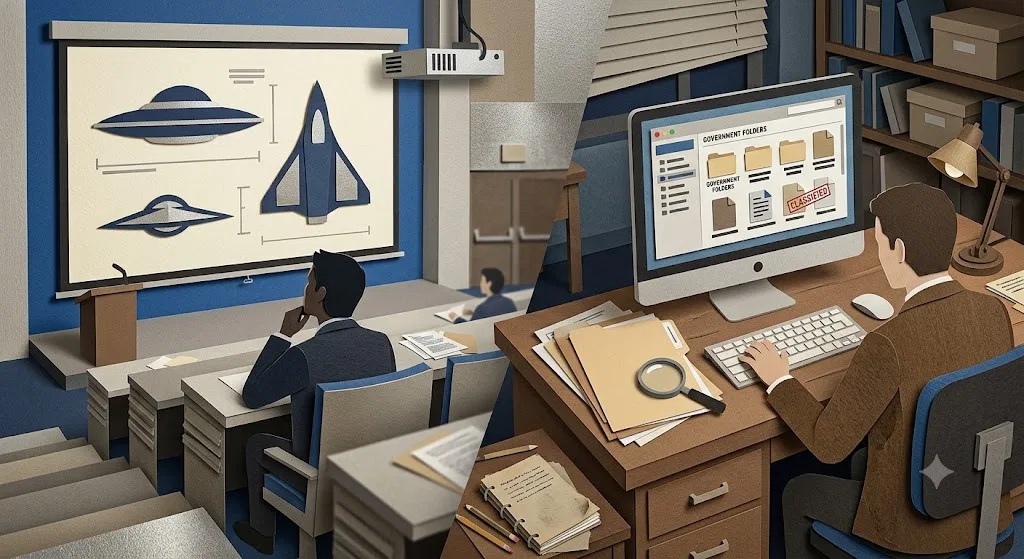
UFO disclosure culture motivated some intruders by turning government computer systems into imagined archives of evidence. Its central story was not merely that officials knew more about unidentified objects than they admitted, but that military and intelligence agencies possessed recovered craft, reverse-engineered propulsion, unedited photographs and technologies capable of producing abundant clean energy. For believers, weakly protected NASA or defence networks therefore appeared to offer direct access to truths that official inquiries, public records requests and journalism had supposedly failed to uncover.
Gary McKinnon expressed this logic unusually clearly. He described hacking as a means to an end and said he was searching for evidence of UFO secrecy, antigravity and suppressed “free energy”. Similar motives had appeared in the earlier activities attributed to British hacker Mathew Bevan. These cases do not validate the secrets they hoped to find. They show instead how disclosure narratives could supply a target, a search strategy and a moral justification for unauthorised access.[wired.com]wired.comUFO Hacker' Tells What He FoundHe claims to have discovered a NASA department that airbrushes UFO images from high-resolution photos and an Excel spreadsheet titled "No…
The claims that made secret networks seem irresistible
The modern disclosure movement presented UFO secrecy as a layered institutional system rather than a collection of unexplained sightings. Its advocates argued that credible military, aviation and government witnesses had encountered extraordinary craft; that fragments or intact vehicles had been recovered; and that classified programmes had attempted to reproduce their capabilities. The 2001 Disclosure Project briefing document assembled witness summaries, official-looking records and policy arguments into a package addressed to journalists, scientists and members of the US government. Organisers said hundreds of witnesses were prepared to testify about UFO-related experiences.[Internet Archive]archive.orgDisclosure Project Briefing Document djvu.txtThis document contains an overview of issues surrounding UFO/ET topics, summarized testimony of military and government witnesses to…
That format mattered. Insider testimony carried a different psychological force from anonymous rumours or spectacular photographs. Pilots, radar operators, military officers and workers associated with sensitive facilities were presented as people whose careers had placed them close to hidden programmes. Their credentials could encourage an audience to treat extraordinary allegations as fragments of a concealed record rather than stories requiring independent proof.
The movement also linked UFO secrecy to technology with immediate human value. McKinnon said he believed governments were withholding antigravity, zero-point energy and other systems that could relieve energy poverty. In his account, the alleged cover-up was therefore not confined to knowledge about extraterrestrial life. It was preventing ordinary people from benefiting from transformative technology. That enlarged the moral stakes: searching restricted networks could be imagined not as curiosity or trespass, but as an attempt to recover knowledge belonging to the public.[WIRED]wired.comUFO Hacker' Tells What He FoundHe claims to have discovered a NASA department that airbrushes UFO images from high-resolution photos and an Excel spreadsheet titled "No…
This combination produced a compelling narrative structure:
- A hidden prize: recovered craft, propulsion research, altered imagery or records of secret personnel.
- A recognisable custodian: NASA, the armed forces, intelligence bodies or defence laboratories.
- An explanation for missing public proof: classification, compartmentalisation and deliberate suppression.
- A public-interest claim: disclosure might advance science, expose deception or release valuable energy technology.
The structure was difficult to disprove from inside the belief system. A lack of public evidence could itself be treated as evidence that concealment was effective. Restricted access could make a computer system seem more promising precisely because outsiders were not permitted to inspect it.
From suspicion to unauthorised access
Disclosure culture did not give intruders their technical abilities, but it could direct those abilities towards particular institutions and files. McKinnon was not accused of penetrating one clearly identified “UFO database”. US prosecutors alleged a much wider series of intrusions into Army, Navy, Air Force, Department of Defense and NASA systems. His own explanation was that he searched through this environment for material matching claims he had already encountered in disclosure literature and testimony.[Department of Justice]justice.govDepartment of JusticeLondon, England Hacker Indicted Under Computer Fraud…Gary McKinnon accessed and damaged without authorization 92…
This is an important distinction. The belief came first and shaped the interpretation of whatever appeared on screen. McKinnon said that testimony about image alteration at NASA led him to look for processed and unprocessed photographs associated with the Johnson Space Center. He also reported encountering a document headed “Non-Terrestrial Officers” and records of unfamiliar ship transfers. Yet he acknowledged that at least some material could have had a conventional or hypothetical military meaning. No authenticated copy of the alleged document or complete image was made publicly available for independent examination.[WIRED]wired.comUFO Hacker' Tells What He FoundHe claims to have discovered a NASA department that airbrushes UFO images from high-resolution photos and an Excel spreadsheet titled "No…
The mechanism was therefore closer to a self-directed investigation than a conventional theft for profit:
- Disclosure advocates identified institutions said to possess hidden evidence.
- Witness stories supplied search terms, departments and expected forms of proof.
- Poor computer security made unauthorised entry appear technically possible.
- Ambiguous files were examined within a pre-existing cover-up narrative.
- The act was retrospectively described as investigation, whistleblowing or public service.
That final step helped reduce the perceived moral barrier. McKinnon’s supporters told Parliament that he regarded himself as being on a “moral crusade” for information about clean energy, UFOs and antigravity. They also portrayed his identification of weak security as a form of warning to the United States. These arguments formed part of the campaign surrounding his extradition, although they did not alter the fact that access had occurred without permission.[UK Parliament]publications.parliament.ukUK Parliament Home Affairs CommitteeUK ParliamentHome Affairs Committee - Minutes of Evidence15 Dec 2009 — Gary believed he was on a moral crusade as he searched for informa…
The US government framed the same activity very differently. Its indictments described intentional unauthorised access and damage to protected systems, including computers connected with national defence. The contrast illustrates the central conflict created by disclosure culture: the intruder may imagine himself retrieving wrongfully hidden knowledge, while the system owner sees an unknown person moving through networks containing operational, personal and security-sensitive information.[Department of Justice]justice.govDepartment of JusticeLondon, England Hacker Indicted Under Computer Fraud…Gary McKinnon accessed and damaged without authorization 92…
Insider testimony turned rumours into search instructions
The appeal of insider testimony was not simply that witnesses sounded credible. Their accounts could be operationalised. A broad conviction that “the government hides UFOs” offers little guidance to an intruder. A claim naming a location, office practice, document category or image-processing procedure offers a route to follow.
McKinnon’s reported search for NASA imagery demonstrates this transition. He said a disclosure witness had described employees removing anomalous objects from high-resolution photographs. The allegation suggested both a physical location and a comparison method: find original and processed images and look for differences. Whether the story was true or not, it transformed a general suspicion into a digital investigative task.[WIRED]wired.comUFO Hacker' Tells What He FoundHe claims to have discovered a NASA department that airbrushes UFO images from high-resolution photos and an Excel spreadsheet titled "No…
The same process applied to claims about recovered technology. If testimony alleged that military contractors or classified programmes had reverse-engineered unconventional craft, then defence research networks became attractive targets. References to propulsion, energy, spacecraft, personnel or transfers could be read as clues to a hidden programme even when the surrounding context was incomplete.
This interpretive pattern creates a strong risk of confirmation bias. Government and military systems contain specialised language, code names, simulations, planning documents and projects whose purpose may be obscure to an outsider. A person already expecting a secret space programme can assign extraordinary significance to unfamiliar terminology. Without provenance, full files, organisational context and independent corroboration, a suggestive heading or unusual photograph cannot establish the interpretation placed upon it.
McKinnon’s account illustrates the evidential weakness that results. His recollections are important evidence of his motivation, because they show what he believed he was searching for and why. They are not equivalent to verifiable evidence of recovered craft or suppressed technology. The files he described were not preserved in a form that investigators, historians or scientists could authenticate, and his interpretation was formed during unauthorised, piecemeal access over a slow connection.[WIRED]wired.comUFO Hacker' Tells What He FoundHe claims to have discovered a NASA department that airbrushes UFO images from high-resolution photos and an Excel spreadsheet titled "No…

An earlier pattern in the Bevan case
McKinnon was not the first British intruder associated with a search for UFO information in US systems. Mathew Bevan, known online as “Kuji”, was accused during the 1990s of entering military and government networks. In a later account, Bevan said his objective was to find information about a conspiracy or cover-up involving UFOs. He described the progression from reading UFO material to searching poorly secured machines as almost natural once access became possible.[Kujimedia]kujimedia.comDatastream Cowboy - Kuji Media Corporation Ltd.In my interview with Bevan, I asked him about the motivation in the attack on Rome…
The comparison is useful because the surrounding disclosure cultures were not identical. Bevan’s interest developed amid 1990s conspiracy literature, hacker networks and long-standing stories about military concealment. McKinnon explicitly pointed to the more organised witness-centred disclosure campaigning that reached a large audience in 2001. Yet the underlying mechanism remained similar: claims of institutional secrecy converted military networks into destinations for unofficial inquiry.
There were also important differences between participants. Accounts of the Rome Laboratory intrusions indicate that Richard Pryce, associated with Bevan during the investigation, was primarily interested in access and sensitive information rather than sharing exactly the same UFO-driven purpose. It would therefore be misleading to treat every person involved in a network intrusion as motivated by disclosure beliefs merely because one associate was.[ISC2]isc2.org#CISSP30: 30 Years After Two Kids Broke into the Air Force#CISSP30: 30 Years After Two Kids Broke into the Air Force
The comparison nevertheless reveals three recurring conditions:
- Technical opportunity: remote systems had weak passwords, exposed services or inadequate monitoring.
- Cultural direction: UFO cover-up stories identified military and space institutions as likely repositories.
- Personal legitimation: the intruder could describe the conduct as truth-seeking rather than ordinary criminality.
Disclosure culture was therefore a motivating framework, not a complete cause. Most people who encountered the same claims did not break into computer systems. Unauthorised access required technical competence, opportunity, persistence and a willingness to cross a legal boundary. The culture helped explain why a small number of technically capable believers chose these particular targets.
The investigator identity blurred legal and ethical boundaries
The most powerful feature of disclosure culture was its ability to recast the relationship between citizen and state. If officials were merely protecting legitimate secrets, unauthorised access was plainly intrusion. If officials were concealing evidence of non-human craft and withholding technology that could benefit humanity, the intruder could imagine that the state had forfeited its moral claim to secrecy.
McKinnon repeatedly positioned himself within the second interpretation. He said he was neither seeking money nor acting for a foreign power. He regarded hacking as an instrument for confirming witness testimony and locating technologies he believed had been unjustly hidden. His willingness to accept ridicule for the UFO motive also strengthened the public impression that the explanation was sincerely held, although sincerity alone cannot establish that the underlying beliefs were accurate.[WIRED]wired.comUFO Hacker' Tells What He FoundHe claims to have discovered a NASA department that airbrushes UFO images from high-resolution photos and an Excel spreadsheet titled "No…
This identity resembles digital vigilantism: an individual concludes that established institutions will not correct an injustice, then assumes investigative authority without permission or oversight. Research on conspiracy belief more broadly suggests that such narratives are often sustained by distrust, perceived threat and the conviction that powerful groups are acting in secret. Those findings cannot diagnose the motives of any particular hacker, but they help explain why believers may regard normal channels as compromised before they have tried or exhausted them.[PubMed Central (PMC)]pmc.ncbi.nlm.nih.govOpen source on nih.gov.
The moral framing also obscures collateral risk. An intruder searching for one category of information may encounter unrelated defence material, personal data or operational systems. Administrators cannot know in real time whether the person moving through their network is an enthusiast, a spy or someone preparing sabotage. The alleged Rome Laboratory intrusions and the McKinnon prosecution both provoked serious security responses because intention could not safely be inferred from the targets selected or the files viewed.[ISC2]isc2.org#CISSP30: 30 Years After Two Kids Broke into the Air Force#CISSP30: 30 Years After Two Kids Broke into the Air Force

Disclosure beliefs explain the search, not the alleged discoveries
The strongest historical conclusion is limited but revealing. UFO disclosure culture provided some hackers with a coherent explanation for where extraordinary secrets would be stored, why those secrets had not emerged through official channels and why breaking into restricted systems might serve the public. It turned rumours into investigative prompts and transformed government networks into symbolic vaults.
The same culture could then reinforce itself after an intrusion. Ambiguous terminology, incomplete images or unfamiliar records could be interpreted as confirmation, while the absence of preserved evidence could be attributed to disconnection, seizure or further suppression. Retellings of the case often focus on the dramatic alleged discoveries, but the more securely documented fact is the motivational chain leading towards the search.
Neither McKinnon’s recollections nor Bevan’s stated purpose proves that recovered spacecraft, antigravity machines or suppressed energy systems were present in the networks they entered. What the cases demonstrate is that beliefs about secrecy can have practical consequences even when the alleged secret remains unverified. In the history of UFO hacking, disclosure culture mattered because it did more than inspire curiosity: it supplied a mission, identified targets and helped intruders portray illegal access as an act of investigation.
Amazon book picks
Further Reading
Books and field guides related to How UFO Disclosure Beliefs Inspired Hacking. Use these as the next step if you want deeper reading beyond the article.
The UFO Experience: A Scientific Inquiry
Cited by the New York Review of Books as "the best brief for visitation," this classic study presents an analysis of UFO reports and conc...
UFOs: Generals, Pilots, and Government Officials Go on the Re...
NEW YORK TIMES BESTSELLER • Impeccably researched, this riveting journalistic investigation separates fact from fiction, and documents th...
Mirage Men: A Journey into Disinformation, Paranoia and UFOs
Seeking the truth about UFOs in America, Mark Pilkington and John Lundberg uncover a 60 year-old story stranger than any conspiracy thril...
The Hacker Crackdown: Law and Disorder on the Electronic Fron...
The bestselling cyberpunk author "has produced by far the most stylish report from the computer outlaw culture since Steven Levy's Hacker...
eBay marketplace picks
Marketplace Samples
Live-tested eBay searches with available results related to this page.
Selected fromufo poster oneBay.co.uk.

Current eBay listing
VINTAGE UFO FLYING SAUCERS COMIC ADVERTISING A2 POSTER PRINT


Current eBay listing
I Want To Believe UFO Poster Giclée Fine Art Heavyweight Print

Endnotes
1.
Source: wired.com
Title: ‘UFO Hacker’ Tells What He Found
Link:https://www.wired.com/2006/06/ufo-hacker-tells-what-he-found
Source snippet
He claims to have discovered a NASA department that airbrushes UFO images from high-resolution photos and an Excel spreadsheet titled "No...
2.
Source: kujimedia.com
Link:https://www.kujimedia.com/tag/datastream-cowboy/
Source snippet
Datastream Cowboy - Kuji Media Corporation Ltd.In my interview with Bevan, I asked him about the motivation in the attack on Rome...
3.
Source: justice.gov
Link:https://www.justice.gov/archive/criminal/cybercrime/press-releases/2002/mckinnonIndict.htm
Source snippet
Department of JusticeLondon, England Hacker Indicted Under Computer Fraud...Gary McKinnon accessed and damaged without authorization 92...
4.
Source: archive.org
Title: Disclosure Project Briefing Document djvu.txt
Link:https://archive.org/stream/DisclosureProjectBriefingDocument/DisclosureProjectBriefingDocument_djvu.txt
Source snippet
This document contains an overview of issues surrounding UFO/ET topics, summarized testimony of military and government witnesses to...
5.
Source: publications.parliament.uk
Title: UK Parliament Home Affairs Committee
Link:https://publications.parliament.uk/pa/cm200809/cmselect/cmhaff/1105/09111002.htm
Source snippet
UK ParliamentHome Affairs Committee - Minutes of Evidence15 Dec 2009 — Gary believed he was on a moral crusade as he searched for informa...
6.
Source: justice.gov
Title: Department of Justice British National Charged with Hacking Into N.J
Link:https://www.justice.gov/archive/criminal/cybercrime/press-releases/2002/mckinnonIndict2.htm
Source snippet
seven-count Virginia Indictment charges McKinnon for intrusions into 92 computer systems belonging to the U.S. Army, Navy, A...
7.
Source: publications.parliament.uk
Link:https://publications.parliament.uk/pa/cm201213/cmhansrd/cm120918/debtext/120918-0003.htm
8.
Source: justice.gov
Link:https://www.justice.gov/archive/usao/nj/Press/files/pdffiles/Older/edva_mckinnon_indictment.pdf
9.
Source: isc2.org
Title: #CISSP30: 30 Years After Two Kids Broke into the Air Force
Link:https://www.isc2.org/Insights/2024/09/CISSP30-30-Years-After-2-Kids-Broke-into-the-Air-Force
10.
Source: publications.parliament.uk
Link:https://publications.parliament.uk/pa/cm201011/cmhansrd/cm111205/debtext/111205-0003.htm
11.
Source: publications.parliament.uk
Link:https://publications.parliament.uk/pa/ld201415/ldselect/ldextradition/126/126.pdf
12.
Source: publications.parliament.uk
Link:https://publications.parliament.uk/pa/ld201516/ldhansrd/text/150601-0001.htm
13.
Source: publications.parliament.uk
Link:https://publications.parliament.uk/pa/cm201011/cmhansrd/chan36.pdf
14.
Source: publications.parliament.uk
Link:https://publications.parliament.uk/pa/cm201011/cmhansrd/chan47.pdf
15.
Source: publications.parliament.uk
Title: uk PARLIAMENTAR Y DEBATES
Link:https://publications.parliament.uk/pa/cm200809/cmhansrd/chan109.pdf
16.
Source: publications.parliament.uk
Link:https://publications.parliament.uk/pa/ld200809/ldhansrd/lhan130.pdf
17.
Source: publications.parliament.uk
Link:https://publications.parliament.uk/pa/cm201213/cmhansrd/chan46.pdf
18.
Source: justice.gov
Link:https://www.justice.gov/d9/2023-05/03.10.23.%20–%20Incidents%20With%20Migrants%20and%20USCBP%20-%20Part%201.pdf
19.
Source: justice.gov
Title: 06.30.23. – Mar-a-Lago Search Warrant
Link:https://www.justice.gov/d9/2023-07/06.30.23.%20–%20Mar-a-Lago%20Search%20Warrant%20-%20Interim.pdf
20.
Source: justice.gov
Link:https://www.justice.gov/archive/oip/lawrevart.pdf
21.
Source: justice.gov
Link:https://www.justice.gov/sites/default/files/usao/legacy/2007/01/11/usab4601.pdf
22.
Source: justice.gov
Link:https://www.justice.gov/file/909921/dl?inline=
23.
Source: justice.gov
Title: 02.14.23. Protests Supreme Court Residences Part 1
Link:https://www.justice.gov/d9/2023-02/02.14.23.%20–%20Protests%20Supreme%20Court%20Residences%20–%20Part%201.pdf
24.
Source: justice.gov
Link:https://www.justice.gov/nsd-fara/page/file/991571/dl?inline=
26.
Source: time.com
Title: hack attack 2
Link:https://time.com/archive/6943962/hack-attack-2/
27.
Source: abcnews.com
Link:https://abcnews.com/Technology/story?id=98572&page=1
Source snippet
ABC NewsGroup Calls for Disclosure of UFO Info10 May 2001 — Greer said there were some 400 witnesses who claim to have firsthand experien...
Published: May 2001
28.
Source: pmc.ncbi.nlm.nih.gov
Link:https://pmc.ncbi.nlm.nih.gov/articles/PMC6282974/
29.
Source: Wikipedia
Title: Mathew Bevan
Link:https://en.wikipedia.org/wiki/Mathew_Bevan
30.
Source: Wikipedia
Title: Gary Mc Kinnon
Link:https://en.wikipedia.org/wiki/Gary_McKinnon
31.
Source: press.org
Link:https://www.press.org/events/ufouap-disclosure-press-conference
32.
Source: assets.publishing.service.gov.uk
Title: 20131128 mod whitehall library resources 1700to1989.csv
Link:https://assets.publishing.service.gov.uk/media/5a7caf90ed915d63cc65c397/20131128-mod-whitehall-library-resources-1700to1989.csv
33.
Source: uapmurders.com
Link:https://uapmurders.com/uaps/Details/Gary_McKinnon/
Additional References
34.
Source: youtube.com
Title: Gary Mc Kinnon wins extradition battle
Link:https://www.youtube.com/watch?v=y4lecD44F5E
Source snippet
The Most Dangerous File the Hacker Found on NASA Servers... (Aliens?!)...
35.
Source: reddit.com
Link:https://www.reddit.com/r/UFOs/comments/16uujkn/gary_mckinnon_talks_about_finding_the/
36.
Source: scribd.com
Link:https://www.scribd.com/document/275910842/Steven-Greer-Transcript
37.
Source: facebook.com
Link:https://www.facebook.com/KendallsPlace/posts/he-hacked-nasa-looking-for-ufos-and-nearly-got-life-in-prison/1598324498636439/
38.
Source: medium.com
Link:https://medium.com/the-lindberg-interviews/interview-with-ufo-hacker-gary-mckinnon-5aa5d366828b
39.
Source: cybereason.com
Link:https://www.cybereason.com/blog/malicious-life-podcast-the-u.s-vs.-gary-mckinnon
40.
Source: facebook.com
Link:https://www.facebook.com/theliverpoolecho/posts/paul-doyles-life-and-career-from-royal-marines-to-crypto-scheme-and-ethical-hack/1190457489847192/
41.
Source: skepsis.nl
Link:https://skepsis.nl/disclosure/
42.
Source: reddit.com
Link:https://www.reddit.com/r/UFOs/comments/16in31n/reminder_gary_mckinnon_caught_nasa_editing_uap/
43.
Source: philarchive.org
Link:https://philarchive.org/rec/SCHTEO-179