Within UFO Hackers
How Roswell Inspired Mathew Bevan's Intrusions
Mathew Bevan reportedly searched defence systems partly because he believed US authorities were concealing information about Roswell.
On this page
- Bevan's background and online identity
- His reported UFO motivation
- How his case differed from Mc Kinnon's
Page outline Jump by section
Introduction
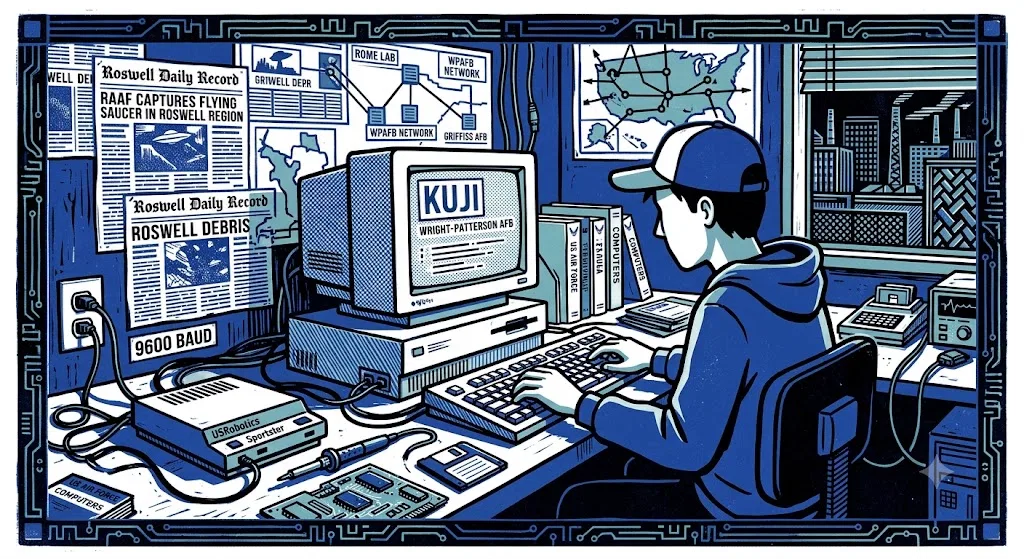
Mathew Bevan was a Welsh computer intruder whose interest in the Roswell story reportedly helped direct him towards United States military networks in the mid-1990s. Using the online name “Kuji”, he gained unauthorised access to systems connected with Air Force research facilities, including Wright-Patterson Air Force Base, where UFO folklore claimed wreckage from the alleged 1947 Roswell crash had been taken. Bevan later said he was looking for evidence of advanced propulsion technology and believed that material he encountered might relate to a recovered craft.[UFO Hackers]ufohackers.orgbevan overview* 1999 Interview of Bevan by Matthew Williams… * Interview by David Glover: YouTube video… Of note is that he got into a Wright-Pat…
The documented intrusions were real and serious. The claimed Roswell connection, however, rests largely on Bevan’s retrospective account rather than on files preserved for independent examination. His case therefore belongs in the history of UFO-motivated hacking not because it verified a government cover-up, but because it shows how conspiracy narratives could influence the selection of targets inside the poorly secured military networks of the early internet era.
From Cardiff to “Kuji”
Bevan was a young information-technology technician from Cardiff who operated under the handle “Kuji”. He became associated online with Richard Pryce, a teenage hacker known as “Datastream Cowboy”. During March and April 1994, the two penetrated computers at Rome Laboratory, an Air Force command-and-control research centre at Griffiss Air Force Base in New York. A United States government investigation recorded more than 150 known intrusions over 26 days.[Intelligence Resource Program]irp.fas.orgIntelligence Resource Program Security in Cyberspace APPENDIX BFrom Rome Labs he was able to attack systems via the Internet at NASA'S, Jet Propulsion Laboratory in California and their Goddard Space…
The intruders exploited weaknesses that were common in networked systems of the period. They installed programs known as “sniffers”, which captured usernames, passwords and other traffic passing across a network. They also used compromised machines as stepping stones into additional organisations. From Rome Laboratory, attacks reached systems associated with NASA’s Goddard Space Flight Center and Jet Propulsion Laboratory, Wright-Patterson Air Force Base and defence contractors.[Intelligence Resource Program]irp.fas.orgIntelligence Resource Program Security in Cyberspace APPENDIX BFrom Rome Labs he was able to attack systems via the Internet at NASA'S, Jet Propulsion Laboratory in California and their Goddard Space…
The operation was more consequential than the image of an isolated enthusiast casually browsing for UFO files might suggest. According to the US General Accounting Office, the intruders obtained sensitive research concerning air-tasking orders, took control of parts of the laboratory network and contributed to all 33 of its subnetworks being removed from service while investigators secured them. Air Force officials estimated that responding to the incident cost more than $500,000, excluding the potential value of compromised research.[National Security Archive]nsarchive.gwu.eduOpen source on gwu.edu.
Bevan was not immediately identified. American investigators initially treated “Kuji” as a potentially foreign intelligence-linked actor because they could not determine who controlled the account or what had happened to copied material. He was eventually arrested in Britain in June 1996 and charged with conspiracy to obtain unauthorised access and cause unauthorised modifications to computer systems operated by the US military and Lockheed Martin.[The Washington Post]washingtonpost.comThe Washington PostBRITAIN CHARGES COMPUTER HACKERJune 24, 1996 — 24 Jun 1996 — Mathew Bevan, 21, an information technology technician, h…
Why Roswell Pointed Him Towards Wright-Patterson
Bevan’s UFO motivation was more specific than a general interest in unexplained sightings. He reportedly believed that the US authorities had recovered a craft near Roswell, New Mexico, in 1947 and had subsequently moved relevant wreckage or technical information to Wright-Patterson Air Force Base in Ohio. That association made Wright-Patterson an obvious target for somebody convinced that proof might be hidden inside military research systems.[Truly*Adventurous]trulyadventure.usTruly*AdventurousThe HackerIn breaching the Wright Patterson Air Force Base systems, Mathew chased the Holy Grail of UFO information disc…
In a later interview, Bevan said that he accessed a Wright-Patterson computer that apparently required no password. He recalled encountering material describing a propulsion or engineering system that appeared to involve controlling gravity. Because he considered the design far beyond conventional technology, he connected it in his own mind with the alleged Roswell vehicle.[Biblioteca Pleyades]bibliotecapleyades.netDescribed by one pentagon spokesman as being "The biggest threat to world peace since Adolf Hitler", Mathew Bevan talks to Matthew Willia…
That account contains an important distinction. Bevan did not say that he found a document explicitly confirming an extraterrestrial spacecraft recovered at Roswell. Rather, he said he saw technical information that seemed unusually advanced and inferred that it might be connected to Roswell. The leap from an unfamiliar military research document to alien-derived technology was therefore interpretative, not something demonstrated by the wording or provenance of an authenticated file.[UFO Hackers]ufohackers.orgbevan overview* 1999 Interview of Bevan by Matthew Williams… * Interview by David Glover: YouTube video… Of note is that he got into a Wright-Pat…
Research into gravity, propulsion and unconventional aerospace concepts was not itself proof of a recovered spacecraft. Wright-Patterson and related Air Force institutions had long conducted legitimate studies spanning advanced aeronautics, physics, intelligence assessment and foreign technology. A document discussing speculative gravity control could consequently have represented theoretical research, a proposal, an unworkable concept, misunderstood terminology or material unrelated to Roswell. Bevan did not preserve a complete copy that could establish which explanation was correct.
The available retellings also vary in their details. Some describe plans for an “anti-gravity engine”; others refer more cautiously to communications or files about advanced propulsion. Such differences matter because the original material has not been publicly authenticated. The most defensible conclusion is that Bevan claimed to have encountered technical content that he personally interpreted through an existing belief in a Roswell cover-up—not that he recovered verifiable evidence of alien technology.
What the Intrusions Actually Established
The strongest evidence surrounding Bevan concerns access and security failure rather than UFO secrecy. Official accounts confirm that “Kuji” participated in repeated penetrations of Rome Laboratory and that compromised systems were used to reach Wright-Patterson, NASA installations and defence organisations. Investigators documented the techniques employed, the affected networks and the operational cost of containing the attacks.[Intelligence Resource Program]irp.fas.orgIntelligence Resource Program Security in Cyberspace APPENDIX BFrom Rome Labs he was able to attack systems via the Internet at NASA'S, Jet Propulsion Laboratory in California and their Goddard Space…
Those records establish several points:
- Bevan was not merely claiming after the event that he had wandered into an obscure military computer; investigators linked “Kuji” to a substantial intrusion campaign.
- Wright-Patterson genuinely appeared among the systems reached from the compromised Air Force network.
- The intrusions exposed serious weaknesses in military computing, including poor password practices, inadequately monitored connections and the ability to pivot from one trusted system to another.
- The official documentation does not corroborate the discovery of Roswell files, alien remains or a working extraterrestrial propulsion system.
This separation between documented access and undocumented discovery is essential. Gaining entry to a military network can establish that a hacker was technically capable of seeing material not intended for the public. It does not authenticate everything the hacker later remembers, infers or associates with that access. Without the original document, metadata, a reliable screenshot or corroboration from another witness, the alleged anti-gravity material cannot be evaluated for authorship, classification, context or scientific meaning.
Bevan’s story nevertheless illustrates why UFO beliefs could be operationally significant even when the resulting discoveries were inconclusive. Roswell supplied a geographical and institutional map: if a recovered object existed, believers reasoned that the Air Force’s technical centres were where its remains and engineering studies would be held. The conspiracy theory did not merely provide a motive; it influenced which networks appeared worth penetrating and how ambiguous information encountered inside them was interpreted.
Why the Prosecution Collapsed
Bevan’s British prosecution did not produce a trial in which the claimed UFO motivation or the contents of the accessed systems were fully tested. In November 1997, the Crown Prosecution Service offered no evidence at Woolwich Crown Court, and Bevan was formally acquitted. Contemporary reporting indicated that the case had become difficult and costly to pursue, particularly because proving the allegations would have required extensive evidence and witnesses from the United States.[The Independent]independent.co.ukThe Independent Court frees man in military hacking caseCharles Arthur. Saturday 22 November 1997 00:02 GMT. Comments. Bookmark popover. Removed from bookmarks.Read more…
The collapse of the prosecution is sometimes presented in UFO-oriented retellings as though American authorities withdrew rather than reveal what Bevan had seen. That interpretation is not established by the court outcome. A decision not to continue a complex computer-misuse prosecution can reflect evidential, jurisdictional, procedural and public-interest considerations without validating the defendant’s explanation of the material involved.
Nor did the acquittal amount to a judicial finding that Bevan had uncovered a hidden propulsion programme. The court did not authenticate his claimed discovery or rule on Roswell. It simply recorded the consequence of the prosecution presenting no evidence. The distinction is particularly important in a case whose later reputation has often been shaped more by extraordinary claims than by the limited question resolved in court.[The Independent]independent.co.ukThe Independent Court frees man in military hacking caseCharles Arthur. Saturday 22 November 1997 00:02 GMT. Comments. Bookmark popover. Removed from bookmarks.Read more…
How Bevan Differed from Gary McKinnon
Bevan’s case anticipated Gary McKinnon’s later search through American military and NASA computers, but the two should not be treated as interchangeable. Both men said that UFO secrecy and suppressed technology influenced their actions, and both portrayed hacking as a means of investigation rather than espionage or financial crime. Bevan’s activity, however, belonged to the network culture of the early 1990s and was intertwined with the Rome Laboratory intrusion attributed to “Kuji” and “Datastream Cowboy”. McKinnon acted independently several years later, primarily between February 2001 and March 2002.[Intelligence Resource Program]irp.fas.orgIntelligence Resource Program Security in Cyberspace APPENDIX BFrom Rome Labs he was able to attack systems via the Internet at NASA'S, Jet Propulsion Laboratory in California and their Goddard Space…
Their claimed discoveries also differed. Bevan’s best-known account concerned technical material at Wright-Patterson that he interpreted as an advanced or gravity-related propulsion design possibly connected with Roswell. McKinnon later described an unusual NASA image, a document headed “Non-Terrestrial Officers” and unexplained references to ship transfers. Neither man retained publicly verifiable copies of the decisive material, leaving both stories dependent on personal testimony.[Biblioteca Pleyades]bibliotecapleyades.netDescribed by one pentagon spokesman as being "The biggest threat to world peace since Adolf Hitler", Mathew Bevan talks to Matthew Willia…
The legal trajectories were sharply different. Bevan was charged in Britain, but his prosecution ended when the Crown offered no evidence in 1997. McKinnon faced a prolonged American extradition effort and became the focus of a major political and human-rights controversy. Contemporary comparisons consequently presented Bevan as an earlier example of a British UFO enthusiast who had entered US military systems but avoided the severe outcome feared by McKinnon.[The Independent]independent.co.ukgary mckinnon inside the head of a super hacker 6095677gary mckinnon inside the head of a super hacker 6095677
There was also a difference in evidential emphasis. Official accounts of the Rome Laboratory incident provide considerable detail about the penetration, network compromise and investigative response, but very little about Bevan’s Roswell claims. McKinnon, by contrast, gave extensive interviews describing exactly what he believed he had found. Bevan’s UFO narrative is therefore historically significant but less richly documented, with many colourful details traceable to later interviews and specialist retellings rather than the contemporary government record.

The Lasting Meaning of Bevan’s Roswell Search
Mathew Bevan’s importance within the history of UFO hackers lies in the meeting of two kinds of secrecy. One was genuine: vulnerable military networks contained research and operational information that the United States had legitimate reasons to protect. The other was alleged: Bevan believed those institutions were concealing physical evidence and technology arising from Roswell.
Once inside, those categories could easily blur. An unfamiliar aerospace proposal, obscure scientific discussion or classified research reference might appear to confirm the theory that had motivated the search. The absence of context made overinterpretation more likely, while the inability to preserve and authenticate the material ensured that the resulting claim would remain unresolved.
The case therefore supports a careful conclusion. Bevan’s Roswell beliefs reportedly helped motivate real and extensive intrusions into US military networks, including systems linked to Wright-Patterson. He later said that he encountered advanced propulsion information which he thought might relate to the alleged Roswell craft. The surviving evidence confirms the hacking and the compromised institutions, but it does not verify that the material described alien technology or that US authorities possessed a recovered extraterrestrial vehicle. Bevan’s story is strongest as a history of belief directing technical intrusion—and of ambiguous information being interpreted through the expectations that led the intruder there.
Amazon book picks
Further Reading
Books and field guides related to How Roswell Inspired Mathew Bevan's Intrusions. Use these as the next step if you want deeper reading beyond the article.
The Roswell Incident
The never before published, fully documented story of a manned UFO landing in New Mexico-a mystery that has endured for years-with new ev...
The Cuckoo's Egg
This is the true story of how a systems manager at Lawrence Berkeley Lab singlehandedly tracked down and helped capture a computer hacker...
The Hacker Crackdown
The bestselling cyberpunk author "has produced by far the most stylish report from the computer outlaw culture since Steven Levy's Hacker...
Ghost in the Wires
In this "intriguing, insightful and extremely educational" novel, the world's most famous hacker teaches you easy cloaking and counter-me...
eBay marketplace picks
Marketplace Samples
Live-tested eBay searches with available results related to this page.
Selected fromRoswell poster oneBay.co.uk.


Endnotes
1.
Source: ufohackers.org
Title: bevan overview
Link:https://www.ufohackers.org/hackers/mathew-bevan/bevan-overview
Source snippet
* 1999 Interview of Bevan by Matthew Williams... * Interview by David Glover: YouTube video... Of note is that he got into a Wright-Pat...
2.
Source: bibliotecapleyades.net
Link:https://www.bibliotecapleyades.net/ciencia/secret_projects/project159.htm
Source snippet
Described by one pentagon spokesman as being "The biggest threat to world peace since Adolf Hitler", Mathew Bevan talks to Matthew Willia...
3.
Source: irp.fas.org
Title: Intelligence Resource Program Security in Cyberspace APPENDIX B
Link:https://irp.fas.org/congress/1996_hr/s960605b.htm
Source snippet
From Rome Labs he was able to attack systems via the Internet at NASA'S, Jet Propulsion Laboratory in California and their Goddard Space...
4.
Source: nsarchive.gwu.edu
Link:https://nsarchive.gwu.edu/media/21407/ocr
5.
Source: washingtonpost.com
Link:https://www.washingtonpost.com/archive/national/1996/06/24/britain-charges-computer-hacker/8902947e-298d-46c8-b0b1-fb9a23c625b6/
Source snippet
The Washington PostBRITAIN CHARGES COMPUTER HACKERJune 24, 1996 — 24 Jun 1996 — Mathew Bevan, 21, an information technology technician, h...
Published: June 24, 1996
6.
Source: trulyadventure.us
Link:https://www.trulyadventure.us/the-hacker
Source snippet
Truly*AdventurousThe HackerIn breaching the Wright Patterson Air Force Base systems, Mathew chased the Holy Grail of UFO information disc...
7.
Source: independent.co.uk
Title: The Independent Court frees man in military hacking case
Link:https://www.independent.co.uk/news/court-frees-man-in-military-hacking-case-1295386.html
Source snippet
Charles Arthur. Saturday 22 November 1997 00:02 GMT. Comments. Bookmark popover. Removed from bookmarks.Read more...
Published: November 1997
8.
Source: independent.co.uk
Title: gary mckinnon inside the head of a super hacker 6095677
Link:https://www.independent.co.uk/news/science/gary-mckinnon-inside-the-head-of-a-super-hacker-6095677.html
9.
Source: decur.org
Title: Mathew Bevan
Link:https://decur.org/figures/mathew-bevan
10.
Source: Wikipedia
Title: Mathew Bevan
Link:https://en.wikipedia.org/wiki/Mathew_Bevan
11.
Source: kujimedia.com
Title: Datastream Cowboy
Link:https://www.kujimedia.com/tag/datastream-cowboy/
12.
Source: kujimedia.com
Title: Richard Pryce
Link:https://www.kujimedia.com/tag/richard-pryce/page/2/
13.
Source: nsarchive.gwu.edu
Link:https://nsarchive.gwu.edu/media/17279/ocr
14.
Source: idcrawl.com
Title: mathew bevan
Link:https://www.idcrawl.com/mathew-bevan
15.
Source: ufohackers.org
Link:https://www.ufohackers.org/
16.
Source: ufohackers.org
Link:https://www.ufohackers.org/hackers
17.
Source: archive.org
Title: Nov 22 1997, Independent, #3461, Ireland (en) djvu.txt
Link:https://archive.org/stream/Independent1997IrelandEnglish/Nov%2022%201997%2C%20Independent%2C%20%233461%2C%20Ireland%20%28en%29_djvu.txt
18.
Source: ndl.ethernet.edu.et
Link:https://ndl.ethernet.edu.et/bitstream/123456789/32097/1/Cyber%20Security%20Policy%20Guidebook.pdf
Additional References
19.
Source: youtube.com
Title: Hacking for UFOs and fighting for his life. Who is Gary Mc Kinnon? | Nord VPN
Link:https://www.youtube.com/watch?v=OImdnvQx7sQ
Source snippet
6 LEGENDARY Hackers: The 15-Year-Old Shocked NASA (Incredible)...
20.
Source: youtube.com
Title: The Man Who Hacked the U.S. Government
Link:https://www.youtube.com/watch?v=ND0zQX1rGdg
Source snippet
Hacking for UFOs and fighting for his life. Who is Gary McKinnon? | NordVPN...
21.
Source: x.com
Link:https://x.com/SecurityTrybe/status/1832065294237389068
22.
Source: theguardian.com
Link:https://www.theguardian.com/uk-news/2026/feb/18/aggravated-burglary-charges-against-18-palestine-action-activists-dropped
23.
Source: facebook.com
Link:https://www.facebook.com/groups/253557958093480/posts/2527069564075630/
24.
Source: studylibpl.com
Link:https://studylibpl.com/doc/1493801/area-51-the-revealing-truth-of-ufos–secret-aircraft–cov
25.
Source: facebook.com
Link:https://www.facebook.com/groups/166536393925/posts/10161713949658926/
26.
Source: facebook.com
Link:https://www.facebook.com/maher.bey.2025/posts/bwana-huyu-anaitwa-mathew-bevan-maarufu-kwa-jina-la-kuji-the-hacker-alizaliwa-mw/950084467475739/
27.
Source: medium.com
Link:https://medium.com/%40markeetafrydrychova/hacker-mathew-bevan-revealed-the-secret-of-the-roswell-crash-954a8b78e00c
28.
Source: scribd.com
Link:https://www.scribd.com/document/93882092/Anti-Gravity-File-in-Military-Computer