Within NASA Targets
Do Processed NASA Images Prove Anything Was Hidden?
Multiple versions of the same space image usually reflect scanning, correction and publication work rather than deliberate concealment.
On this page
- Why Scientific Images Need Processing
- How Apollo Film Became Digital Files
- Where Routine Editing Becomes Misunderstood
Page outline Jump by section
Introduction
Claims about NASA’s “processed” and “unprocessed” images have played a prominent role in UFO narratives, including those surrounding Gary McKinnon. The existence of multiple versions of the same photograph is real, but it does not by itself indicate that objects were removed or evidence concealed. Instead, NASA photographs often exist in several technical forms because original film, spacecraft sensor data and digital scans must be calibrated, corrected and prepared for scientific analysis and public presentation. Understanding this workflow is essential for interpreting McKinnon’s claim that he encountered folders containing both “processed” and “unprocessed” images. The terminology describes standard image-production practice far more readily than it demonstrates a hidden editing programme.[NASA Science]science.nasa.govScience Raw Images FAQNASA ScienceRaw Images FAQ - NASA ScienceNovember 2, 2024…
Why Scientific Images Need Processing
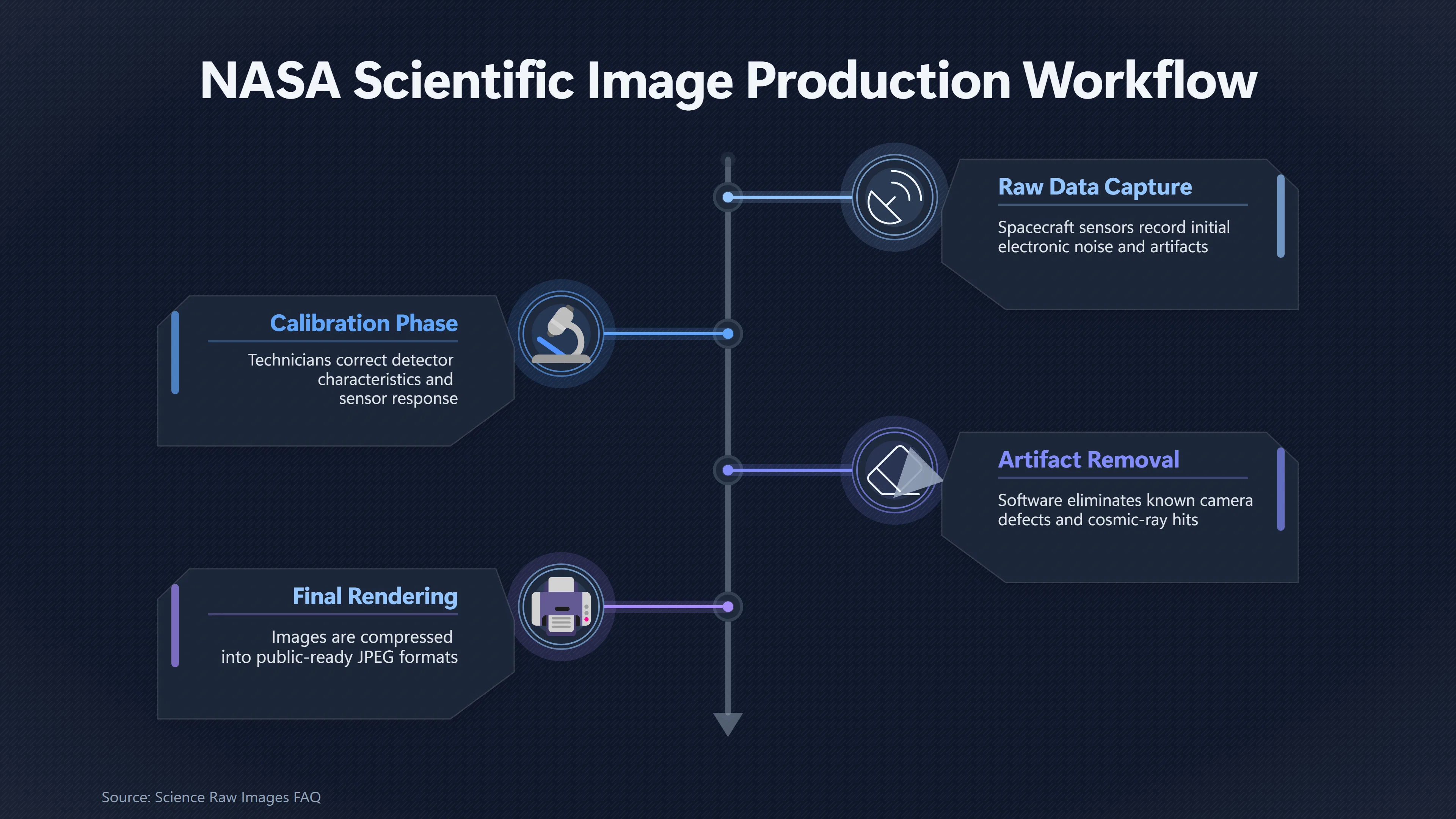
The word “processed” often sounds suspicious outside scientific imaging, yet every modern space mission produces processed data as part of normal operations. Raw images are not finished photographs in the everyday sense. They typically contain instrumental effects, uneven sensor response, electronic noise, compression artefacts or colour information that requires calibration before scientists can accurately interpret the scene.
NASA explains that processing may involve adjusting contrast, combining colour channels, correcting detector characteristics or producing panoramas and maps. These operations are intended to reveal information already present in the recorded data rather than introduce new features. In many missions, multiple processed products are generated because different scientific questions require different visual representations.[NASA Science]science.nasa.govScience Raw Images FAQNASA ScienceRaw Images FAQ - NASA ScienceNovember 2, 2024…
For example, processing may include:
- Correcting sensor response so brightness measurements are scientifically meaningful.
- Removing known camera defects, dust artefacts or cosmic-ray hits.
- Combining several exposures into mosaics or panoramas.
- Producing natural-colour and enhanced-colour versions for different purposes.
- Compressing files into formats suitable for public distribution while preserving higher-quality archival versions for research.[NASA Science]science.nasa.govScience Raw Images FAQNASA ScienceRaw Images FAQ - NASA ScienceNovember 2, 2024…
None of these steps imply that astronomical or terrestrial objects have been selectively removed.
How Apollo Film Became Digital Files
The Apollo missions illustrate why several versions of a single image often exist. The original photographs were captured on film rather than by digital cameras. Decades later, those negatives and transparencies were scanned repeatedly as imaging technology improved.
Earlier Apollo image catalogues used relatively modest digital scans suitable for browsing. The Lunar and Planetary Institute documented that images were digitised, cropped and colour-adjusted to compensate for film ageing before being converted into compressed JPEGs for online catalogues. The institute explicitly notes that these browse images were intended for identification rather than scientific analysis, while higher-resolution products should be obtained for research.[LPI]lpi.usra.eduLPIApollo Image AtlasScanning And Image Processing…
Later preservation projects substantially improved image quality. NASA’s Johnson Space Center collaborated with Arizona State University to create extremely high-resolution scans from the original Apollo film. These scans preserve far than older public releases and are available alongside derivative versions that have been cropped, colour-balanced or otherwise prepared for easier viewing. The US National Archives likewise maintains digital surrogates of Apollo photography derived from original mission film.[National Archives]archives.govNational Archives NASA | National ArchivesNational ArchivesNASA | National ArchivesNovember 22, 2022…
Consequently, it is entirely normal for archives to contain:
- Original film.
- High-resolution archival scans.
- Working files used during restoration.
- Publication-ready JPEGs.
- Smaller catalogue thumbnails.
These are different technical products derived from the same underlying photographs rather than separate evidential records.
Where Routine Editing Becomes Misunderstood
Within UFO discussions, the distinction between image restoration and image alteration is often blurred. Colour balancing, dust removal or cropping can appear suspicious when viewers expect every released image to be an untouched record.
Film restoration illustrates the problem clearly. High-resolution Apollo scans frequently show scratches, dust, hairs, uneven exposure and ageing effects inherited from the physical film. Restoration projects openly document removing these defects to create cleaner viewing copies while preserving the underlying image content. Before-and-after examples show cosmetic improvements rather than disappearing spacecraft or celestial objects.[Apollo Space]apollospace.comApollo Space IMAGING PROCESSApollo SpaceIMAGING PROCESS - Apollospace…
Similarly, modern planetary missions routinely release both raw and processed imagery. NASA encourages enthusiasts to download raw images and produce their own processed versions, noting that citizen scientists often create high-quality products using the same publicly available source material. Once archival-quality calibrated data are released, independent users can reproduce many of the same processing steps performed by mission teams.[NASA Science]solarsystem.nasa.govScience FAQ | Raw Images – NASA Solar System ExplorationNASA ScienceFAQ | Raw Images – NASA Solar System Exploration…
This transparency makes routine processing fundamentally different from an allegation of systematic concealment.
What This Means for McKinnon’s Account
Gary McKinnon has consistently said that he encountered directories containing “processed” and “unprocessed” NASA image files while searching computer systems he believed were associated with photographic work. Within the context of NASA’s documented imaging practices, those directory names are not unusual. Large imaging archives commonly separate original scans, calibrated working files and publication-ready products for practical and scientific reasons.
The existence of such folders therefore cannot, by itself, demonstrate that objects were being removed from photographs. To support that conclusion, one would need independently verifiable examples showing the same scene before and after the alleged removal, accompanied by authenticated provenance establishing that the alteration occurred within NASA’s official workflow.
No such authenticated image set has emerged publicly. McKinnon has said that his slow dial-up connection prevented him from downloading the large image he believed showed an anomalous object, leaving only his recollection of what briefly appeared on screen. His description remains uncorroborated by preserved files, forensic analysis or independent witnesses with access to the same material.[Reddit]reddit.comReminder: Gary McKinnon caught NASA editing UAP out of their images two decades ago. They are part of the cover-up.September 14, 2023…
The Practical Lesson for Evaluating NASA Images
The presence of multiple versions of a NASA photograph is expected in both historical and modern space missions. Image processing serves identifiable scientific, archival and publishing purposes, including calibration, restoration, compression and presentation. Those routine workflows explain why researchers, archivists and the public may encounter files labelled as raw, scanned, processed or enhanced.
For readers assessing UFO-related claims, the important distinction is between ordinary image processing, which NASA documents extensively and often makes reproducible, and selective evidence removal, which requires specific, independently verifiable proof. The existence of processed and unprocessed image files establishes the former. By itself, it does not establish the latter.[nasa.gov]science.nasa.govScience Raw Images FAQNASA ScienceRaw Images FAQ - NASA ScienceNovember 2, 2024…
Amazon book picks
Further Reading
Books and field guides related to Do Processed NASA Images Prove Anything Was Hidden?. Use these as the next step if you want deeper reading beyond the article.
Apollo Remastered
This definitive photographic book about the Apollo missions reveals hundreds of extraordinary, newly-restored, and all-new images from th...
Digital Image Processing
This is the eBook of the printed book and may not include any media, website access codes, or print supplements that may come packaged wi...
The NASA Archives. 60 Years in Space
Prepare to embark on a journey through space and time with The NASA Archives, a visual celebration of humankind's unstoppable urge to tra...
eBay marketplace picks
Marketplace Samples
Live-tested eBay searches with available results related to this page.
Selected fromNASA photo print oneBay.co.uk.
Endnotes
1.
Source: science.nasa.gov
Title: Science Raw Images FAQ
Link:https://science.nasa.gov/solar-system/multimedia/raw-images-faq/
Source snippet
NASA ScienceRaw Images FAQ - NASA ScienceNovember 2, 2024...
Published: November 2, 2024
2.
Source: lpi.usra.edu
Title: LPIApollo Image Atlas
Link:https://www.lpi.usra.edu/resources/apollo/processing/
Source snippet
Scanning And Image Processing...
3.
Source: solarsystem.nasa.gov
Title: Science FAQ | Raw Images – NASA Solar System Exploration
Link:https://solarsystem.nasa.gov/raw-images/raw-images-faq/
Source snippet
NASA ScienceFAQ | Raw Images – NASA Solar System Exploration...
4.
Source: science.nasa.gov
Title: Science Image Processing Methods
Link:https://science.nasa.gov/asset/hubble/image-processing-methods/
Source snippet
Processing Methods - NASA ScienceAugust 13, 1990 — IMAGE PROCESSING METHODS Image: Image Processing Methods This picture shows a comparis...
Published: August 13, 1990
5.
Source: archives.gov
Title: National Archives NASA | National Archives
Link:https://www.archives.gov/research/still-pictures/nasa
Source snippet
National ArchivesNASA | National ArchivesNovember 22, 2022...
Published: November 22, 2022
6.
Source: reddit.com
Link:https://www.reddit.com/r/UFOs/comments/16in31n/reminder_gary_mckinnon_caught_nasa_editing_uap/
Source snippet
Reminder: Gary McKinnon caught NASA editing UAP out of their images two decades ago. They are part of the cover-up.September 14, 2023...
Published: September 14, 2023
7.
Source: nasa.gov
Title: JS C Building 227
Link:https://www.nasa.gov/johnson/history/building-227/
Source snippet
Johnson Space Center Houston, Texas The Printing and Reproduction Facility (Building 227) consisted of a long, rectangular main build...
8.
Source: science.nasa.gov
Title: WHAT ARE RAW IMAGES? Raw images are photos from space missi
Link:https://science.nasa.gov/solar-system/multimedia/what-are-raw-images/
Source snippet
Are Raw Images - NASA ScienceNovember 5, 2024 — Image: A gray moon that looks somewhat like a flying saucer is seen against the darkness...
Published: November 5, 2024
9.
Source: nasa.gov
Title: Apollo 11 Image Library
Link:https://www.nasa.gov/wp-content/uploads/static/history/alsj/a11/images11.html
Source snippet
JONES AND KEN GLOVER. All rights reserved. HTML Design by Brian W. Lawrence. Last revised 12 May 2020. No copyright is asser...
Published: May 2020
10.
Source: apollospace.com
Title: Apollo Space IMAGING PROCESS
Link:https://apollospace.com/about-us/imaging-process/
Source snippet
Apollo SpaceIMAGING PROCESS - Apollospace...
11.
Source: apollospace.com
Title: IMAGE S
Link:https://apollospace.com/images/
Source snippet
IMAGES - ApollospaceFebruary 10, 2025 — IMAGES IMAGESJeremy Theoret2025-02-10T18:47:00:00 The Apollo Mission Flight Photographs The APOLL...
Published: February 10, 2025
12.
Source: apollospace.com
Title: These raw images can be seen on the National Archives website and various NASA
Link:https://apollospace.com/images/apollo-missions/apollo-7/apollo-7-flight-images-usb/
Source snippet
APOLLO 7 FLIGHT IMAGES USB - ApollospaceOctober 23, 2019 — JSC digitally scanned the Apollo Program photographs for the 40^{th} anniversa...
Published: October 23, 2019
Additional References
13.
Source: astrogeology.usgs.gov
Title: moon apollo metric mapping camera data
Link:https://astrogeology.usgs.gov/search/map/moon_apollo_metric_mapping_camera_data
Source snippet
September 25, 2012 — MOON APOLLO METRIC MAPPING CAMERA DATA Primary Authors Arizona State University Originators NASA, Johnson Space Cent...
Published: September 25, 2012
14.
Source: youtube.com
Title: How NASA created Webb’s image of the Carina Nebula with Alyssa Pagan
Link:https://www.youtube.com/watch?v=1QPJd2Fl6i4
Source snippet
Processing Astronomical Images with Judy Schmidt...
15.
Source: youtube.com
Title: Are colours in astronomical images real?
Link:https://www.youtube.com/watch?v=BodtjPYFaP8
Source snippet
Making False-Color X-ray Images with NASA Files from the Chandra Observatory...
16.
Source: youtube.com
Title: Processing Astronomical Images with Judy Schmidt
Link:https://www.youtube.com/watch?v=iiXzfeE5EjI
Source snippet
JWST's Biggest Secret Revealed (It's Not What You Think)...
17.
Source: youtube.com
Title: JWST’s Biggest Secret Revealed (It’s Not What You Think)
Link:https://www.youtube.com/watch?v=FNyFiaF2Q8s
Source snippet
Are colours in astronomical images real?...
18.
Source: youtube.com
Title: Making False-Color X-ray Images with NASA Files from the Chandra Observatory
Link:https://www.youtube.com/watch?v=50ATKiX6w7o