Within Image Artefacts
What Would Actually Verify a Strange Space Image?
A credible identification depends on the original file, metadata, adjacent frames, camera geometry and processing records.
On this page
- Why the original file and metadata matter
- How adjacent frames test motion and persistence
- Which processing logs expose corruption or artefacts
Page outline Jump by section
Introduction
A striking space image, viewed in isolation, cannot establish that it shows an unusual spacecraft or any other extraordinary object. In the context of claims such as those associated with Gary McKinnon’s account of seeing a remarkable NASA image, the decisive question is not how unusual the image appears but whether the underlying scientific evidence allows it to be authenticated and interpreted. A low-resolution screenshot, compressed copy or remembered visual impression lacks the information needed to distinguish a genuine object from detector artefacts, transmission errors, reflections, cosmic-ray strikes or processing mistakes.
For that reason, image verification depends on preserving the original observational record. Scientists rely on the original data file, its metadata, neighbouring exposures, instrument geometry and processing history to determine whether an apparent anomaly represents a real feature in space or a by-product of how the image was captured, transmitted or reconstructed.[FITS Support Office]fits.gsfc.nasa.govFITS Support OfficeFITS Support OfficeApril 3, 2023…
Why the Original File and Metadata Matter
The strongest evidence begins with the original scientific image rather than a converted JPEG, screenshot or edited illustration. Most astronomical and spacecraft observations are stored in the Flexible Image Transport System (FITS), the standard scientific format used across NASA and much of astronomy. Unlike ordinary image formats, a FITS file contains extensive header information describing how and when the observation was made.[FITS Support Office]fits.gsfc.nasa.govFITS Support OfficeFITS Support OfficeApril 3, 2023…
Key metadata typically includes:
- Observation time, often recorded to high precision.
- Instrument and detector identification.
- Exposure duration.
- Telescope or spacecraft pointing information.
- Filter or wavelength used.
- Calibration status.
- Processing history and software versions.
This information allows investigators to reconstruct the circumstances under which the image was acquired. If metadata is missing, inconsistent or has been stripped away—as commonly happens when images are converted for web publication—the evidential value of the image is greatly reduced.
Equally important is provenance: an image should be traceable from the observing instrument through archive storage to any publicly released version. A documented chain of custody makes later alterations, accidental corruption or misidentification much easier to detect.[FITS Support Office]fits.gsfc.nasa.govFITS Support OfficeFITS Support OfficeApril 3, 2023…
How Adjacent Frames Test Motion and Persistence
A single frame rarely provides enough evidence to identify an unexpected object. Scientists instead examine images immediately before and after the reported anomaly.
This comparison answers several critical questions:
- Does the object remain visible across multiple exposures?
- Does it move consistently with orbital mechanics or spacecraft motion?
- Does it stay fixed relative to detector pixels, suggesting a sensor defect?
- Does it appear only once, consistent with a cosmic-ray strike?
- Does its brightness evolve in a physically plausible way?
Transient detector events usually affect only one exposure. Genuine astronomical objects generally appear repeatedly, with predictable positional changes based on telescope pointing and exposure timing.
Many observatories also compare simultaneous observations from different instruments or different spacecraft. If an object appears only on one detector while every other instrument sees nothing corresponding to it, an instrumental explanation becomes considerably more likely.[STEREO Science Center]stereo-ssc.nascom.nasa.govSTEREO Science Center
Why Camera Geometry Matters
Understanding the observing geometry is often enough to explain apparently mysterious shapes.
Investigators reconstruct:
- the telescope’s pointing direction,
- spacecraft orientation,
- optical configuration,
- detector layout,
- positions of bright planets, stars or the Sun,
- expected reflections within the instrument.
This reconstruction determines whether an apparent object lies where a known optical reflection, diffraction feature or internal ghost image should occur.
NASA’s documentation for the STEREO mission illustrates how internal reflections, debris, spacecraft rolls and camera-specific effects can generate visually convincing features that disappear once the instrument geometry is understood. These explanations rely on engineering information rather than visual appearance alone.[STEREO Science Center]stereo-ssc.nascom.nasa.govSTEREO Science Center

Which Processing Logs Expose Corruption or Artefacts
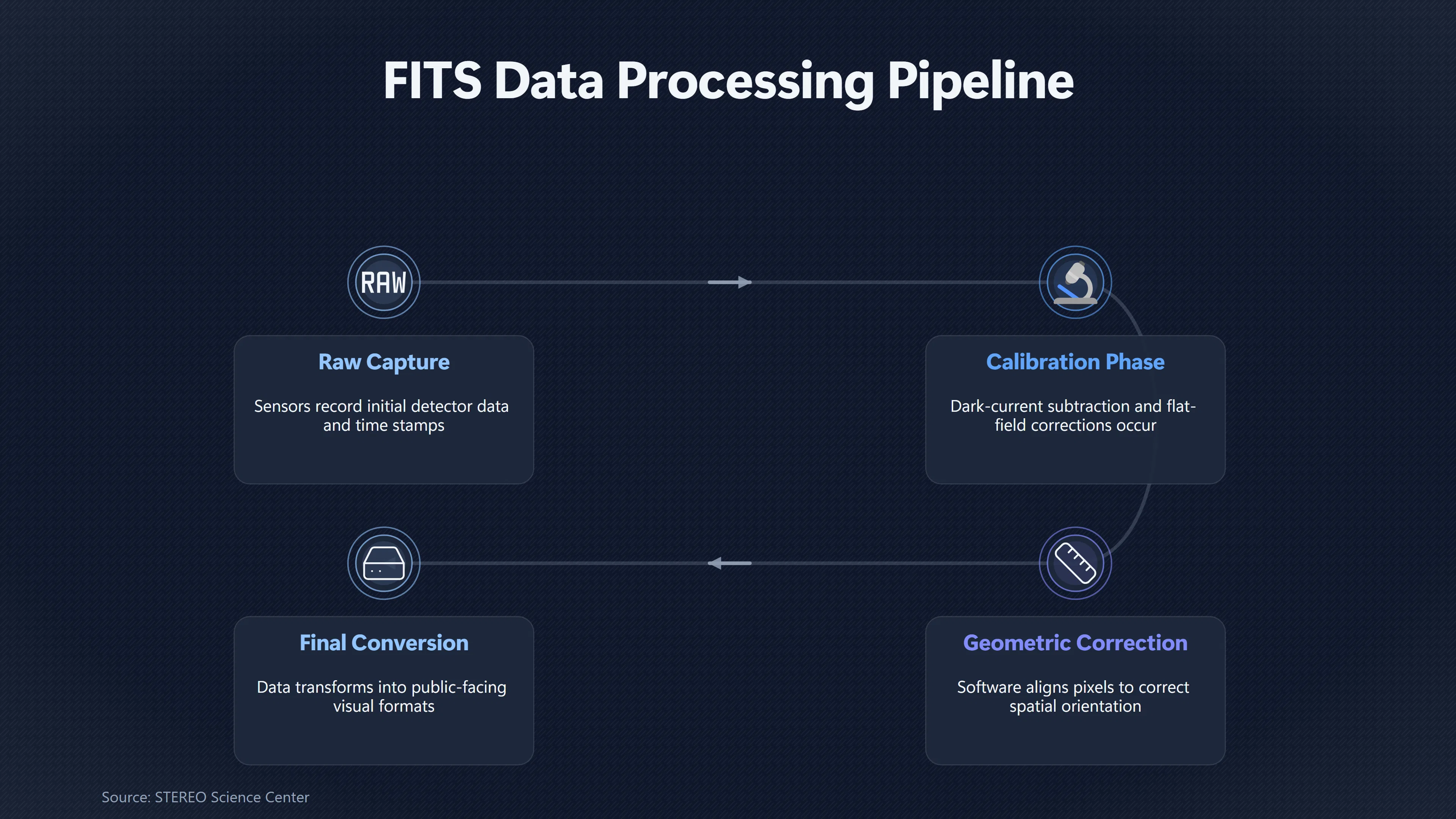
Raw detector data normally undergo multiple processing stages before becoming the images seen by scientists or the public.
These stages may include:
- decompression,
- calibration,
- dark-current subtraction,
- flat-field correction,
- cosmic-ray removal,
- geometric correction,
- colour assignment,
- file conversion.
Processing logs document exactly what happened at each step.
These records can reveal whether:
- packets were missing during transmission,
- software substituted placeholder values,
- calibration files changed the appearance,
- detector errors were corrected,
- compression introduced visible distortions.
NASA’s STEREO documentation includes examples of corrupted images created when onboard processors became overloaded, sometimes mixing data from different telescopes into a single image. Such cases demonstrate why an unusual-looking image cannot be evaluated without knowing its processing history.[STEREO Science Center]stereo-ssc.nascom.nasa.govSTEREO Science Center
Why Compression and Public Images Can Mislead
Images released for public viewing are frequently optimised for rapid transmission or visual presentation rather than forensic analysis.
Compressed products may contain:
- block artefacts,
- ringing around bright features,
- exaggerated cosmic-ray hits,
- smoothed edges,
- altered contrast.
The STEREO mission distinguishes between low-bandwidth “beacon” images transmitted quickly for operational awareness and higher-quality science data downloaded later. Apparent anomalies seen in beacon images sometimes disappear or become readily identifiable when the corresponding full-resolution scientific data arrive.[STEREO Science Center]stereo-ssc.nascom.nasa.govSTEREO Science Center
Similarly, many celebrated colour images from telescopes such as Hubble or the James Webb Space Telescope are carefully processed composites assembled from multiple exposures taken through different filters. They are scientifically accurate visualisations but are not direct camera snapshots. Understanding the processing workflow is essential before drawing conclusions from any unusual visual feature.[NASA Science]science.nasa.govScience Process Astronomical Images on Your Home Computer Just Like the ExpertsNASA ScienceProcess Astronomical Images on Your Home Computer Just Like the Experts - NASA ScienceJuly 8, 2004…
Applying These Standards to Claimed UFO Images
These verification principles explain why some well-known claims remain unresolved rather than confirmed.
In Gary McKinnon’s account, no original image file, FITS header, filename, observation identifier, telemetry record, adjacent frames or processing logs were preserved. The reported observation survives only as a personal recollection of briefly viewing a partially downloaded image over a slow remote connection using reduced colour depth and resolution.
Without the underlying technical evidence, investigators cannot determine whether the reported shape represented:
- a real spacecraft or satellite,
- orbital debris,
- an astronomical object,
- detector artefacts,
- corrupted transmission,
- incomplete image rendering,
- compression effects,
- or another routine imaging phenomenon.
The absence of the original scientific record therefore prevents either confirmation or definitive refutation. The claim remains evidentially incomplete because the critical data needed for verification are unavailable.
What Would Count as Strong Verification?
A genuinely persuasive case would require multiple independent forms of evidence rather than a single striking image.
The strongest verification would include:
- The original unmodified scientific data file.
- Complete metadata describing the observation.
- Verified timestamps and instrument configuration.
- Adjacent exposures showing consistent behaviour.
- Independent observations from another instrument or observatory.
- Processing records demonstrating that no corruption occurred.
- Instrument-team analysis ruling out known optical and detector artefacts.
- Reproducible access to the archived observation for independent examination.
Only when these elements align can investigators confidently distinguish an authentic, previously unknown object from the many documented artefacts that routinely appear in space imagery. Extraordinary interpretations therefore depend less on the visual appearance of a single frame than on the completeness, provenance and reproducibility of the underlying observational evidence.
Amazon book picks
Further Reading
Books and field guides related to What Would Actually Verify a Strange Space Image?. Use these as the next step if you want deeper reading beyond the article.
Digital Image Processing
This is the eBook of the printed book and may not include any media, website access codes, or print supplements that may come packaged wi...
Bad Astronomy
A clever, thought-provoking guide that attacks common astronomical misconceptions What is Bad Astronomy? Anything that accidentally or in...
The Handbook of Astronomical Image Processing
First published 2000. Subjects: CCD cameras, Imaging systems in astronomy, Data processing, Astronomical photography.
The Demon-Haunted World
NEW YORK TIMES BESTSELLER • From the renowned astronomer and author of Cosmos comes a “powerful [and] stirring defense of informed ration...
eBay marketplace picks
Marketplace Samples
Live-tested eBay searches with available results related to this page.
Selected fromspace photography poster oneBay.co.uk.
Endnotes
1.
Source: fits.gsfc.nasa.gov
Link:https://fits.gsfc.nasa.gov/
Source snippet
FITS Support OfficeFITS Support OfficeApril 3, 2023...
Published: April 3, 2023
2.
Source: stereo-ssc.nascom.nasa.gov
Title: STEREO Science Center
Link:https://stereo-ssc.nascom.nasa.gov/artifacts/artifacts.shtml
3.
Source: heasarc.gsfc.nasa.gov
Title: HEASARCfitsverify Home Page
Link:https://heasarc.gsfc.nasa.gov/docs/software/ftools/fitsverify/index.html
4.
Source: stereo-ssc.nascom.nasa.gov
Title: STEREO Science Center
Link:https://stereo-ssc.nascom.nasa.gov/artifacts/artifacts_corrupted.shtml
5.
Source: stereo-ssc.nascom.nasa.gov
Title: STEREO Science Center
Link:https://stereo-ssc.nascom.nasa.gov/artifacts/artifacts_beacon.shtml
6.
Source: science.nasa.gov
Title: Science Process Astronomical Images on Your Home Computer Just Like the Experts
Link:https://science.nasa.gov/missions/hubble/process-astronomical-images-on-your-home-computer-just-like-the-experts
Source snippet
NASA ScienceProcess Astronomical Images on Your Home Computer Just Like the Experts - NASA ScienceJuly 8, 2004...
Published: July 8, 2004
7.
Source: science.nasa.gov
Title: Science How Are Webb’s Full-Color Images Made?
Link:https://science.nasa.gov/mission/webb/science-overview/science-explainers/how-are-webbs-full-color-images-made/
Source snippet
NASA ScienceSeptember 3, 2025 — DOWNLOADING RAW IMAGE FILES All data, or images, from Webb’s cameras are located in MAST. This is a view...
Published: September 3, 2025
8.
Source: solarsystem.nasa.gov
Title: raw images faq
Link:https://solarsystem.nasa.gov/raw-images/raw-images-faq/
Source snippet
Each image is taken with one or more filters positioned in front of the camera sensor. This is not unlike how photographers on...
9.
Source: heasarc.gsfc.nasa.gov
Link:https://heasarc.gsfc.nasa.gov/docs/heasarc/fits.html
10.
Source: science.nasa.gov
Title: raw images faq
Link:https://science.nasa.gov/solar-system/multimedia/raw-images-faq/
11.
Source: fits.gsfc.nasa.gov
Title: fits home
Link:https://fits.gsfc.nasa.gov/fits_home.html
12.
Source: stereo-ssc.nascom.nasa.gov
Title: artifacts camera.shtml
Link:https://stereo-ssc.nascom.nasa.gov/artifacts/artifacts_camera.shtml
13.
Source: fits.gsfc.nasa.gov
Title: fits standard
Link:https://fits.gsfc.nasa.gov/fits_standard.html
14.
Source: stereo-ssc.nascom.nasa.gov
Title: artifacts debris.shtml
Link:https://stereo-ssc.nascom.nasa.gov/artifacts/artifacts_debris.shtml
15.
Source: fits.gsfc.nasa.gov
Link:https://fits.gsfc.nasa.gov/users_guide/users_guide/node6.html
16.
Source: fits.gsfc.nasa.gov
Link:https://fits.gsfc.nasa.gov/users_guide/users_guide/node50.html
17.
Source: eol.jsc.nasa.gov
Link:https://eol.jsc.nasa.gov/FAQ/
18.
Source: nationalarchives.gov.uk
Title: PRONO M | Search by format
Link:https://www.nationalarchives.gov.uk/pronom/x-fmt/383
Additional References
19.
Source: youtube.com
Link:https://www.youtube.com/watch?v=tcIsgL1bs1I
Source snippet
DS9 Part 2 Tutorials: VISUALIZE FITS IMAGE ASTRONOMICAL IMAGE ANALYSIS & PROCESSING...
20.
Source: youtube.com
Link:https://www.youtube.com/watch?v=2xk5lBOKk9I
Source snippet
Extract Hidden Metadata From Images with ExifTool | Digital Forensics...
21.
Source: youtube.com
Title: FITS File Extension: Flexible Image Transport System Files Explained
Link:https://www.youtube.com/watch?v=lpgXdlzJfXs
Source snippet
Astropy Python Astronomy Tutorial: How To Read, Plot FITS File Image Analysis/processing...
22.
Source: youtube.com
Title: Extract Hidden Metadata From Images with Exif Tool | Digital Forensics
Link:https://www.youtube.com/watch?v=GVHieQZekCo
Source snippet
OSINT At Home #8 – Calculate time using shadows in a photo or video...
23.
Source: outerspace.stsci.edu
Link:https://outerspace.stsci.edu/spaces/MASTDOCS/pages/97290409/Required%2BMetadata
Source snippet
Shaw, last updated on Jul 15, 2025 1 minute read Metadata, or data that describe data, are required for documenting essential attributes...
24.
Source: arxiv.org
Title: arXiv Detection and Removal of Artifacts in Astronomical Images
Link:https://arxiv.org/abs/1601.07182
25.
Source: youtube.com
Title: OSINT At Home #8 – Calculate time using shadows in a photo or video
Link:https://www.youtube.com/watch?v=9z26rSP2eqs
Source snippet
Flexible Image Transport System Files Explained...
26.
Source: archive.stsci.edu
Title: fits standard
Link:https://archive.stsci.edu/fits/fits_standard/