Within Image Artefacts
Could Telescope Reflections Explain a Geometric UFO?
Light bouncing inside a telescope can create discs, arcs and patches far from the bright source that caused them.
On this page
- Where internal reflections form inside space cameras
- Why reflected light appears displaced from its source
- How repeated geometry identifies an optical artefact
Page outline Jump by section
Introduction
Unusual geometric shapes in space images are sometimes presented as evidence of structured or artificial objects. In many cases, however, the simplest explanation is not an external object at all but light reflecting between optical surfaces inside the telescope. Internal reflections—often called ghost images—can produce rings, diamonds, discs, crosses, arcs and apparently isolated luminous patches that seem detached from any bright source. Unless the complete image, instrument geometry and observing conditions are examined, these reflections can be mistaken for solid craft.
This distinction is particularly relevant when discussing claimed UFO imagery associated with cases such as Gary McKinnon’s account of viewing an unusual NASA image. Because no original file, metadata or full-resolution image survives, it is impossible to exclude well-documented optical artefacts such as internal reflections before considering more extraordinary explanations.
Where Internal Reflections Form Inside Space Cameras
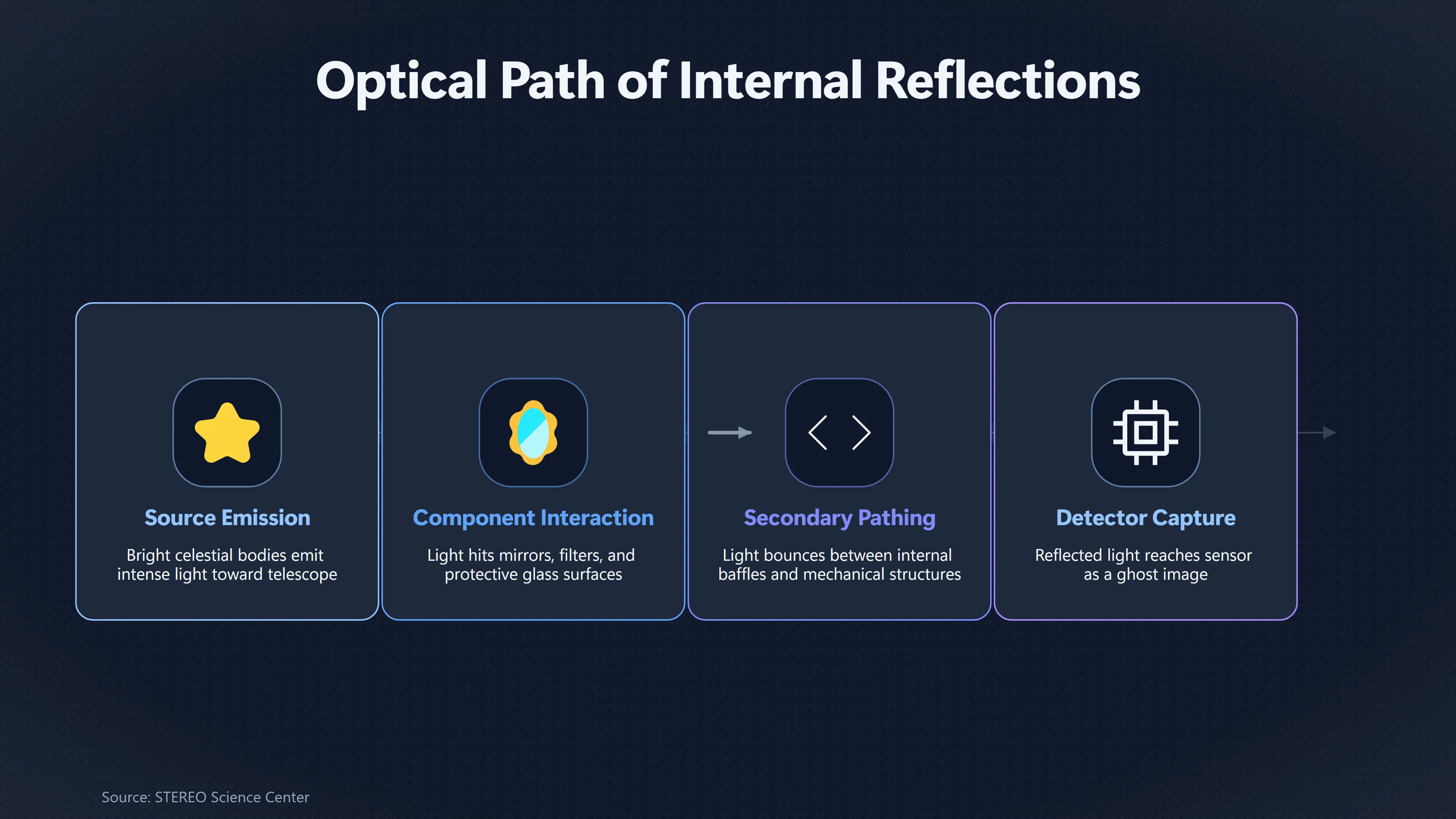
A space telescope is not simply a single mirror pointing at the sky. Light passes through, or reflects from, multiple carefully engineered components including mirrors, filters, detector windows, protective glass, baffles and mechanical structures designed to suppress stray light. Even with sophisticated optical design, an extremely bright source can reflect from one surface to another before reaching the detector.
These secondary light paths produce images that are not part of the astronomical scene. Instead, they are optical by-products created entirely within the instrument. Because the reflected light follows predictable geometric paths through the telescope, the resulting artefacts often display smooth edges, symmetry and repeated shapes that can resemble engineered structures rather than random glare. NASA’s STEREO mission documents numerous examples of planets producing rings, bubbles and geometric reflections inside its heliospheric imagers.[STEREO Science Center]stereo-ssc.nascom.nasa.govJune 6, 2022…
The phenomenon is not unique to one spacecraft. Astronomical cameras, solar observatories and deep-sky survey instruments all require calibration procedures that identify and model internal reflections so they are not confused with genuine celestial objects. Research on astronomical imaging likewise treats internal reflections as measurable optical effects that can be characterised and removed from scientific data.[arXiv]arxiv.orgarXiv Removing Internal Reflections from Deep Imaging DatasetsRemoving Internal Reflections from Deep Imaging DatasetsSeptember 17, 2009…
Why Reflected Light Appears Displaced from Its Source
One reason these artefacts appear mysterious is that the bright object responsible may not lie anywhere near the apparent “UFO”.
Unlike ordinary photographic lens flare familiar from consumer cameras, telescope reflections frequently appear far from the originating source because the light has travelled through several reflections before reaching the detector. Depending on the optical layout, the ghost image may appear:
- opposite the bright object across the detector;
- offset by a fixed geometric distance;
- enlarged into a diffuse disc or ring;
- transformed into a polygonal or diamond-like patch;
- partially outside the apparent optical axis.
This displacement makes it easy to overlook the true cause when examining only a cropped image. A viewer may see an isolated luminous object without realising that an exceptionally bright planet or the Earth itself lies elsewhere in the original field.
NASA repeatedly demonstrates this effect using STEREO observations in which Earth or Venus generates reflections that remain synchronised with the planet as it moves through the field of view. The apparent “object” is therefore not an independently moving body but an optical consequence of the bright source’s changing position.[STEREO Science Center]stereo-ssc.nascom.nasa.govSTEREO Science CenterJune 6, 2022…
How Repeated Geometry Identifies an Optical Artefact
The strongest evidence that these features originate inside the instrument is their repeatability.
True spacecraft would be expected to move independently of the telescope’s optical system. Internal reflections instead obey the geometry of the camera. Investigators therefore look for patterns such as:
- identical shapes appearing whenever the same bright planet enters the field;
- reflections remaining mirrored across the detector from the bright source;
- predictable changes in size as the source approaches or leaves the field of view;
- multiple faint copies generated simultaneously by different reflecting surfaces;
- identical artefacts recurring over many years with different astronomical targets.
NASA has published several explanatory pages specifically because geometric reflections have repeatedly been interpreted online as anomalous craft. One example addresses a triangular or diamond-shaped object seen in STEREO imagery during late 2011. Another explains a wheel-like object reported in 2020. In both cases, the unusual geometry tracked the position of Venus almost perfectly and was identified as an internal reflection within the telescope optics rather than an external object.[STEREO Science Center]stereo-ssc.nascom.nasa.govSTEREO Science CenterSTEREO Science Center
The repeatability of these patterns is one of the strongest diagnostic tools available. Random unknown vehicles would not consistently recreate the same optical geometry every time a bright planet occupied a particular position in the detector.

Why Geometric Shapes Can Look Artificial
Human perception is highly sensitive to symmetry. Circular discs, diamonds, crosses and sharply bounded luminous forms naturally suggest manufactured objects.
Internal reflections reinforce this impression because they often inherit aspects of the telescope’s own construction. Reflections may incorporate the outline of baffles, apertures or support structures, producing surprisingly regular forms that appear designed rather than accidental.
In some astronomical survey images, observers have mistaken reflected images of the telescope’s secondary mirror supports for enormous artificial structures. Experienced astronomers instead recognise these patterns as signatures of the instrument itself rather than features in space. Community discussions around Digitized Sky Survey imagery repeatedly converge on this explanation, matching longstanding documentation of reflection artefacts in survey photographs.[Reddit]reddit.comObject identification helpObject identification helpJune 14, 2024…
The apparent precision of the shape therefore argues neither for nor against an extraordinary interpretation. It simply reflects the precision with which astronomical instruments are manufactured.

Why the Full Field of View Matters
Many UFO interpretations begin with a cropped image that excludes the bright source responsible for the reflection.
Examining the complete frame often changes the interpretation immediately. A bright planet near the detector edge, the Earth just outside the visible field or the Sun illuminating internal surfaces may explain an isolated luminous feature that otherwise appears inexplicable.
Instrument teams routinely inspect:
- the uncropped image;
- detector orientation;
- spacecraft pointing information;
- the location of bright planets and stars;
- previous and subsequent frames;
- calibration documentation for known optical artefacts.
These additional data frequently reveal that the suspected object moves exactly as predicted for a reflection rather than as an independently flying body. NASA’s published STEREO examples are especially instructive because they show the complete sequence rather than a single frame, making the optical relationship obvious.[STEREO Science Center]stereo-ssc.nascom.nasa.govSTEREO Science CenterJune 6, 2022…
What This Means for Claimed Spacecraft Images
Internal reflections do not explain every unusual astronomical image, but they represent one of the best-documented mechanisms by which apparently geometric UFO-like forms are created.
For cases lacking the original image, detector metadata, calibration information or observing sequence—as with Gary McKinnon’s reported observation—it is impossible to determine whether an apparent object was a genuine scene or a reflection generated within the telescope. Because such reflections are known to produce isolated, symmetrical and apparently engineered forms, they must be excluded before an image can reasonably be interpreted as evidence of an unknown spacecraft. The existence of numerous repeatable, instrument-specific examples demonstrates that visually compelling geometry alone is not a reliable indicator of an artificial object.
Amazon book picks
Further Reading
Books and field guides related to Could Telescope Reflections Explain a Geometric UFO?. Use these as the next step if you want deeper reading beyond the article.
Optics
For courses in Optics A Contemporary Approach to Optics with Practical Applications and New Focused Pedagogy Hecht Optics balances theory...

Astronomical Optics
First published 1999. Subjects: Astronomical instruments, Optics, Astronomy.

The Handbook of Astronomical Image Processing
First published 2000. Subjects: CCD cameras, Imaging systems in astronomy, Data processing, Astronomical photography.
eBay marketplace picks
Marketplace Samples
Live-tested eBay searches with available results related to this page.
Selected fromtelescope model oneBay.co.uk.
Endnotes
1.
Source: stereo-ssc.nascom.nasa.gov
Title: STEREO Science Center
Link:https://stereo-ssc.nascom.nasa.gov/artifacts/artifacts_reflections.shtml
Source snippet
June 6, 2022...
Published: June 6, 2022
2.
Source: stereo-ssc.nascom.nasa.gov
Title: STEREO Science Center
Link:https://stereo-ssc.nascom.nasa.gov/artifacts/artifacts.shtml
3.
Source: arxiv.org
Title: arXiv Removing Internal Reflections from Deep Imaging Datasets
Link:https://arxiv.org/abs/0909.3320
Source snippet
Removing Internal Reflections from Deep Imaging DatasetsSeptember 17, 2009...
Published: September 17, 2009
4.
Source: stereo-ssc.nascom.nasa.gov
Title: STEREO Science Center
Link:https://stereo-ssc.nascom.nasa.gov/artifacts/wheel/
5.
Source: stereo-ssc.nascom.nasa.gov
Title: STEREO Science Center
Link:https://stereo-ssc.nascom.nasa.gov/artifacts/triangle/index.shtml
6.
Source: reddit.com
Title: Object identification help
Link:https://www.reddit.com/r/Astronomy/comments/1dfwa5j
Source snippet
Object identification helpJune 14, 2024...
Published: June 14, 2024
7.
Source: reddit.com
Title: What is THIS!?!?
Link:https://www.reddit.com/r/hubble/comments/1s6qrxx/what_is_this/
Source snippet
What is THIS!?!?...
8.
Source: reddit.com
Title: What is this?
Link:https://www.reddit.com/r/askastronomy/comments/1uommmt/what_is_this/
Source snippet
What is this?...
9.
Source: science.nasa.gov
Title: hubbles mirror flaw
Link:https://science.nasa.gov/mission/hubble/observatory/design/optics/hubbles-mirror-flaw/
Source snippet
Hubble has more than doubled its 15-year life expectancy and significantly expanded our und...
10.
Source: science.nasa.gov
Link:https://science.nasa.gov/mission/hubble/observatory/design/
Source snippet
QUICK FACTS Hubble’s frame is made of graphite-epoxy covered by a light aluminum shell and a...
11.
Source: science.nasa.gov
Title: QUICK FACTS Hubble’s primary mirror collects 40,000 times more light t
Link:https://science.nasa.gov/mission/hubble/observatory/design/optics/
Source snippet
NASA ScienceJanuary 18, 2024 — OPTICS Hubble’s light-gathering ability lies in its 1,825-pound (828-kilogram), 7.9-foot (2.4-meter) diame...
Published: January 18, 2024
12.
Source: stereo.gsfc.nasa.gov
Link:https://stereo.gsfc.nasa.gov/artifacts/triangle/
13.
Source: stereo-ssc.nascom.nasa.gov
Title: artifacts corrupted.shtml
Link:https://stereo-ssc.nascom.nasa.gov/artifacts/artifacts_corrupted.shtml
14.
Source: ntrs.nasa.gov
Link:https://ntrs.nasa.gov/search.jsp?R=19910003124&lang=en
15.
Source: youtube.com
Title: Lens Flares: Why they look like that?
Link:https://www.youtube.com/watch?v=OaHVdA8KLtw
Source snippet
Lens Flare...
16.
Source: youtube.com
Title: Lens Flare
Link:https://www.youtube.com/watch?v=D5H5AgnHCls
Source snippet
Camera Lens Flare and Ghosting: What You Need to Know for Better Photography...
Additional References
17.
Source: youtube.com
Title: Total Internal Reflection
Link:https://www.youtube.com/watch?v=0z-F_scr16E
Source snippet
Ray Optics & Optical Instruments Explained | Mirrors, Lenses, Microscopes & Telescopes Made Easy...
18.
Source: youtube.com
Title: Camera Lens Flare and Ghosting: What You Need to Know for Better Photography
Link:https://www.youtube.com/watch?v=XuKenlhD504
Source snippet
Total Internal Reflection - Applications & Mirages - SPM & IGCSE Physics...
19.
Source: youtube.com
Link:https://www.youtube.com/watch?g=1&v=Xg9MHf_unhQ
20.
Source: esahubble.org
Title: Hubble’s Instruments: COSTAR
Link:https://esahubble.org/about/general/instruments/costar/
21.
Source: airandspace.si.edu
Title: repairing hubble
Link:https://airandspace.si.edu/stories/editorial/repairing-hubble