Within Mental Health
When Does Extradition Become Inhumane for Vulnerable Defendants?
Extradition may become disproportionate when removal, detention and disrupted care create severe risks beyond those of an ordinary prosecution.
On this page
- The difference between prosecution and extradition harm
- Factors courts should examine before surrender
- Why foreign treatment assurances may not settle the issue
Page outline Jump by section
Introduction
Mental illness does not automatically prevent extradition, nor does it excuse alleged criminal conduct. The legal question is narrower and more demanding: whether removing a particular person to face prosecution abroad would create a level of suffering so severe that extradition itself becomes a disproportionate and inhumane response. In cases such as Gary McKinnon’s, the focus shifted away from the allegations and towards the foreseeable consequences of removal—separation from established support networks, disruption of psychiatric care, unfamiliar detention conditions and an exceptional risk of suicide. The issue is therefore not whether prosecution is justified, but whether extradition adds avoidable harm beyond that inherent in a criminal trial.[GOV.UK]GOV.UKTheresa May statement on Gary Mc Kinnon extraditionTheresa May statement on Gary McKinnon extradition - GOV.UKOctober 16, 2012…
When does extradition become inhumane for vulnerable defendants?
The distinction between prosecution and extradition is crucial. Every criminal prosecution involves stress, uncertainty and the possibility of imprisonment. Extradition introduces additional burdens that may affect a mentally vulnerable person far more severely than an ordinary defendant.
For someone with serious depression, autism spectrum disorder accompanied by acute anxiety, psychosis or another significant psychiatric condition, extradition may involve:
- abrupt removal from family members and long-standing carers;
- disruption of established psychiatric treatment and medication;
- detention in an unfamiliar legal and healthcare system;
- communication difficulties with new clinicians and lawyers;
- prolonged uncertainty while awaiting trial in another country; and
- a foreseeable deterioration in mental health, including an increased risk of self-harm or suicide.
The legal concern is the cumulative effect of these factors. Courts are not simply asking whether prison healthcare exists in the requesting country, but whether the process of extradition itself would expose the individual to a real and unacceptable risk of catastrophic harm.[GOV.UK]GOV.UKTheresa May statement on Gary Mc Kinnon extraditionTheresa May statement on Gary McKinnon extradition - GOV.UKOctober 16, 2012…
Gary McKinnon’s case illustrates this distinction. The Home Secretary did not conclude that he should avoid prosecution because he had Asperger’s syndrome. Rather, after reviewing extensive psychiatric evidence and obtaining independent medical advice, she concluded that extradition would create such a high risk of suicide that surrender would be incompatible with his human rights. Domestic prosecution remained a separate possibility.[GOV.UK]GOV.UKTheresa May statement on Gary Mc Kinnon extraditionTheresa May statement on Gary McKinnon extradition - GOV.UKOctober 16, 2012…
The difference between prosecution and extradition harm
One of the most common misunderstandings is to treat opposition to extradition as opposition to accountability. Legally, these are separate questions.
A defendant may still be capable of standing trial while nevertheless facing disproportionate harm from removal abroad. The additional burdens created by extradition include:
- Geographical separation. Family members who provide emotional support may be unable to visit regularly because of distance or cost.
- Loss of clinical continuity. Long-term treating psychiatrists and psychologists cannot simply transfer their therapeutic relationship to another jurisdiction.
- Extended pre-trial detention. Some extradition cases involve lengthy periods before trial, increasing uncertainty and psychological strain.
- Different custodial practices. Even where medical treatment is available, prison regimes, observation procedures and mental health services may differ substantially.
These factors matter because psychiatric deterioration is often driven not by a single event but by the interaction of isolation, uncertainty and disrupted support. A court therefore evaluates foreseeable consequences for the individual rather than assuming that all defendants will respond in the same way.[GOV.UK]GOV.UKTheresa May statement on Gary Mc Kinnon extraditionTheresa May statement on Gary McKinnon extradition - GOV.UKOctober 16, 2012…

Factors courts should examine before surrender
Modern extradition decisions involving mental illness are highly individualised. Diagnosis alone is rarely decisive.
Courts generally place significant weight on questions such as:
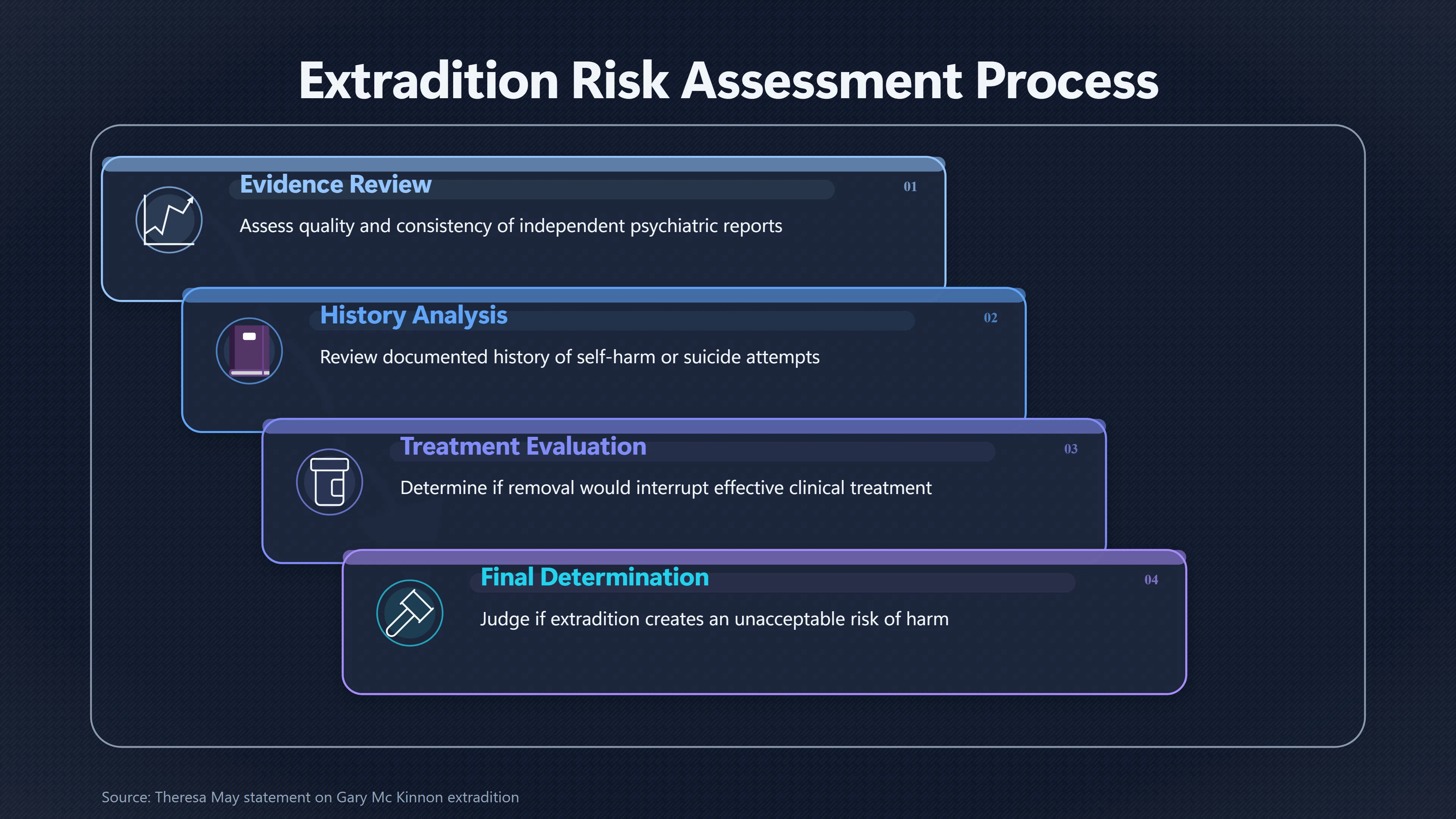
- the quality, independence and consistency of psychiatric evidence;
- documented history of suicide attempts or self-harm;
- previous deterioration during periods of stress or detention;
- whether removal would interrupt effective treatment;
- the person’s ability to cope with unfamiliar custodial conditions;
- availability of equivalent psychiatric care after extradition;
- whether protective measures would genuinely reduce the risk rather than merely contain it; and
- whether prosecution could realistically occur in the person’s home jurisdiction instead.
This approach avoids two opposite errors. The first is assuming that any mental illness automatically prevents extradition. The second is assuming that the existence of prison medical services necessarily removes the risk. Psychiatric experts frequently distinguish between treatment being theoretically available and treatment being capable of preventing foreseeable deterioration in a particular individual.[GOV.UK]GOV.UKTheresa May statement on Gary Mc Kinnon extraditionTheresa May statement on Gary McKinnon extradition - GOV.UKOctober 16, 2012…
Why foreign treatment assurances may not settle the issue
Requesting states often provide diplomatic or prosecutorial assurances that appropriate medical treatment will be available after extradition. These assurances are important, but they are not automatically decisive.
The central question is whether the assurances address the actual mechanism of harm.
For example, an assurance that psychiatric medication will be available does not necessarily answer concerns about:
- the psychological impact of forced removal itself;
- prolonged isolation from established support networks;
- deterioration triggered by uncertainty before trial;
- heightened suicide risk during transport or early detention; or
- the practical ability of prison healthcare to manage an individual with unusually complex needs.
The debate therefore extends beyond the existence of medical facilities. Decision-makers must consider whether those facilities realistically prevent the specific risks identified by independent clinicians.
Earlier stages of McKinnon’s litigation illustrate this point. At one stage, courts accepted American assurances regarding prison conditions and healthcare yet concluded that the legal threshold for blocking extradition had not been met. Later, following additional medical assessment and a different evidential picture, the Home Secretary reached the opposite conclusion because the predicted suicide risk was judged to be substantially higher. The change reflected evolving evidence rather than a general rejection of foreign medical assurances.[Hansard]hansard.parliament.ukHansard Gary Mc Kinnon (ExtraditionGary McKinnon (Extradition) - Hansard - UK Parliament…

Why McKinnon’s case remains significant
The lasting importance of Gary McKinnon’s case lies in the principle it illustrates rather than in any suggestion that autism or depression automatically bar extradition.
His case demonstrates that proportionality depends upon the interaction between an individual’s psychiatric condition and the practical consequences of surrender. Serious criminal allegations remain capable of prosecution, but extradition may become unlawful where credible medical evidence shows that removal itself creates an exceptional and foreseeable risk of inhuman treatment through severe psychiatric collapse or suicide.
For later debates about vulnerable defendants, the case provides a framework rather than a blanket rule. Mental illness is neither an automatic shield from prosecution nor an irrelevant personal circumstance. It is a factor requiring careful, evidence-based assessment of whether the additional burdens imposed by extradition exceed what a democratic legal system can proportionately require.[gov.uk]GOV.UKTheresa May statement on Gary Mc Kinnon extraditionTheresa May statement on Gary McKinnon extradition - GOV.UKOctober 16, 2012…
Amazon book picks
Further Reading
Books and field guides related to When Does Extradition Become Inhumane for Vulnerable Defendants?. Use these as the next step if you want deeper reading beyond the article.
Extradition Law: Reviewing Grounds for Refusal from the Class...
In Extradition Law, Miguel João Costa offers not only an exhaustive review of this legal area and of transnational criminal law more gene...
The Devil You Know: Stories of Human Cruelty and Compassion
"What drives someone to commit an act of terrible violence? Drawing from her thirty years' experience in working with people who have com...
Beyond Human Rights: The Legal Status of the Individual in In...
Beyond Human Rights, previously published in German and now available in English, is a historical and doctrinal study about the legal sta...
Extradition Law: A Practitioner's Guide
First published 2013. Subjects: Law, great britain.
eBay marketplace picks
Marketplace Samples
Live-tested eBay searches with available results related to this page.
Selected frommental health poster oneBay.co.uk.

Endnotes
1.
Source: GOV.UK
Title: Theresa May statement on Gary Mc Kinnon extradition
Link:https://www.gov.uk/government/news/theresa-may-statement-on-gary-mckinnon-extradition
Source snippet
Theresa May statement on Gary McKinnon extradition - GOV.UKOctober 16, 2012...
Published: October 16, 2012
2.
Source: tribunalsdecisions.service.gov.uk
Title: 3. The human rights aspect of the appeal was relisted f
Link:https://tribunalsdecisions.service.gov.uk/utiac/pa-00682-2019-28bb528e-6f34-47b0-873d-0607be9d3123
Source snippet
Tribunal decisionsSeptember 28, 2022 — The Upper Tribunal set aside that part of the First-tier Tribunal decision in an error of law deci...
Published: September 28, 2022
3.
Source: hansard.parliament.uk
Title: Hansard Extradition
Link:https://hansard.parliament.uk/Commons/2012-10-16/debates/12101642000005/Extradition
Source snippet
UK ParliamentOctober 16, 2012 — 12.35pm The Secretary of State for the Home Department (Mrs Theresa May) With permission, Mr Sp...
Published: October 16, 2012
4.
Source: hansard.parliament.uk
Title: Hansard Gary Mc Kinnon (Extradition)
Link:https://hansard.parliament.uk/Commons/2009-12-01/debates/09120144000002/GaryMckinnon%28Extradition%29
Source snippet
Gary McKinnon (Extradition) - Hansard - UK Parliament...
5.
Source: hansard.parliament.uk
Title: uk Extradition
Link:https://hansard.parliament.uk/lords/2012-10-16/debates/12101643000907/Extradition
Source snippet
UK ParliamentOctober 16, 2012 — HANSARD Statement 3.17pm The Parliamentary Under-Secretary of State, Home Office (Lord Taylor o...
Published: October 16, 2012
6.
Source: parallelparliament.co.uk
Link:https://www.parallelparliament.co.uk/lord/theresa-may/debate/2012-10-16/commons/commons-chamber/extradition
Source snippet
Baroness May of Maidenhead extracts from Extradition (16th October 2012)October 16, 2012 — Extradition Debate Full Debate: Read Full Deba...
Published: October 16, 2012
7.
Source: publications.parliament.uk
Link:https://publications.parliament.uk/pa/cm200910/cmhansrd/cm091201/debtext/91201-0004.htm
Source snippet
David Burrowes (Enfield, Southgate) (Con) (Urgent Question): To ask the Secretary of State for the Home Department if he will make a stat...
Additional References
8.
Source: theguardian.com
Link:https://www.theguardian.com/law/2012/oct/16/gary-mckinnon-theresa-may-human-rights
Source snippet
Gary McKinnon: Theresa May had no choice but to use human rights grounds | Joshua Rozenberg | The GuardianOctober 16, 2012 — Theresa May...
Published: October 16, 2012
9.
Source: casemine.com
Link:https://www.casemine.com/judgement/uk/5a8ff75260d03e7f57eab404
Source snippet
Whether the Secretary of State's decision to extradite the Plaintiff to the United States would infringe his rights under Article 3 of th...
10.
Source: youtube.com
Title: British justice rejects Julian Assange’s extradition to the US on health grounds
Link:https://www.youtube.com/watch?v=ewMeaqos0E8
Source snippet
This video on Rulebreakers: Alleged hacker Lauri Love - BBC World Service is directly relevant because it explores how depression and aut...
11.
Source: youtube.com
Title: Rulebreakers: Alleged hacker Lauri Love
Link:https://www.youtube.com/watch?v=rlQZyTs1eR4
Source snippet
Julian Assange: Wikileaks founder extradition to US blocked by UK judge - BBC News...
12.
Source: pmc.ncbi.nlm.nih.gov
Link:https://pmc.ncbi.nlm.nih.gov/articles/PMC7476620/
Source snippet
spectrum disorder and suitability for extradition: Love v the Government of the United States [2018] 1 WLR 2889; [2018] EWHC 172 (Admin)...
13.
Source: eur-lex.europa.eu
Title: eu EU R-Lex
Link:https://eur-lex.europa.eu/legal-content/EN/TXT/?uri=celex%3A62016CJ0353
Source snippet
Ha status ufficiale. Visualizzazione multilingue [Input][Input] Lingua 1 [Select] Lingua 2 [Select] Lingua 3 [Select] [Button: Visualizza...
14.
Source: youtube.com
Title: Gary Mc Kinnon wins extradition battle
Link:https://www.youtube.com/watch?v=y4lecD44F5E
Source snippet
British justice rejects Julian Assange's extradition to the US on health grounds...
15.
Source: hudoc.echr.coe.int
Link:https://hudoc.echr.coe.int/app/conversion/docx/html/body?id=001-214330&library=ECHR
Source snippet
The CREDOF argued in favour of a heightened level of protection for mentally ill patients in removal cases under Article 3 of the Convent...
16.
Source: youtube.com
Title: Julian Assange: Wikileaks founder extradition to US blocked by UK judge
Link:https://www.youtube.com/watch?v=25uUaWHDAwc
Source snippet
Gary McKinnon wins extradition battle...
17.
Source: youtube.com
Title: UK hacker’s extradition to US blocked
Link:https://www.youtube.com/watch?v=v4Js8DF80HY
Source snippet
Rulebreakers: Alleged hacker Lauri Love - BBC World Service...