Within Image Artefacts
Could a Giant Space Object Be Nearby Dust?
Tiny particles close to a camera can appear enormous because a single image provides no dependable distance or scale.
On this page
- Why image size does not reveal physical size
- How motion blur and backlighting alter dust
- How two camera observations establish distance
Page outline Jump by section
Introduction
A bright, apparently enormous object in a single space photograph is not necessarily enormous at all. One of the simplest and best-documented explanations is that the “object” is actually a tiny dust particle or fragment located very close to the camera. Without reliable information about distance, a two-dimensional image cannot distinguish between a small nearby particle and a much larger object much farther away. This limitation has played a role in the interpretation of several purported UFO images from space, including discussions surrounding claims such as those associated with Gary McKinnon’s account of viewing an unusual NASA image. The image alone, especially if viewed at low resolution or without supporting metadata, cannot establish the physical size or distance of an unidentified feature.
Why Image Size Does Not Reveal Physical Size
A camera records only the angle an object occupies in its field of view. It does not directly measure how far away that object is. Consequently:
- A dust grain a few centimetres from a spacecraft camera can occupy the same number of pixels as a kilometre-wide object thousands of kilometres away.
- Brightness alone is equally misleading because it depends on illumination, exposure settings, focus and detector response rather than physical size.
- A single frame contains no dependable depth information unless additional measurements are available.
This is a familiar problem in everyday photography. A nearby insect can appear enormous against the Moon, while a distant aircraft may appear tiny. Spacecraft imaging systems face the same geometric limitation, except that the lighting conditions and absence of familiar reference objects make judging scale even harder.
For this reason, image analysts avoid estimating an object’s physical size from a lone image unless they can determine its distance independently.
How Motion Blur and Backlighting Change the Appearance of Dust
Dust particles become especially deceptive when they are strongly illuminated.
Sunlight striking a particle close to a spacecraft can produce an intensely bright reflection. Because the particle is out of focus, the camera does not record a sharp grain but instead produces a blurred patch whose shape depends on the optics rather than the particle itself. Exposure time, spacecraft motion and detector processing can enlarge this blur even further.
Several effects combine to exaggerate the apparent object:
- Defocus: Objects much closer than the camera’s focus distance become large blurred discs or irregular shapes.
- Motion blur: A drifting particle can stretch into a streak or elongated object during the exposure.
- Backlighting: Sunlight scattered directly toward the detector can make tiny particles appear disproportionately bright.
- Image processing: Compression, sharpening and contrast enhancement may introduce smooth edges or structured-looking features that were not present in the original optical image.[STEREO Science Center]stereo-ssc.nascom.nasa.govNovember 29, 2010…
These effects help explain why nearby debris is sometimes described as cigar-shaped, disc-shaped or even apparently engineered despite originating from microscopic material.
Why Larger Often Means Closer
Counter-intuitively, an apparently larger blurred feature can indicate that an object is closer to the camera rather than larger in reality.
NASA’s STEREO mission provides documented examples. Small fragments of spacecraft insulation and other nearby debris occasionally drift through the coronagraphs’ field of view. Because these particles are extremely close to the optics, they are heavily out of focus and can appear as enormous glowing “donuts” or diffuse blobs. The STEREO team notes that the biggest-looking debris is generally the closest to the telescope, not the largest physical fragment.[STEREO Science Center]stereo-ssc.nascom.nasa.govNovember 29, 2010…
Similarly, tiny dust particles adhering directly to a detector can become conspicuous image features. Although physically only fractions of a millimetre across, they can appear surprisingly prominent in processed images because their optical signature is enlarged by the imaging system.[STEREO Science Center]stereo-ssc.nascom.nasa.govSTEREO Science Center
This inversion of intuition is one reason visual appearance alone is a poor guide to an object’s true dimensions.
How Two-Camera Observations Establish Distance
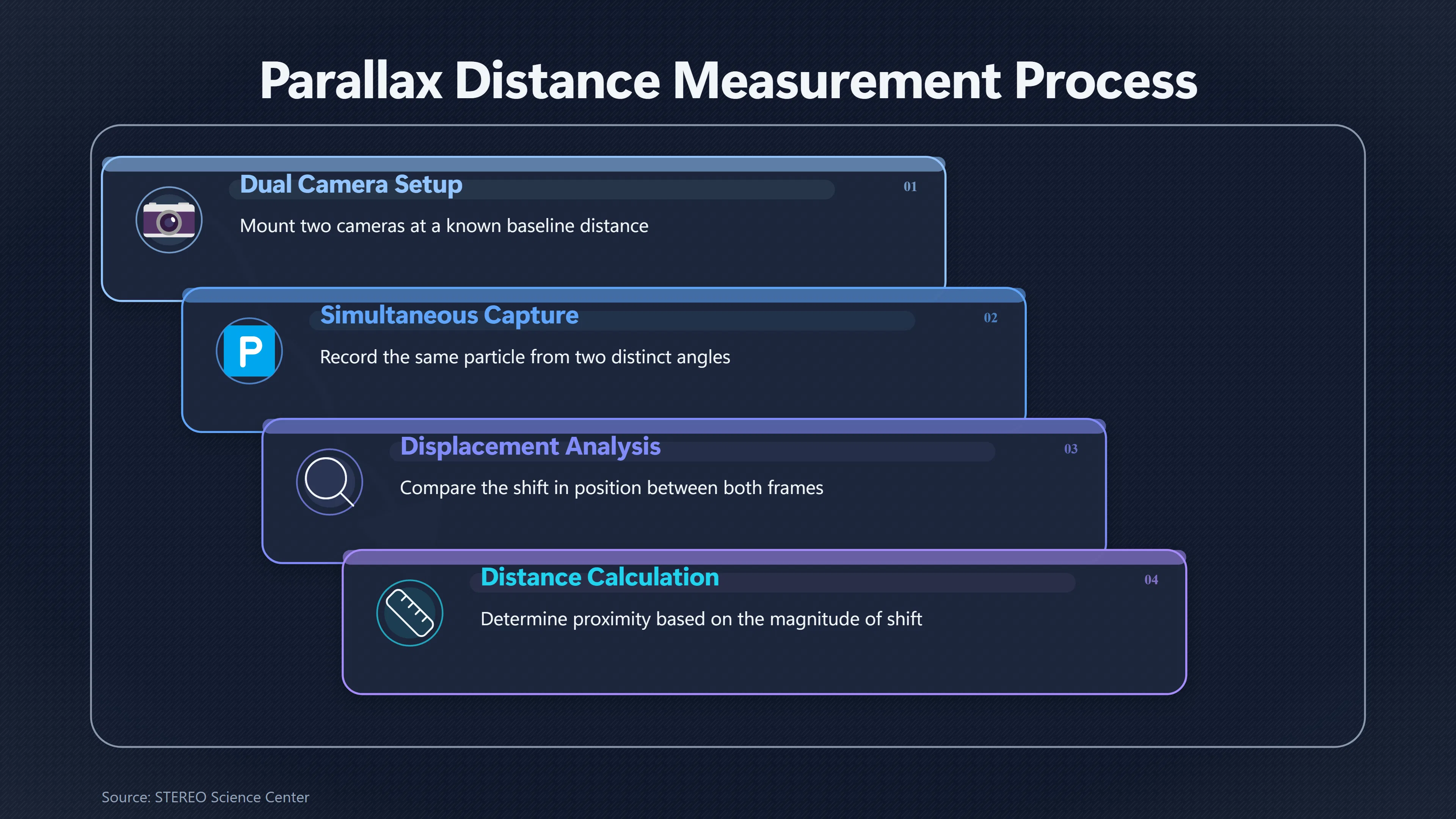
The most reliable way to distinguish nearby dust from distant objects is to measure parallax.
Parallax is the apparent shift in an object’s position when viewed from two different locations. Nearby objects shift noticeably, whereas distant objects shift very little.
Space missions exploit this principle whenever possible:
- Two cameras separated by a known baseline can compare the apparent position of the same particle.
- If the particle shifts significantly between the two images, it is nearby.
- If it remains fixed relative to distant stars, it is much farther away.
A practical example comes from the European Space Agency’s Rosetta mission. Researchers used simultaneous images from two OSIRIS cameras mounted about 70 centimetres apart to calculate the distances to dust particles around Comet 67P. By measuring the displacement between the two images, they could determine whether a particle was hundreds or thousands of metres from the spacecraft rather than relying on appearance alone.[arXiv]arxiv.orgDistance determination method of dust particles using Rosetta OSIRIS NAC and WAC dataMay 10, 2017…
The same geometric principle underlies astronomical parallax measurements used for stars, although on vastly larger scales. NASA has demonstrated this technique using observations from Earth and the New Horizons spacecraft to show how nearby stars shift against more distant backgrounds.[NASA]nasa.gov’s New Horizons Conducts the First Interstellar Parallax ExperimentNASA’s New Horizons Conducts the First Interstellar Parallax Experiment - NASAJune 10, 2020…
Without such multi-view observations, estimating the true distance—and therefore the true size—of an isolated object in a spacecraft image becomes highly uncertain.
Why This Matters for UFO Claims in Space Images
Claims that a single NASA image depicts a gigantic spacecraft often assume that the object’s apparent size reflects its physical size. That assumption is not justified unless its distance is known.
A bright feature near a camera may represent:
- a dust particle,
- a small fragment of spacecraft debris,
- contamination on the detector,
- or another nearby artefact,
yet still occupy many pixels and appear visually impressive. NASA’s STEREO documentation specifically catalogues these kinds of artefacts because they recur in routine spacecraft imaging and are easily mistaken for unusual objects when viewed without technical context.[STEREO Science Center]stereo-ssc.nascom.nasa.govNovember 29, 2010…
In discussions surrounding Gary McKinnon’s reported observation of an unusual NASA image, this limitation is especially important. Because the image was reportedly viewed only briefly, at reduced colour depth and resolution, and was never preserved with its metadata or accompanying observations, there is no way to determine whether the apparent object represented a distant structured craft, a nearby illuminated particle, or another imaging artefact. The image alone cannot resolve that question.
Amazon book picks
Further Reading
Books and field guides related to Could a Giant Space Object Be Nearby Dust?. Use these as the next step if you want deeper reading beyond the article.
Bad Astronomy
A clever, thought-provoking guide that attacks common astronomical misconceptions What is Bad Astronomy? Anything that accidentally or in...
Optics
For courses in Optics A Contemporary Approach to Optics with Practical Applications and New Focused Pedagogy Hecht Optics balances theory...
Astrophotography
Today's photographic equipment allows amateurs to take pictures of the stars that far surpass images taken just a few decades ago by even...
The Handbook of Astronomical Image Processing
First published 2000. Subjects: CCD cameras, Imaging systems in astronomy, Data processing, Astronomical photography.
eBay marketplace picks
Marketplace Samples
Live-tested eBay searches with available results related to this page.
Selected fromspace photography poster oneBay.co.uk.

Endnotes
1.
Source: stereo-ssc.nascom.nasa.gov
Title: STEREO Science Center
Link:https://stereo-ssc.nascom.nasa.gov/artifacts/artifacts_debris.shtml
Source snippet
November 29, 2010...
Published: November 29, 2010
2.
Source: stereo-ssc.nascom.nasa.gov
Title: STEREO Science Center
Link:https://stereo-ssc.nascom.nasa.gov/artifacts/artifacts_camera.shtml
3.
Source: arxiv.org
Link:https://arxiv.org/abs/1705.03740
Source snippet
Distance determination method of dust particles using Rosetta OSIRIS NAC and WAC dataMay 10, 2017...
Published: May 10, 2017
4.
Source: nasa.gov
Title: ’s New Horizons Conducts the First Interstellar Parallax Experiment
Link:https://www.nasa.gov/solar-system/nasas-new-horizons-conducts-the-first-interstellar-parallax-experiment/
Source snippet
NASA’s New Horizons Conducts the First Interstellar Parallax Experiment - NASAJune 10, 2020...
Published: June 10, 2020
5.
Source: nasa.gov
Title: Tiny NASA Cameras to Picture Interaction Between Lander, Moon’s Surface
Link:https://www.nasa.gov/missions/artemis/clps/tiny-nasa-cameras-to-picture-interaction-between-lander-moons-surface/
Source snippet
February 2, 2024 — 4 Min Read TINY NASA CAMERAS TO PICTURE INTERACTION BETWEEN LANDER, MOON’S SURFACE Image NASA's Stereo Cameras for...
Published: February 2, 2024
6.
Source: nasa.gov
Title: ‘Echo Mapping’ in Faraway Galaxies Could Measure Vast Cosmic Distances
Link:https://www.nasa.gov/missions/echo-mapping-in-faraway-galaxies-could-measure-vast-cosmic-distances/
7.
Source: soho.nascom.nasa.gov
Link:https://soho.nascom.nasa.gov/hotshots/2003_01_17/
8.
Source: nasa.gov
Title: What Scientists Found After Sifting Through Dust in the Solar System
Link:https://www.nasa.gov/solar-system/what-scientists-found-after-sifting-through-dust-in-the-solar-system/
9.
Source: nasa.gov
Title: camera on nasas lunar orbiter survived 2014 meteoroid hit
Link:https://www.nasa.gov/missions/camera-on-nasas-lunar-orbiter-survived-2014-meteoroid-hit/
10.
Source: space.com
Title: ‘UFO’ Seen in Live Space Station Video Is Just Fluff | Space
Link:https://www.space.com/34285-ufo-seen-in-live-space-station-video-is-just-fluff.html
11.
Source: stereo-ssc.nascom.nasa.gov
Title: artifacts corrupted.shtml
Link:https://stereo-ssc.nascom.nasa.gov/artifacts/artifacts_corrupted.shtml
12.
Source: space.com
Title: U-F-NO! NASA Shoots Down Speculation Over Space Station Video | Space
Link:https://www.space.com/33419-nasa-shoots-down-space-station-video-rumors.html
13.
Source: stereo-ssc.nascom.nasa.gov
Title: artifacts background.shtml
Link:https://stereo-ssc.nascom.nasa.gov/artifacts/artifacts_background.shtml
14.
Source: jpl.nasa.gov
Title: the mysterious case of the disappearing dust
Link:https://www.jpl.nasa.gov/news/the-mysterious-case-of-the-disappearing-dust/
15.
Source: stereo-ssc.nascom.nasa.gov
Link:https://stereo-ssc.nascom.nasa.gov/artifacts/artifacts.shtml
16.
Source: science.nasa.gov
Title: the two faced whirlpool galaxy
Link:https://science.nasa.gov/asset/hubble/the-two-faced-whirlpool-galaxy/
Additional References
17.
Source: pegasusastro.zendesk.com
Title: 33792993283997 The Ghostly Rings Understanding and Removing Dust Donuts
Link:https://pegasusastro.zendesk.com/hc/en-us/articles/33792993283997-The-Ghostly-Rings-Understanding-and-Removing-Dust-Donuts
Source snippet
Ghostly Rings: Understanding and Removing Dust Donuts – Pegasus AstroFebruary 7, 2026 — THE GHOSTLY RINGS: UNDERSTANDING AND REMOVING DUS...
Published: February 7, 2026
18.
Source: ufouap.net
Title: Camera Bokeh and Digital Zoom in UFO Videos | Global UFO Archive
Link:https://www.ufouap.net/en/explainers/camera-bokeh-digital-zoom-ufo-videos
Source snippet
July 16, 2026 — Evidence / Updated 2026-07-16 / 8 min read CAMERA BOKEH AND DIGITAL ZOOM IN UFO VIDEOS A distant point light can become a...
Published: July 16, 2026
19.
Source: sony.co.uk
Title: e mount body nex 6 series
Link:https://www.sony.co.uk/electronics/support/e-mount-body-nex-6-series/articles/00028753
Source snippet
White, round glare spots or orbs sometimes appear in a recorded image when using the flash | Sony UKJuly 14, 2026 — Article ID: 00057547...
Published: July 14, 2026
20.
Source: youtube.com
Title: Photo Tricks For Beginners: Forced Perspective Photography
Link:https://www.youtube.com/watch?v=uM_TG6SeuYk
Source snippet
Visual Illusions That Help Us Understand Depth Perception...
21.
Source: ufouap.net
Title: Speed ca
Link:https://www.ufouap.net/en/explainers/parallax-in-uap-videos
Source snippet
Parallax in UAP Videos: Why Objects Seem Fast | Global UFO ArchiveJuly 11, 2026 — Evidence / Updated 2026-07-11 / 7 min read PARALLAX IN...
Published: July 11, 2026
22.
Source: youtube.com
Title: Visual Illusions That Help Us Understand Depth Perception
Link:https://www.youtube.com/watch?v=COvd1HkDCWQ
Source snippet
Orb (Optics) and Near-Camera Backscatter...
23.
Source: dehancer.com
Link:https://www.dehancer.com/learn/articles/dehancer-film-damage
24.
Source: stereoskopie.org
Link:https://stereoskopie.org/en/stereoskopie-2/golden-rules.html
25.
Source: isu3d.org
Link:https://isu3d.org/goldenrules/
26.
Source: cam.start.canon
Link:https://cam.start.canon/en/C022/manual/html/UG-04_Shooting_0390.html