Within NASA Image
Original File Forens
If the original NASA image that Gary McKinnon said he briefly viewed were ever recovered in its original form, investigators would finally be able to move beyond competing recollections and apply standard digital and aerospace forensic methods.
Page outline Jump by section
Introduction
If the original NASA image that Gary McKinnon said he briefly viewed were ever recovered in its original form, investigators would finally be able to move beyond competing recollections and apply standard digital and aerospace forensic methods. At present, no authenticated copy of the alleged image is publicly available, so neither supporters nor sceptics can perform meaningful technical analysis. A preserved original would not automatically prove that the image showed an unknown craft, but it could answer several concrete questions: when and where the image was acquired, whether it had been altered, what mission produced it, and whether the object could be matched to known spacecraft, hardware or imaging artefacts. These are routine investigative steps used in scientific image verification rather than UFO-specific techniques.
Which Metadata Would Matter Most?
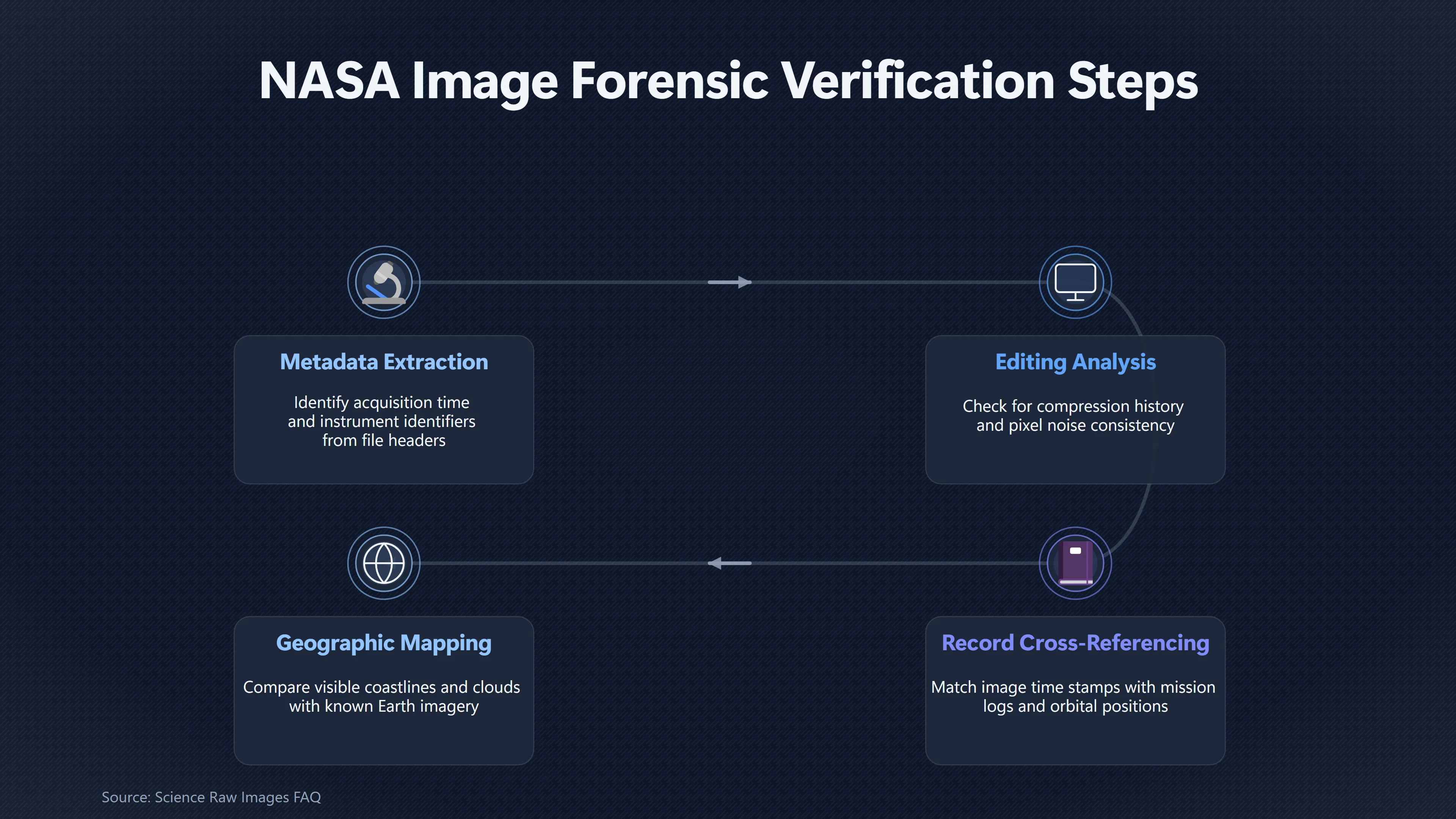
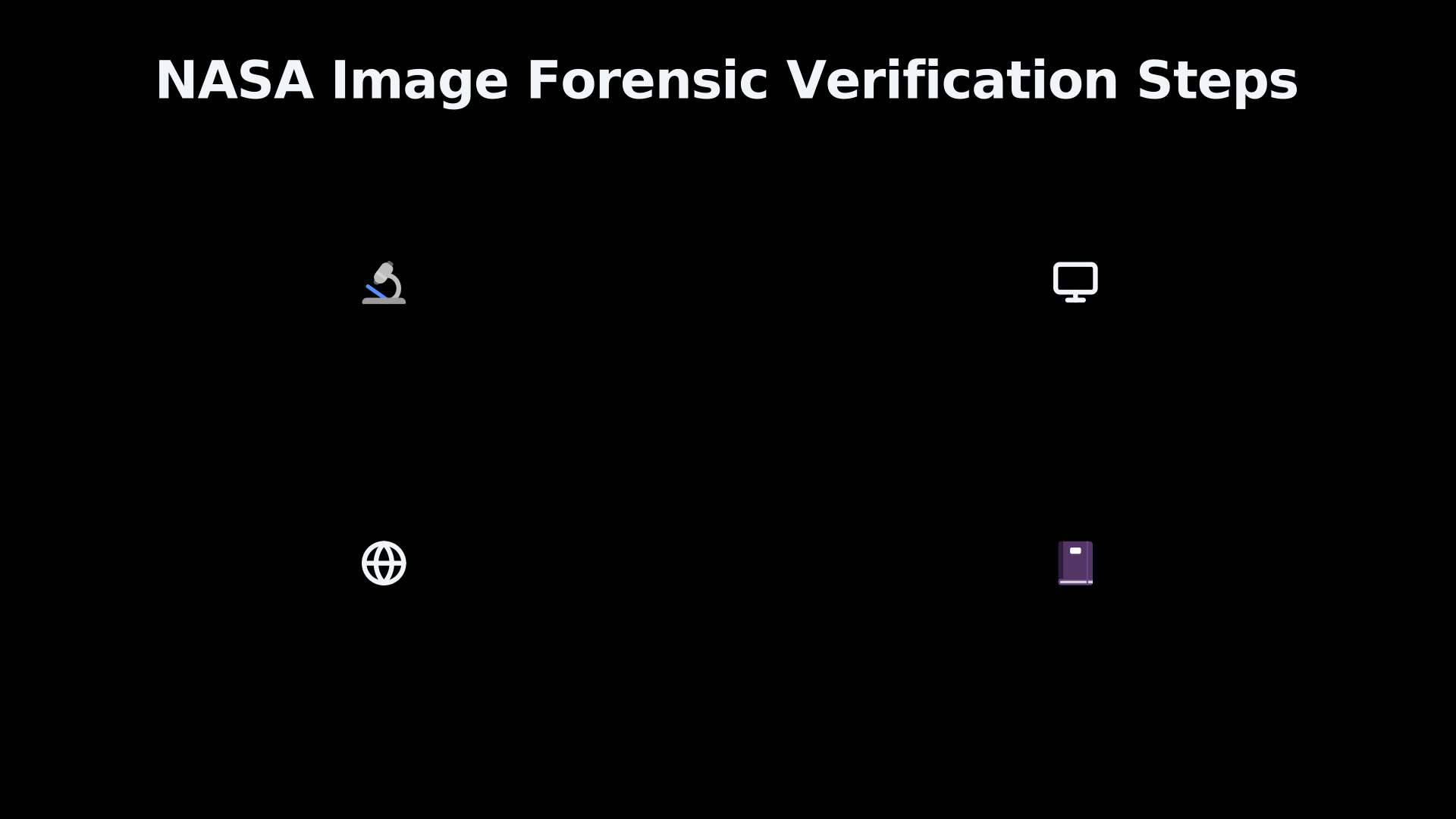
The first priority would be the file itself rather than the picture alone. Original NASA imagery often carries extensive metadata describing how and when it was acquired. Depending on the mission and file format, this can include acquisition time, instrument identifiers, spacecraft orientation, exposure settings, calibration information, processing history and links to the originating mission. NASA notes that archival scientific images preserve substantially richer metadata than publicly distributed preview versions, allowing researchers to reconstruct acquisition conditions with considerable precision.[NASA Science]science.nasa.govScience Raw Images FAQNASA ScienceRaw Images FAQ - NASA ScienceNovember 2, 2024…
Investigators would look for information such as:
- Exact creation and modification timestamps.
- Original filename and directory structure.
- Camera or sensor identification.
- Mission, orbit or frame number.
- Processing software or pipeline identifiers.
- Checksums or other integrity information.
- Embedded comments or engineering labels.
These details could establish whether the file genuinely originated within a NASA workflow or was created or altered elsewhere. Even if standard photographic EXIF fields were absent—as is common for scientific image formats—the mission-specific metadata could still provide an extensive chain of provenance.[NASA Science]science.nasa.govScience Raw Images FAQNASA ScienceRaw Images FAQ - NASA ScienceNovember 2, 2024…
Could the Image Have Been Edited?
One of the recurring claims associated with McKinnon’s account is that he allegedly encountered “processed” and “unprocessed” image folders. If an original file became available, digital forensic analysis could test whether the image had actually undergone editing rather than relying on anecdotal descriptions.
Investigators would examine:
- Compression history, including repeated JPEG recompression.
- Pixel noise consistency across the image.
- Edge transitions around the alleged object.
- Colour interpolation patterns.
- Clone detection indicating copied image regions.
- Evidence of layered editing or compositing.
- Thumbnail consistency where embedded previews exist.
Modern forensic techniques can often identify traces left by image manipulation, although they cannot always determine who performed an edit or why. Likewise, the absence of detectable editing would not prove that the image depicts an extraordinary object; it would merely indicate that no obvious digital alteration could be demonstrated.[arXiv]arxiv.orgarXiv A Forensic Methodology for Detecting Image ManipulationsA Forensic Methodology for Detecting Image ManipulationsAugust 9, 2023…
It would also matter whether investigators obtained the highest-quality archival file rather than a compressed derivative. NASA distinguishes between archival scientific data—which preserve full resolution and bit depth—and compressed JPEG or PNG versions intended for public viewing. Compression can erase subtle forensic indicators and reduce the reliability of image analysis.[NASA Science]science.nasa.govScience Raw Images FAQNASA ScienceRaw Images FAQ - NASA ScienceNovember 2, 2024…
Could NASA Records Identify the Scene?
A recovered image would not exist in isolation. NASA imagery is normally associated with mission documentation, engineering records and image catalogues.
Investigators could attempt to identify:
- The spacecraft or platform that acquired the image.
- The mission timeline corresponding to the timestamp.
- Orbital position at the moment of acquisition.
- Camera pointing direction.
- Other frames captured immediately before and after.
- Mission logs describing scheduled observations.
Finding adjacent frames from the same image sequence would be especially valuable. If multiple photographs showed the same object moving consistently through successive frames, investigators could estimate its position and behaviour. Conversely, if neighbouring images revealed a conventional satellite, payload or camera artefact, the mystery might largely disappear.
NASA’s archival collections preserve extensive historical imagery and associated documentation that can often be cross-referenced with mission records.[NASA]nasa.govArchives: HeadquartersNASA Archives: Headquarters - NASAJuly 23, 2026…

Could Earth Features Reveal the Location?
McKinnon recalled seeing Earth beneath the object but could not identify the location or estimate the object’s size. An original high-resolution file might allow investigators to determine both.
Analysts could compare visible geographical features with known Earth imagery to identify:
- Coastlines.
- Cloud formations.
- Ice fields.
- Ocean colour.
- Mountain ranges.
- Night-time city lights, if applicable.
Once the Earth’s location in the frame had been established, orbital mechanics could narrow the range of spacecraft capable of acquiring the image at that time. If the observing platform were identified, the apparent size and distance of the object could be estimated far more accurately than from memory alone.
Scale is particularly important because many objects photographed in orbit appear visually ambiguous without distance information. An item close to the camera can resemble a much larger object hundreds of kilometres away.
Could the Object Match Known Space Hardware?
The most practical question would be whether the object matched documented aerospace hardware.
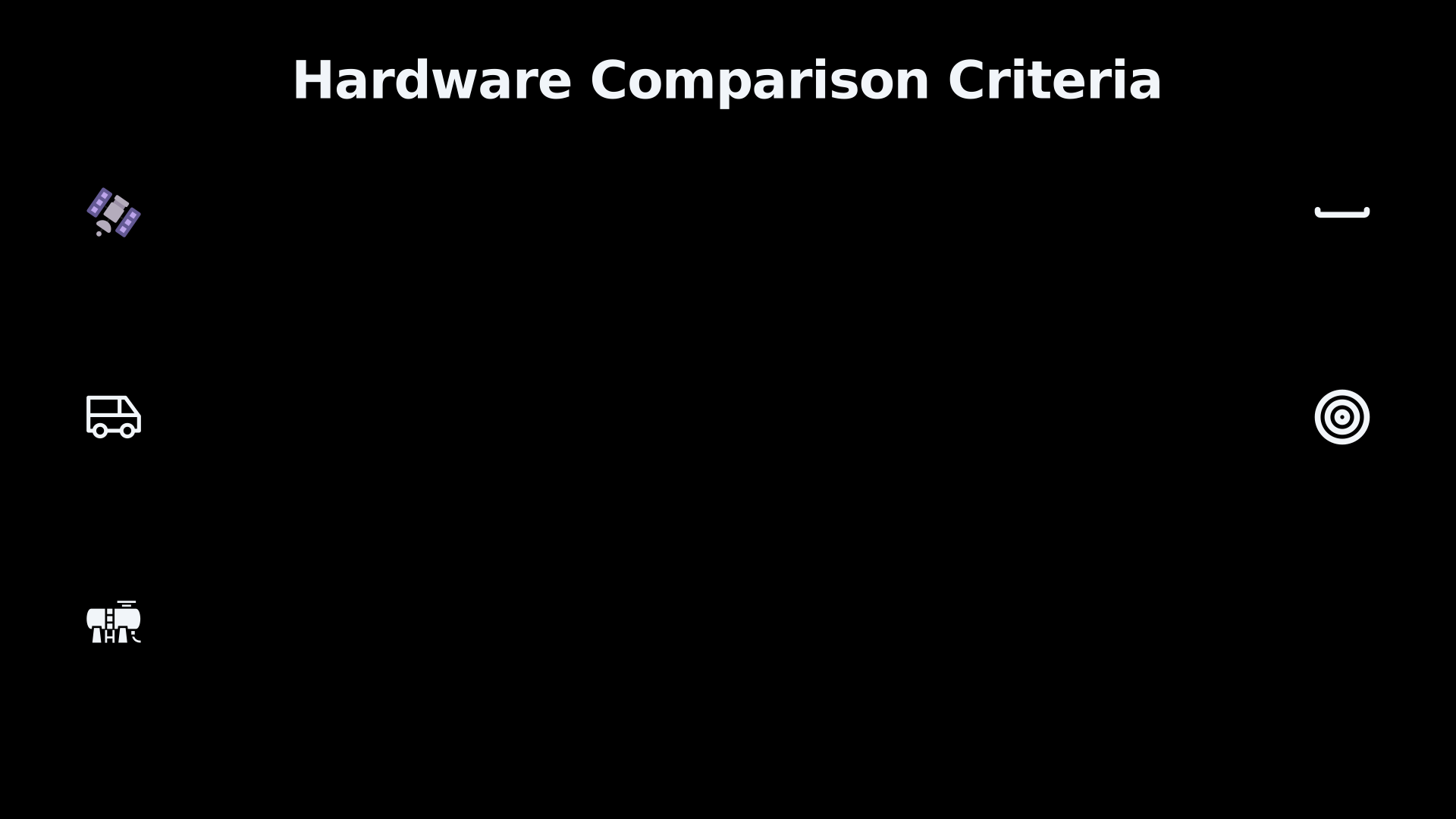
Investigators would compare its shape against:
- Satellites operating during the relevant period.
- Shuttle payloads.
- International Space Station components.
- Rocket stages.
- Space debris catalogues.
- Calibration targets or engineering hardware.
Lighting geometry would also be examined. Reflections from cylindrical spacecraft, insulation blankets or fuel tanks can create smooth, featureless silhouettes that differ substantially from their physical appearance. A single viewing angle may hide structural details such as solar panels or antennas.
If the object’s position and acquisition time were known, orbital catalogues maintained by space-tracking organisations could determine whether a known object occupied the same location.
What Could the File Actually Prove?
Even an authenticated original would have evidential limits.
It could potentially establish:
- That the image genuinely originated within a NASA imaging system.[image.gsfc.nasa.gov]image.gsfc.nasa.govSource details in endnotes.
- Whether it had been digitally modified.
- When and how it was acquired.
- Which mission produced it.
- Whether the depicted object corresponded to known aerospace hardware.
It could not, by itself, demonstrate the existence of extraterrestrial technology. An unexplained object in a single authenticated photograph would remain only that: unexplained until supported by independent evidence such as additional images, telemetry, mission documentation or corroborating observations.
This distinction is important in the McKinnon case. The absence of the original file prevents every one of these technical tests. As a result, the alleged cigar-shaped NASA image remains an unverified personal recollection rather than a piece of evidence that can be independently examined using established digital forensic and aerospace investigative methods.
Amazon book picks
Further Reading
Books and field guides related to Original File Forens. Use these as the next step if you want deeper reading beyond the article.
Digital Image Processing
This is the eBook of the printed book and may not include any media, website access codes, or print supplements that may come packaged wi...

Packing for Mars
Rating: 3.9/5 from 19 Google Books ratings
What happens to you when you can't walk for a year? When you can't have sex? Or smell flowers? What happens if you vomit in your helmet d...
Computer Vision: Algorithms and Applications
Computer Vision: Algorithms and Applications explores the variety of techniques used to analyze and interpret images. It also describes c...
Practical Forensic Imaging
Forensic image acquisition is an important part of postmortem incident response and evidence collection. Digital forensic investigators a...
eBay marketplace picks
Marketplace Samples
Live-tested eBay searches with available results related to this page.
Selected fromNASA space print oneBay.co.uk.
Endnotes
1.
Source: science.nasa.gov
Title: Science Raw Images FAQ
Link:https://science.nasa.gov/solar-system/multimedia/raw-images-faq/
Source snippet
NASA ScienceRaw Images FAQ - NASA ScienceNovember 2, 2024...
Published: November 2, 2024
2.
Source: arxiv.org
Title: arXiv A Forensic Methodology for Detecting Image Manipulations
Link:https://arxiv.org/abs/2308.04723
Source snippet
A Forensic Methodology for Detecting Image ManipulationsAugust 9, 2023...
Published: August 9, 2023
3.
Source: nasa.gov
Title: Archives: Headquarters
Link:https://www.nasa.gov/archives/hq-archives/
Source snippet
NASA Archives: Headquarters - NASAJuly 23, 2026...
Published: July 23, 2026
4.
Source: planetarydata.jpl.nasa.gov
Title: Archive of Viking Lander 1 and 2 EDR Images
Link:https://planetarydata.jpl.nasa.gov/w10n/viking_lander/vl_0002/document/volinfo.htm
5.
Source: nasa.gov
Title: Latest Updates from NASA on IMAGE Recovery
Link:https://www.nasa.gov/solar-system/latest-updates-from-nasa-on-image-recovery/
Source snippet
August 28, 2018 — 10 min read LATEST UPDATES FROM NASA ON IMAGE RECOVERY Image: The headshot image of Rob Garner Rob Garner News Chie...
Published: August 28, 2018
6.
Source: nasa.gov
Link:https://www.nasa.gov/history/rogersrep/v3appn.htm
7.
Source: image.gsfc.nasa.gov
Link:https://image.gsfc.nasa.gov/
8.
Source: ares.jsc.nasa.gov
Link:https://ares.jsc.nasa.gov/image-science/isag/
Additional References
9.
Source: nij.ojp.gov
Link:https://nij.ojp.gov/library/publications/exif-format-worth-thousand-words
Source snippet
ojp.govEXIF: A Format is Worth a Thousand Words | National Institute of JusticeJanuary 1, 2007 — EXIF: A FORMAT IS WORTH A THOUSAND WORDS...
Published: January 1, 2007
10.
Source: ibtimes.co.uk
Title: By Francis Miñoza Published 05 July
Link:https://www.ibtimes.co.uk/nasa-insider-ufo-allegations-resurface-1806887
Source snippet
NASA Insider Claims Photo Labs Airbrush UFOs Out of Images Before Public Release | IBTimes UKJuly 5, 2026 — NASA INSIDER CLAIMS PHOTO LAB...
Published: July 5, 2026
11.
Source: youtube.com
Title: Extract Hidden Metadata From Images with Exif Tool | Digital Forensics
Link:https://www.youtube.com/watch?v=GVHieQZekCo
Source snippet
How NASA created Webb's image of the Carina Nebula with Alyssa Pagan...
12.
Source: youtube.com
Title: Image Forensics, Is My Image Edited? Primeau Forensics
Link:https://www.youtube.com/watch?v=z0l2VDPuDZk
Source snippet
Extract Hidden Metadata From Images with ExifTool | Digital Forensics...
13.
Source: commons.wikimedia.org
Link:https://commons.wikimedia.org/wiki/File%3ASTS050-234-016-_STS-050-Wire_Insulation_Flammability_Experiment_Imagery_from_the_experiment_camera.-DPLA-_d84e9b9ebbd438871a91e382c8eacff9.jpg
14.
Source: ojp.gov
Title: EXI F: A Format is Worth a Thousand Words | Office of Justice Programs
Link:https://www.ojp.gov/library/publications/exif-format-worth-thousand-words
15.
Source: youtube.com
Title: Photo Forensics Tutorial
Link:https://www.youtube.com/watch?v=XRCq8CJrI_s
Source snippet
Image Forensics, Is My Image Edited? Primeau Forensics...
16.
Source: youtube.com
Title: Hacking for UFOs and fighting for his life. Who is Gary Mc Kinnon?
Link:https://www.youtube.com/watch?v=OImdnvQx7sQ
Source snippet
Photo Forensics Tutorial...
17.
Source: indico.cern.ch
Link:https://indico.cern.ch/event/1188041/contributions/5309342/attachments/2639493/4567424/PV2023_johnson_nasa.pdf
18.
Source: youtube.com
Title: How NASA created Webb’s image of the Carina Nebula with Alyssa Pagan
Link:https://www.youtube.com/watch?v=1QPJd2Fl6i4