Within Mental Health
Does Autism Reduce Responsibility for a Cybercrime Offence?
Autism may affect judgement or understanding, but courts must establish a clear connection between the condition and the offending behaviour.
On this page
- Diagnosis versus impaired decision making
- How motive and fixation may affect culpability
- Why reduced culpability is never automatic
Page outline Jump by section
Introduction
Autism does not automatically reduce legal responsibility for a cybercrime. In cases involving alleged hackers such as Gary McKinnon, the crucial legal question is not whether a person has an autism diagnosis, but whether that condition materially affected their judgement, decision-making or behaviour at the time of the offence. Courts in England and Wales assess culpability on an individual basis, requiring evidence of a genuine connection between the person’s condition and the offending conduct rather than assuming that a diagnosis alone diminishes responsibility.[Sentencing Council]sentencingcouncil.org.ukSentencing CouncilSentencing offenders with mental disorders, developmental disorders, or neurological impairmentsOctober 1, 2020…
The McKinnon case is often misunderstood in public discussion because his successful challenge to extradition was based primarily on the severe risk that extradition would have to his mental health, not on a finding that Asperger’s syndrome excused the alleged unauthorised access. That distinction remains central to how modern courts approach autism in cybercrime cases.
Does Autism Reduce Responsibility for a Cybercrime Offence?
Autism spectrum disorder is a neurodevelopmental condition that affects individuals in very different ways. Many autistic people possess a full understanding of legal rules, appreciate the consequences of their actions and are fully capable of making deliberate choices. Consequently, neither English criminal law nor sentencing practice treats autism as a blanket defence or automatic mitigating factor.[Sentencing Council]sentencingcouncil.org.ukSentencing CouncilSentencing offenders with mental disorders, developmental disorders, or neurological impairmentsOctober 1, 2020…
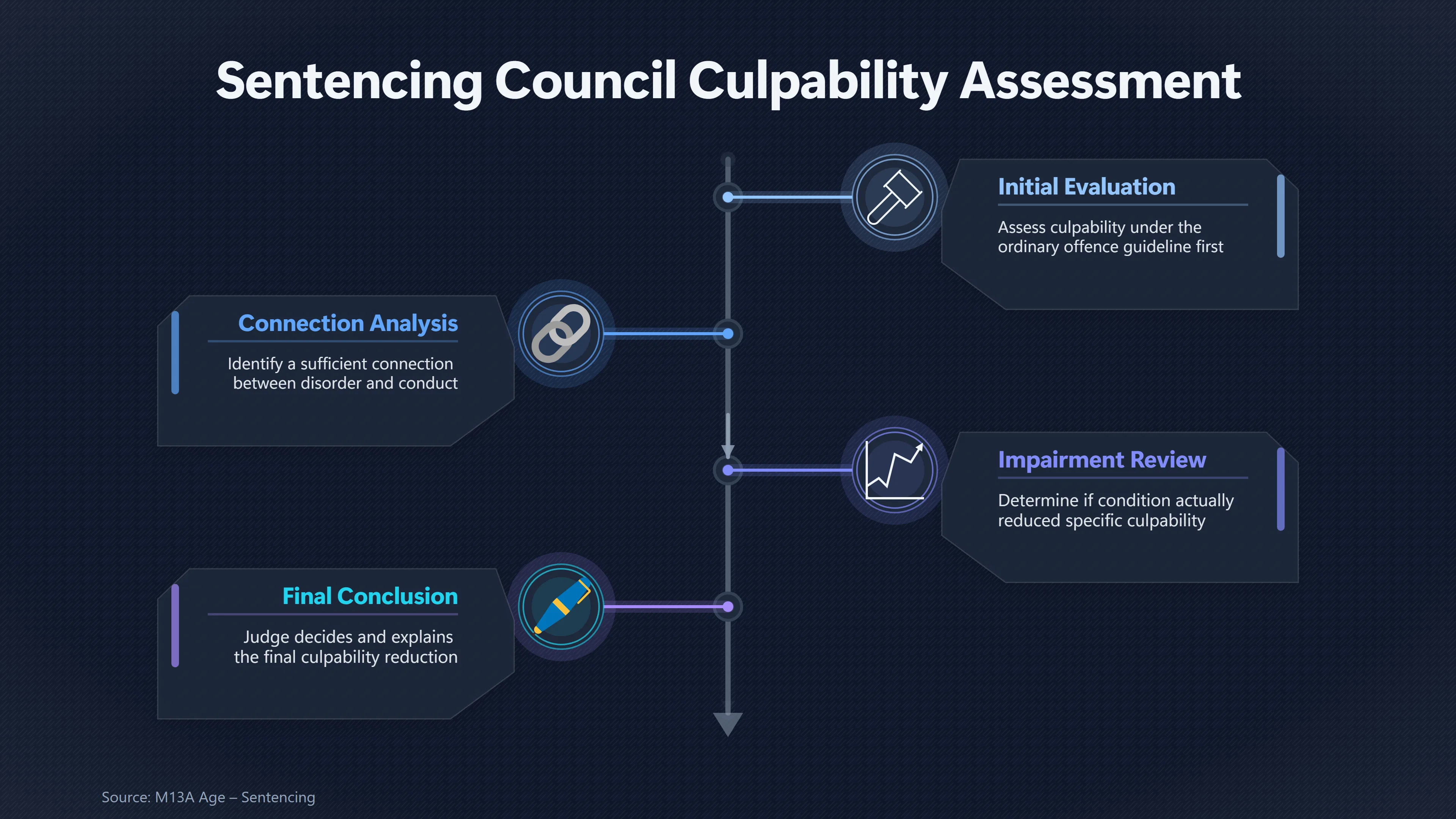
Instead, the legal system asks whether the offender’s condition actually impaired relevant abilities at the time of the offence. These may include:
- exercising appropriate judgement;
- making rational decisions;
- understanding the nature and consequences of actions;
- controlling behaviour where the impairment directly contributed to the offence.
Only where evidence establishes such a connection can culpability be reduced. Even then, any reduction depends on the degree of impairment rather than the diagnosis itself.[Sentencing Council]sentencingcouncil.org.ukSentencing CouncilSentencing offenders with mental disorders, developmental disorders, or neurological impairmentsOctober 1, 2020…
Diagnosis versus impaired decision-making
A clinical diagnosis is evidence of a medical condition, not evidence that criminal responsibility is reduced.
The Sentencing Council’s guideline for offenders with mental disorders, developmental disorders and neurological impairments requires judges first to assess culpability under the ordinary offence guideline and then decide whether the impairment actually reduced that culpability. The guideline expressly states that there must be a “sufficient connection” between the disorder and the offending behaviour. In some cases the connection may be substantial; in others it may be absent altogether.[Sentencing Council]sentencingcouncil.org.ukSentencing CouncilSentencing offenders with mental disorders, developmental disorders, or neurological impairmentsOctober 1, 2020…
This approach prevents two common errors:
- assuming that every autistic defendant has diminished responsibility; or
- ignoring clinically significant impairments simply because the offence involved sophisticated computer skills.
The assessment therefore remains evidence-based rather than diagnosis-based.
How Motive and Fixation May Affect Culpability
One issue that occasionally arises in cybercrime cases is whether an autistic person’s intense interests or highly focused patterns of behaviour influenced the offence.
Autism may involve unusually persistent interests, rigid routines or intense preoccupation with particular subjects. In rare cases, these characteristics may help explain why someone became fixated on computer systems, government networks or particular technical challenges. However, explanation is not the same as legal excuse. A special interest in computer security or UFO-related material does not itself diminish criminal responsibility.[Sentencing Council]sentencingcouncil.org.ukSentencing CouncilSentencing offenders with mental disorders, developmental disorders, or neurological impairmentsOctober 1, 2020…
Instead, courts examine whether the fixation genuinely impaired the person’s ability to make lawful choices. Relevant questions include whether the defendant:
- understood that access was unauthorised;
- recognised the potential consequences of continuing;
- was capable of stopping despite the fixation;
- acted through careful planning over an extended period.
Where evidence shows sustained planning, concealment or repeated deliberate decisions, these factors may indicate that the individual retained substantial decision-making capacity despite having autism. Conversely, where expert evidence demonstrates that autistic traits significantly impaired judgement or behavioural control, that may support reduced culpability. The outcome depends on the facts rather than stereotypes about autism.[Sentencing Council]sentencingcouncil.org.ukSentencing CouncilSentencing offenders with mental disorders, developmental disorders, or neurological impairmentsOctober 1, 2020…
Why Reduced Culpability Is Never Automatic
The law distinguishes between understanding why an offence occurred and deciding how responsible the offender was.
For that reason, courts rely on comprehensive evidence rather than assumptions. Relevant material may include psychiatric or psychological reports, educational and medical records, testimony from treating clinicians, evidence about functioning at the time of the offence and the circumstances of the offending itself. Although expert evidence is often influential, the judge ultimately decides whether culpability was reduced and must explain that conclusion.[Sentencing Council]sentencingcouncil.org.ukSentencing CouncilSentencing offenders with mental disorders, developmental disorders, or neurological impairmentsOctober 1, 2020…
Recent research commissioned by the Sentencing Council also shows that sentencers regard formal diagnosis and independent clinical evidence as important because self-identification alone rarely establishes the required causal connection between a condition and offending behaviour. Judges interviewed for the research emphasised the need for reliable evidence rather than assuming that references to autism automatically justify mitigation.[Sentencing Council]sentencingcouncil.org.ukSentencing CouncilResearch review of the overarching guideline for sentencing offenders with mental disorders, developmental disorders, o…
The Crown Prosecution Service adopts a similar individualised approach. It recognises autism as one of several neurodevelopmental conditions that may be relevant to prosecution decisions, while stressing that people with the same diagnosis can be affected in very different ways and that charging decisions should be made case by case.[Crown Prosecution Service]cps.gov.ukOpen source on cps.gov.uk.

The McKinnon Case Illustrates the Distinction
Gary McKinnon’s case demonstrates why autism and culpability should not be conflated.
His diagnosis of Asperger’s syndrome became highly significant during the extradition proceedings because medical evidence linked his condition, depression and suicidal risk to the likely consequences of extradition to the United States. The eventual decision to halt extradition turned on human rights considerations and the foreseeable risk of catastrophic harm, not on a judicial finding that autism excused the alleged hacking or eliminated criminal responsibility.
This distinction is important when discussing hackers associated with UFO-related claims. McKinnon’s autism formed part of the evidence concerning extradition and proportionality, but it did not establish that the alleged offences carried reduced culpability as a matter of law. Any assessment of criminal responsibility would still have required a separate examination of the relationship between his condition and his conduct.
Accordingly, the McKinnon litigation reinforces a broader legal principle: autism may sometimes be relevant to culpability, sentencing or prosecutorial decisions, but only where reliable evidence demonstrates that the condition materially affected the offending behaviour. It is never treated as an automatic excuse for unauthorised access to computer systems.[Sentencing Council]sentencingcouncil.org.ukSentencing CouncilSentencing offenders with mental disorders, developmental disorders, or neurological impairmentsOctober 1, 2020…
Amazon book picks
Further Reading
Books and field guides related to Does Autism Reduce Responsibility for a Cybercrime Offence?. Use these as the next step if you want deeper reading beyond the article.
Autism Spectrum Disorder, Developmental Disabilities, and the...
For autistic people who find themselves facing a criminal charge, understanding how the features of autism may have contributed to their...
Autism Spectrum Disorder in the Criminal Justice System
This book focuses on autism spectrum disorder (ASD) in the criminal justice system. Rather than being the perpetrators of offending behav...
Working with Autistic People in the Criminal Justice and Fore...
Working with Autistic People in the Criminal Justice and Forensic Mental Health Systems: A Handbook for Practitioners is the first book t...
eBay marketplace picks
Marketplace Samples
Live-tested eBay searches with available results related to this page.
Selected frommental health pin oneBay.co.uk.



Endnotes
1.
Source: sentencingcouncil.org.uk
Link:https://sentencingcouncil.org.uk/guidelines/sentencing-offenders-with-mental-disorders-developmental-disorders-or-neurological-impairments/?source=7511
Source snippet
Sentencing CouncilSentencing offenders with mental disorders, developmental disorders, or neurological impairmentsOctober 1, 2020...
Published: October 1, 2020
2.
Source: cps.gov.uk
Link:https://www.cps.gov.uk/prosecution-guidance/mental-health-suspects-and-defendants
3.
Source: sentencingcouncil.org.uk
Link:https://sentencingcouncil.org.uk/latest/new-guideline-for-sentencing-offenders-with-mental-disorders-published/
4.
Source: sentencingcouncil.org.uk
Link:https://sentencingcouncil.org.uk/html-publications/research-review-of-the-overarching-guideline-for-sentencing-offenders-with-mental-disorders-developmental-disorders-or-neurological-impairments/
Source snippet
Sentencing CouncilResearch review of the overarching guideline for sentencing offenders with mental disorders, developmental disorders, o...
5.
Source: ccrc.gov.uk
Link:https://ccrc.gov.uk/decision/reynolds-gary/
Source snippet
Reynolds, Gary - Criminal Cases Review CommissionSeptember 9, 2024 — REYNOLDS, GARY...
Published: September 9, 2024
6.
Source: sentencingcouncil.org.uk
Title: M13A Age – Sentencing
Link:https://www.sentencingcouncil.org.uk/droppable/item/m13a-age/
Source snippet
April 1, 2024 — M13A AGE Effective from: 01 October 2019 (revised 1 April 2024) > Care should be taken to avoid double counting factors i...
Published: April 1, 2024
7.
Source: sentencingcouncil.org.uk
Title: Perverting the course of justice
Link:https://sentencingcouncil.org.uk/guidelines/perverting-the-course-of-justice
Source snippet
October 1, 2023 — * nervousness * a lack of understanding of the system * mental disorder * learning disabilities * communication difficu...
Published: October 1, 2023
8.
Source: sentencingcouncil.org.uk
Link:https://sentencingcouncil.org.uk/guidelines/sentencing-offenders-with-mental-disorders-developmental-disorders-or-neurological-impairments
Source snippet
Sentencing offenders with mental disorders, developmental disorders, or neurological impairmentsOctober 1, 2020 — MHTRs MHTRs provide a u...
Published: October 1, 2020
9.
Source: sentencingcouncil.org.uk
Link:https://sentencingcouncil.org.uk/guidelines/sentencing-offenders-with-mental-disorders-developmental-disorders-or-neurological-impairments/?source=7510
10.
Source: sentencingcouncil.org.uk
Link:https://www.sentencingcouncil.org.uk/news/item/sentencing-council-publishes-new-guideline-for-sentencing-offenders-with-mental-disorders/
11.
Source: cps.gov.uk
Title: Mental Health: Victims and Witnesses | The Crown Prosecution Service
Link:https://www.cps.gov.uk/prosecution-guidance/mental-health-victims-and-witnesses
12.
Source: sentencingcouncil.org.uk
Title: Sentencing Offenders with Mental Health Conditions or Disorders
Link:https://sentencingcouncil.org.uk/guidelines/sentencing-offenders-with-mental-health-conditions-or-disorders-draft-guideline-for-consultation/
13.
Source: consult.justice.gov.uk
Link:https://consult.justice.gov.uk/sentencing-council/overarching-principles-sentencing-offenders-with-m-1/consult_view/
14.
Source: sentencingcouncil.org.uk
Title: Manslaughter by reason of diminished responsibility
Link:https://sentencingcouncil.org.uk/guidelines/manslaughter-by-reason-of-diminished-responsibility/?source=7511
15.
Source: consult.justice.gov.uk
Link:https://consult.justice.gov.uk/sentencing-council/generic-sentencing-guideline-for-use-where-there-i/
16.
Source: sentencingcouncil.org.uk
Link:https://sentencingcouncil.org.uk/guidelines/deception-for-consultation-only/
Additional References
17.
Source: judiciary.uk
Link:https://www.judiciary.uk/guidance-and-resources/guidelines-for-sentencing-offenders-with-mental-disorders-published-by-sentencing-council/
Source snippet
Courts and Tribunals JudiciaryGuidelines for sentencing offenders with mental disorders published by Sentencing Council - Courts and Trib...
18.
Source: youtube.com
Title: Gary Mc Kinnon wins extradition battle
Link:https://www.youtube.com/watch?v=y4lecD44F5E
Source snippet
This video on The Man Who Hacked the U.S. Government provides comprehensive background on Gary McKinnon's case, illustrating why an autis...
19.
Source: youtube.com
Title: Autistic UK hacker faces extradition to US
Link:https://www.youtube.com/watch?v=WH5vs-wiT90
Source snippet
Rulebreakers: Alleged hacker Lauri Love - BBC World Service...
20.
Source: youtube.com
Title: UK hacker to learn extradition fate
Link:https://www.youtube.com/watch?v=LEvGU1b4ysw
Source snippet
Autistic UK hacker faces extradition to US...
21.
Source: youtube.com
Title: Rulebreakers: Alleged hacker Lauri Love
Link:https://www.youtube.com/watch?v=rlQZyTs1eR4
Source snippet
Gary McKinnon wins extradition battle...
22.
Source: youtube.com
Title: The Man Who Hacked the U.S. Government
Link:https://www.youtube.com/watch?v=ND0zQX1rGdg
Source snippet
UK hacker to learn extradition fate...
23.
Source: publications.parliament.uk
Title: uk House of Lords
Link:https://publications.parliament.uk/pa/ld5901/ldselect/ldautismact/205/20512.htm