Within File Context
When a Government Draft Looks Officially Final
Official formatting, classifications and senior names can make unfinished proposals look like settled government conclusions.
On this page
- How drafts acquire the appearance of authority
- What approval history and versioning can reveal
- Why isolated draft language is easy to overread
Page outline Jump by section
Introduction
Government documents can appear remarkably authoritative long before they represent an approved government position. Draft memoranda, proposed directives and working papers are commonly prepared using official templates, classification markings, distribution lists and the names of senior offices because they are designed to move through formal review processes. When such documents are later discovered in archives, released under freedom of information laws or discussed in connection with cases such as UFO-motivated hacking by Gary McKinnon, their polished appearance can be mistaken for proof that they record settled institutional conclusions. In reality, the appearance of authority and the authority of a document are different questions. Understanding how government drafts are created, reviewed and preserved helps explain why authentic files can still represent ideas under discussion rather than official policy.[National Archives]archives.govNational Archives Records Management Guidance | National ArchivesNational ArchivesRecords Management Guidance | National ArchivesMarch 11, 2021…

How Drafts Acquire the Appearance of Authority
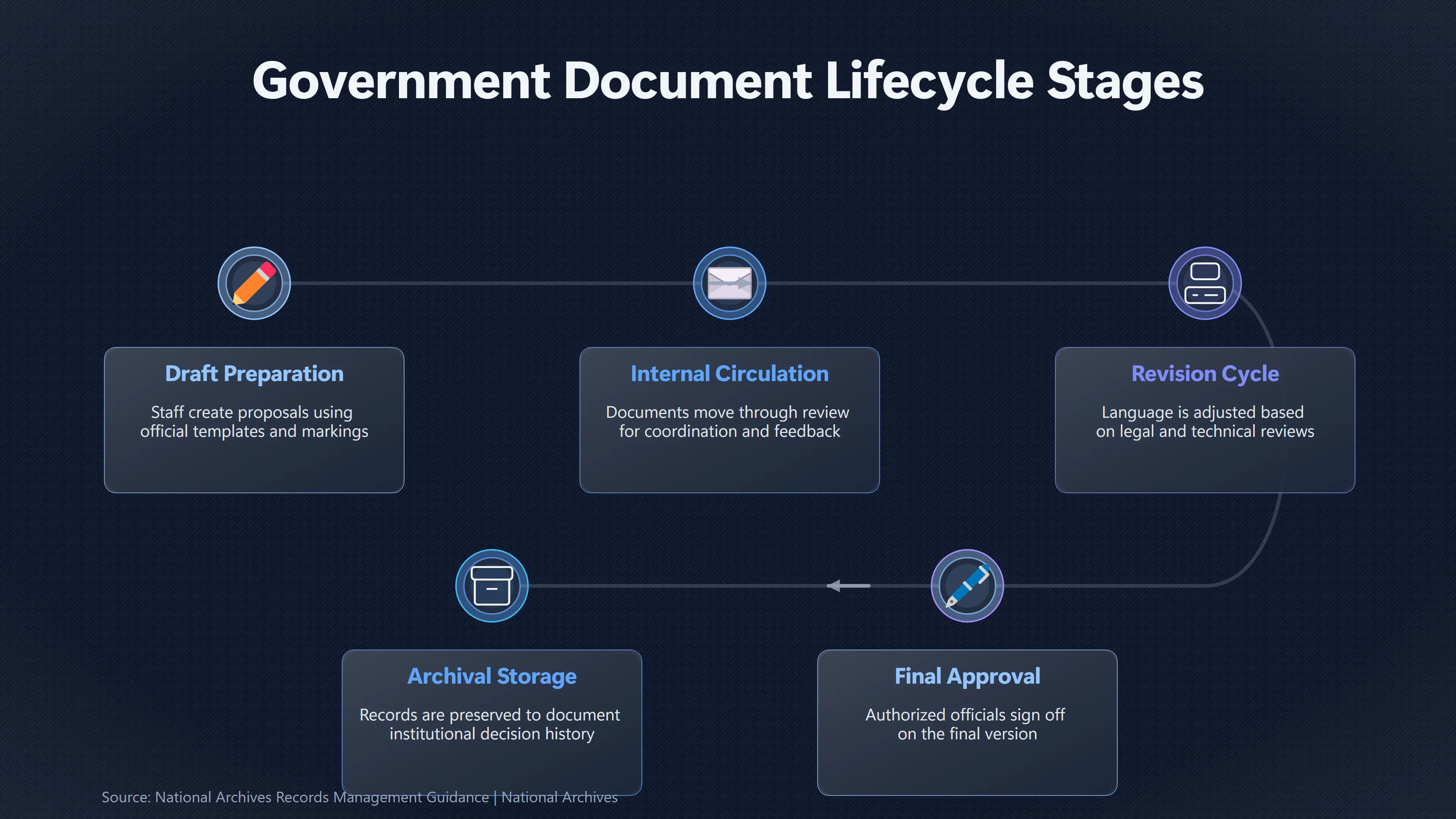
Government organisations generally expect important proposals to be written in a form that closely resembles the finished document. This allows reviewers to evaluate the exact language that could eventually be approved rather than vague notes or outlines. As a result, a draft may contain:
- Official departmental letterheads and templates.
- Security classifications or handling markings.
- Distribution lists naming senior officials.
- Signature blocks prepared for future approval.
- Formal legal or policy language.
None of these features necessarily indicates that the proposal completed the approval process. Instead, they are often prerequisites for internal circulation. CIA correspondence guidance, for example, distinguishes between multiple stages of preparation—including draft, final and revision—even though each stage may carry similar official formatting and control markings.[CIA]cia.govCORRESPONDENCE STYLE & PROCEDURES | CIA FOIA (foia.cia.govCORRESPONDENCE STYLE & PROCEDURES | CIA FOIA (foia.cia.gov)…
This distinction is particularly important when isolated pages circulate online without their surrounding file history. A single page bearing an agency seal or classification banner can look definitive even if later pages show requested changes, objections or withdrawal.
What Approval History and Versioning Can Reveal
The most reliable way to judge a government’s position is not by appearance alone but by the document’s approval trail.
Indicators that a document remained a draft
Several clues often indicate that a file was still moving through an internal process:
- References to comments or coordination from other offices.
- Language requesting approval or concurrence.
- Revision numbers or labels such as “Draft”, “Revised Draft” or “Working Copy”.
- Missing signatures from approving officials.
- Notes indicating future circulation or consultation.
Government recordkeeping guidance also distinguishes between drafts and official file copies. The final record normally includes evidence of approval, while agencies may retain drafts and related materials because they document how decisions evolved. Electronic recordkeeping guidance specifically recommends identifying draft status, associating relevant drafts with the final document where appropriate and preserving version history when those drafts themselves qualify as records.[National Archives]archives.govNational Archives A Management Guide | National ArchivesNational Archives A Management Guide | National Archives

Why multiple versions matter
Large organisations rarely produce only one version of an important document. Successive drafts may contain substantial differences in wording, recommendations or conclusions. Early language can be softened, removed or reversed after legal review, technical assessment or senior management discussion.
Consequently, finding one dramatic sentence in an early draft does not establish that the same statement survived into the approved version.
Why Isolated Draft Language Is Easy to Overread
The risk of misunderstanding increases when only fragments of a document become public.
Without access to surrounding material, readers may be unable to determine:
- Whether the text was written by the agency or received from another organisation.
- Whether comments from reviewers challenged or rejected the language.
- Whether later revisions removed the disputed passages.
- Whether the proposal was approved, amended or abandoned entirely.
Government archives routinely preserve working material because it documents institutional activity rather than only successful outcomes. Records management guidance therefore treats drafts as potentially valuable records without implying that every draft became official policy.[National Archives]archives.govNational Archives Records Management Guidance | National ArchivesNational ArchivesRecords Management Guidance | National ArchivesMarch 11, 2021…
This distinction is especially relevant in discussions surrounding alleged discoveries on government computer systems. An authentic draft found on an official network demonstrates that someone prepared or stored that document within the organisation. It does not, by itself, demonstrate that the organisation adopted every statement it contains.
Why This Matters When Assessing UFO-Related Claims
In debates surrounding UFO-related document discoveries—including claims associated with Gary McKinnon’s reported searches of government systems—the formal appearance of a document is sometimes presented as evidence that its contents represent official government conclusions.
That inference skips an essential step. Analysts, archivists and records professionals instead look for corroborating evidence such as:
- The complete document rather than isolated extracts.
- Metadata showing authorship and revision history.
- Evidence of approval by authorised officials.
- References to superseding versions.
- Related correspondence explaining how the document was handled.
Without that wider documentary context, it is difficult to distinguish between an approved directive, a proposed policy, a discussion paper or an abandoned idea.
The Practical Lesson
Authenticity and institutional endorsement are separate questions. A document can genuinely originate from a government network while still representing an unfinished proposal, a staff recommendation or an internal discussion rather than settled policy.
For that reason, official formatting, classification markings and senior names should be treated as evidence that a document belonged within a government workflow—not as proof that its contents became the government’s final position. The most reliable interpretation comes from examining approval history, revision records and the document’s place within the wider administrative process rather than judging its authority from appearance alone.[cia.gov]cia.govCORRESPONDENCE STYLE & PROCEDURES | CIA FOIA (foia.cia.govCORRESPONDENCE STYLE & PROCEDURES | CIA FOIA (foia.cia.gov)…
Amazon book picks
Further Reading
Books and field guides related to When a Government Draft Looks Officially Final. Use these as the next step if you want deeper reading beyond the article.
Calling Bullshit: The Art of Skepticism in a Data-Driven World
Bullshit isn’t what it used to be. Now, two science professors give us the tools to dismantle misinformation and think clearly in a world...

The Craft of Research
Rating: 4.3/5 from 6 Google Books ratings
Since 1995, students, researchers, and professionals have turned to The Craft of Research for clear and helpful guidance on how to conduc...
Archives: Principles and Practices
This new and extensively revised second edition offers an international perspective on archives management, providing authoritative guida...
eBay marketplace picks
Marketplace Samples
Live-tested eBay searches with available results related to this page.
Selected fromUFO disclosure print oneBay.co.uk.




Endnotes
1.
Source: archives.gov
Title: National Archives Records Management Guidance | National Archives
Link:https://www.archives.gov/guidance/records-management-guidance
Source snippet
National ArchivesRecords Management Guidance | National ArchivesMarch 11, 2021...
Published: March 11, 2021
2.
Source: archives.gov
Title: National Archives A Management Guide | National Archives
Link:https://www.archives.gov/records-mgmt/policy/agency-recordkeeping-requirements.html
3.
Source: cia.gov
Title: CORRESPONDENCE STYLE & PROCEDURES | CIA FOIA (foia.cia.gov)
Link:https://www.cia.gov/readingroom/document/cia-rdp74-00005r000200060045-8
Source snippet
CORRESPONDENCE STYLE & PROCEDURES | CIA FOIA (foia.cia.gov)...
4.
Source: archives.gov
Title: Records Management Regulations and Guidance | National Archives
Link:https://www.archives.gov/records-mgmt/policy
Source snippet
Government is responsible for developing Federal records management guidance related to records creat...
5.
Source: archives.gov
Title: OF R Handbooks | National Archives
Link:https://www.archives.gov/federal-register/write/handbook
Source snippet
OFR Handbooks | National ArchivesJanuary 26, 2026 — OFR HANDBOOKS These handbooks provide policy, guidance, instructions, and examples fo...
Published: January 26, 2026
6.
Source: archives.gov
Title: Document Drafting Handbook (DDH) | National Archives
Link:https://www.archives.gov/federal-register/write/ddh
Source snippet
August 22, 2025 — DOCUMENT DRAFTING HANDBOOK (DDH) Note: Throughout this handbook website, “we,” “our,” and “OFR” refer to the Office of...
Published: August 22, 2025
7.
Source: archives.gov
Title: NAR A Guidance Portal | National Archives
Link:https://www.archives.gov/guidance
8.
Source: archives.gov
Title: Accessioning Guidance and Policy | National Archives
Link:https://www.archives.gov/records-mgmt/accessioning
9.
Source: archives.gov
Title: NAR A Records Schedule
Link:https://www.archives.gov/about/records-schedule/chapter-01.html
10.
Source: cia.gov
Title: RECORD S AND CORRESPONDENCE | CIA FOIA (foia.cia.gov)
Link:https://www.cia.gov/readingroom/document/cia-rdp74-00005r000200150011-5
11.
Source: cia.gov
Title: NATIONA L SECURITY INFORMATION | CIA FOIA (foia.cia.gov)
Link:https://www.cia.gov/readingroom/document/cia-rdp87b01034r000200050009-9
12.
Source: cia.gov
Title: DRAF T EXECUTIVE ORDER RESPONSIVE TO PRM-29 | CIA FOIA (foia.cia.gov)
Link:https://www.cia.gov/readingroom/document/cia-rdp83m00171r002300040004-5
13.
Source: cia.gov
Link:https://www.cia.gov/readingroom/document/loc-hak
14.
Source: cia.gov
Title: CI A HISTORICAL STAFF STYLE MANUAL | CIA FOIA (foia.cia.gov)
Link:https://www.cia.gov/readingroom/document/cia-rdp81-00314r000600070004-0
15.
Source: GOV.UK
Title: 2024 03 19 drafting guidance
Link:https://www.gov.uk/government/publications/drafting-bills-for-parliament/2024-03-19-drafting-guidance
16.
Source: GOV.UK
Title: www.gov.uk Instrument for the Retention of Public Records
Link:https://www.gov.uk/government/publications/signed-instrument-for-the-retention-of-public-records
Additional References
17.
Source: thefederalregister.org
Title: records schedules availability and request for comments
Link:https://thefederalregister.org/documents/2026-04574/records-schedules-availability-and-request-for-comments
Source snippet
Records Schedules; Availability and Request for Comments | 91 FR 11337March 9, 2026 — RECORDS SCHEDULES; AVAILABILITY AND REQUEST FOR COM...
Published: March 9, 2026
18.
Source: thefederalregister.org
Title: records schedules availability and request for comments
Link:https://thefederalregister.org/documents/2026-09573/records-schedules-availability-and-request-for-comments
Source snippet
Records Schedules; Availability and Request for Comments | 91 FR 27371May 14, 2026 — RECORDS SCHEDULES; AVAILABILITY AND REQUEST FOR COMM...
Published: May 14, 2026
19.
Source: thefederalregister.org
Title: records schedules availability and request for comments
Link:https://thefederalregister.org/documents/2026-11955/records-schedules-availability-and-request-for-comments
Source snippet
Records Schedules; Availability and Request for Comments | 91 FR 36013June 15, 2026 — RECORDS SCHEDULES; AVAILABILITY AND REQUEST FOR COM...
Published: June 15, 2026
20.
Source: doi.gov
Link:https://www.doi.gov/ocio/policy-mgmt-support/information-and-records-management/it-guidance
21.
Source: congress.gov
Link:https://www.congress.gov/crs-product/R43072
22.
Source: youtube.com
Title: Ancient Aliens: Hacking NASA Secrets (Season 12, Episode 9)
Link:https://www.youtube.com/watch?v=20rWFDfh68Y
Source snippet
UK hacker's extradition to US blocked...
23.
Source: youtube.com
Title: Gary Mc Kinnon wins extradition battle
Link:https://www.youtube.com/watch?v=y4lecD44F5E
Source snippet
Gary McKinnon: No hacking charges in UK...
24.
Source: youtube.com
Title: UK hacker’s extradition to US blocked
Link:https://www.youtube.com/watch?v=v4Js8DF80HY
Source snippet
UK Hacker extradition to US blocked...
25.
Source: youtube.com
Title: UK Hacker extradition to US blocked
Link:https://www.youtube.com/watch?v=Y5jtyps4oaY
Source snippet
Gary McKinnon wins extradition battle...
26.
Source: youtube.com
Title: Gary Mc Kinnon: No hacking charges in UK
Link:https://www.youtube.com/watch?v=xAhzZRa2aws