Within Mc Kinnon Case
Mckinnon Extradition
Gary McKinnon's case never reached a criminal trial because the legal battle centred on whether he should be extradited from the United Kingdom to the United States, not on whether he was guilty of the computer offences alleged by US prosecutors.
Page outline Jump by section
The US extradition request
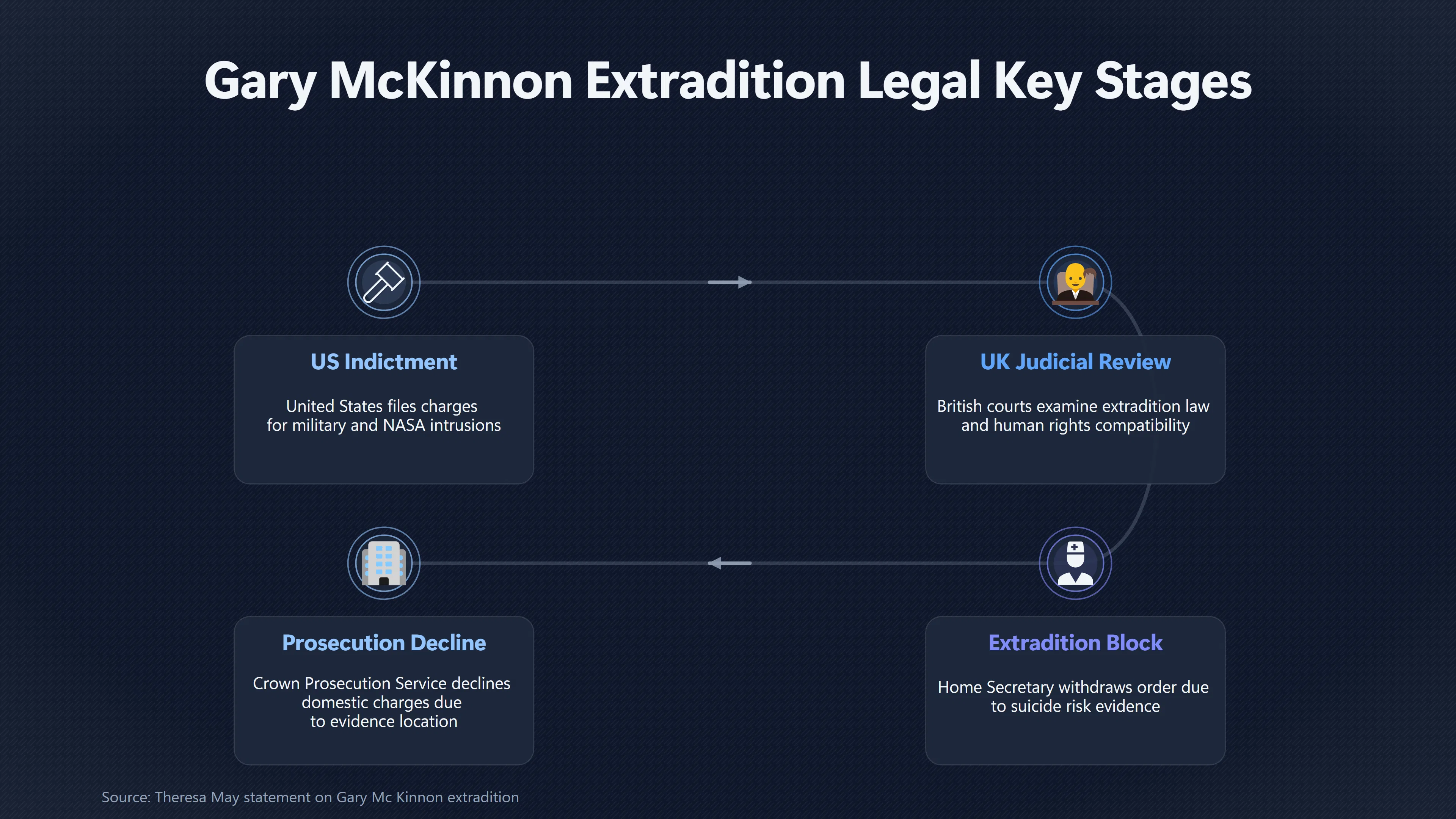
The United States indicted McKinnon in 2002 on multiple computer-related offences arising from alleged intrusions into military and NASA systems. Because he was living in London and the alleged victims were American government agencies, US authorities sought his extradition under the UK–US Extradition Treaty and the Extradition Act 2003 rather than attempting to prosecute him in Britain first.
From the outset, the central legal issue in the UK was therefore procedural: should McKinnon be surrendered to face trial in a US federal court? British judges were not being asked to determine whether the prosecution could prove the hacking allegations beyond reasonable doubt. Instead, they examined whether the legal requirements for extradition had been satisfied and whether extradition would be compatible with UK law and the European Convention on Human Rights.[Hansard]hansard.parliament.ukHansard ExtraditionExtradition - Hansard - UK ParliamentOctober 16, 2012…
This distinction is often overlooked. Repeated references to court hearings can give the impression that McKinnon’s criminal liability was fully litigated in Britain. In reality, the proceedings focused on extradition law, not a criminal determination of guilt.
What British courts did—and did not—decide
During years of appeals, British courts considered arguments including:
- whether the extradition request complied with UK legislation;
- whether prosecution in the United States was legally appropriate;
- whether extradition would violate McKinnon’s human rights; and
- whether his diagnosed Asperger’s syndrome and severe depression created an unacceptable risk if he were removed to the United States.
The courts generally rejected earlier legal challenges to extradition, meaning that the judicial process largely upheld the legality of sending him to the United States under existing law. Those rulings did not amount to findings that he was guilty of every allegation contained in the US indictments, nor did they resolve disputed claims about the scale of network damage or financial losses. Those questions would ordinarily have been examined at a criminal trial in the requesting jurisdiction.[Hansard]parliament.ukOpen source on parliament.uk.
Because no jury ever heard evidence from both prosecution and defence, allegations about deleted files, operational disruption and the precise consequences of the intrusions remained prosecution claims rather than trial-tested findings.
Why extradition was ultimately stopped
The decisive turning point came in October 2012, when Home Secretary Theresa May exercised her statutory role after the judicial process had concluded.
Following independent medical assessments and legal advice, she concluded that extraditing McKinnon would create such a high risk of suicide that removal to the United States would be incompatible with his human rights. She therefore withdrew the extradition order. Her decision did not question the seriousness of the allegations or invalidate the American prosecution. Instead, it rested on the exceptional medical evidence relating to McKinnon’s mental health.[GOV.UK]GOV.UKTheresa May statement on Gary Mc Kinnon extraditionTheresa May statement on Gary McKinnon extradition - GOV.UK…
May emphasised that extradition remained an important tool for international criminal justice and characterised the decision as exceptional rather than a change in general extradition policy.[GOV.UK]GOV.UKTheresa May statement on Gary Mc Kinnon extraditionTheresa May statement on Gary McKinnon extradition - GOV.UK…

Why there was no UK criminal trial afterwards
Blocking extradition did not automatically end the possibility of prosecution. Instead, the matter passed to the Director of Public Prosecutions, who had to decide whether criminal proceedings should be brought in England and Wales.
In December 2012, the Crown Prosecution Service announced that McKinnon would not be prosecuted in the United Kingdom. Prosecutors concluded that the evidential and practical difficulties were substantial because the alleged offences had been committed against US government computer systems, with most witnesses and evidence located overseas. They also stated that nothing had altered the earlier assessment that the United States remained the proper forum for any prosecution. As a result, no British criminal case was commenced.[The Guardian]theguardian.comThe GuardianGary McKinnon will face no charges in UK | Gary McKinnon | The GuardianDecember 14, 2012…
This sequence of decisions produced an unusual legal outcome:
- extradition was blocked on human rights grounds;
- the United States did not obtain a trial;
- the United Kingdom declined to prosecute domestically; and
- no criminal court ever examined the evidence in a full adversarial trial.
How the legal outcome shaped the public story
The absence of a criminal trial had lasting consequences for public understanding of McKinnon’s case.
First, many of the technical allegations remained disputed. McKinnon openly acknowledged gaining unauthorised access to US systems, but the prosecution’s claims regarding the extent of damage, operational disruption and financial losses were never tested through witness examination and cross-examination before a jury.
Second, McKinnon’s own account of searching for UFO-related material likewise escaped judicial scrutiny. His descriptions of seeing an unusual spacecraft image and references to alleged “non-terrestrial officers” became widely discussed in popular culture, but no criminal proceedings evaluated those claims as evidence because they were peripheral to the extradition litigation itself.
Finally, the prolonged focus on extradition transformed the case into a broader debate about UK–US extradition arrangements, human rights protections and the treatment of defendants with significant mental health conditions. Parliamentary discussion and media coverage increasingly concentrated on those legal and humanitarian questions rather than on the underlying computer offences.[parliament.uk]hansard.parliament.ukHansard ExtraditionExtradition - Hansard - UK ParliamentOctober 16, 2012…

What the case established—and what it did not
The legal history of Gary McKinnon’s case established that extradition proceedings are not a substitute for a criminal trial. British courts examined whether he could lawfully and safely be sent to the United States, while the Home Secretary ultimately halted extradition because of exceptional medical evidence. When UK prosecutors later decided not to bring domestic charges, the opportunity for any criminal trial disappeared.
As a result, the case ended without a judicial determination of the contested factual issues that continue to attract public interest. The legality of extradition, rather than the truth or falsity of every allegation surrounding the hacking or McKinnon’s claimed discoveries, became the defining legal question of the entire proceedings.[gov.uk]GOV.UKTheresa May statement on Gary Mc Kinnon extraditionTheresa May statement on Gary McKinnon extradition - GOV.UK…
Amazon book picks
Further Reading
Books and field guides related to Mckinnon Extradition. Use these as the next step if you want deeper reading beyond the article.
The Rule of Law
'A gem of a book ... Inspiring and timely. Everyone should read it' Independent 'The Rule of Law' is a phrase much used but little examin...
The Secret Barrister
Writing as S. J. Fleet, The Secret Barrister's first novel, The Cut Throat Trial, is available for pre-order now. ____ An anonymous barri...
East West Street
THE BRITISH BOOK AWARDS NON-FICTION BOOK OF THE YEAR 2017 SUNDAY TIMES TOP 10 BESTSELLER When he receives an invitation to deliver a lect...

Cybercrime: The Transformation of Crime in the Information Age
First published 2007. Subjects: Computer related crime, Computer crimes, Computer security, Informatiemaatschappij, Databrott.
eBay marketplace picks
Marketplace Samples
Live-tested eBay searches with available results related to this page.
Selected fromUFO patch oneBay.co.uk.




Endnotes
1.
Source: GOV.UK
Title: Theresa May statement on Gary Mc Kinnon extradition
Link:https://www.gov.uk/government/news/theresa-may-statement-on-gary-mckinnon-extradition
Source snippet
Theresa May statement on Gary McKinnon extradition - GOV.UK...
2.
Source: GOV.UK
Title: www.gov.uk Latest on Gary [Mc Kinnon case]({{ ‘mc-kinnon-case/’ | relative_url }})
Link:https://www.gov.uk/government/news/latest-on-gary-mckinnon-case
3.
Source: hansard.parliament.uk
Title: Hansard Extradition
Link:https://hansard.parliament.uk/commons/2012-10-16/debates/12101642000005/Extradition
Source snippet
Extradition - Hansard - UK ParliamentOctober 16, 2012...
Published: October 16, 2012
4.
Source: hansard.parliament.uk
Title: Hansard Extradition
Link:https://hansard.parliament.uk/lords/2012-10-16/debates/12101643000907/Extradition
Source snippet
UK ParliamentOctober 16, 2012 — HANSARD Statement 3.17pm The Parliamentary Under-Secretary of State, Home Office (Lord Taylor o...
Published: October 16, 2012
5.
Source: theguardian.com
Link:https://www.theguardian.com/world/2012/dec/14/gary-mckinnon-no-uk-charges
Source snippet
The GuardianGary McKinnon will face no charges in UK | Gary McKinnon | The GuardianDecember 14, 2012...
Published: December 14, 2012
6.
Source: theguardian.com
Link:https://www.theguardian.com/world/2012/oct/16/gary-mckinnon-not-extradited-may
7.
Source: publications.parliament.uk
Link:https://publications.parliament.uk/pa/cm201213/cmhansrd/cm121016/debtext/121016-0001.htm
Source snippet
Other people who are subject to extradition or immigration proceedings cite medical conditions as a reason for them not to be...
8.
Source: publications.parliament.uk
Link:https://publications.parliament.uk/pa/cm201011/cmhansrd/cm111205/debtext/111205-0004.htm
9.
Source: publications.parliament.uk
Title: uk House of Commons
Link:https://publications.parliament.uk/pa/cm201011/cmselect/cmhaff/644/11011804.htm
10.
Source: publications.parliament.uk
Title: uk House of Lords
Link:https://publications.parliament.uk/pa/ld200708/ldjudgmt/jd080730/mckinn-1.htm
Additional References
11.
Source: itv.com
Title: XNo charges against US hacker
Link:https://www.itv.com/news/story/2012-12-14/gary-mckinnon
Source snippet
5 updates 2. 14 December 2012 NO CHARGES AGAINST US HACKER Gary McKinnon, who is wanted in the US after hacking into the Pentagon's compu...
Published: December 2012
12.
Source: youtube.com
Title: Gary Mc Kinnon wins extradition battle
Link:https://www.youtube.com/watch?v=y4lecD44F5E
Source snippet
Gary McKinnon will not face prosecution in the UK...
13.
Source: youtube.com
Title: The Man Who Hacked the U.S. Government
Link:https://www.youtube.com/watch?v=ND0zQX1rGdg
Source snippet
PM Discusses The Fate Of Hacker Gary McKinnon...
14.
Source: youtube.com
Title: Gary Mc Kinnon will not face prosecution in the UK
Link:https://www.youtube.com/watch?v=viLcoe_xPMU
Source snippet
UK hacker's extradition to US blocked...
15.
Source: youtube.com
Title: UK hacker’s extradition to US blocked
Link:https://www.youtube.com/watch?v=v4Js8DF80HY
Source snippet
The Man Who Hacked the U.S. Government...
16.
Source: youtube.com
Title: PM Discusses The Fate Of Hacker Gary Mc Kinnon
Link:https://www.youtube.com/watch?v=WChPMnpJnco