Within UFO Hackers
Was Mc Kinnon a Searcher or a Saboteur?
US authorities alleged disruption, deleted files, and high repair costs, while McKinnon denied acting as a destructive attacker.
On this page
- What US authorities alleged
- Mc Kinnon's competing account
- Why no completed trial matters
Page outline Jump by section
Introduction
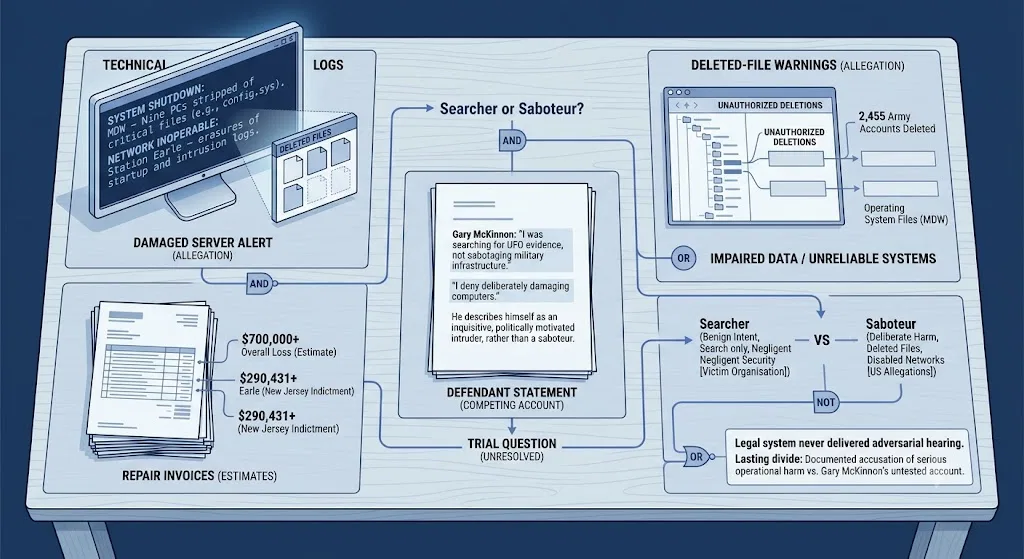
The damage question sits at the centre of the Gary McKinnon case. US authorities did not portray his intrusions merely as unauthorised searches for UFO material: they alleged that he deleted essential files and user accounts, disabled military networks, erased logs and created repair costs exceeding $700,000. McKinnon admitted entering US government computers without permission, but denied deliberately damaging them and described himself as an inquisitive, politically motivated intruder rather than a saboteur.
Both propositions cannot simply be treated as established fact. The American allegations were detailed enough to support indictments and extradition proceedings, but they were never tested through a completed criminal trial. British courts repeatedly summarised the prosecution case, yet extradition hearings were not designed to determine whether each outage, deletion and dollar of claimed loss had been proved beyond reasonable doubt. The result is a lasting divide between a documented accusation of serious operational harm and McKinnon’s untested competing account.[parliament.uk]publications.parliament.ukUK Parliament House of LordsUK ParliamentHouse of Lords - Mckinnon V Government of The United…30 Jul 2008 — It damaged computers by impairing their integrity, The…
What US authorities alleged
The prosecution case concerned more than the number of machines accessed. According to the account accepted for extradition purposes by the House of Lords, McKinnon gained unauthorised access to 97 US government computers between February 2001 and March 2002. The alleged consequences included impaired data, unreliable systems and disruption to defence-related networks. The House of Lords recorded an overall alleged repair cost of more than $700,000 and stated that examination of McKinnon’s home computer supported the allegations, while carefully noting that he had not admitted actually causing damage.[UK Parliament]publications.parliament.ukUK Parliament House of LordsUK ParliamentHouse of Lords - Mckinnon V Government of The United…30 Jul 2008 — It damaged computers by impairing their integrity, The…
The allegations identified several concrete forms of harm:
- The Military District of Washington: McKinnon was accused of deleting critical operating-system files from nine computers, causing a network serving more than 2,000 machines to shut down for 24 hours and disrupting government functions.
- Army user accounts: Authorities alleged that he deleted 2,455 accounts from a computer controlling access to an Army network, making affected machines reboot or become unusable.
- Naval Weapons Station Earle: Prosecutors said he erased logs and other files from computers at the New Jersey base, whose systems included information about naval vessels and military readiness. The base network of more than 300 computers was allegedly rendered inoperable shortly after the attacks of 11 September 2001.
- Persistence and exposure: McKinnon was accused of installing remote-administration software and leaving systems vulnerable to renewed access by himself or other intruders.[UK Parliament]publications.parliament.ukUK Parliament House of LordsUK ParliamentHouse of Lords - Mckinnon V Government of The United…30 Jul 2008 — It damaged computers by impairing their integrity, The…
The Earle allegation formed the basis of a separate New Jersey indictment. The US Department of Justice attributed approximately $290,431 in damage there to deleted start-up files, erased intrusion logs and security work required after the installation of the RemotelyAnywhere access program. This figure was therefore not simply a price placed on viewing files: it incorporated claimed recovery, investigation and network-security costs.[Department of Justice]justice.govDepartment of Justice British National Charged with Hacking Into N.Jthis intrusion into the network, McKinnon allegedly caused approximately $290,431 in damage to NWS Earle by deleting comp…
Early public descriptions of the overall financial loss were not completely consistent. Justice officials and contemporary reporting initially cited approximately $900,000 across affected systems, whereas the later extradition narrative commonly used “over $700,000”. The difference does not by itself disprove the claims; estimates can change as investigations narrow charges or recalculate recoverable loss. It does show, however, why the headline sum should be understood as a prosecution estimate rather than a judicially determined award.[WIRED]wired.comBrit Accused of Hacking Pentagonfederal authorities of hacking into 92 computer networks operated by the U.S. military and NASA, causing $900,000 in damages across 14 st…
Operational harm, not physical destruction
In computer-crime law, “damage” does not require smashed equipment or permanently destroyed hardware. Loss of availability, deletion of accounts, restoration work and compromised system integrity can all qualify. That distinction mattered in McKinnon’s case because the alleged harm largely consisted of systems becoming unavailable or unreliable and technicians having to restore them.
It also explains why McKinnon’s use of a home computer and dial-up connection did not automatically rule out substantial consequences. A remote intruder does not need high bandwidth to delete a small but essential configuration file, alter permissions or disable accounts. The amount of data transmitted can be modest while the recovery work is extensive. Whether McKinnon performed the specific destructive acts alleged remained disputed, but the technical category of harm described by prosecutors was plausible in principle.[Department of Justice]justice.govDepartment of Justice British National Charged with Hacking Into N.Jthis intrusion into the network, McKinnon allegedly caused approximately $290,431 in damage to NWS Earle by deleting comp…
McKinnon’s competing account
McKinnon did not deny the underlying unauthorised access. He publicly acknowledged scanning US networks for poorly protected Windows computers and browsing military and NASA systems. His defence was narrower: he said his purpose was to search for evidence of UFO secrecy, antigravity research and suppressed technology, and he rejected the depiction of himself as someone seeking to cripple defence infrastructure.[WIRED]wired.comufo hacker tells what he foundThe search for proof of the existence of UFOs landed Gary McKinnon in a world of trouble…. Save this story… McKinnon tells what he…
He stated that he did not knowingly delete or damage anything and questioned whether a person operating through a 56k dial-up modem could have produced the scale of disruption alleged. That argument addressed his intention and self-understanding more strongly than it addressed technical causation. Slow access would have made large transfers difficult, but it would not necessarily have prevented commands that deleted files, stopped services or altered accounts.[Computing]computing.co.ukIn an interview with Computing before his court appearance, McKinnon said: 'I honestly hope that someone on a 56k modem is not capable of…
McKinnon also maintained that many of the computers were insecure, with blank or weak administrator passwords. Contemporary reporting indicated that he used automated scanning tools to locate vulnerable Windows systems and that investigators found numerous machines protected by easily guessed credentials. Those weaknesses help explain how the intrusions occurred, but they do not settle responsibility for later disruption. Negligent security by the victim organisation can coexist with unlawful and damaging conduct by an intruder.[WIRED]wired.comattempts to extradite him for charges related to what is described as the largest successful hacking effort against American military net…
The hardest point for the benign-search narrative was that the US case did not rest solely on accidental instability. It alleged deliberate deletion of accounts, operating-system files and logs. Erasing logs would be consistent with concealing unauthorised access rather than simply reading UFO-related material. Conversely, the public record available outside a trial does not reveal the full forensic chain needed to establish which commands were issued by McKinnon, which failures followed directly from those commands and which recovery expenses were reasonably attributable to him.
His position is therefore best described neither as a complete denial nor as an admission to the American damage case. He accepted persistent intrusion and some confrontational activity, but disputed destructive intent and denied causing the operational damage for which prosecutors sought to hold him responsible. The House of Lords itself preserved this distinction by recording admissions of responsibility for unauthorised conduct while adding that he had not admitted actually causing damage.[UK Parliament]publications.parliament.ukUK Parliament House of LordsUK ParliamentHouse of Lords - Mckinnon V Government of The United…30 Jul 2008 — It damaged computers by impairing their integrity, The…
How damage increased the legal stakes
The alleged damage transformed the case from a story about trespass into one about interference with military operations. Accessing an unclassified machine without permission was already criminal conduct, but allegations of disabling networks after 11 September 2001 gave prosecutors a much stronger public-safety narrative. Naval Weapons Station Earle supplied munitions to the Atlantic Fleet, while the Military District of Washington had responsibilities connected with the US capital. Framing the intrusions as operational disruption made the place and timing of the conduct central to the prosecution’s seriousness assessment.[Department of Justice]justice.govDepartment of Justice British National Charged with Hacking Into N.Jthis intrusion into the network, McKinnon allegedly caused approximately $290,431 in damage to NWS Earle by deleting comp…
Financial loss also mattered under US computer-crime charges because demonstrable damage can affect charging, jurisdiction and sentencing. The indictments therefore quantified losses and connected them to individual computers or facilities. In the New Jersey case, the alleged loss of approximately $290,431 made the claimed impact concrete; in the broader extradition case, the figure above $700,000 conveyed a campaign of accumulated harm rather than a series of harmless visits.[Department of Justice]justice.govDepartment of Justice British National Charged with Hacking Into N.Jthis intrusion into the network, McKinnon allegedly caused approximately $290,431 in damage to NWS Earle by deleting comp…
The prosecution’s language additionally challenged McKinnon’s preferred public identity. A “searcher” might read documents and leave; a saboteur impairs systems, destroys records or obstructs recovery. By alleging deleted logs, inaccessible accounts and prolonged outages, the US authorities placed his conduct on the second side of that divide. McKinnon’s supporters, by contrast, stressed his lack of espionage, financial or terrorist motive and argued that the case was being amplified to punish an embarrassing exposure of weak military security. Contemporary US officials acknowledged that there was no evidence he supplied information to a foreign government or terrorist organisation, although absence of espionage did not answer the separate accusation of computer damage.[WIRED]wired.comattempts to extradite him for charges related to what is described as the largest successful hacking effort against American military net…
What the extradition judgments did — and did not — establish
British judgments are often cited as though they conclusively proved that McKinnon deleted the files and caused every alleged outage. Their actual function was more limited. Extradition courts were deciding whether the legal requirements for surrender to the United States had been met, not conducting the American criminal trial in Britain.
The House of Lords gave a detailed summary of the alleged conduct because the seriousness of the offences, McKinnon’s admissions and the proposed US proceedings were relevant to his extradition appeal. Its judgment stated that forensic analysis of his home computer confirmed the allegations, but the court did not hear the full prosecution and defence evidence needed for a criminal verdict. The summary was based on the case advanced by the requesting US authorities and on material used within the extradition process.[UK Parliament]publications.parliament.ukUK Parliament House of LordsUK ParliamentHouse of Lords - Mckinnon V Government of The United…30 Jul 2008 — It damaged computers by impairing their integrity, The…
This distinction matters because extradition proceedings generally test whether a foreign prosecution is legally valid and sufficiently supported under the applicable treaty arrangements. They do not normally require the requesting state to prove guilt beyond reasonable doubt. McKinnon could challenge matters such as human rights, abuse of process and the consequences of extradition, but he did not receive a completed evidential trial in which technical witnesses were cross-examined about each deletion, outage and cost calculation.
It would therefore be misleading to say that British courts found him guilty of causing $700,000 in damage. It would be equally misleading to say that the allegations were invented or unsupported merely because there was no verdict. They were formal, particularised charges backed by investigative material sufficient to sustain a long-running extradition request. Their ultimate accuracy remained unresolved.
Why no completed trial matters
The extradition process ended in October 2012 when Home Secretary Theresa May concluded that sending McKinnon to the United States would create such a high risk of suicide that extradition would be incompatible with his human rights. Her decision did not declare him innocent and did not reject the American damage evidence. She explicitly characterised the accusations as serious while deciding that his health made extradition impermissible.[GOV.UK]GOV.UKgary mckinnon extradition case home secretarys statementgary mckinnon extradition case home secretarys statement
The possibility of a British prosecution was then considered. In December 2012, the Crown Prosecution Service decided not to charge him in England and Wales. The stated obstacles included the passage of time, the location of most witnesses and physical evidence in the United States, the sensitivity and volume of unused material, and the difficulty of transferring an American-built case into a British trial while meeting disclosure obligations. The CPS concluded that the prospect of securing a conviction reflecting the full extent of the alleged criminality was not high.[The Guardian]theguardian.comgary mckinnon no uk chargesgary mckinnon no uk charges
That decision is sometimes interpreted as a rejection of the damage claims. It was not. The CPS said that the evidential geography of the case still favoured the United States: most witnesses, physical evidence and supporting material remained there. Its conclusion concerned whether a viable prosecution could be mounted in England and Wales a decade later, not whether no damage had occurred.[The Guardian]theguardian.comgary mckinnon no uk chargesgary mckinnon no uk charges
The absence of a completed trial left several questions unanswered:
- Which deleted files and accounts could be forensically attributed to McKinnon rather than to administrators, automated processes or unrelated intruders?
- How directly did those deletions cause the reported network outages?
- Did all claimed repair costs represent necessary recovery from his conduct, or did some include broader security upgrades and investigative expenditure?
- Were the early $900,000 estimate, the later figure above $700,000 and the facility-specific calculations based on consistent methods?
- To what extent did McKinnon intend disruption, foresee it or act recklessly despite claiming a purely investigative motive?
These are ordinary trial questions involving attribution, causation, intent and valuation. Because no jury or trial judge resolved them, later accounts should preserve the legal word “alleged” rather than silently converting the prosecution narrative into established history.
Searcher or saboteur?
The strongest evidence for the “searcher” interpretation is McKinnon’s acknowledged UFO-related motive, the absence of an alleged profit or espionage scheme and his consistent denial that he intended to damage systems. His methods also exposed embarrassingly weak security on some government machines, including weak or missing passwords.[WIRED]wired.comufo hacker tells what he foundThe search for proof of the existence of UFOs landed Gary McKinnon in a world of trouble…. Save this story… McKinnon tells what he…
The strongest evidence for the “saboteur” interpretation is the specificity of the US allegations: nine computers stripped of critical files, thousands of deleted accounts, erased naval logs, disabled networks and substantial restoration costs. The case was not framed simply as an administrator charging for password resets after an intrusion. Prosecutors claimed identifiable operational failures at named military facilities.[UK Parliament]publications.parliament.ukUK Parliament House of LordsUK ParliamentHouse of Lords - Mckinnon V Government of The United…30 Jul 2008 — It damaged computers by impairing their integrity, The…
Neither label is fully satisfactory as a substitute for adjudicated facts. McKinnon was unquestionably an unauthorised intruder, not a lawful researcher. Yet “saboteur” implies a destructive purpose that he denied and that no completed trial established. A fair description is that he presented himself as a UFO-motivated searcher whose intrusions US prosecutors alleged became materially destructive.
That unresolved tension explains much of the case’s cultural afterlife. For admirers, the damage claims appeared to turn an eccentric hunt for hidden information into an exaggerated national-security prosecution. For US authorities, the UFO explanation did not neutralise deleted records, unavailable systems or the burden of restoring compromised defence networks. The legal system never delivered the adversarial hearing that might have separated those narratives more decisively.
The governance lesson behind the dispute
The damage controversy exposed two governance failures that can exist at the same time. First, a remote user was able to enter numerous defence and space-agency systems through elementary security weaknesses. Military organisations had an obligation to enforce strong credentials, monitor remote access and isolate sensitive functions. The intrusions demonstrated serious deficiencies regardless of McKinnon’s motives.[WIRED]wired.comattempts to extradite him for charges related to what is described as the largest successful hacking effort against American military net…
Second, weak security does not grant outsiders permission to explore government networks. Once inside, an intruder may unintentionally interrupt services, alter timestamps, overwrite evidence or trigger expensive incident-response procedures. Curiosity-driven access can therefore produce real operational costs even without a plan to steal secrets or destroy infrastructure.
The case also illustrates why public damage claims in cyber prosecutions need transparent, technically grounded accounting. Investigation costs, emergency recovery, software reinstallation, lost staff time and long-term security improvements are not interchangeable. Separating them helps courts assess causation and proportionality while protecting defendants from inflated headline totals. McKinnon’s case never reached the stage where those categories could be publicly tested.
The most defensible conclusion is consequently narrower than either side’s preferred story. US authorities advanced a substantial and detailed case that McKinnon’s intrusions disrupted military systems and generated hundreds of thousands of dollars in losses. McKinnon admitted unauthorised access but denied knowingly destructive conduct. Because extradition was stopped on human-rights grounds and no British prosecution followed, the central damage allegations remain serious, documented and legally consequential — but not finally proved by a criminal verdict.

Amazon book picks
Further Reading
Books and field guides related to Was Mc Kinnon a Searcher or a Saboteur?. Use these as the next step if you want deeper reading beyond the article.
The Cuckoo's Egg
This is the true story of how a systems manager at Lawrence Berkeley Lab singlehandedly tracked down and helped capture a computer hacker...
Cybercrime and Society
The Third Edition of Cybercrime and Society provides readers with expert analysis on the most important cybercrime issues affecting moder...
Spam Nation
Now a New York Times bestseller! There is a Threat Lurking Online with the Power to Destroy Your Finances, Steal Your Personal Data, and...
Ghost in the Wires
In this "intriguing, insightful and extremely educational" novel, the world's most famous hacker teaches you easy cloaking and counter-me...
eBay marketplace picks
Marketplace Samples
Live-tested eBay searches with available results related to this page.
Selected fromUFO wall art oneBay.co.uk.



Endnotes
1.
Source: publications.parliament.uk
Title: UK Parliament House of Lords
Link:https://publications.parliament.uk/pa/ld200708/ldjudgmt/jd080730/mckinn-1.htm
Source snippet
UK ParliamentHouse of Lords - Mckinnon V Government of The United...30 Jul 2008 — It damaged computers by impairing their integrity, The...
2.
Source: justice.gov
Title: Department of Justice British National Charged with Hacking Into N.J
Link:https://www.justice.gov/archive/criminal/cybercrime/press-releases/2002/mckinnonIndict2.htm
Source snippet
this intrusion into the network, McKinnon allegedly caused approximately $290,431 in damage to NWS Earle by deleting comp...
3.
Source: wired.com
Title: Brit Accused of Hacking Pentagon
Link:https://www.wired.com/2002/11/brit-accused-of-hacking-pentagon
Source snippet
federal authorities of hacking into 92 computer networks operated by the U.S. military and NASA, causing $900,000 in damages across 14 st...
4.
Source: wired.com
Link:https://www.wired.com/2002/11/brit-fights-hacking-extradition
Source snippet
attempts to extradite him for charges related to what is described as the largest successful hacking effort against American military net...
5.
Source: wired.com
Title: ufo hacker tells what he found
Link:https://www.wired.com/2006/06/ufo-hacker-tells-what-he-found/
Source snippet
The search for proof of the existence of UFOs landed Gary McKinnon in a world of trouble.... Save this story... McKinnon tells what he...
6.
Source: wired.com
Link:https://www.wired.com/2009/07/mckinnon/
Source snippet
trial for cracking nearly 100 Pentagon and NASA computers in 2001 and 2002.... He allegedly crashed some systems, in one case deleting c...
7.
Source: justice.gov
Link:https://www.justice.gov/archive/criminal/cybercrime/press-releases/2002/mckinnonIndict.htm
8.
Source: GOV.UK
Title: gary mckinnon extradition case home secretarys statement
Link:https://www.gov.uk/government/speeches/gary-mckinnon-extradition-case-home-secretarys-statement
9.
Source: GOV.UK
Title: www.gov.uk Horizon Convictions Redress Scheme (HCRS): legal cost framework
Link:https://www.gov.uk/government/publications/horizon-convictions-redress-scheme-hcrs-legal-cost-framework/horizon-convictions-redress-scheme-hcrs-legal-cost-framework
10.
Source: GOV.UK
Title: www.gov.uk Horizon Convictions Redress Scheme (HCRS): assessment framework
Link:https://www.gov.uk/government/publications/horizon-convictions-redress-scheme-hcrs-assessment-framework/horizon-convictions-redress-scheme-hcrs-assessment-framework
11.
Source: cps.gov.uk
Title: D G6 Desktop Guide | The Crown Prosecution Service
Link:https://www.cps.gov.uk/prosecution-guidance/dg6-desktop-guide
12.
Source: cps.gov.uk
Title: Proceeds of Crime | The Crown Prosecution Service
Link:https://www.cps.gov.uk/prosecution-guidance/proceeds-crime
13.
Source: cps.gov.uk
Link:https://www.cps.gov.uk/prosecution-guidance/expert-guidance-disclosure-unused-material-and-case-management
14.
Source: cps.gov.uk
Title: Disclosure of Material to Third Parties | The Crown Prosecution Service
Link:https://www.cps.gov.uk/prosecution-guidance/disclosure-material-third-parties
15.
Source: cps.gov.uk
Link:https://www.cps.gov.uk/prosecution-guidance/disclosure-previous-convictions-prosecution-witnesses
16.
Source: cps.gov.uk
Title: Disclosure Manual: Chapter 37
Link:https://www.cps.gov.uk/prosecution-guidance/disclosure-manual-chapter-37-guidance-dealing-current-and-past-cases-where
17.
Source: cps.gov.uk
Link:https://www.cps.gov.uk/prosecution-guidance/victims-and-witnesses-cps-commitments-support
18.
Source: cps.gov.uk
Title: Disclosure Manual: Chapter 15
Link:https://www.cps.gov.uk/prosecution-guidance/disclosure-manual-chapter-15-defence-disclosure
19.
Source: cps.gov.uk
Title: Hearsay | The Crown Prosecution Service
Link:https://www.cps.gov.uk/prosecution-guidance/hearsay
20.
Source: cps.gov.uk
Title: Community Impact Statements | The Crown Prosecution Service
Link:https://www.cps.gov.uk/prosecution-guidance/community-impact-statements
21.
Source: cps.gov.uk
Link:https://www.cps.gov.uk/publication/directors-guidance-accompany-attorney-generals-guidelines-plea-discussions-cases
22.
Source: publications.parliament.uk
Link:https://publications.parliament.uk/pa/cm200910/cmhansrd/cm091201/debtext/91201-0004.htm
23.
Source: wired.com
Title: aclu mckinnon
Link:https://www.wired.com/2009/08/aclu-mckinnon/
24.
Source: hansard.parliament.uk
Title: uk Gary Mc Kinnon
Link:https://hansard.parliament.uk/commons/2009-03-24/debates/09032470000106/GaryMckinnon
25.
Source: wired.com
Title: uk hacker gary
Link:https://www.wired.com/2008/08/uk-hacker-gary/
26.
Source: publications.parliament.uk
Title: uk House of Lords
Link:https://publications.parliament.uk/pa/ld200708/ldjudgmt/jd080730/mckinn-2.htm
27.
Source: wired.com
Title: british hacker
Link:https://www.wired.com/2007/04/british-hacker-/
28.
Source: hcourt.gov.au
Title: Mc Kinnon v Secretary, Department of Treasury | High Court of Australia
Link:https://www.hcourt.gov.au/cases-and-judgments/judgments/judgments-1998-current/mckinnon-v-secretary-department-treasury
29.
Source: wired.com
Title: terrorist or ufo truth seeker
Link:https://www.wired.com/2006/04/terrorist-or-ufo-truth-seeker/
30.
Source: justice.gov
Link:https://www.justice.gov/archive/usao/nj/Press/files/pdffiles/Older/edva_mckinnon_indictment.pdf
31.
Source: justice.gov
Title: 06.09.23. Memo Violence School Administratiors (AFLF) Part 1
Link:https://www.justice.gov/d9/2023-06/06.09.23.%20–%20Memo%20Violence%20School%20Administratiors%20%28AFLF%29%20Part%201.pdf
32.
Source: hansard.parliament.uk
Title: uk Gary Mc Kinnon (Extradition)
Link:https://hansard.parliament.uk/commons/2009-12-01/debates/09120144000002/GaryMckinnon%28Extradition%29
33.
Source: parliament.uk
Link:https://www.parliament.uk/business/news/news-by-year/2012/october/statement-on-gary-mckinnon/
34.
Source: publications.parliament.uk
Link:https://publications.parliament.uk/pa/ld200809/ldhansrd/lhan111.pdf
35.
Source: publications.parliament.uk
Link:https://publications.parliament.uk/pa/cm201012/cmselect/cmhaff/644/644.pdf
36.
Source: GOV.UK
Title: latest on gary mckinnon case
Link:https://www.gov.uk/government/news/latest-on-gary-mckinnon-case
37.
Source: assets.publishing.service.gov.uk
Title: public views 3
Link:https://assets.publishing.service.gov.uk/media/5a7af96ae5274a319e77c120/public-views-3.pdf
38.
Source: assets.publishing.service.gov.uk
Title: public consultation 7
Link:https://assets.publishing.service.gov.uk/media/5a7ad76ce5274a34770e77c2/public-consultation-7.pdf
39.
Source: cps.gov.uk
Link:https://www.cps.gov.uk/about-cps/disclosure
40.
Source: time.com
Title: hack attack 2
Link:https://time.com/archive/6943962/hack-attack-2/
41.
Source: computing.co.uk
Link:https://www.computing.co.uk/news/1855426/hacker-defends-raids-pentagons-heart
Source snippet
In an interview with Computing before his court appearance, McKinnon said: 'I honestly hope that someone on a 56k modem is not capable of...
42.
Source: theguardian.com
Title: gary mckinnon no uk charges
Link:https://www.theguardian.com/world/2012/dec/14/gary-mckinnon-no-uk-charges
43.
Source: schneier.com
Title: Gary Mc Kinnon
Link:https://www.schneier.com/?p=2390
44.
Source: theguardian.com
Link:https://www.theguardian.com/technology/2008/jul/30/gary.mckinnon
45.
Source: theguardian.com
Link:https://www.theguardian.com/technology/2006/jul/07/news.usnews
46.
Source: theguardian.com
Title: British hacker faces extradition to US | US news | The Guardian
Link:https://www.theguardian.com/technology/2006/may/10/news.usnews
47.
Source: itv.com
Title: gary mckinnon
Link:https://www.itv.com/news/story/2012-12-14/gary-mckinnon
48.
Source: media.techtarget.com
Link:https://media.techtarget.com/rms/computerweekly/DowntimePDF/pdf/mckinnon.pdf
49.
Source: theguardian.com
Title: gary mckinnon timeline extradition
Link:https://www.theguardian.com/world/2012/oct/16/gary-mckinnon-timeline-extradition
50.
Source: theguardian.com
Title: gary mckinnon lodges challenge extradition
Link:https://www.theguardian.com/world/2009/dec/10/gary-mckinnon-lodges-challenge-extradition
51.
Source: theguardian.com
Link:https://www.theguardian.com/world/2005/jun/08/usa.uk
52.
Source: theguardian.com
Link:https://www.theguardian.com/technology/2005/jul/27/hacking.internetcrime
53.
Source: theguardian.com
Link:https://www.theguardian.com/technology/2008/aug/28/hacking.security
54.
Source: theguardian.com
Title: gary mckinnon extradition timeline
Link:https://www.theguardian.com/world/2009/nov/26/gary-mckinnon-extradition-timeline
55.
Source: Wikipedia
Title: Gary Mc Kinnon
Link:https://en.wikipedia.org/wiki/Gary_McKinnon
56.
Source: abcnews.com
Link:https://abcnews.com/International/story?id=1945581&page=1
Additional References
57.
Source: youtube.com
Title: The Man Who Hacked the U.S. Government
Link:https://www.youtube.com/watch?v=ND0zQX1rGdg
Source snippet
This video report covers the UK government's decision regarding Gary McKinnon's extradition over allegations of severe military network d...
58.
Source: sundaytimes.lk
Link:https://www.sundaytimes.lk/101017/Education/ed01.html
59.
Source: newlawjournal.co.uk
Link:https://www.newlawjournal.co.uk/content/law-reports-275
60.
Source: cybereason.com
Link:https://www.cybereason.com/blog/malicious-life-podcast-the-u.s-vs.-gary-mckinnon
61.
Source: projectcamelot.org
Link:https://projectcamelot.org/lang/en/gary_mckinnon_interview_transcript_en.html
62.
Source: icrsconsult.com
Link:https://icrsconsult.com/insights/quantum-expert-reports-adjudication-contents
63.
Source: independent.co.uk
Link:https://www.independent.co.uk/extras/big-question/the-big-question-what-exactly-did-gary-mckinnon-do-wrong-and-should-he-be-extradited-1766967.html
64.
Source: youtube.com
Title: Gary Mc Kinnon: No hacking charges in UK
Link:https://www.youtube.com/watch?v=xAhzZRa2aws
Source snippet
Hacking for UFOs and fighting for his life. Who is Gary McKinnon?...
65.
Source: facebook.com
Title: the hacker who almost faced 70 years and the uk blocked it at the last secondin
Link:https://www.facebook.com/StreetCrimeUK1/posts/the-hacker-who-almost-faced-70-years-and-the-uk-blocked-it-at-the-last-secondin-/1272615451676588/
66.
Source: ukhumanrightsblog.com
Title: gary mckinnon price charles letters and free speech the human rights roundup
Link:https://ukhumanrightsblog.com/2012/10/22/gary-mckinnon-price-charles-letters-and-free-speech-the-human-rights-roundup/