Within Extradition
Was the Extradition Treaty Stacked Against Mc Kinnon?
McKinnon's case exposed a dispute over whether similar legal thresholds concealed very different opportunities to challenge prosecution evidence.
On this page
- Probable cause and reasonable suspicion compared
- Why official reviewers called the standards equivalent
- Why critics focused on the missing evidence hearing
Page outline Jump by section
Introduction
Gary McKinnon’s extradition case became the focal point of a much wider argument about whether the 2003 US–UK extradition arrangements were fundamentally unfair to British citizens. Supporters claimed that the United States could obtain extradition without presenting meaningful evidence, while the United Kingdom faced a higher hurdle when seeking suspects from America. Government-commissioned reviews and many extradition specialists reached a different conclusion, arguing that the legal standards were broadly equivalent in practice even though they used different language. The real dispute, they suggested, was less about the wording of the treaty than about the limited opportunity for British courts to examine the prosecution’s evidence before extradition.
Was the Extradition Treaty Stacked Against McKinnon?
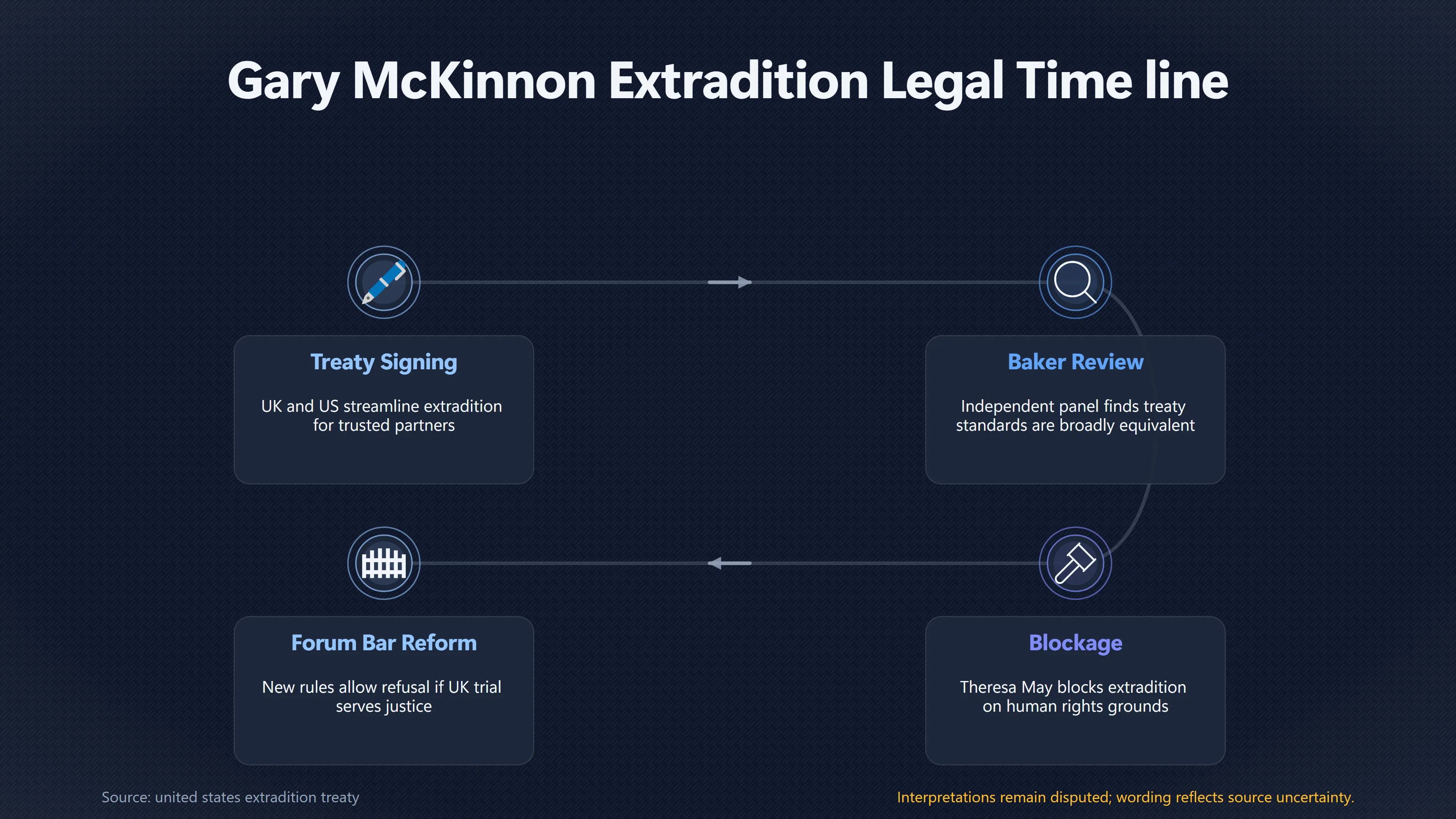
The claim that the treaty was “one-sided” rested on a simple comparison. Under the previous 1972 arrangements, both countries generally had to provide a prima facie case—evidence capable of supporting a prosecution. The 2003 treaty removed that requirement for requests between the UK and the US as part of a broader effort to streamline extradition between trusted partners after the September 2001 terrorist attacks. Critics argued that Britain had given away an important safeguard without securing genuine reciprocity.[UK Parliament API]api.parliament.ukunited states extradition treatyUK Parliament APIUnited States: Extradition Treaty (Hansard, 26 June 2003)June 26, 2003…
McKinnon’s supporters therefore argued that he could be sent to the United States without an English court testing whether the American allegations were supported by sufficient evidence. Since he admitted unauthorised access but disputed aspects of the prosecution’s description of damage and losses, they believed an evidential hearing might have exposed weaknesses before he was removed from Britain.
Government ministers and later independent reviewers rejected the claim that the treaty itself created an unequal legal relationship. They argued that comparisons often confused different legal systems rather than different standards of proof.
Probable Cause and Reasonable Suspicion Compared
Much of the controversy centred on two legal expressions that sound quite different:
- Probable cause, the American constitutional standard generally required before a US judge issues an arrest warrant.
- Reasonable suspicion, the standard applied by UK courts when considering whether a requesting state has supplied enough information to justify arrest under the Extradition Act 2003.
Campaigners frequently interpreted “probable cause” as a substantially higher evidential threshold than “reasonable suspicion”. However, the Scott Baker Review concluded that both standards require an objective factual basis connecting the requested person to the alleged offence and that neither amounts to a trial of the prosecution evidence.[GOV.UK]GOV.UKIndependent review of the United Kingdom's extradition arrangements18, 2011…
The House of Lords Extradition Committee later examined the issue in detail. It noted that although the wording differs because each country operates within its own legal tradition, expert evidence consistently indicated that the practical thresholds are broadly comparable. The committee found little convincing evidence that the difference in terminology translated into systematically easier extradition requests for the United States.[UK Parliament]publications.parliament.ukUK Parliament House of LordsUK ParliamentHouse of Lords - Extradition: UK law and practice - Select Committee on Extradition Law…
Why Official Reviewers Called the Standards Equivalent
The independent review chaired by Sir Scott Baker was specifically asked whether the US–UK treaty was unbalanced. After reviewing case law, hearing evidence from practitioners and examining the operation of both legal systems, the panel concluded that it was not.
Its reasoning rested on several points:
- Both countries require judicial scrutiny before extradition can proceed.
- Neither country’s extradition hearing is intended to determine guilt or innocence.
- The differing evidential language reflects different domestic legal systems rather than an unequal bargain.
- Available case evidence did not demonstrate that British requests were disadvantaged by the American standard.[GOV.UK]GOV.UKIndependent review of the United Kingdom's extradition arrangements18, 2011…
The House of Lords committee revisited the controversy several years later. Although some witnesses preferred restoring a prima facie evidence requirement for all non-European requests, the committee did not conclude that the United States should be treated as a uniquely privileged partner. Instead, it observed that concerns about evidential standards extended to other countries designated under Part 2 of the Extradition Act.[UK Parliament]publications.parliament.ukUK Parliament House of LordsUK ParliamentHouse of Lords - Extradition: UK law and practice - Select Committee on Extradition Law…
When Theresa May announced in 2012 that McKinnon’s extradition would be blocked on human-rights grounds, she also accepted the Baker Review’s assessment that the treaty itself was broadly sound and stated that there was no significant practical difference between probable cause and reasonable suspicion.[GOV.UK]GOV.UKGary Mc Kinnon extradition case: Home Secretary's statementGary McKinnon extradition case: Home Secretary's statement - GOV.UKOctober 16, 2012…
Why Critics Focused on the Missing Evidence Hearing
The strongest criticism was not necessarily that the treaty imposed a lower legal threshold, but that British courts could not examine whether the prosecution’s evidence was persuasive before extradition.
This distinction became central to public debate. Opponents argued that:
- British judges were largely prevented from assessing the strength of the American case.
- Defendants could be sent abroad before testing disputed allegations.
- The absence of an evidential hearing gave requesting authorities considerable leverage, particularly where defendants faced lengthy foreign proceedings or strong incentives to negotiate guilty pleas.
For campaigners, this procedural limitation mattered more than technical arguments about probable cause versus reasonable suspicion. They believed that someone in McKinnon’s position should have been able to challenge the substance of the accusations in a British court before being removed to another jurisdiction.[UK Parliament]publications.parliament.ukUK Parliament House of LordsUK ParliamentHouse of Lords - Extradition: UK law and practice - Select Committee on Extradition Law…
Supporters of the existing system responded that extradition hearings have never been intended to become miniature criminal trials. In their view, deciding whether evidence ultimately proves guilt is the responsibility of the trial court in the requesting state, not the extradition court.
The Broader Legacy of the Debate
Although official reviews rejected the claim that the treaty’s evidential standards were legally unequal, McKinnon’s case exposed a different concern: how decisions should be made when alleged conduct occurred largely in Britain but produced effects overseas.
That debate contributed to later reforms, including the introduction of a strengthened forum bar, allowing courts in some circumstances to refuse extradition where prosecution in the United Kingdom would better serve the interests of justice. Subsequent cases, including that of Lauri Love, demonstrated that attention increasingly shifted away from the wording of the treaty itself and towards where cross-border cybercrime should properly be tried.[Financial Times]ft.comFinancial Times Mike Lynch acquittal turns spotlight on UK-US extradition dealHis case has brought renewed attention to the fairness of the US-UK extradition treaty established in 2003, which critics argue is biased…
In retrospect, McKinnon’s case did not produce a consensus that the US–UK treaty contained an inherently unequal evidential standard. Instead, it highlighted a more nuanced distinction between formal legal thresholds, which official reviewers regarded as broadly equivalent, and procedural safeguards, particularly the absence of a hearing to test the prosecution’s evidence before extradition. That procedural difference remained the aspect most critics regarded as unfair, even after repeated official reviews concluded that the treaty’s wording did not itself favour the United States.
Amazon book picks
Further Reading
Books and field guides related to Was the Extradition Treaty Stacked Against Mc Kinnon?. Use these as the next step if you want deeper reading beyond the article.
The Rule of Law
'A gem of a book ... Inspiring and timely. Everyone should read it' Independent 'The Rule of Law' is a phrase much used but little examin...
The Hacker and the State
Rating: 5.0/5 from 18 Google Books ratings
“A must-read...It reveals important truths.” —Vint Cerf, Internet pioneer “One of the finest books on information security published so f...
Extradition Law: A Practitioner's Guide
First published 2013. Subjects: Law, great britain.
'Transnational Criminal Law'?
International criminal law is currently subdivided into international criminal law stricto sensu - the so-called core crimes - and crimes...
eBay marketplace picks
Marketplace Samples
Live-tested eBay searches with available results related to this page.
Selected fromcivil liberties poster oneBay.co.uk.




Endnotes
1.
Source: api.parliament.uk
Title: united states extradition treaty
Link:https://api.parliament.uk/historic-hansard/lords/2003/jun/26/united-states-extradition-treaty
Source snippet
UK Parliament APIUnited States: Extradition Treaty (Hansard, 26 June 2003)June 26, 2003...
Published: June 26, 2003
2.
Source: publications.parliament.uk
Title: UK Parliament House of Lords
Link:https://publications.parliament.uk/pa/ld201415/ldselect/ldextradition/126/12614.htm
Source snippet
UK ParliamentHouse of Lords - Extradition: UK law and practice - Select Committee on Extradition Law...
3.
Source: GOV.UK
Title: Independent review of the United Kingdom’s extradition arrangements
Link:https://www.gov.uk/government/publications/independent-review-of-the-united-kingdoms-extradition-arrangements
Source snippet
18, 2011...
4.
Source: publications.parliament.uk
Title: UK Parliament House of Lords
Link:https://publications.parliament.uk/pa/ld201415/ldselect/ldextradition/126/12604.htm
Source snippet
UK ParliamentHouse of Lords - Extradition: UK law and practice - Select Committee on Extradition Law...
5.
Source: committees.parliament.uk
Link:https://committees.parliament.uk/writtenevidence/53098/html/
Source snippet
UK Parliament CommitteesEXL0043 - Evidence on Extradition Law...
6.
Source: publications.parliament.uk
Title: UK Parliament House of Lords
Link:https://publications.parliament.uk/pa/ld201415/ldselect/ldextradition/126/12613.htm
Source snippet
UK ParliamentHouse of Lords - Extradition: UK law and practice - Select Committee on Extradition Law...
7.
Source: GOV.UK
Title: Gary Mc Kinnon extradition case: Home Secretary’s statement
Link:https://www.gov.uk/government/speeches/gary-mckinnon-extradition-case-home-secretarys-statement
Source snippet
Gary McKinnon extradition case: Home Secretary's statement - GOV.UKOctober 16, 2012...
Published: October 16, 2012
8.
Source: ft.com
Title: Financial Times Mike Lynch acquittal turns spotlight on UK-US extradition deal
Link:https://www.ft.com/content/e82ce830-9b05-404d-b14a-d5138c341880
Source snippet
His case has brought renewed attention to the fairness of the US-UK extradition treaty established in 2003, which critics argue is biased...
9.
Source: hansard.parliament.uk
Link:https://hansard.parliament.uk/lords/2022-06-29/debates/C27ABB95-F2BC-4421-AC41-1339F9BD1C66/ExtraditionAct2003
Source snippet
Act 2003 - Hansard - UK ParliamentJune 29, 2022 — HANSARD Question 3.17pm Asked by Lord Moylan To ask Her Majesty’s Government what plans...
Published: June 29, 2022
10.
Source: publications.parliament.uk
Title: uk House of Lords
Link:https://publications.parliament.uk/pa/ld201415/ldselect/ldextradition/126/12602.htm
11.
Source: committees.parliament.uk
Link:https://committees.parliament.uk/writtenevidence/53090/html/
12.
Source: committees.parliament.uk
Link:https://committees.parliament.uk/writtenevidence/53107/html/
13.
Source: GOV.UK
Title: www.gov.uk Extradition: processes and review
Link:https://www.gov.uk/guidance/extradition-processes-and-review
14.
Source: publications.parliament.uk
Title: uk House of Commons
Link:https://publications.parliament.uk/pa/cm201012/cmselect/cmhaff/644/64403.htm
15.
Source: publications.parliament.uk
Title: uk House of Commons
Link:https://publications.parliament.uk/pa/cm201012/cmselect/cmhaff/644/64402.htm
16.
Source: publications.parliament.uk
Title: uk House of Commons
Link:https://publications.parliament.uk/pa/cm201012/cmselect/cmhaff/644/644we05.htm
17.
Source: GOV.UK
Title: www.gov.uk Extradition review
Link:https://www.gov.uk/government/speeches/extradition-review
18.
Source: GOV.UK
Title: www.gov.uk Extradition review published
Link:https://www.gov.uk/government/news/extradition-review-published
19.
Source: GOV.UK
Title: www.gov.uk Sir Scott Baker will lead review of extradition
Link:https://www.gov.uk/government/news/sir-scott-baker-will-lead-review-of-extradition
20.
Source: hansard.parliament.uk
Title: uk U S-UK Extradition Treaty
Link:https://hansard.parliament.uk/commons/2009-07-15/debates/09071559000001/US-UKExtraditionTreaty
21.
Source: hansard.parliament.uk
Title: uk Extradition: UK and USA
Link:https://hansard.parliament.uk/Lords/2005-06-15/debates/8ce37043-535d-4f15-9c9c-ccceecc417b5/ExtraditionUKAndUSA
22.
Source: hansard.parliament.uk
Title: uk Extradition To Us
Link:https://hansard.parliament.uk/lords/2004-12-06/debates/28d989de-5ef0-4a0f-80f2-fea17895da30/ExtraditionToUs
23.
Source: committees.parliament.uk
Link:https://committees.parliament.uk/writtenevidence/52334/html/
Additional References
24.
Source: youtube.com
Title: PM Discusses The Fate Of Hacker Gary Mc Kinnon
Link:https://www.youtube.com/watch?v=WChPMnpJnco
Source snippet
This report on UK hacker's extradition to US blocked is directly relevant because it details the Home Office decision regarding Gary McKi...
25.
Source: youtube.com
Title: UK hacker’s extradition to US blocked
Link:https://www.youtube.com/watch?v=v4Js8DF80HY
Source snippet
Gary McKinnon ruling: 'UK Extradition laws are a disgrace'...
26.
Source: youtube.com
Title: UK hacker to learn extradition fate
Link:https://www.youtube.com/watch?v=LEvGU1b4ysw
Source snippet
PM Discusses The Fate Of Hacker Gary McKinnon...
27.
Source: youtube.com
Title: Gary Mc Kinnon ruling: ‘UK Extradition laws are a disgrace’
Link:https://www.youtube.com/watch?v=e4_b8qR4_5E
Source snippet
Gary McKinnon wins extradition battle...
28.
Source: youtube.com
Title: Gary Mc Kinnon wins extradition battle
Link:https://www.youtube.com/watch?v=y4lecD44F5E
Source snippet
UK hacker to learn extradition fate...