Within Media Narrative
Was Mc Kinnon a Threat or a Truth Seeker?
Binary headlines simplified a complex computer-misuse case into a choice between national-security menace and heroic outsider.
On this page
- How the binary frame emerged
- Why extreme labels attract attention
- What the framing left out
Page outline Jump by section
Introduction
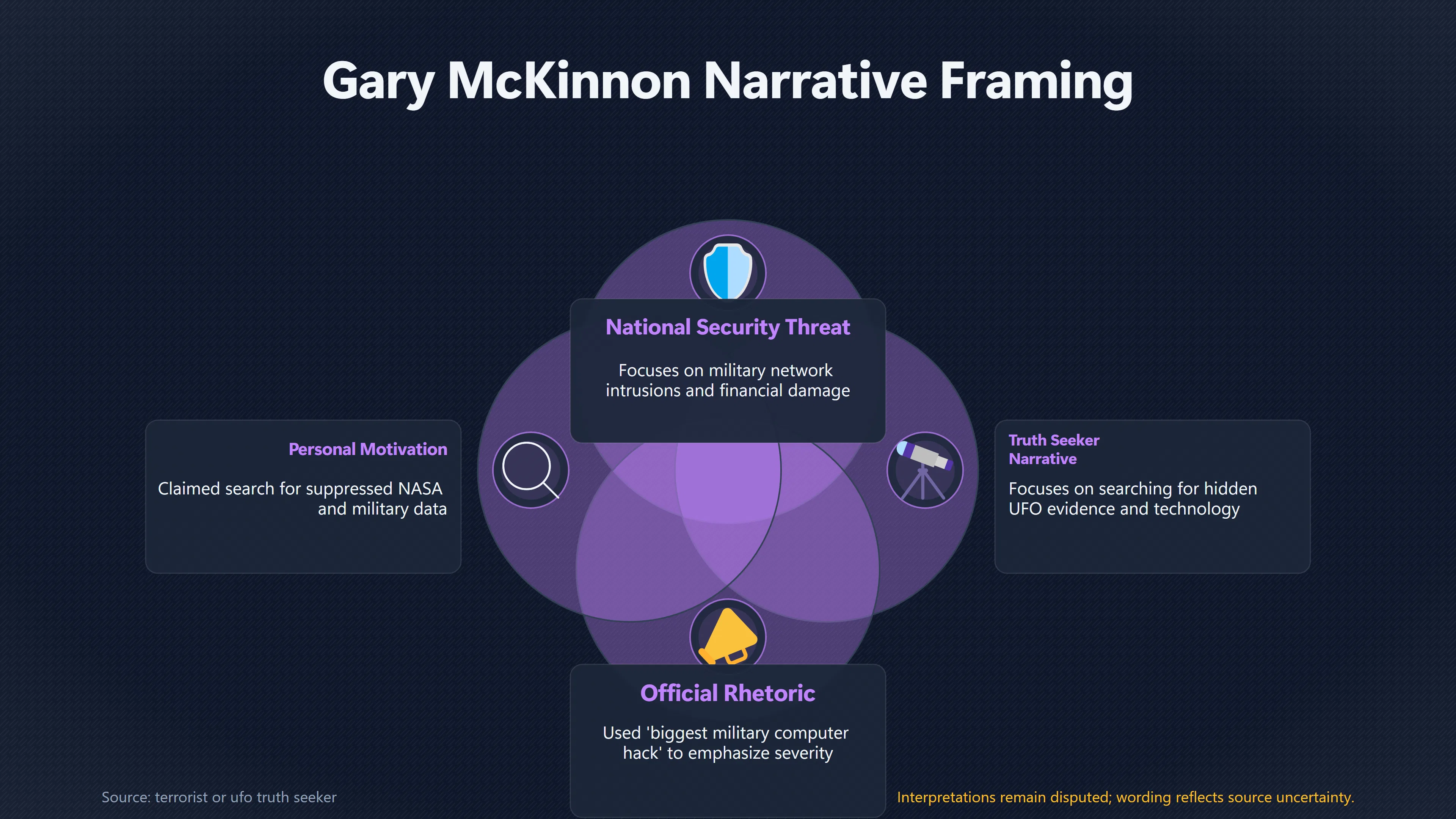
Gary McKinnon’s story was often presented as a choice between two dramatic identities: a dangerous attacker who threatened United States national security or an eccentric truth seeker searching for evidence of UFO secrecy. That binary made an unusually complex computer-crime and extradition case easy to understand at a glance, but it also distorted the underlying issues. The legal case concerned unauthorised access to government computer systems, while McKinnon’s public explanation centred on his search for evidence of hidden aerospace and UFO programmes. Headlines frequently elevated one side of that tension while minimising the other, encouraging readers to adopt a simplified moral narrative rather than examine the technical, legal and evidential details.[WIRED]wired.comterrorist or ufo truth seekerTerrorist or UFO Truth Seeker? | WIREDApril 28, 2006…
How the binary frame emerged
The “terrorist or truth seeker” framing did not appear by accident. It grew from two competing narratives that were both unusually easy for journalists to communicate.
On one side stood US prosecutors. Their public statements stressed the seriousness of the alleged intrusions, the number of affected military systems, estimated financial damage and the description of McKinnon as responsible for “the biggest military computer hack of all time”. Coming soon after the attacks of 11 September 2001, this language naturally encouraged many readers to associate computer intrusion with national security threats, even though McKinnon was never charged with terrorism.[WIRED]wired.comterrorist or ufo truth seekerTerrorist or UFO Truth Seeker? | WIREDApril 28, 2006…
On the other side was McKinnon’s own explanation. Rather than denying that he had accessed government systems, he consistently argued that his purpose was to investigate claims of UFO cover-ups, suppressed technology and alleged evidence hidden within NASA and military networks. This account immediately distinguished him from conventional cybercrime defendants because it provided a dramatic personal motive rather than one based on money, espionage or sabotage.[WIRED]wired.comufo hacker tells what he foundWIRED'UFO Hacker' Tells What He Found | WIREDJune 21, 2006…
The result was an unusually polarised media narrative. Instead of presenting a technically complex computer misuse prosecution, many reports reduced the story to a clash between official authority and an unconventional individual pursuing hidden knowledge.
Why extreme labels attract attention
Headline writers are rewarded for producing narratives that readers can understand instantly. McKinnon’s case naturally lent itself to two memorable archetypes.
The national-security threat. Referring to military networks, NASA computers and the post-9/11 security environment conveyed high stakes without requiring lengthy technical explanation. Readers did not need to understand password vulnerabilities or network administration to recognise a threat to defence systems.[WIRED]wired.comterrorist or ufo truth seekerTerrorist or UFO Truth Seeker? | WIREDApril 28, 2006…
The outsider searching for forbidden truths. UFOs already occupy a well-established place in popular culture. Once McKinnon explained that he was searching for evidence of extraterrestrial technology, the case acquired elements of conspiracy, mystery and government secrecy that generated wider public interest than an ordinary hacking prosecution.[WIRED]wired.comufo hacker tells what he foundWIRED'UFO Hacker' Tells What He Found | WIREDJune 21, 2006…
These opposing identities also appealed to different audiences:
- Security-focused reporting highlighted risk, military vulnerability and cybercrime.
- Technology publications often explored both the legal allegations and McKinnon’s own account.
- UFO-oriented coverage frequently concentrated on what he claimed to have seen rather than the criminal charges.
- British campaign reporting increasingly focused on proportionality, extradition and McKinnon’s personal circumstances rather than the original network intrusions.[wired.com]wired.comterrorist or ufo truth seekerTerrorist or UFO Truth Seeker? | WIREDApril 28, 2006…
The binary therefore reflected both journalistic storytelling and audience expectations rather than a careful summary of the evidence.
What the framing left out
The most significant consequence of the binary was not that either description was entirely false, but that each excluded important context.
The “terrorist” frame obscured the fact that McKinnon was prosecuted under computer misuse laws rather than terrorism legislation. Although some reports suggested he was effectively being treated as a cyber-terrorist because of official rhetoric or campaign claims, the indictments themselves concerned unauthorised access and computer damage, not terrorist offences.[WIRED]wired.comBritish Hacker Gary Mc Kinnon Cries Guantánamo Too Much | WIREDBritish Hacker Gary McKinnon Cries Guantánamo Too Much | WIRED…
Conversely, the “truth seeker” frame often blurred the distinction between McKinnon’s motivations and the evidence supporting his UFO claims. He publicly described seeing what he believed were unusual images and references such as a spreadsheet headed “Non-Terrestrial Officers”, but these claims were not independently verified through court proceedings or released government documentation. They therefore remained assertions rather than established findings.[WIRED]wired.comufo hacker tells what he foundWIRED'UFO Hacker' Tells What He Found | WIREDJune 21, 2006…
The simplified framing also pushed several important questions into the background:
- Whether weak password security contributed significantly to the intrusions.
- How alleged financial damage was calculated.
- Whether extradition was proportionate.
- How McKinnon’s later autism diagnosis affected public understanding of the case.
- The difference between a defendant’s motive and proof that the underlying beliefs were correct.
These issues were often more legally significant than the dramatic identities dominating headlines.
The power of a false choice
Presenting McKinnon as either a villain or a heroic whistle-blower implied that readers had to choose between mutually exclusive interpretations.
In reality, several propositions can be true simultaneously:
- McKinnon admitted gaining unauthorised access to government computers.
- His stated motivation centred on searching for UFO-related material rather than financial gain.
- US authorities viewed the intrusions as serious computer crimes.
- His personal motives do not by themselves establish that his UFO-related claims were accurate.
- Questions about extradition and sentencing are separate from questions about guilt or about alleged government secrecy.[WIRED]wired.comterrorist or ufo truth seekerTerrorist or UFO Truth Seeker? | WIREDApril 28, 2006…
Reducing the story to two opposing identities encouraged readers to collapse these separate issues into a single judgement about McKinnon’s character.

Why the headline binary endured
The “terrorist or truth seeker” formula has proved remarkably durable because it provides an emotionally satisfying narrative while requiring little specialist knowledge. It compresses cybersecurity, military secrecy, UFO culture, criminal law and international extradition into a familiar conflict between powerful institutions and a lone individual.
That simplicity came at a cost. Readers were more likely to remember the competing labels than the underlying legal distinctions or the limited evidential basis for many of the extraordinary claims associated with the case. As a result, McKinnon’s place in popular culture became defined less by the details of the prosecution than by a headline-friendly contest between two exaggerated identities, neither of which fully captured the complexity of the events.[WIRED]wired.comterrorist or ufo truth seekerTerrorist or UFO Truth Seeker? | WIREDApril 28, 2006…
Amazon book picks
Further Reading
Books and field guides related to Was Mc Kinnon a Threat or a Truth Seeker?. Use these as the next step if you want deeper reading beyond the article.
Saving Gary McKinnon: A Mother's Story
The ordinary lives of Gary McKinnon and his mother Janis changed dramatically one morning in 2002 when police interviewed Gary about hack...
The Hacker Crackdown: Law and Disorder on the Electronic Fron...
The bestselling cyberpunk author "has produced by far the most stylish report from the computer outlaw culture since Steven Levy's Hacker...
Ghost in the Wires: My Adventures as the World's Most Wanted...
In this "intriguing, insightful and extremely educational" novel, the world's most famous hacker teaches you easy cloaking and counter-me...
Them: Adventures with Extremists
A wide variety of extremist groups -- Islamic fundamentalists, neo-Nazis -- share the oddly similar belief that a tiny shadowy elite rule...
eBay marketplace picks
Marketplace Samples
Live-tested eBay searches with available results related to this page.
Selected fromalien wall art oneBay.co.uk.



Endnotes
1.
Source: wired.com
Title: terrorist or ufo truth seeker
Link:https://www.wired.com/2006/04/terrorist-or-ufo-truth-seeker/
Source snippet
Terrorist or UFO Truth Seeker? | WIREDApril 28, 2006...
Published: April 28, 2006
2.
Source: wired.com
Title: ufo hacker tells what he found
Link:https://www.wired.com/2006/06/ufo-hacker-tells-what-he-found/
Source snippet
WIRED'UFO Hacker' Tells What He Found | WIREDJune 21, 2006...
Published: June 21, 2006
3.
Source: wired.com
Title: British Hacker Gary Mc Kinnon Cries Guantánamo Too Much | WIRED
Link:https://www.wired.com/2007/04/british-hacker-/
Source snippet
British Hacker Gary McKinnon Cries Guantánamo Too Much | WIRED...
4.
Source: wired.com
Title: british ufo hac
Link:https://www.wired.com/2008/07/british-ufo-hac/
Source snippet
ker Gary McKinnon Is Coming to America | WIREDJuly 30, 2008 — Kevin Poulsen Security Jul 30, 2008 12:33 PM BRITISH UFO HACKER GARY MCKINN...
Published: July 30, 2008
5.
Source: theguardian.com
Title: The Guardian The humble superhacker | UK news | The Guardian
Link:https://www.theguardian.com/uk/2006/may/10/usa.september11
6.
Source: spectrum.ieee.org
Title: freeing gary mckinnon
Link:https://spectrum.ieee.org/freeing-gary-mckinnon
Source snippet
Gary McKinnon - IEEE SpectrumApril 30, 2010 — Freeing Gary McKinnon FREEING GARY MCKINNON HACKERS, ASPERGER SYNDROME, AND EXTRADITION 3 m...
Published: April 30, 2010
7.
Source: theguardian.com
Title: Profile: Gary Mc Kinnon | Gary Mc Kinnon | The Guardian
Link:https://www.theguardian.com/technology/2009/jul/31/gary-mckinnon-hacking-extradition
Source snippet
Profile: Gary McKinnon | Gary McKinnon | The GuardianJuly 31, 2009 — Gary McKinnon This article is more than 16 years old Profile PROFILE...
Published: July 31, 2009
8.
Source: theguardian.com
Title: British hacker faces extradition to US | US news | The Guardian
Link:https://www.theguardian.com/technology/2006/may/10/news.usnews
9.
Source: abcnews.go.com
Link:https://abcnews.go.com/International/story?id=1945581&page=1
Additional References
10.
Source: blogs.nature.com
Title: will the hacker fry
Link:https://blogs.nature.com/blog/will_the_hacker_fry/
Source snippet
nature.comUFO-obsessed hacker loses extradition battle | nature.com blogsJuly 31, 2008 — UFO-OBSESSED HACKER LOSES EXTRADITION BATTLE Pos...
Published: July 31, 2008
11.
Source: aljazeera.com
Title: Image Prosecutors say 97 government syste
Link:https://www.aljazeera.com/news/2006/7/6/uk-to-extradite-alleged-hacker-to-us
Source snippet
UK to extradite alleged hacker to US | News | Al JazeeraJuly 6, 2006 — UK TO EXTRADITE ALLEGED HACKER TO US Britain has agreed to extradi...
Published: July 6, 2006
12.
Source: youtube.com
Title: The Interview They Tried to Erase From the Internet
Link:https://www.youtube.com/watch?v=WvILY-h-6_Y
Source snippet
This video explores how media and government portrayals framed Gary McKinnon either as a severe threat to national security or as an obse...
13.
Source: nature.com
Title: UF O mind-melting in government report: Nature News
Link:https://www.nature.com/news/2006/060508/full/news060508-6.html
14.
Source: youtube.com
Title: Gary Mc Kinnon Wins Extradition Battle
Link:https://www.youtube.com/watch?v=y4lecD44F5E
Source snippet
The Interview They Tried to Erase From the Internet...
15.
Source: youtube.com
Title: The Man Who Hacked the U.S. Government
Link:https://www.youtube.com/watch?v=ND0zQX1rGdg
Source snippet
UK Hacker's Extradition to US Blocked...
16.
Source: youtube.com
Title: UK Hacker’s Extradition to US Blocked
Link:https://www.youtube.com/watch?v=v4Js8DF80HY
Source snippet
Ancient Aliens: Hacking NASA Secrets...
17.
Source: youtube.com
Title: Ancient Aliens: Hacking NASA Secrets
Link:https://www.youtube.com/watch?v=20rWFDfh68Y
Source snippet
Gary McKinnon Wins Extradition Battle...