Within Circular Claims
What Later Stories Left Out of Mc Kinnon's Claims
Each shortened retelling tended to preserve the extraordinary claim while dropping his uncertainty about games, context and interpretation.
On this page
- The qualifications in Mc Kinnon's original wording
- How summaries converted uncertainty into certainty
- Why missing context changes the apparent claim
Page outline Jump by section
Introduction
Later retellings of Gary McKinnon’s UFO-related claims often became more dramatic not because new evidence emerged, but because his original qualifications were gradually stripped away. In his earliest detailed interviews, McKinnon repeatedly distinguished between what he believed he had seen and what he could actually prove. He acknowledged uncertainty about the meaning of files, accepted that some material might have an ordinary explanation, and admitted that he could not preserve the most important alleged evidence before his connection was terminated. As the story circulated through articles, documentaries, podcasts, blogs and social media, those caveats were frequently omitted while the headline claims remained. The result was a narrative that appeared increasingly certain even though its evidential basis had not changed.[WIRED]wired.comufo hacker tells what he foundWIRED'UFO Hacker' Tells What He Found | WIREDJune 21, 2006…
The qualifications in McKinnon’s original wording
The most revealing part of McKinnon’s 2006 Wired interview is not the description of an alleged spacecraft image or the spreadsheet headed “Non-Terrestrial Officers”. It is the interviewer’s follow-up question asking whether the spreadsheet could have been part of a military strategy game or hypothetical exercise.
McKinnon did not reject that possibility outright. Instead, he replied:
“What I found could be a game – it’s hard to know for certain.”
That sentence is one of the clearest examples of him acknowledging uncertainty. It shows that, despite his personal belief that governments concealed advanced technology, he recognised that his interpretation of what he saw was not the only possible explanation.[WIRED]wired.comufo hacker tells what he foundWIRED'UFO Hacker' Tells What He Found | WIREDJune 21, 2006…
The same interview contains several other important qualifications:
- He described the alleged NASA image as something that “didn’t look manmade” to him rather than claiming it was definitively extraterrestrial.
- He explained that the image was viewed remotely over a slow dial-up connection before he was disconnected.
- He stated that he never obtained a copy of the image.
- He acknowledged uncertainty about the spreadsheet’s meaning rather than claiming it conclusively documented a secret space fleet.[WIRED]wired.comufo hacker tells what he foundWIRED'UFO Hacker' Tells What He Found | WIREDJune 21, 2006…
These distinctions matter because they separate observation from interpretation. McKinnon consistently presented his conclusions as inferences drawn from what he believed he had seen, not as independently verifiable facts.
How summaries converted uncertainty into certainty
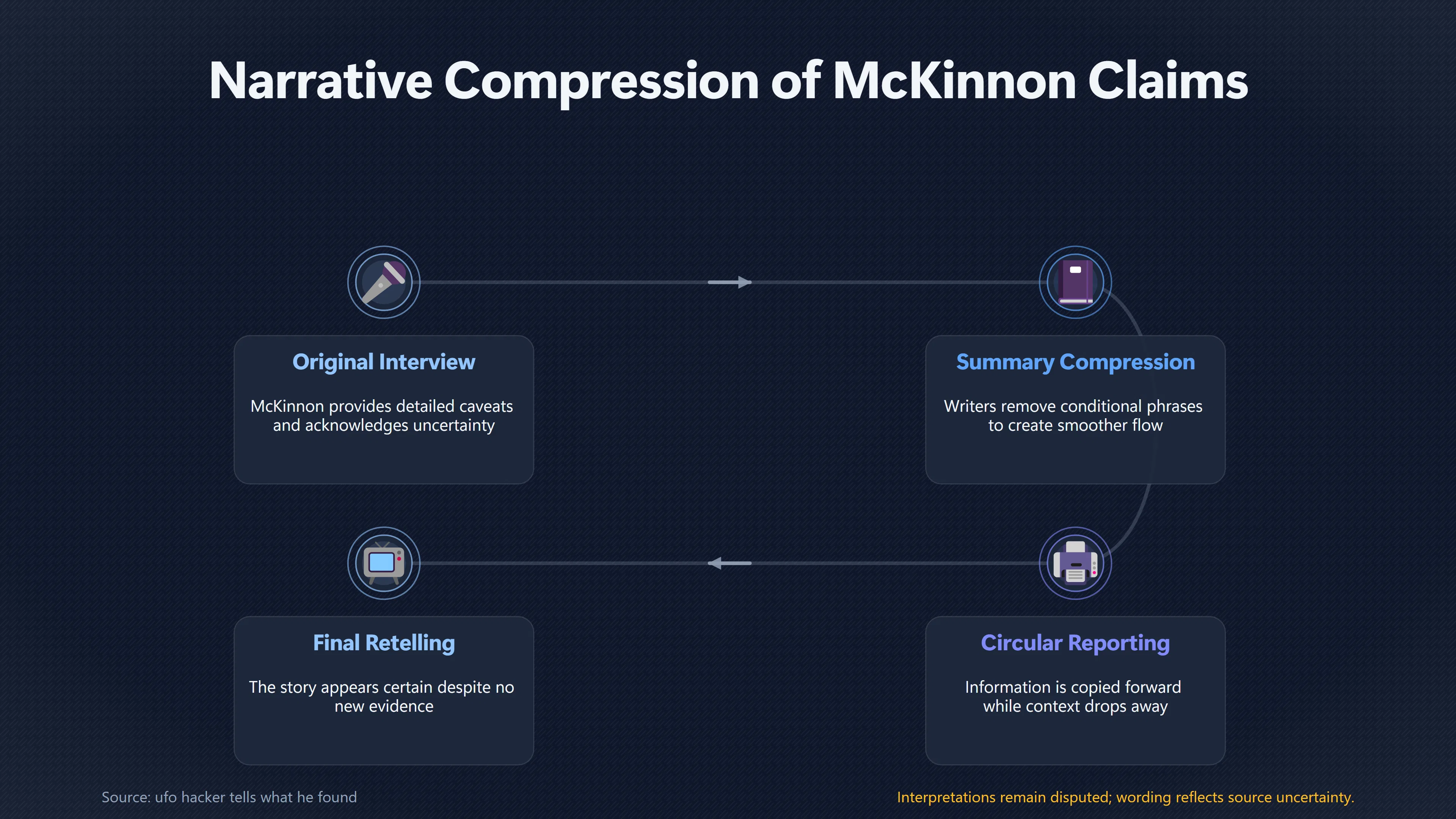
As the story spread, many shorter accounts naturally compressed the narrative. Compression alone is not unusual, but in McKinnon’s case it often removed precisely the sentences expressing doubt while preserving the extraordinary conclusions.
A typical progression looked like this:
Original interviewLater condensed retelling”Could be a game—it’s hard to know for certain.”Spreadsheet of “Non-Terrestrial Officers” described as evidence of a secret space programme.Object “didn’t look manmade”.McKinnon “found a UFO”.Image could not be downloaded or preserved.NASA image treated as though it had been documented.Personal interpretation.Apparent factual description.
Each individual change is subtle. Together they transform the tone of the story from tentative recollection into apparent certainty.
The IEEE Spectrum profile, for example, recounts McKinnon’s claims about the alleged spacecraft image and the “nonterrestrial officers” list but, like many retrospective profiles, necessarily relies on his own recollections because no independent copy of the files has ever entered the public record. The profile therefore documents what McKinnon said rather than independently verifying the underlying material.[IEEE Spectrum]spectrum.ieee.orgSpectrum Gary Mc Kinnon: The Autistic HackerIEEE SpectrumGary McKinnon: The Autistic Hacker - IEEE Spectrum…
Why caveats disappear during retelling
Several well-understood features of information transmission help explain why qualifications tend to vanish.
Extraordinary claims make better headlines
Headlines reward memorable statements.
“British hacker claims to have found evidence of secret space fleet” attracts more attention than “British hacker says files may have another explanation.”
Because headlines are necessarily brief, uncertainty is often the first casualty.
Narrative simplification
Most later writers were not analysing the reliability of McKinnon’s testimony. They were summarising a colourful story.
Removing conditional phrases creates a smoother narrative:
- search for UFO evidence;
- hacker enters NASA systems;[youtube.com]youtube.comHacking for UFOs and Fighting for His Life: Who Is Gary Mc Kinnon?The Most Dangerous File the Hacker Found on NASA Servers…
- discovers secret files;
- government reacts.
That sequence is easier to tell than repeatedly distinguishing between observation, interpretation and speculation.
Repetition without returning to the primary source
Many articles relied on earlier summaries instead of revisiting the complete Wired interview.
Each generation of reporting inherited what the previous generation chose to emphasise. If one intermediary omitted the sentence acknowledging uncertainty, later summaries based on that intermediary were likely to omit it as well. This is a classic mechanism in circular reporting: information is copied forward while contextual detail gradually drops away.[WIRED]wired.comufo hacker tells what he foundWIRED'UFO Hacker' Tells What He Found | WIREDJune 21, 2006…
Why missing context changes the apparent claim
The disappearance of caveats changes how readers assess the evidence.
Consider two versions of essentially the same statement:
- “I saw a spreadsheet that I interpreted as significant, although it could have been part of a game.”
- “I found a spreadsheet proving a secret space programme.”
Only the second sounds like direct evidence.
Yet the underlying observation has not changed. What changed is the removal of uncertainty.
The same applies to the alleged spacecraft image. McKinnon consistently explained that he viewed it briefly over a remote connection, could not download it, and lost access before preserving it. Without those details, readers may incorrectly assume that a photograph exists somewhere awaiting release, when no authenticated public copy has ever been produced.[WIRED]wired.comufo hacker tells what he foundWIRED'UFO Hacker' Tells What He Found | WIREDJune 21, 2006…
The effect on circular reporting
Once caveats disappear, circular reporting becomes more persuasive.
Later authors may cite:
- previous news reports;
- documentaries;
- podcasts;
- blogs;
- social-media discussions.
To a casual reader, the large number of sources can resemble independent confirmation. In reality, they often repeat the same original interview while omitting the parts where McKinnon himself expressed uncertainty.
This creates an illusion of strengthening evidence. The number of retellings increases, but the number of independent witnesses, authenticated documents and publicly examinable files does not.
The distinction is important because the undisputed facts—that McKinnon hacked into US government systems and later described unusual material—are separate from the disputed question of whether his interpretation was correct. The caveats preserved that distinction; their disappearance blurred it.[WIRED]wired.comufo hacker tells what he foundWIRED'UFO Hacker' Tells What He Found | WIREDJune 21, 2006…
Reading later accounts critically
The safest way to evaluate later versions of McKinnon’s story is to compare them against his earliest recorded interviews.
Useful questions include:
- Does the account distinguish between what McKinnon said he observed and what he concluded?
- Does it mention that he acknowledged alternative explanations?
- Does it explain that the alleged image was never publicly preserved?
- Does it identify whether claims originate from McKinnon’s testimony or from independent evidence?
Retellings that retain these distinctions more accurately represent the evidential status of the case. Those that remove them may unintentionally convert a qualified personal recollection into something that appears far more definitive than McKinnon himself originally claimed.[WIRED]wired.comufo hacker tells what he foundWIRED'UFO Hacker' Tells What He Found | WIREDJune 21, 2006…
Amazon book picks
Further Reading
Books and field guides related to What Later Stories Left Out of Mc Kinnon's Claims. Use these as the next step if you want deeper reading beyond the article.
Calling Bullshit
Bullshit isn’t what it used to be. Now, two science professors give us the tools to dismantle misinformation and think clearly in a world...
The Demon-Haunted World
NEW YORK TIMES BESTSELLER • From the renowned astronomer and author of Cosmos comes a “powerful [and] stirring defense of informed ration...
The Skeptics' Guide to the Universe
An all-encompassing guide to skeptical thinking from podcast host and academic neurologist at Yale University School of Medicine Steven N...
Mistakes Were Made (but Not by Me)
Why is it so hard to say "I made a mistake"-and really believe it? When we make mistakes, cling to outdated attitudes, or mistreat other...
eBay marketplace picks
Marketplace Samples
Live-tested eBay searches with available results related to this page.
Selected fromUFO poster oneBay.co.uk.
Current eBay listing
I Want To Believe UFO Poster Giclée Fine Art Heavyweight Print


Current eBay listing
VINTAGE UFO FLYING SAUCERS COMIC ADVERTISING A2 POSTER PRINT

Endnotes
1.
Source: wired.com
Title: ufo hacker tells what he found
Link:https://www.wired.com/2006/06/ufo-hacker-tells-what-he-found/
Source snippet
WIRED'UFO Hacker' Tells What He Found | WIREDJune 21, 2006...
Published: June 21, 2006
2.
Source: spectrum.ieee.org
Title: Spectrum Gary Mc Kinnon: The Autistic Hacker
Link:https://spectrum.ieee.org/the-autistic-hacker
Source snippet
IEEE SpectrumGary McKinnon: The Autistic Hacker - IEEE Spectrum...
3.
Source: spectrum.ieee.org
Title: autistic hacker wont be extradited to us
Link:https://spectrum.ieee.org/autistic-hacker-wont-be-extradited-to-us
Source snippet
IEEE SpectrumOctober 16, 2012 — AUTISTIC HACKER WON'T BE EXTRADITED TO U.S. UK GOVERNMENT GIVES GARY MCKINNON A REPRIEVE ON [HUMAN RIGHTS]({{ 'human-rights/' | relative_url }})...
Published: October 16, 2012
4.
Source: wired.com
Title: uk hacker gary
Link:https://www.wired.com/2008/08/uk-hacker-gary/
5.
Source: wired.com
Title: terrorist or ufo truth seeker
Link:https://www.wired.com/2006/04/terrorist-or-ufo-truth-seeker/
6.
Source: wanttoknow.info
Title: * * * Wired,
Link:https://www.wanttoknow.info/a-ufo-hacker-tells-what-he-found
Source snippet
'UFO Hacker' Tells What He FoundFebruary 19, 2024 — 'UFO HACKER' TELLS WHAT HE FOUND Key Excerpts from Article on Website of Wired Image...
Published: February 19, 2024
7.
Source: theguardian.com
Title: Gary Mc Kinnon | Life and style | The Guardian
Link:https://www.theguardian.com/theobserver/2007/apr/22/features.magazine7
8.
Source: longform.org
Link:https://longform.org/archive/publications/ieee-spectrum
9.
Source: projectcamelot.org
Title: gary mckinnon
Link:https://projectcamelot.org/gary_mckinnon.html
Additional References
10.
Source: theguardian.com
Title: Photograph: Andrew Winning/Reuters Janis Sharp, Gary Mc Kinnon’s mother, celebr
Link:https://www.theguardian.com/world/2012/oct/16/gary-mckinnon-hacker-sparked-storm
Source snippet
Gary McKinnon: how unknown hacker sparked political and diplomatic storm | Gary McKinnon | The GuardianOctober 16, 2012 — Image: Janis Sh...
Published: October 16, 2012
11.
Source: forums.escapistmagazine.com
Title: the autistic hacker is he at fault.85431
Link:https://forums.escapistmagazine.com/threads/the-autistic-hacker-is-he-at-fault.85431/
Source snippet
The Escapist ForumsJune 30, 2011 — THE AUTISTIC HACKER: IS HE AT FAULT? * Thread starter shado_temple * Start date Jun 30, 2011 Recomme...
Published: June 30, 2011
12.
Source: uapedia.ai
Title: Gary Mc Kinnon: The Brit Who Hacked U.S
Link:https://www.uapedia.ai/wiki/gary-mckinnon-the-brit-who-hacked-u-s-secret-uap-programs
Source snippet
Secret UAP Programs - UAPediaMarch 15, 2026 — GARY MCKINNON: THE BRIT WHO HACKED U.S. SECRET UAP PROGRAMS Gary McKinnon is not a conventi...
Published: March 15, 2026
13.
Source: davidkushner.com
Title: The Autistic Hacker – David Kushner
Link:https://davidkushner.com/article/the-autistic-hacker/
Source snippet
July 15, 2011 — The Autistic Hacker Written by David Kushner, IEEE Spectrum Friday, July 15, 2011 Gary McKinnon hacked thousands of gover...
Published: July 15, 2011
14.
Source: youtube.com
Title: Hacking for UFOs and Fighting for His Life: Who Is Gary Mc Kinnon?
Link:https://www.youtube.com/watch?v=OImdnvQx7sQ
Source snippet
The Most Dangerous File the Hacker Found on NASA Servers...
15.
Source: ufohackers.org
Link:https://www.ufohackers.org/hackers
16.
Source: youtube.com
Title: Ancient Aliens: Hacking NASA Secrets
Link:https://www.youtube.com/watch?v=20rWFDfh68Y
Source snippet
Hacking for UFOs and Fighting for His Life: Who Is Gary McKinnon?...
17.
Source: theguardian.com
Title: The betrayal of Gary Mc Kinnon | Nadine Stavonina de Montagnac | The Guardian
Link:https://www.theguardian.com/commentisfree/2009/nov/27/gary-mckinnon-aspergers-autistic
18.
Source: theguardian.com
Title: British hacker faces extradition to US | US news | The Guardian
Link:https://www.theguardian.com/technology/2006/may/10/news.usnews
19.
Source: ufohackers.org
Link:https://www.ufohackers.org/hackers/gary-mckinnon/mckinnon-overview