Within Access vs Proof
Why Military Network Breaches Draw Such Strong Responses
Military systems attract aggressive enforcement because even limited access can expose vulnerabilities, disrupt operations and invite repeat attacks.
On this page
- Operational risks created by unauthorised access
- Why harmless intent cannot be assumed
- Deterrence and the protection of sensitive systems
Page outline Jump by section
Introduction
The strong official response to military network intrusions is best understood as a consequence of the risks created by unauthorised access rather than as evidence that an intruder discovered hidden information. This distinction is central to the Gary McKinnon case. McKinnon said he was searching for evidence relating to UFOs and advanced technology, but the legal and security response focused on his alleged access to United States defence and NASA systems, the disruption said to have resulted, and the potential consequences of compromising sensitive military networks.[Department of Justice]justice.govDepartment of JusticeLondon, England Hacker Indicted Under Computer Fraud and Abuse Act For Accessing Military Computers (November 12, 20…
In other words, the seriousness of the reaction reflects the nature of the systems involved. Defence organisations are expected to treat any successful intrusion as a possible threat to national security, regardless of whether the intruder claims to have been motivated by curiosity, political protest or a search for extraordinary evidence.
Operational risks created by unauthorised access
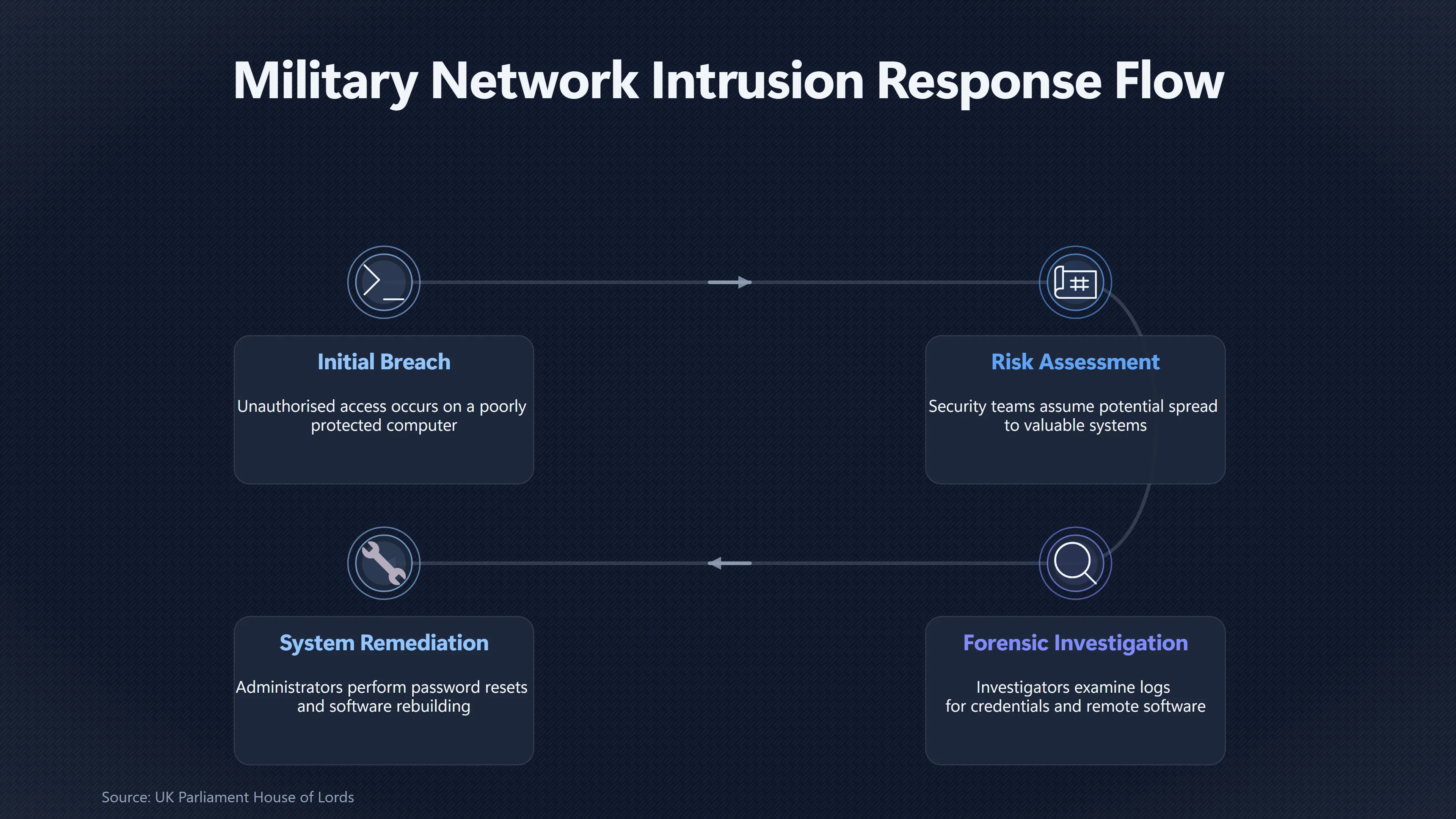
Military computer systems differ from ordinary government networks because they support activities where confidentiality, integrity and availability are directly linked to defence operations. Even if an intruder initially accesses only one poorly protected computer, security teams must assume that the compromise could spread to more valuable systems or expose weaknesses that others might exploit.
The operational risks include:
- Exposure of network architecture. User accounts, password files, system configurations and administrator tools can reveal how larger defence networks are organised.
- Loss of trust in system integrity. Once unauthorised access has occurred, administrators cannot immediately know whether files have merely been viewed or secretly altered.
- Potential operational disruption. Even accidental deletion of system files or user accounts can interrupt military communications, logistics or command functions.
- Future exploitation. Information gathered during one intrusion may enable later attacks by the same individual or by entirely different actors.
These concerns explain why defence organisations usually respond with forensic investigations, password resets, software rebuilding, monitoring for persistence mechanisms and broader security reviews. The response is driven by uncertainty as much as by confirmed damage.[UK Parliament]publications.parliament.ukUK Parliament House of LordsUK ParliamentHouse of Lords - Mckinnon V Government of The United States of America and Another…
Why harmless intent cannot be assumed
One of the most common misconceptions surrounding cases such as Gary McKinnon’s is that authorities should distinguish immediately between a curious individual and a hostile attacker. In practice, they cannot safely make that assumption.
An investigator examining network logs sees unauthorised access, elevated privileges, remote-control software or copied credentials—not the intruder’s personal motivations. Claims made after identification may or may not reflect the person’s genuine intentions, but they cannot safely guide the initial security response.
This is particularly important because the same techniques can be used by very different actors:
- independent enthusiasts;
- criminal groups seeking valuable information;
- foreign intelligence services conducting espionage;
- actors preparing later sabotage or disruption.
From a defensive perspective, the technical indicators often look similar during the early stages of an investigation. Treating one intrusion lightly because it appears unconventional would create opportunities for more dangerous attackers to exploit the same weaknesses.
For that reason, military cyber-defence doctrine generally treats every successful compromise of protected systems as potentially significant until investigators can establish otherwise.[arXiv]arxiv.orgOpen source on arxiv.org.
The McKinnon allegations as an illustration
The allegations against Gary McKinnon demonstrate why prosecutors and defence agencies regarded the case as serious independently of his UFO explanations.
According to the United States indictments and later judicial summaries, McKinnon allegedly obtained administrator privileges on numerous military and NASA computers, installed remote administration software, copied password files, deleted user accounts and critical operating system files, and moved between networks after gaining access. Prosecutors further alleged that disruption affected the Military District of Washington network and that systems associated with Naval Weapons Station Earle were compromised. McKinnon consistently maintained that his objective was to search for evidence relating to UFOs and suppressed technologies rather than to damage national security.[Department of Justice]justice.govDepartment of JusticeLondon, England Hacker Indicted Under Computer Fraud and Abuse Act For Accessing Military Computers (November 12, 20…
Whether or not an intruder believes their actions are benign does not eliminate the security consequences of:
- installing unauthorised remote-access software;
- copying authentication credentials;
- modifying system files;
- reducing confidence in the integrity of military systems.
These alleged activities explain why investigators concentrated on the conduct itself rather than on evaluating the truth of McKinnon’s beliefs about UFO-related material.
Deterrence and the protection of sensitive systems
Governments also pursue serious investigations and prosecutions because military cyber incidents have a deterrence function. If successful unauthorised access were treated leniently whenever an intruder claimed curiosity or unconventional motives, it would weaken the credibility of access controls protecting defence infrastructure.
Legal frameworks in both the United Kingdom and the United States therefore focus primarily on unauthorised access, impairment of systems and resulting harm. The purpose is to discourage attempts to compromise sensitive networks before they can produce more serious consequences. Modern UK guidance under the Computer Misuse Act similarly recognises that attacks affecting government networks or critical national infrastructure can justify substantially higher penalties because of the risks created, not merely because information was viewed.[Crown Prosecution Service]cps.gov.ukCrown Prosecution Service Computer Misuse Act | The Crown Prosecution ServiceCrown Prosecution ServiceComputer Misuse Act | The Crown Prosecution ServiceAugust 3, 2023…
This emphasis reflects a practical reality: cyber-defenders cannot know in advance whether an intrusion is the end of an incident or merely the first stage of a larger campaign.
What this means for UFO-related interpretations
Within discussions of UFO researchers and alleged government secrecy, it is important to separate two different questions.
The first is whether someone successfully entered protected military systems without authorisation. That question can be addressed through technical evidence, computer logs, forensic analysis and criminal investigation.
The second is whether those systems contained concealed evidence of extraterrestrial technology or other extraordinary material. That requires independently verifiable documentary or physical evidence about the contents themselves.
The severity of the official response to a military network breach supports the conclusion that defence organisations considered the intrusion a significant security matter. It does not, by itself, demonstrate that the systems contained hidden UFO information. The response is adequately explained by the operational risks associated with compromising military networks, regardless of the specific beliefs or motivations claimed by the individual responsible.[parliament.uk]publications.parliament.ukUK Parliament House of LordsUK ParliamentHouse of Lords - Mckinnon V Government of The United States of America and Another…
Amazon book picks
Further Reading
Books and field guides related to Why Military Network Breaches Draw Such Strong Responses. Use these as the next step if you want deeper reading beyond the article.
Sandworm
"With the nuance of a reporter and the pace of a thriller writer, Andy Greenberg gives us a glimpse of the cyberwars of the future while...
Countdown to Zero Day
Top cybersecurity journalist Kim Zetter tells the story behind the virus that sabotaged Iran’s nuclear efforts and shows how its existenc...
Cyber War
Rating: 3.0/5 from 96 Google Books ratings
An essential, eye-opening book about cyberterrorism, cyber war, and the next great threat to our national security. " Cyber War may be th...
Ghost in the Wires
In this "intriguing, insightful and extremely educational" novel, the world's most famous hacker teaches you easy cloaking and counter-me...
eBay marketplace picks
Marketplace Samples
Live-tested eBay searches with available results related to this page.
Selected fromnetwork security sign oneBay.co.uk.



Endnotes
1.
Source: justice.gov
Link:https://www.justice.gov/archive/criminal/cybercrime/press-releases/2002/mckinnonIndict.htm
Source snippet
Department of JusticeLondon, England Hacker Indicted Under Computer Fraud and Abuse Act For Accessing Military Computers (November 12, 20...
2.
Source: publications.parliament.uk
Title: UK Parliament House of Lords
Link:https://publications.parliament.uk/pa/ld200708/ldjudgmt/jd080730/mckinn-1.htm
Source snippet
UK ParliamentHouse of Lords - Mckinnon V Government of The United States of America and Another...
3.
Source: arxiv.org
Link:https://arxiv.org/abs/2104.11906
4.
Source: arxiv.org
Link:https://arxiv.org/abs/1912.01959
5.
Source: justice.gov
Link:https://www.justice.gov/archive/criminal/cybercrime/press-releases/2002/mckinnonIndict2.htm
Source snippet
Department of JusticeBritish National Charged with Hacking Into N.J. Naval Weapons Station Computers, Disabling Network After Sept. 11 (N...
6.
Source: hansard.parliament.uk
Title: uk Commons Chamber
Link:https://hansard.parliament.uk/html/%E2%80%8CCommons/2009-12-01/CommonsChamber
Source snippet
David Burrowes (Enfield, Southgate) (Con) (Urgent Question): To ask the Secretary of State for the Home Department if he will make a stat...
7.
Source: cps.gov.uk
Title: Crown Prosecution Service Computer Misuse Act | The Crown Prosecution Service
Link:https://www.cps.gov.uk/prosecution-guidance/computer-misuse-act
Source snippet
Crown Prosecution ServiceComputer Misuse Act | The Crown Prosecution ServiceAugust 3, 2023...
Published: August 3, 2023
8.
Source: GOV.UK
Title: latest on gary mckinnon case
Link:https://www.gov.uk/government/news/latest-on-gary-mckinnon-case
Source snippet
on Gary McKinnon case - GOV.UKNovember 4, 2010 — LATEST ON GARY MCKINNON CASE Find out the latest position on the Glasgow-born systems ad...
Published: November 4, 2010
Additional References
9.
Source: youtube.com
Title: Gary Mc Kinnon: No hacking charges in UK
Link:https://www.youtube.com/watch?v=xAhzZRa2aws
Source snippet
This selection provides direct historical news coverage and analytical breakdowns of Gary McKinnon's military network intrusions, highlig...
10.
Source: uscode.house.gov
Link:https://uscode.house.gov/view.xhtml?edition=prelim&num=0&req=granuleid%3AUSC-prelim-title10-section394
Source snippet
14, 2026 — 10 USC 394: Authorities concerning military cyber operations Text contains those laws in effect on July 14, 2026 From Title 10...
Published: July 14, 2026
11.
Source: youtube.com
Title: The Man Who Hacked the U.S. Government
Link:https://www.youtube.com/watch?v=ND0zQX1rGdg
Source snippet
Hacking for UFOs and fighting for his life. Who is Gary McKinnon?...
12.
Source: youtube.com
Title: Hacking for UFOs and fighting for his life. Who is Gary Mc Kinnon?
Link:https://www.youtube.com/watch?v=OImdnvQx7sQ
Source snippet
UK hacker's extradition to US blocked...
13.
Source: govexec.com
Title: British man indicted for hacking into military networks
Link:https://www.govexec.com/technology/2002/11/british-man-indicted-for-hacking-into-military-networks/12896/
14.
Source: youtube.com
Title: Gary Mc Kinnon wins extradition battle
Link:https://www.youtube.com/watch?v=y4lecD44F5E
Source snippet
Gary McKinnon: No hacking charges in UK...
15.
Source: youtube.com
Title: UK hacker’s extradition to US blocked
Link:https://www.youtube.com/watch?v=v4Js8DF80HY
Source snippet
Gary McKinnon wins extradition battle...
16.
Source: vlex.co.uk
Title: Mc Kinnon v United States of America
Link:https://vlex.co.uk/vid/mckinnon-v-united-states-793612009
17.
Source: vlex.co.uk
Title: Mc Kinnon v United States of America
Link:https://vlex.co.uk/vid/mckinnon-v-usa-818719549
18.
Source: en.wikisource.org
Title: US v Gary Mc Kinnon Indictment
Link:https://en.wikisource.org/wiki/US_v_Gary_McKinnon_Indictment