Within Military Targets
Why a Low Level Military Computer Still Mattered
An internet-facing military workstation might hold no alien secrets yet still expose credentials, directories and routes into more sensitive parts of an
On this page
- What unclassified government machines could contain
- How weak systems supported deeper network movement
- Why institutional location was mistaken for evidential value
Page outline Jump by section
Introduction
The Gary McKinnon case is often framed around his search for alleged UFO evidence inside US military and NASA computers. That framing can create the mistaken impression that every military computer he accessed was expected to contain highly classified secrets. In reality, the systems described in court documents were largely ordinary operational or administrative computers connected to broader government networks rather than repositories for the United States’ most sensitive intelligence. The significance of these machines lay not in their supposed possession of extraterrestrial evidence, but in what they revealed about network security, user credentials and pathways into larger organisations. Understanding that distinction helps explain why an apparently “low-level” military computer could still be an attractive target for an intruder while offering no evidence that classified UFO programmes were stored there.[Department of Justice]justice.govDepartment of JusticeLondon, England Hacker Indicted Under Computer Fraud and Abuse Act For Accessing Military Computers (November 12, 20…

What unclassified government machines could contain
Military organisations operate enormous numbers of computer systems that are not themselves classified. These systems may support administration, logistics, maintenance, engineering, personnel management or routine communications. They often process information that is sensitive but not formally classified, making them accessible to far larger groups of authorised users than intelligence repositories.
Even without holding classified documents, such computers can contain valuable information, including:
- Network diagrams showing how systems are organised.
- User account names and password files.
- Lists of servers and shared resources.
- Internal directories and email addresses.
- Configuration files revealing software versions and security settings.
- Operational schedules and maintenance records.
For an attacker, these details can be more valuable than a single secret document because they help map an organisation’s digital environment. Court documents in the McKinnon case allege that after obtaining administrator privileges, he copied password files, installed remote administration software and used compromised machines to identify additional military and NASA systems.[Department of Justice]justice.govDepartment of JusticeLondon, England Hacker Indicted Under Computer Fraud and Abuse Act For Accessing Military Computers (November 12, 20…
This illustrates an important point: compromising one internet-facing workstation can become the first step in understanding a much larger network.
How weak systems supported deeper network movement
Modern cybersecurity describes a common attack pattern as moving laterally through a network. Rather than breaking directly into the most protected server, an intruder first compromises an easier target and then attempts to use that position to reach additional systems.
In the early 2000s, many organisations—including government agencies—were still adapting to rapidly expanding internet-connected infrastructure. Security practices that are now considered fundamental were not always consistently implemented across every machine.
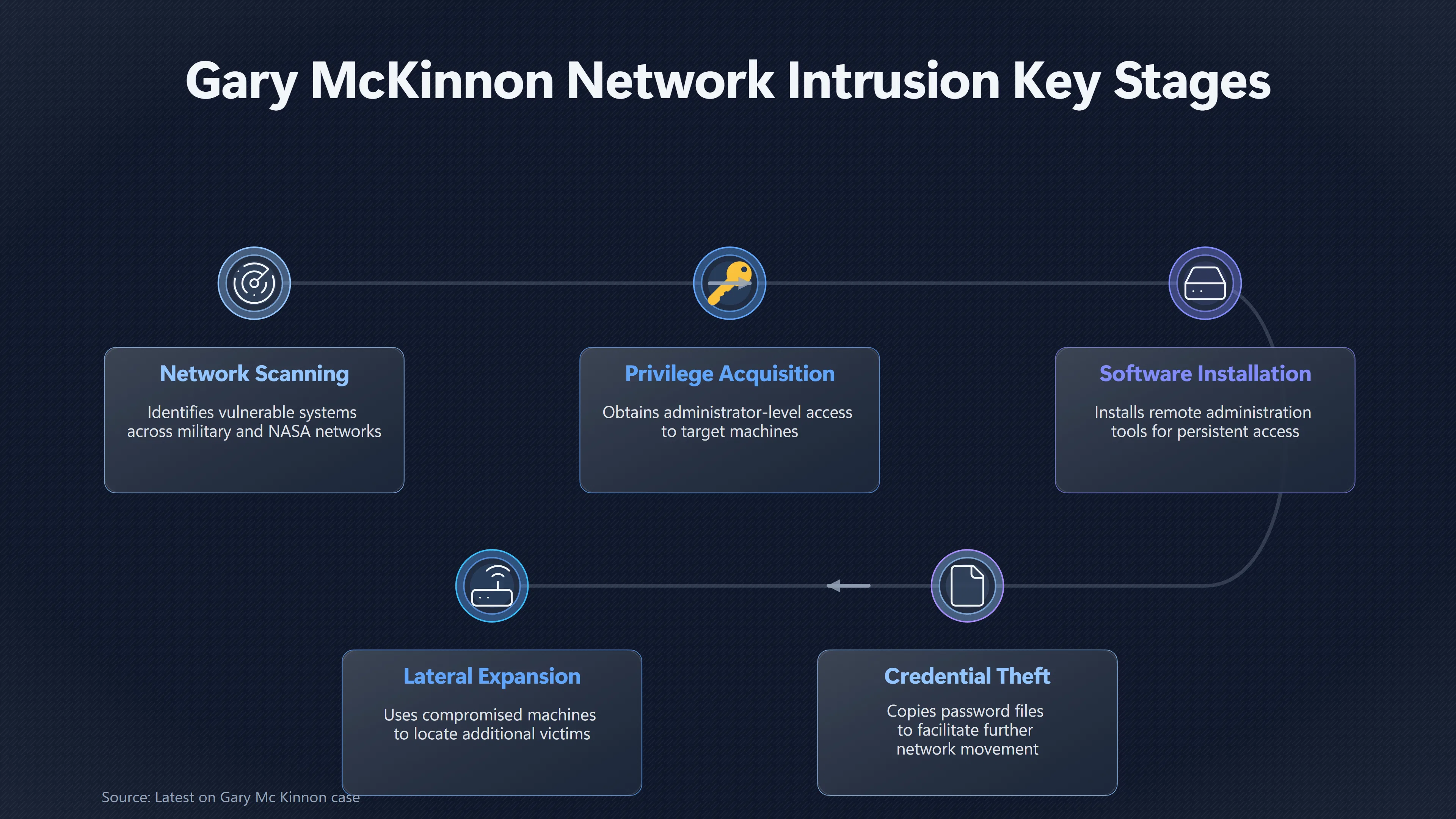
According to the US indictments, McKinnon allegedly:
- Scanned military networks for vulnerable systems.
- Obtained administrator-level access.
- Installed remote administration software.[vlex.co.uk]vlex.co.ukMc Kinnon v United States of AmericaMcKinnon v United States of America - vLex United KingdomApril 3, 2007 — 3 Once "remotely anywhere" was installed, Mr McKinnon proceeded…
- Copied password files.
- Used compromised systems to locate additional victims across military and NASA networks.[Department of Justice]justice.govDepartment of JusticeLondon, England Hacker Indicted Under Computer Fraud and Abuse Act For Accessing Military Computers (November 12, 20…
Whether or not an individual machine stored classified material, administrator access could expose credentials or trusted relationships that simplified access elsewhere. This is why defenders treat seemingly ordinary workstations as important security assets rather than disposable endpoints.
Why classified repositories were different
A common misunderstanding is that breaking into a military computer automatically provides access to the government’s most closely guarded information. In practice, highly classified information is protected through multiple layers beyond simply belonging to a military organisation.
Sensitive intelligence is commonly separated by:
- Classification levels.
- “Need-to-know” restrictions.
- Special Access Programmes.
- Physically or logically segregated networks.
- Additional authentication and auditing requirements.
Consequently, a computer connected to an ordinary military network would not normally provide direct access to repositories containing highly compartmented defence or intelligence programmes.
This distinction matters when assessing UFO-related claims. The fact that a computer belonged to NASA, the Department of Defense or another military organisation does not mean it held evidence of alleged extraterrestrial projects. Institutional ownership is not equivalent to unrestricted access across every classified environment.
Why institutional location was mistaken for evidential value
Within UFO discussions, the names “NASA”, “Pentagon” or “Air Force” often carry symbolic weight. Because these organisations genuinely conduct classified aerospace and defence work, some observers assume that any successful intrusion into one of their computers would naturally expose hidden UFO files.
That assumption overlooks how large organisations are structured.
A modern defence department contains thousands of computers performing entirely routine functions. An attacker may compromise one administrative server without coming anywhere near systems supporting intelligence analysis, weapons development or compartmented research.
The McKinnon case demonstrates this distinction clearly. His stated motivation was to search for evidence relating to UFOs and advanced technologies, yet the publicly documented criminal allegations focus on unauthorised access, password theft, remote administration software and disruption of operational networks rather than confirmed discovery of classified extraterrestrial information. The US government has never confirmed his claims regarding alleged “non-terrestrial officers” or other extraordinary findings, and no independently verified documentary evidence has emerged from the case.[justice.gov]justice.govDepartment of JusticeLondon, England Hacker Indicted Under Computer Fraud and Abuse Act For Accessing Military Computers (November 12, 20…

What the case revealed about security rather than UFO secrecy
From an information-security perspective, the enduring importance of the McKinnon case lies less in what he claimed to have found than in what investigators said he was able to do.
The indictments describe widespread unauthorised access across numerous military and NASA systems over many months, resulting in stolen credentials, installation of remote-access tools, deleted system files and disruption to operational networks. Prosecutors argued that compromised computers were repeatedly used as stepping stones to identify additional targets, demonstrating how weaknesses in one part of a network could increase risk elsewhere.[Department of Justice]justice.govDepartment of JusticeLondon, England Hacker Indicted Under Computer Fraud and Abuse Act For Accessing Military Computers (November 12, 20…
For cybersecurity professionals, this illustrates a familiar lesson: attackers frequently begin with the least protected system available rather than attempting an immediate assault on the most secure one. Even an unclassified workstation can provide reconnaissance, credentials and trusted access that become valuable during a broader intrusion.
Within the broader history of UFO-focused hacking, that technical reality is often overshadowed by claims about hidden alien records. The publicly documented evidence supports the importance of network security failures and lateral movement through military systems, but it does not demonstrate that unclassified computers contained verified evidence of extraterrestrial programmes.
Amazon book picks
Further Reading
Books and field guides related to Why a Low Level Military Computer Still Mattered. Use these as the next step if you want deeper reading beyond the article.
The Hacker and the State
Rating: 5.0/5 from 18 Google Books ratings
“A must-read...It reveals important truths.” —Vint Cerf, Internet pioneer “One of the finest books on information security published so f...
Ghost in the Wires
In this "intriguing, insightful and extremely educational" novel, the world's most famous hacker teaches you easy cloaking and counter-me...
Security Engineering
Rating: 4.5/5 from 7 Google Books ratings
Now that there's software in everything, how can you make anything secure? Understand how to engineer dependable systems with this newly...
The Art of Intrusion
Hacker extraordinaire Kevin Mitnick delivers the explosive encore to his bestselling The Art of Deception Kevin Mitnick, the world's most...
eBay marketplace picks
Marketplace Samples
Live-tested eBay searches with available results related to this page.
Selected frommilitary computer poster oneBay.co.uk.


Endnotes
1.
Source: justice.gov
Link:https://www.justice.gov/archive/criminal/cybercrime/press-releases/2002/mckinnonIndict.htm
Source snippet
Department of JusticeLondon, England Hacker Indicted Under Computer Fraud and Abuse Act For Accessing Military Computers (November 12, 20...
2.
Source: justice.gov
Link:https://www.justice.gov/archive/criminal/cybercrime/press-releases/2002/mckinnonIndict2.htm
Source snippet
Department of JusticeBritish National Charged with Hacking Into N.J. Naval Weapons Station Computers, Disabling Network After Sept. 11 (N...
3.
Source: GOV.UK
Title: Latest on Gary Mc Kinnon case
Link:https://www.gov.uk/government/news/latest-on-gary-mckinnon-case
Source snippet
From: Home Office and The Rt Hon Theresa May...
4.
Source: oig.nasa.gov
Title: investigators expose a chinese national phishing for defense software
Link:https://oig.nasa.gov/news/nasa-investigators-expose-a-chinese-national-phishing-for-defense-software/
Source snippet
NASA OIGApril 23, 2026 — 4 min read NASA INVESTIGATORS EXPOSE A C...
Published: April 23, 2026
5.
Source: Wikipedia
Title: Gary Mc Kinnon
Link:https://en.wikipedia.org/wiki/Gary_McKinnon
Additional References
6.
Source: theguardian.com
Title: Profile: Gary Mc Kinnon | Gary Mc Kinnon | The Guardian
Link:https://www.theguardian.com/technology/2009/jul/31/gary-mckinnon-hacking-extradition
Source snippet
Profile: Gary McKinnon | Gary McKinnon | The GuardianJuly 31, 2009 — Gary McKinnon This article is more than 16 years old Profile PROFILE...
Published: July 31, 2009
7.
Source: youtube.com
Title: The Kid Who Hacked the Pentagon (and paid with his life)
Link:https://www.youtube.com/watch?v=I1rzcZWTIjo
Source snippet
This video details Gary McKinnon's computer network intrusions into US military and NASA systems, exploring how unclassified operational...
8.
Source: vlex.co.uk
Title: Mc Kinnon v United States of America
Link:https://vlex.co.uk/vid/mckinnon-v-united-states-793612009
Source snippet
McKinnon v United States of America - vLex United KingdomApril 3, 2007 — 3 Once "remotely anywhere" was installed, Mr McKinnon proceeded...
Published: April 3, 2007
9.
Source: spectrum.ieee.org
Title: the autistic hacker
Link:https://spectrum.ieee.org/the-autistic-hacker
Source snippet
McKinnon: The Autistic Hacker - IEEE SpectrumJune 27, 2011 — THE AUTISTIC HACKER GARY MCKINNON HACKED THOUSANDS OF GOVERNMENT COMPUTERS 1...
Published: June 27, 2011
10.
Source: youtube.com
Title: The Man Who Hacked the U.S. Government
Link:https://www.youtube.com/watch?v=ND0zQX1rGdg
Source snippet
Ancient Aliens: Hacking NASA Secrets (Season 12, Episode 9) | History...
11.
Source: theguardian.com
Link:https://www.theguardian.com/technology/2002/nov/13/hacking.internetcrime
12.
Source: youtube.com
Title: Gary Mc Kinnon wins extradition battle
Link:https://www.youtube.com/watch?v=y4lecD44F5E
Source snippet
The Kid Who Hacked the Pentagon (and paid with his life)...
13.
Source: youtube.com
Title: Ancient Aliens: Hacking NASA Secrets (Season 12, Episode 9) | History
Link:https://www.youtube.com/watch?v=20rWFDfh68Y
Source snippet
UK hacker's extradition to US blocked...
14.
Source: govexec.com
Title: British man indicted for hacking into military networks
Link:https://www.govexec.com/technology/2002/11/british-man-indicted-for-hacking-into-military-networks/12896/
15.
Source: youtube.com
Title: UK hacker’s extradition to US blocked
Link:https://www.youtube.com/watch?v=v4Js8DF80HY
Source snippet
Gary McKinnon wins extradition battle...