Within Circular Claims
How One UFO Claim Became Many Sources
Intermediate articles can make one person's testimony appear independently verified when later writers stop tracing the claim back to its origin.
On this page
- How intermediate citations obscure original testimony
- Why publisher independence is not evidential independence
- How to reconstruct a hidden citation chain
Page outline Jump by section
Introduction
The Gary McKinnon UFO story illustrates a common information problem known as citation laundering: a process in which a single person’s testimony comes to appear supported by numerous independent sources because later writers cite one another rather than tracing the claim back to its original origin. In McKinnon’s case, repeated references to an alleged NASA image, a spreadsheet labelled “Non-Terrestrial Officers”, and unexplained ship-transfer records often create the impression of multiple confirmations. Yet the public record shows that these specific UFO-related claims consistently trace back to McKinnon’s own descriptions rather than to independently available documents or additional witnesses.[WIRED]wired.comufo hacker tells what he foundWIRED'UFO Hacker' Tells What He Found | WIREDJune 21, 2006…
Understanding this mechanism is essential when assessing UFO-hacker stories. The issue is not whether many articles mention the same details, but whether those details originate from separate evidence streams. Citation laundering obscures that distinction by replacing evidential independence with publication independence.
How intermediate citations obscure original testimony
Citation laundering rarely involves fabrication. Instead, it gradually disconnects a claim from its original evidential context.
In McKinnon’s case, the earliest widely cited account is his 2006 interview with Wired. There he personally described seeing what he believed was a cigar-shaped object in NASA imagery, a spreadsheet headed “Non-Terrestrial Officers”, and records of ship-to-ship transfers. Importantly, he also acknowledged uncertainty, stating that what he had found “could be a game” and that he could not know for certain what the material represented.[WIRED]wired.comufo hacker tells what he foundWIRED'UFO Hacker' Tells What He Found | WIREDJune 21, 2006…
As later articles retold the story, many summarised these claims without repeating the original interview’s uncertainty or directing readers back to the primary source. Instead, writers frequently referenced an earlier magazine feature, documentary, blog post or news article. Each additional step made the narrative appear to rest on a broader documentary foundation than actually existed.[IEEE Spectrum]spectrum.ieee.orgSpectrum Gary Mc Kinnon: The Autistic HackerIEEE SpectrumGary McKinnon: The Autistic Hacker - IEEE Spectrum…
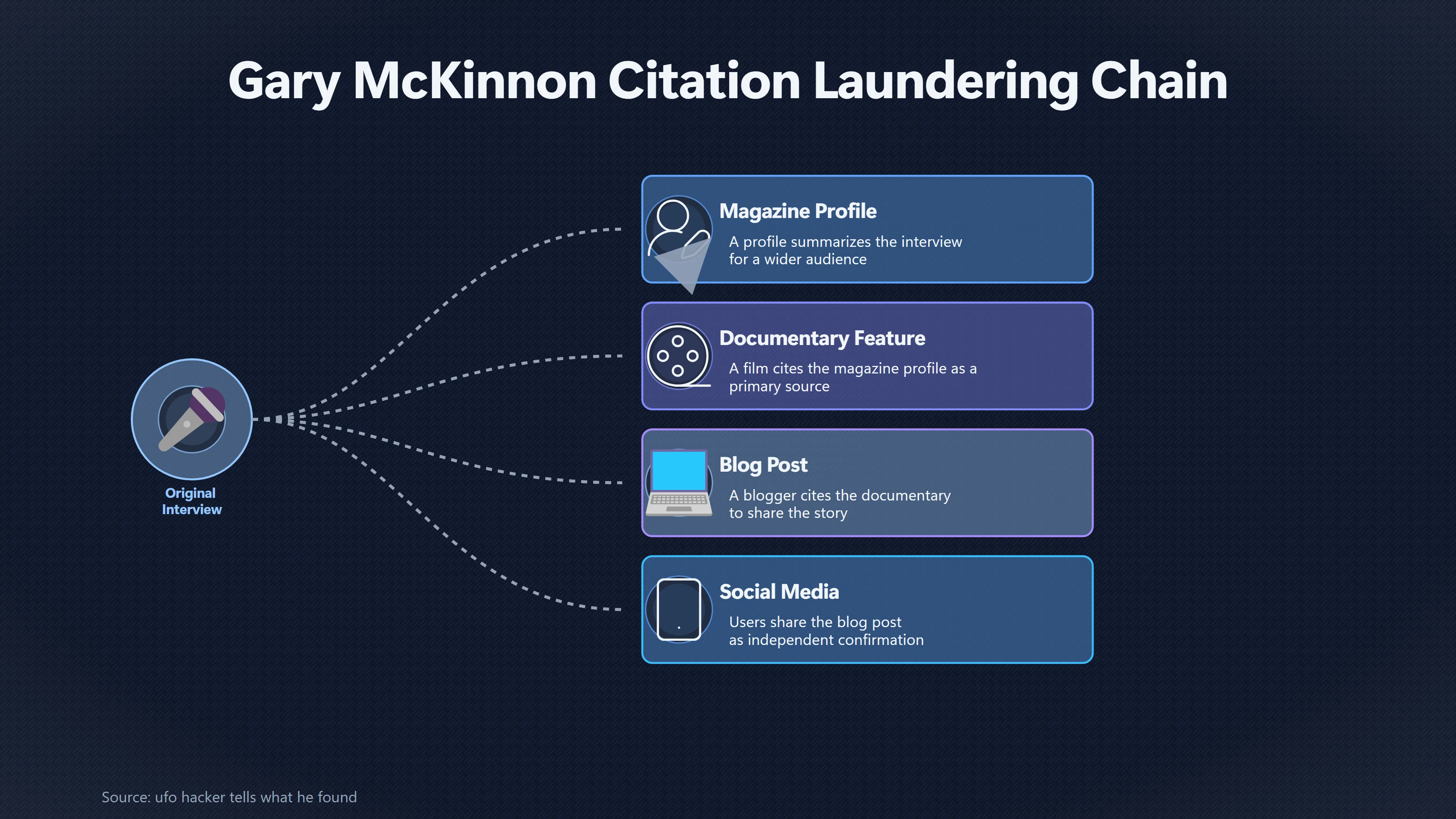
A typical citation chain may look like this:
- McKinnon’s interview.[boingboing.net]boingboing.netInterview with "UFO Hacker" Gary Mc Kinnon: why'd he do it?Interview with "UFO Hacker" Gary Mc Kinnon: why'd he do it?
- A magazine profile summarising the interview.
- A documentary citing the magazine.
- A blog citing the documentary.
- Social media posts citing the blog.
- Discussion forums pointing to all of the above as separate “sources”.
Although six publications now exist, the underlying evidence remains one witness recalling one experience.
Why publisher independence is not evidential independence
One of the easiest mistakes in evaluating unusual claims is assuming that different publishers represent different evidence.
They do not.
Independent publishers can all rely upon exactly the same underlying testimony. A publication becomes an independent evidential source only if it contributes genuinely new material, such as:
- an additional eyewitness;
- authenticated documents;
- preserved images;
- contemporaneous records;
- forensic examination;
- or official records unavailable to previous writers.
The IEEE Spectrum profile of McKinnon is an instructive example. It recounts his description of the NASA image and the “Non-Terrestrial Officers” spreadsheet, but these remain things McKinnon said he encountered. The article does not introduce recovered copies of the files, testimony from another individual who examined them, or newly authenticated documentation confirming their contents. Its value lies in reporting McKinnon’s account, not independently verifying it.[IEEE Spectrum]spectrum.ieee.orgSpectrum Gary Mc Kinnon: The Autistic HackerIEEE SpectrumGary McKinnon: The Autistic Hacker - IEEE Spectrum…
This distinction matters because readers often unconsciously substitute publication volume for evidential strength. Ten reputable outlets repeating one person’s recollection still represent one primary witness unless new evidence enters the record.
How repetition changes the apparent credibility of a claim
Citation laundering affects perception through several cumulative effects.
First, repetition creates familiarity. Readers encountering identical details across multiple websites naturally infer that the information has been repeatedly verified rather than repeatedly reproduced.
Second, later writers often omit the qualifiers present in earlier accounts. McKinnon’s acknowledgement that the spreadsheet “could be a game” is less frequently repeated than the memorable phrase “Non-Terrestrial Officers.” As uncertainty drops out of successive retellings, confidence appears to increase even though no new evidence has appeared.[WIRED]wired.comufo hacker tells what he foundWIRED'UFO Hacker' Tells What He Found | WIREDJune 21, 2006…
Third, different media formats reinforce one another. A newspaper article, podcast, documentary, forum discussion and social-media thread may feel like five independent confirmations despite ultimately relying on the same interview.
The result is not deliberate deception in every instance. More often it reflects ordinary journalistic shorthand, content aggregation and online sharing. Nevertheless, the cumulative effect can significantly alter readers’ perception of how well supported a claim actually is.
How to reconstruct a hidden citation chain
Readers can usually expose citation laundering by working backwards rather than forwards.
A practical approach is:
- Identify the specific factual claim—for example, the alleged spreadsheet or spacecraft image.
- Follow each article’s citations or references to determine where it obtained the information.
- Continue tracing until the earliest identifiable source is reached.
- Ask whether any later publication contributes genuinely independent evidence.
- Separate reports that merely repeat testimony from those that introduce new documentation.
Applied to McKinnon’s UFO claims, this process consistently returns to his own interviews and public statements. The legal proceedings surrounding his hacking activities are independently documented, but the alleged UFO image, spreadsheet and ship-transfer records remain publicly known through his descriptions rather than preserved primary evidence.[WIRED]wired.comufo hacker tells what he foundWIRED'UFO Hacker' Tells What He Found | WIREDJune 21, 2006…

What citation laundering cannot prove
Citation laundering does not establish that a claim is false.
Equally, it cannot make a claim stronger simply because it has been widely repeated.
The mechanism explains only why a narrative may appear to have multiple confirmations when it actually has one evidential origin. Determining whether the original testimony was accurate requires independent supporting material. For McKinnon’s specific UFO-related claims, no publicly authenticated copies of the alleged image or spreadsheet have emerged that would allow independent verification. Later publications therefore document the persistence of the story rather than adding new evidence for its factual accuracy.[WIRED]wired.comufo hacker tells what he foundWIRED'UFO Hacker' Tells What He Found | WIREDJune 21, 2006…
The broader lesson for UFO-hacker stories
McKinnon’s case demonstrates why source tracing is more informative than source counting. His hacking activities and subsequent legal case are matters of public record, while his descriptions of unusual NASA material remain personal testimony. Citation laundering can blur that distinction by making one account appear to have acquired multiple independent witnesses through repeated publication alone.
For readers examining UFO-hacker narratives, the critical question is therefore not how many articles repeat a claim, but how many genuinely independent sources support it. In McKinnon’s case, tracing the citation chain shows that the most widely repeated UFO details continue to derive from a single original witness, even when they are reproduced across numerous outlets over many years.[wired.com]wired.comufo hacker tells what he foundWIRED'UFO Hacker' Tells What He Found | WIREDJune 21, 2006…
Amazon book picks
Further Reading
Books and field guides related to How One UFO Claim Became Many Sources. Use these as the next step if you want deeper reading beyond the article.
Calling Bullshit
Bullshit isn’t what it used to be. Now, two science professors give us the tools to dismantle misinformation and think clearly in a world...
The Skeptics' Guide to the Universe
An all-encompassing guide to skeptical thinking from podcast host and academic neurologist at Yale University School of Medicine Steven N...
The Demon-Haunted World
NEW YORK TIMES BESTSELLER • From the renowned astronomer and author of Cosmos comes a “powerful [and] stirring defense of informed ration...
Mistakes Were Made (but Not by Me)
Why is it so hard to say "I made a mistake"-and really believe it? When we make mistakes, cling to outdated attitudes, or mistreat other...
eBay marketplace picks
Marketplace Samples
Live-tested eBay searches with available results related to this page.
Selected fromUFO poster oneBay.co.uk.

Current eBay listing
I Want To Believe UFO Poster Giclée Fine Art Heavyweight Print


Current eBay listing
VINTAGE UFO FLYING SAUCERS COMIC ADVERTISING A2 POSTER PRINT

Endnotes
1.
Source: wired.com
Title: ufo hacker tells what he found
Link:https://www.wired.com/2006/06/ufo-hacker-tells-what-he-found/
Source snippet
WIRED'UFO Hacker' Tells What He Found | WIREDJune 21, 2006...
Published: June 21, 2006
2.
Source: spectrum.ieee.org
Title: Spectrum Gary Mc Kinnon: The Autistic Hacker
Link:https://spectrum.ieee.org/the-autistic-hacker
Source snippet
IEEE SpectrumGary McKinnon: The Autistic Hacker - IEEE Spectrum...
3.
Source: wired.com
Title: Terrorist or UFO Truth Seeker? | WIRED
Link:https://www.wired.com/2006/04/terrorist-or-ufo-truth-seeker/
Source snippet
Terrorist or UFO Truth Seeker? | WIRED...
4.
Source: spectrum.ieee.org
Title: autistic hacker wont be extradited to us
Link:https://spectrum.ieee.org/autistic-hacker-wont-be-extradited-to-us
Source snippet
IEEE SpectrumOctober 16, 2012 — AUTISTIC HACKER WON'T BE EXTRADITED TO U.S. UK GOVERNMENT GIVES GARY MCKINNON A REPRIEVE ON [HUMAN RIGHTS]({{ 'human-rights/' | relative_url }})...
Published: October 16, 2012
5.
Source: spectrum.ieee.org
Title: hacking news articles
Link:https://spectrum.ieee.org/hacking-news-articles
Source snippet
Hacking Matrix - IEEE SpectrumJuly 6, 2011 — THE HACKING MATRIX We took 25 of the biggest hacking stories we've published and assessed th...
Published: July 6, 2011
6.
Source: spectrum.ieee.org
Title: freeing gary mckinnon
Link:https://spectrum.ieee.org/freeing-gary-mckinnon
Source snippet
Gary McKinnon - IEEE SpectrumApril 30, 2010 — Freeing Gary McKinnon FREEING GARY MCKINNON HACKERS, ASPERGER SYNDROME, AND EXTRADITION 3 m...
Published: April 30, 2010
7.
Source: wired.com
Title: uk hacker gary
Link:https://www.wired.com/2008/08/uk-hacker-gary/
Source snippet
Hacker Gary McKinnon Plays the Asperger's Card | WIREDAugust 28, 2008 — Aug 28, 2008 10:21 AM U.K. HACKER GARY MCKINNON PLAYS THE ASPERGE...
Published: August 28, 2008
8.
Source: wired.com
Title: its official ufos are just uaps
Link:https://www.wired.com/2006/05/its-official-ufos-are-just-uaps/
9.
Source: wanttoknow.info
Title: * * * Wired,
Link:https://www.wanttoknow.info/a-ufo-hacker-tells-what-he-found
Source snippet
'UFO Hacker' Tells What He FoundFebruary 19, 2024 — 'UFO HACKER' TELLS WHAT HE FOUND Key Excerpts from Article on Website of Wired Image...
Published: February 19, 2024
10.
Source: uapmurders.com
Title: Gary Mc Kinnon
Link:https://uapmurders.com/uaps/Details/Gary_McKinnon/
Additional References
11.
Source: youtube.com
Title: Gary Mc Kinnon wins extradition battle
Link:https://www.youtube.com/watch?v=y4lecD44F5E
Source snippet
These videos directly document Gary McKinnon's single-source UFO claims, the media coverage that amplified his interviews, and the legal...
12.
Source: ufohackers.org
Link:https://www.ufohackers.org/hackers
13.
Source: theguardian.com
Title: British hacker faces extradition to US | US news | The Guardian
Link:https://www.theguardian.com/technology/2006/may/10/news.usnews
14.
Source: ufohackers.org
Link:https://www.ufohackers.org/hackers/gary-mckinnon/mckinnon-overview
15.
Source: boingboing.net
Title: Interview with “UFO Hacker” Gary Mc Kinnon: why’d he do it?
Link:https://boingboing.net/2006/06/21/interview-with-ufo-h.html
16.
Source: youtube.com
Title: The Interview They Tried to Erase From the Internet
Link:https://www.youtube.com/watch?v=WvILY-h-6_Y
Source snippet
The Man Who Hacked the U.S. Government...
17.
Source: seclists.org
Title: funsec: [privacy] ‘UFO Hacker’ Tells What He Found
Link:https://seclists.org/funsec/2006/q2/2330
18.
Source: youtube.com
Title: The Man Who Hacked the U.S. Government
Link:https://www.youtube.com/watch?v=ND0zQX1rGdg
Source snippet
Ancient Aliens: Hacking NASA Secrets...
19.
Source: youtube.com
Title: UK hacker’s extradition to US blocked
Link:https://www.youtube.com/watch?v=v4Js8DF80HY
Source snippet
Gary McKinnon wins extradition battle...
20.
Source: youtube.com
Title: Ancient Aliens: Hacking NASA Secrets
Link:https://www.youtube.com/watch?v=20rWFDfh68Y
Source snippet
UK hacker's extradition to US blocked...