Within Extradition
Why Wasn't Mc Kinnon Tried in Britain?
British prosecutors declined a domestic case even though McKinnon acted from London and had strong personal and evidential ties to Britain.
On this page
- The case for treating Britain as the natural forum
- Why the Director of Public Prosecutions declined charges
- How the High Court defended the decision
Page outline Jump by section
Introduction
One of the most disputed aspects of the Gary McKinnon affair was not whether he had accessed American military and NASA computers, but why he was never prosecuted in Britain despite carrying out the alleged conduct from his home in London. To many observers, a domestic prosecution appeared to offer a compromise: McKinnon could accept responsibility under British computer misuse law while avoiding the much harsher consequences that might follow a US trial. Instead, British prosecutors declined to bring charges, leaving extradition as the only realistic route to a criminal trial. That decision became a central battleground in the wider extradition dispute because it raised a fundamental question about jurisdiction in cross-border cybercrime: should a suspect normally be tried where the keyboard was located, or where the targeted computers and alleged harm were located?
The case for treating Britain as the natural forum
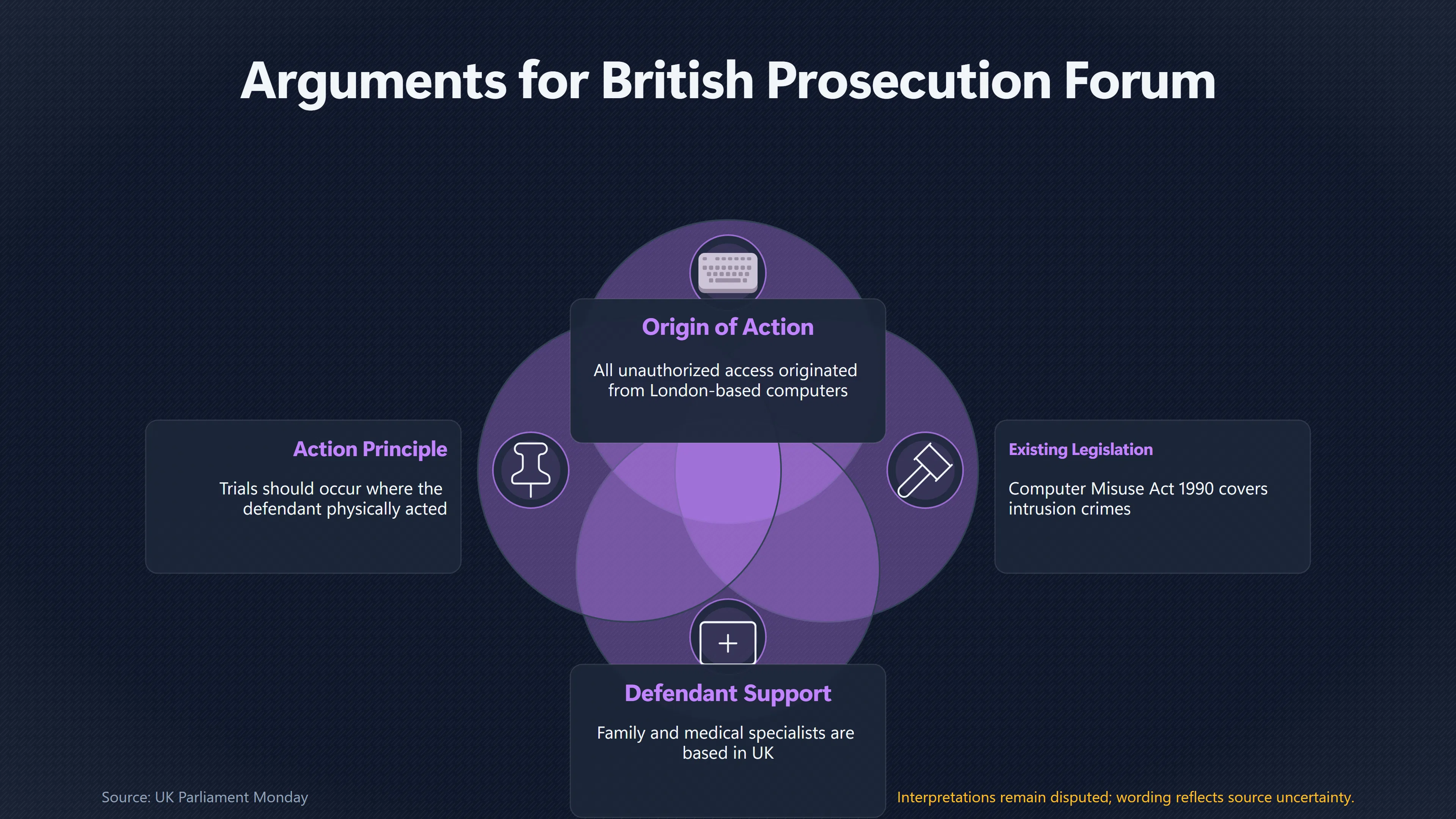
McKinnon’s supporters argued that Britain was the obvious place for prosecution for several practical and legal reasons.
First, every act of alleged unauthorised access originated in England. McKinnon lived in London, used computers there and was arrested there. He was a British citizen with no physical presence in the United States during the alleged offences.
Second, Britain already possessed legislation capable of prosecuting computer intrusion. The Computer Misuse Act 1990 criminalised unauthorised access to computer systems, meaning there was no legal vacuum requiring an American prosecution.
Third, a British trial would have been easier for the defendant. His family, legal advisers and medical specialists were all based in the UK. After his diagnosis with Asperger’s syndrome, supporters argued that these factors became even more significant.
Finally, many critics believed a domestic prosecution would have better reflected the principle that criminal trials should normally occur where a defendant acted unless compelling reasons pointed elsewhere. This became known in the extradition debate as the “forum” issue—the question of the most appropriate jurisdiction for prosecution rather than whether a crime had occurred at all.[UK Parliament]publications.parliament.ukUK Parliament MondayVolume 537 No. 235 HOUSE OFDecember 6, 2011…
Why the Director of Public Prosecutions declined charges
The Director of Public Prosecutions (DPP), then Keir Starmer, decided that Britain should not prosecute McKinnon. The decision was not based on a conclusion that no offence had been committed. Instead, prosecutors concluded that the United States was the more appropriate forum.
Several considerations influenced that judgment.
The alleged victims were American government agencies, including the Department of Defense, Army, Navy, Air Force and NASA. The affected computer systems, data and network administrators were located in the United States. The principal evidence concerning operational disruption, system recovery and financial losses also lay there.
From the prosecution perspective, the alleged criminality was directed at American interests rather than British ones. Although the keystrokes occurred in London, prosecutors regarded the intended targets, the protected information and the alleged consequences as overwhelmingly American.
The CPS also considered that many essential witnesses would have to come from the United States if a British prosecution were attempted. Engineers, investigators, military personnel and officials responsible for assessing the alleged damage would all need to provide evidence. Conducting the trial where those witnesses and the affected systems were located was viewed as more practical.
When McKinnon’s legal team later argued that he should instead face British charges, the CPS described such a prosecution as an attempt to avoid extradition rather than the most appropriate venue for determining the allegations.[The Times]thetimes.co.ukThe Times How Keir Starmer tried to change the establishment from the insideDespite never having prosecuted a case, his preparedness impressed colleagues. He prioritized empathy in prosecutorial decisions, notably…
How the High Court defended the decision
McKinnon challenged the DPP’s refusal through judicial review, arguing that Britain should prosecute him instead of surrendering him to the United States.
The High Court rejected that challenge in July 2009.
Lord Justice Stanley Burnton accepted that McKinnon’s conduct physically took place in Britain but emphasised that it had been directed at the United States. The court highlighted several factors:
- the targeted computers were located in America;
- the information accessed belonged to US agencies;
- any confidentiality concerns related to American government information;
- the alleged damage occurred in the United States;
- the principal witnesses regarding that damage were American.
On that basis, the court held that the DPP could reasonably conclude that prosecution in the United States was the more appropriate course.
Importantly, the judges also drew a constitutional distinction between reviewing legality and substituting their own judgment. They held that deciding the appropriate prosecuting forum belonged to the Director of Public Prosecutions, not the courts. Judicial review therefore examined only whether the decision had been irrational or legally flawed, not whether the judges themselves would have preferred a British trial.
The court concluded that the DPP’s reasoning fell well within the range of lawful prosecutorial discretion and refused permission to challenge it further.[Hansard]hansard.parliament.ukHansard Gary Mc Kinnon (ExtraditionGary McKinnon (Extradition) - Hansard - UK Parliament…
Why the decision became politically controversial
Although legally upheld, the decision attracted sustained criticism from politicians, lawyers and civil liberties groups.
Critics argued that British prosecutors had effectively surrendered jurisdiction over a British citizen before testing whether a domestic prosecution was feasible. They questioned why Britain would decline to prosecute conduct committed within its own territory when it possessed both the legal powers and the defendant.
The controversy also exposed a gap in the extradition framework existing at the time. There was no statutory “forum bar” allowing courts to refuse extradition because Britain was the more appropriate place for trial. Instead, the practical decision rested largely with prosecutors, leaving defendants with only the limited remedy of judicial review.
Parliamentary debates repeatedly cited McKinnon’s case as evidence that forum decisions lacked sufficient independent judicial oversight. This criticism later influenced wider reviews of UK extradition law and contributed to reforms introducing a statutory forum bar in subsequent legislation.[UK Parliament]publications.parliament.ukUK Parliament MondayVolume 537 No. 235 HOUSE OFDecember 6, 2011…
What the decision reveals about cross-border cybercrime
The refusal to prosecute McKinnon in Britain illustrates a broader challenge that has only become more important with the growth of international cybercrime.
Unlike conventional offences committed entirely within one country, computer intrusions often involve multiple jurisdictions simultaneously. The attacker may be in one country, the servers in another, the victims elsewhere and digital evidence spread across several legal systems. As a result, more than one country may possess lawful jurisdiction.
The McKinnon case demonstrated that British prosecutors placed significant weight on where the protected systems, victims and alleged consequences were located, even when the defendant never left Britain. That approach favoured the state experiencing the principal effects of the alleged intrusion rather than the state from which the activity originated.
The controversy also showed that forum decisions can become politically sensitive when different legal systems offer dramatically different sentencing practices, plea bargaining arrangements or procedural safeguards. For many observers, the dispute was never simply about geography. It became a test of how allied democracies should balance territorial sovereignty, practical prosecution and fairness when cyber offences cross national borders.
Amazon book picks
Further Reading
Books and field guides related to Why Wasn't Mc Kinnon Tried in Britain?. Use these as the next step if you want deeper reading beyond the article.
International Extradition: United States Law and Practice
This comprehensive guide covers all aspects of extradition to and from the United States, makes critical, theoretical and practical evalu...
The Hacker and the State
Rating: 5.0/5 from 18 Google Books ratings
“A must-read...It reveals important truths.” —Vint Cerf, Internet pioneer “One of the finest books on information security published so f...
Cybercrime and Society
The Third Edition of Cybercrime and Society provides readers with expert analysis on the most important cybercrime issues affecting moder...
Extradition Law: A Practitioner's Guide
First published 2013. Subjects: Law, great britain.
eBay marketplace picks
Marketplace Samples
Live-tested eBay searches with available results related to this page.
Selected fromhacker badge oneBay.co.uk.



Endnotes
1.
Source: publications.parliament.uk
Title: UK Parliament Monday
Link:https://publications.parliament.uk/pa/cm201011/cmhansrd/chan235.pdf
Source snippet
Volume 537 No. 235 HOUSE OFDecember 6, 2011...
Published: December 6, 2011
2.
Source: hansard.parliament.uk
Title: Hansard Gary Mc Kinnon (Extradition)
Link:https://hansard.parliament.uk/Commons/2009-12-01/debates/09120144000002/GaryMckinnon%28Extradition%29
Source snippet
Gary McKinnon (Extradition) - Hansard - UK Parliament...
3.
Source: publications.parliament.uk
Title: UK Parliament House of Commons
Link:https://publications.parliament.uk/pa/cm200809/cmselect/cmhaff/1105/09111005.htm
Source snippet
UK ParliamentHouse of Commons - Home Affairs Committee - Minutes of Evidence...
4.
Source: publications.parliament.uk
Link:https://publications.parliament.uk/pa/cm200809/cmhansrd/cm090715/debtext/90715-0012.htm
Source snippet
UK ParliamentHouse of Commons Hansard Debates for 15 July 2009 (pt 0012)...
Published: July 2009
5.
Source: questions-statements.parliament.uk
Title: uk Written questions and answers
Link:https://questions-statements.parliament.uk/written-questions/detail/2017-01-30/62297
6.
Source: publications.parliament.uk
Title: uk House of Commons
Link:https://publications.parliament.uk/pa/cm201011/cmselect/cmhaff/644/11011804.htm
7.
Source: publications.parliament.uk
Link:https://publications.parliament.uk/pa/cm200910/cmhansrd/cm091201/debtext/91201-0004.htm
8.
Source: publications.parliament.uk
Link:https://publications.parliament.uk/pa/cm200910/cmhansrd/cm091201/debtext/91201-0006.htm
9.
Source: publications.parliament.uk
Link:https://publications.parliament.uk/pa/cm200910/cmhansrd/cm091201/debtext/91201-0005.htm
10.
Source: hansard.parliament.uk
Title: uk Commons Chamber
Link:https://hansard.parliament.uk/html/%E2%80%8CCommons/2009-12-01/CommonsChamber
11.
Source: hansard.parliament.uk
Title: uk Commons Chamber
Link:https://hansard.parliament.uk/Commons/2009-12-01/debates/f3766a4d-8bb1-473f-abd2-7982ab0c00d7/CommonsChamber
12.
Source: hansard.parliament.uk
Title: uk Commons Chamber
Link:https://hansard.parliament.uk/Commons/2009-07-15/debates/18f9afd9-3ed5-4567-adea-2ade74b43a54/CommonsChamber
13.
Source: cps.gov.uk
Title: Crown Prosecution Service Jurisdiction | The Crown Prosecution Service
Link:https://www.cps.gov.uk/prosecution-guidance/jurisdiction
Source snippet
Jurisdiction | The Crown Prosecution ServiceJune 2, 2025 — JURISDICTION Updated: 5 October 2022, 2 June 2025 Prosecution Guidance * Intro...
Published: June 2, 2025
14.
Source: thetimes.co.uk
Title: The Times How Keir Starmer tried to change the establishment from the inside
Link:https://www.thetimes.co.uk/article/how-keir-starmer-change-establishment-from-inside-dpp-cps-l7zq3cck5
Source snippet
Despite never having prosecuted a case, his preparedness impressed colleagues. He prioritized empathy in prosecutorial decisions, notably...
Additional References
15.
Source: cps.gov.uk
Title: Reconsidering a Prosecution Decision | The Crown Prosecution Service
Link:https://www.cps.gov.uk/prosecution-guidance/reconsidering-prosecution-decision
Source snippet
January 25, 2023 — RECONSIDERING A PROSECUTION DECISION Updated: 26 February 2021, 25 Jan 2023 Prosecution Guidance Appeals, Reviews and...
Published: January 25, 2023
16.
Source: cps.gov.uk
Title: There are a number
Link:https://www.cps.gov.uk/prosecution-guidance/private-prosecutions
Source snippet
Private Prosecutions | The Crown Prosecution ServiceNovember 1, 2024 — * Procedure PRINCIPLE A private prosecution is a prosecution condu...
Published: November 1, 2024
17.
Source: youtube.com
Title: What Does Keir Starmer ACTUALLY Believe?
Link:https://www.youtube.com/watch?v=H7gqvdJSOBw
Source snippet
Hacking for UFOs and fighting for his life. Who is Gary McKinnon?...
18.
Source: youtube.com
Title: Gary Mc Kinnon will not face prosecution in the UK
Link:https://www.youtube.com/watch?v=viLcoe_xPMU
Source snippet
What Does Keir Starmer ACTUALLY Believe?...
19.
Source: youtube.com
Title: UK hacker’s extradition to US blocked
Link:https://www.youtube.com/watch?v=v4Js8DF80HY
Source snippet
Gary McKinnon will not face prosecution in the UK...
20.
Source: GOV.UK
Title: www.gov.uk The case for the prosecution: independence and the [public interest]({{ ‘public-interest/’ | relative_url }})
Link:https://www.gov.uk/government/speeches/the-case-for-the-prosecution-independence-and-the-public-interest
21.
Source: youtube.com
Title: Hacking for UFOs and fighting for his life. Who is Gary Mc Kinnon?
Link:https://www.youtube.com/watch?v=OImdnvQx7sQ
Source snippet
Gary McKinnon wins extradition battle...
22.
Source: itv.com
Title: ‘CPS have declared decision not to prosecute Mc Kinnon’
Link:https://www.itv.com/news/update/2012-12-14/cps-have-declared-decision-not-to-prosecute-mckinnon/
23.
Source: cps.gov.uk
Title: Consents to Prosecute | The Crown Prosecution Service
Link:https://www.cps.gov.uk/prosecution-guidance/consents-prosecute
24.
Source: GOV.UK
Title: www.gov.uk Gary Mc Kinnon extradition case: Home Secretary’s statement
Link:https://www.gov.uk/government/speeches/gary-mckinnon-extradition-case-home-secretarys-statement