Within Early Insecurity
Why Nobody Could See the Whole Government Network
Thousands of locally managed systems left agencies without a complete picture of exposed computers, software versions or privileged accounts.
On this page
- How agencies and contractors managed systems separately
- Why incomplete inventories concealed vulnerable hosts
- How uneven oversight slowed coordinated defense
Page outline Jump by section
Introduction
One of the least visible weaknesses behind the era of high-profile intrusions by UFO-motivated hackers such as Gary McKinnon was not a single technical flaw but the way US government computing was organised. During the late 1990s and early 2000s, federal information technology was spread across military commands, civilian agencies, research laboratories, field offices and contractors, each operating large numbers of systems under separate administrative control. No organisation possessed a complete, continuously updated picture of every internet-connected computer, its software, or who held administrative privileges. As a result, vulnerable machines could remain exposed for long periods without attracting central attention, even while other parts of government maintained far stronger security practices. This fragmented governance helps explain how relatively unsophisticated attack methods could locate overlooked systems across otherwise sophisticated organisations.[GAO]gao.govgaoInformation Security: Improving Oversight of Access to Federal Systems and Data by Contractors Can Reduce Risk | U.S. GAOApril 22, 2005…
How Separate Organisations Managed Their Own Systems
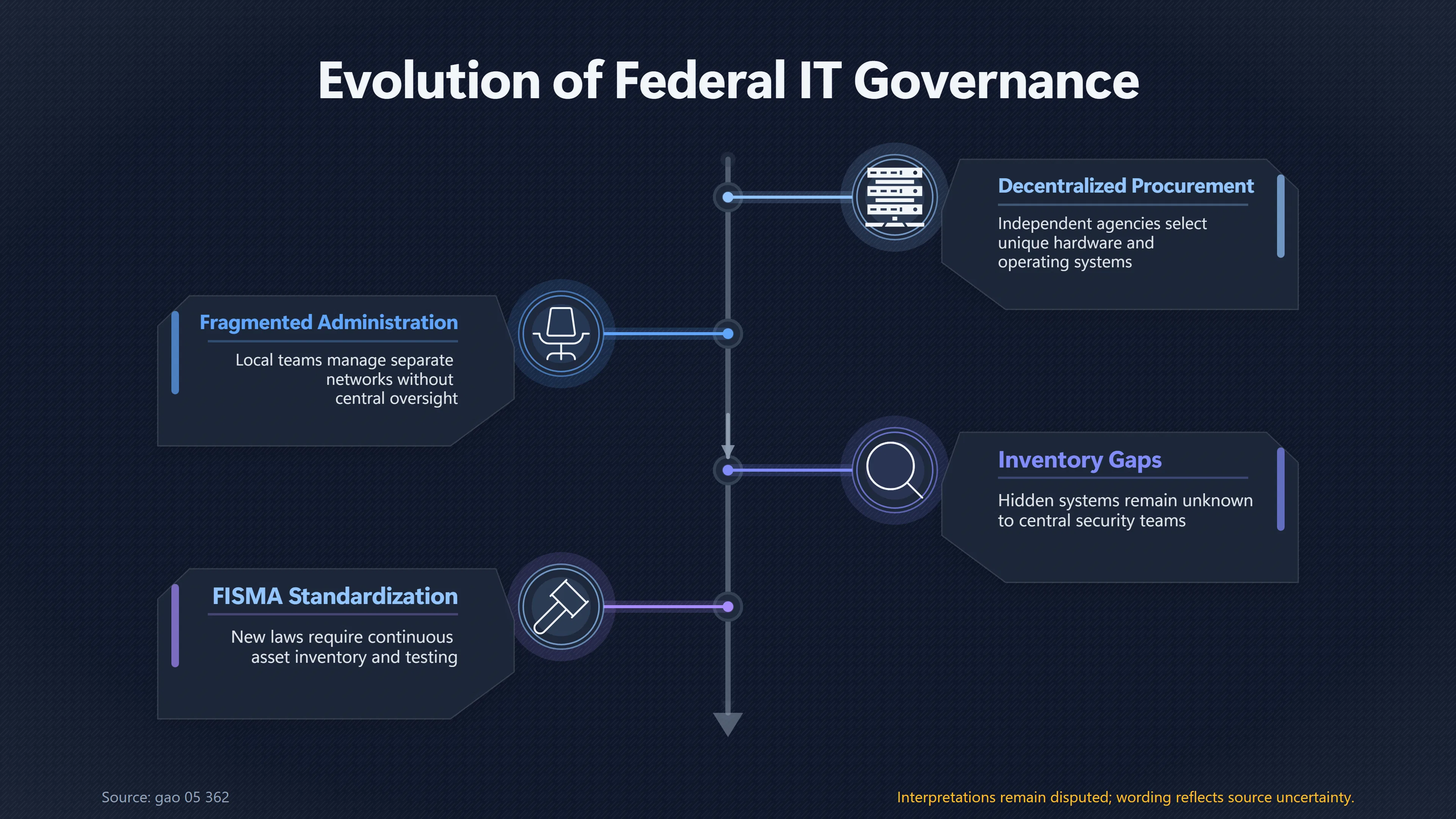
The popular image of a single, centrally managed “government network” did not reflect operational reality. Federal computing evolved through decades of independent procurement, mission-specific projects and local administration. Individual military bases, laboratories, programme offices and agencies often selected their own hardware, operating systems and administrative procedures.
This decentralised model brought operational advantages. Local administrators understood the needs of their own organisations and could deploy specialised equipment quickly. Research facilities, engineering commands and operational units frequently required different computing environments, making uniform management difficult.
The downside was inconsistent security. A department might operate thousands of systems, yet responsibility for patching, account management and software configuration remained distributed among dozens or hundreds of local teams. Consequently, one well-managed network could exist alongside another that had fallen months behind on updates or retained obsolete administrator accounts. Government audits repeatedly found access-control weaknesses across multiple agencies rather than isolated failures, indicating systemic inconsistency rather than one defective organisation.[GAO]gao.govgaoInformation Security: Improving Oversight of Access to Federal Systems and Data by Contractors Can Reduce Risk | U.S. GAOApril 22, 2005…
Why Incomplete Inventories Concealed Vulnerable Hosts
A fundamental security requirement is knowing what systems exist. During the period surrounding McKinnon’s intrusions, many agencies struggled to maintain complete inventories of their information systems, particularly where legacy equipment, contractor-operated infrastructure or independently managed facilities were involved.
Without reliable inventories, security teams faced several problems:
- Internet-facing computers could remain unknown to central administrators.
- Obsolete servers continued operating after their original projects ended.
- Unsupported software versions remained online because nobody realised they still existed.
- Administrator accounts accumulated without regular review.
- Security scanners could only examine assets already known to the organisation.
The importance of comprehensive inventories later became explicit in federal security law and guidance. The Federal Information Security Management Act (FISMA) required agencies to maintain and update inventories of major information systems because effective testing, risk management and contingency planning depend on knowing what assets exist and how they connect to other networks.[GAO]gao.gov09-232G, Federal Information System Controls Audit Manual (FISCAMGAO-09-232G, Federal Information System Controls Audit Manual (FISCAM)…
For attackers performing broad internet scans, these hidden administrative gaps created opportunities. A forgotten server managed by a small office could be significantly easier to compromise than highly visible systems receiving regular security attention.
Contractors Extended the Security Boundary
Government infrastructure also extended well beyond government-owned facilities. Contractors operated information systems, maintained applications, managed research environments and administered networks supporting federal missions.
This arrangement complicated oversight because agencies no longer needed only to secure their own equipment. They also had to understand:
- which contractor systems handled federal information;
- how privileged contractor personnel were supervised;
- whether contractor networks met government security requirements; and
- how interconnected contractor systems affected federal networks.
The Government Accountability Office identified contractor oversight as a government-wide concern, noting that agencies increasingly relied upon external organisations that possessed privileged access to federal systems or sensitive information. Weak oversight in these relationships increased the number of environments requiring coordinated security management while reducing central visibility into day-to-day administration.[GAO]gao.govgaoInformation Security: Improving Oversight of Access to Federal Systems and Data by Contractors Can Reduce Risk | U.S. GAOApril 22, 2005…
For investigators examining cases such as McKinnon’s, this organisational complexity matters because an exposed machine did not necessarily belong to a centrally managed headquarters network. It might instead belong to a contractor, research laboratory or local office operating under different administrative practices.

Uneven Oversight Slowed Coordinated Defence
Fragmented administration also complicated defensive action after vulnerabilities were discovered.
When security weaknesses appeared across government, officials frequently needed to coordinate responses among numerous independent organisations with different funding, staffing levels and technical priorities. Even when central guidance existed, implementation depended upon local administrators carrying out updates and verifying completion.
This uneven governance produced several practical consequences:
- Security patches were deployed at different speeds.
- Password policies differed between organisations.
- Network monitoring capabilities varied substantially.
- Some units maintained dedicated security staff while others relied upon general IT personnel.
- Incident reporting was less consistent because organisations used different operational processes.
Later federal reforms, including FISMA and increasingly standardised guidance from the Office of Management and Budget and the National Institute of Standards and Technology (NIST), sought to improve agency-wide governance by requiring structured security programmes, inventories, periodic assessments and independent evaluations. These reforms reflected recognition that technical controls alone were insufficient without stronger organisational visibility.[GAO]gao.govFederal Information Security: Mixed Progress in Implementing Program Components; Improved Metrics Needed to Measure Effectiveness | U…
What This Meant During the McKinnon Era
Within the broader story of early internet insecurity behind UFO-related hacking claims, decentralised governance explains why vulnerable computers could persist despite significant government investment in technology.
McKinnon’s alleged method—searching broadly for poorly protected Windows systems rather than attacking a single fortified target—was well suited to an environment where thousands of independently managed machines existed across numerous organisations. Success did not require defeating an integrated national defence architecture. It depended on eventually finding one overlooked system whose administrators had weaker practices than others.
That distinction is important. The vulnerability lay less in spectacular failures of cryptography or network engineering than in incomplete organisational awareness. When no authority maintained a reliable, enterprise-wide view of exposed computers, software versions, administrative accounts and interconnections, isolated weaknesses could remain effectively invisible until an outsider discovered them first.
Subsequent federal cybersecurity programmes increasingly emphasised continuous asset inventories, centralised visibility, configuration management and agency-wide governance precisely because experience demonstrated that organisations cannot secure systems they cannot reliably identify or monitor.[GAO]gao.gov09-232G, Federal Information System Controls Audit Manual (FISCAMGAO-09-232G, Federal Information System Controls Audit Manual (FISCAM)…
Amazon book picks
Further Reading
Books and field guides related to Why Nobody Could See the Whole Government Network. Use these as the next step if you want deeper reading beyond the article.
Security Engineering: A Guide to Building Dependable Distribu...
Rating: 4.5/5 from 7 Google Books ratings
Now that there's software in everything, how can you make anything secure? Understand how to engineer dependable systems with this newly...
The Fifth Domain: Defending Our Country, Our Companies, and O...
An urgent new warning from two bestselling security experts--and a gripping inside look at how governments, firms, and ordinary citizens...

Where Wizards Stay Up Late
Rating: 3.8/5 from 11 Google Books ratings
In 1990, the ARPANET itself was shut down, fully merged by then with the Internet it had spawned.
Cyber War: The Next Threat to National Security and What to D...
Rating: 3.0/5 from 96 Google Books ratings
An essential, eye-opening book about cyberterrorism, cyber war, and the next great threat to our national security. " Cyber War may be th...
eBay marketplace picks
Marketplace Samples
Live-tested eBay searches with available results related to this page.
Selected fromUFO disclosure print oneBay.co.uk.




Endnotes
1.
Source: gao.gov
Title: gao 05 362
Link:https://www.gao.gov/products/gao
Source snippet
Information Security: Improving Oversight of Access to Federal Systems and Data by Contractors Can Reduce Risk | U.S. GAOApril 22, 2005...
Published: April 22, 2005
2.
Source: gao.gov
Title: 09-232G, Federal Information System Controls Audit Manual (FISCAM)
Link:https://www.gao.gov/assets/a77155.html
Source snippet
GAO-09-232G, Federal Information System Controls Audit Manual (FISCAM)...
3.
Source: gao.gov
Link:https://www.gao.gov/products/gao
Source snippet
Federal Information Security: Weaknesses Continue to Indicate Need for Effective Implementation of Policies and Practices | U.S. GAO...
4.
Source: gao.gov
Link:https://www.gao.gov/products/gao
Source snippet
Federal Information Security: Mixed Progress in Implementing Program Components; Improved Metrics Needed to Measure Effectiveness | U...
5.
Source: gao.gov
Title: Federal Information System Controls Audit Manual | U.S. GAO
Link:https://www.gao.gov/fiscam
Source snippet
Federal Information System Controls Audit Manual | U.S. GAO...
6.
Source: gao.gov
Title: Federal Information System Controls Audit Manual | U.S
Link:https://www.gao.gov/products/gao-26-108633
Source snippet
June 29, 2026 — FEDERAL INFORMATION SYSTEM CONTROLS AUDIT MANUAL GAO-26-108633...
Published: June 29, 2026
7.
Source: files.gao.gov
Link:https://files.gao.gov/reports/GAO-26-108443/index.html
Source snippet
Cloud services provide benefits, including on-demand access to shared resources such as networks, servers, and...
8.
Source: files.gao.gov
Link:https://files.gao.gov/reports/GAO-26-107668/index.html
Source snippet
gao.govGAO-26-107668, TELECOMMUNICATIONS: Selected Agencies Have Taken Steps to Address Risks of Equipment Linked to ChinaMay 19, 2026 —...
Published: May 19, 2026
9.
Source: files.gao.gov
Link:https://files.gao.gov/reports/GAO-26-108131/index.html
Source snippet
gao.govGAO-26-108131, DEPARTMENT OF GOVERNMENT EFFICIENCY: Treasury Needs to Fully Implement Data Protection ControlsApril 28, 2026 — LET...
Published: April 28, 2026
10.
Source: files.gao.gov
Link:https://files.gao.gov/reports/GAO-26-107861/index.html
11.
Source: files.gao.gov
Link:https://files.gao.gov/reports/GAO-25-107795/index.html
12.
Source: files.gao.gov
Link:https://files.gao.gov/reports/GAO-25-107470/index.html
13.
Source: files.gao.gov
Link:https://files.gao.gov/reports/GAO-25-106795/index.html
14.
Source: gao.gov
Title: gao 24 107026
Link:https://www.gao.gov/products/gao-24-107026
15.
Source: gao.gov
Title: gao 22 104560
Link:https://www.gao.gov/products/gao-22-104560
16.
Source: gao.gov
Title: gao 10 237
Link:https://www.gao.gov/products/gao
17.
Source: gao.gov
Link:https://www.gao.gov/assets/a260126.html
18.
Source: gao.gov
Link:https://www.gao.gov/assets/a248973.html
19.
Source: gao.gov
Link:https://www.gao.gov/assets/a237450.html
20.
Source: gao.gov
Link:https://www.gao.gov/products/gao-01-1168t
21.
Source: gao.gov
Link:https://www.gao.gov/products/gao-01-1132t
Additional References
22.
Source: youtube.com
Title: The Interview They Tried to Erase From the Internet
Link:https://www.youtube.com/watch?v=WvILY-h-6_Y
Source snippet
Ancient Aliens: Hacking NASA Secrets (Season 12, Episode 9)...
23.
Source: dla.mil
Link:https://www.dla.mil/About-DLA/News/News-Article-View/Article/1838742/consolidation-of-supply-functions-under-dsa-brought-efficiencies-cost-savings-t/
24.
Source: federalnewsnetwork.com
Link:https://federalnewsnetwork.com/defense-main/2026/04/dod-modernization-exchange-2026-navys-scott-st-pierre-on-modernizing-the-services-enterprise-information-ecosystem/
25.
Source: doncio.navy.mil
Link:https://www.doncio.navy.mil/chips/ArticleDetails.aspx?id=13571
26.
Source: peodigital.navy.mil
Link:https://www.peodigital.navy.mil/News/Article/3431521/peo-eis-legacy-as-the-dons-defense-business-systems-and-enterprise-it-acquisiti/
27.
Source: youtube.com
Title: The Man Who Hacked the U.S. Government
Link:https://www.youtube.com/watch?v=ND0zQX1rGdg
Source snippet
Hacking for UFOs and fighting for his life. Who is Gary McKinnon?...
28.
Source: youtube.com
Title: UK hacker’s extradition to US blocked
Link:https://www.youtube.com/watch?v=v4Js8DF80HY
Source snippet
The Interview They Tried to Erase From the Internet...
29.
Source: youtube.com
Title: Hacking for UFOs and fighting for his life. Who is Gary Mc Kinnon?
Link:https://www.youtube.com/watch?v=OImdnvQx7sQ
Source snippet
UK hacker's extradition to US blocked...
30.
Source: ciodive.com
Title: How a decentralized approach to IT put the DOT at risk | CIO Dive
Link:https://www.ciodive.com/news/how-a-decentralized-approach-to-it-put-the-dot-at-risk/437914/
31.
Source: mitre.org
Title: command authority information flows net centric operations
Link:https://www.mitre.org/news-insights/publication/command-authority-information-flows-net-centric-operations