Within Media Narrative
How Interviews Humanised the 'UFO Hacker'
Profiles and interviews replaced the faceless intruder with a self-deprecating, obsessive and recognisably human figure.
On this page
- The domestic details reporters highlighted
- How self description changed the tone
- Why motive affected moral judgement
Page outline Jump by section
Introduction
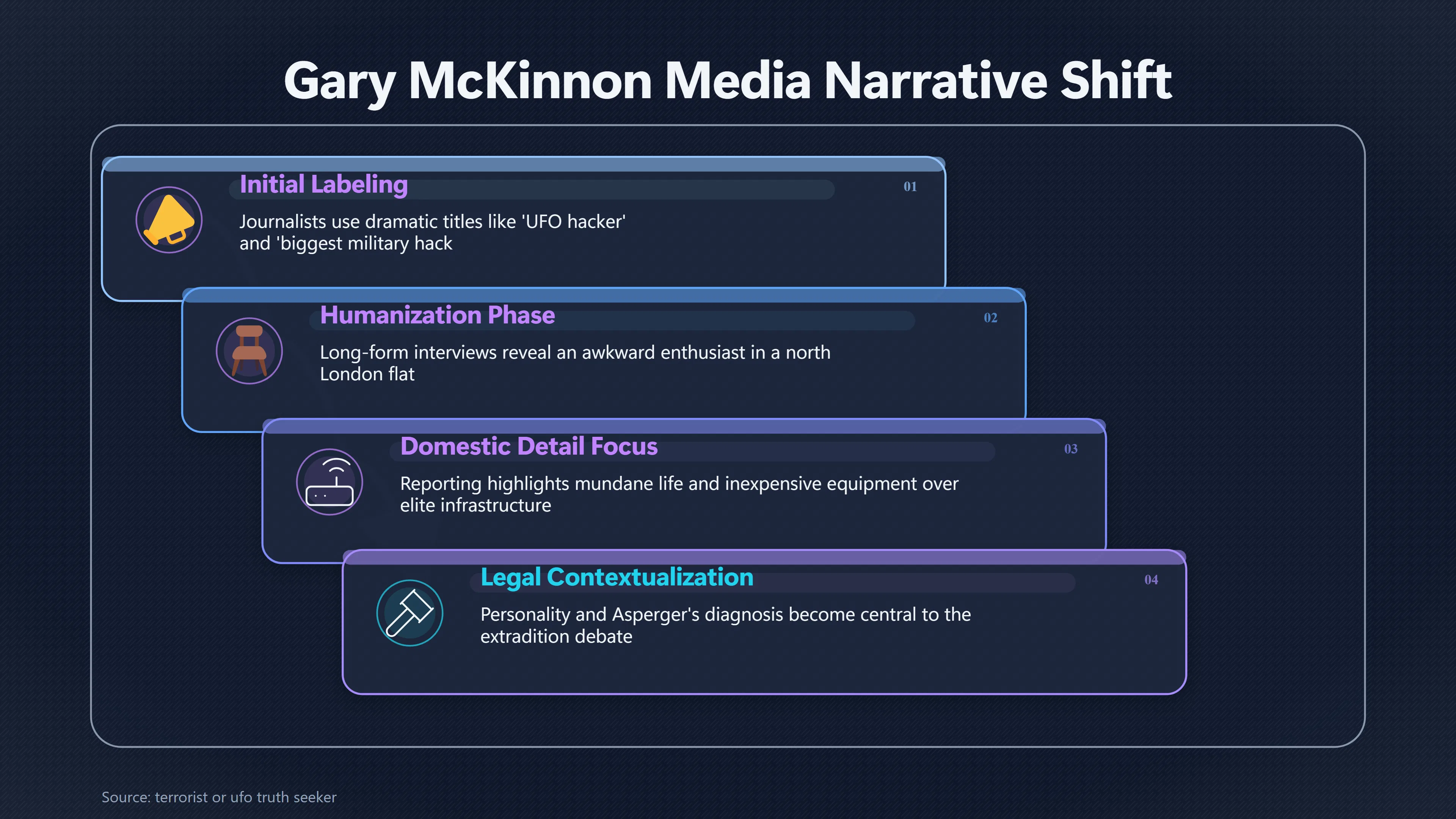
One of the most striking shifts in media coverage of Gary McKinnon was not a change in the facts of his case, but a change in how journalists presented him. Early reporting often introduced him through dramatic labels such as the “UFO hacker” or the alleged perpetrator of the “biggest military computer hack of all time”. As television appearances, newspaper profiles and long-form interviews accumulated, however, audiences increasingly encountered a very different figure: an awkward, self-deprecating computer enthusiast living an ordinary life in north London, driven by obsessive curiosity rather than by espionage or financial gain.[WIRED]wired.comterrorist or ufo truth seekerTerrorist or UFO Truth Seeker? | WIREDApril 28, 2006…
This humanisation mattered because it altered how many readers interpreted both his motives and the proportionality of the American prosecution. Interviews did not erase the seriousness of the unauthorised intrusions, nor did they resolve disputes over his claims about UFO-related material. Instead, they replaced an abstract cybercriminal with a recognisably human individual whose personality, habits and explanations became central to public debate.
The domestic details that displaced the myth
Much of the transformation came through mundane reporting rather than dramatic revelations.
Instead of depicting McKinnon as an anonymous elite hacker, profiles repeatedly located him in ordinary surroundings. Journalists described him operating from a modest north London flat using inexpensive equipment and a standard internet connection rather than sophisticated infrastructure. His life outside the hacking allegations appeared equally unremarkable: periods of contract IT work, unemployment, fixing friends’ computers, reading at home, and later taking ordinary jobs while awaiting years of legal proceedings.[The Guardian]theguardian.comThe Guardian Profile: Gary Mc Kinnon | Gary Mc Kinnon | The GuardianThe Guardian Profile: Gary Mc Kinnon | Gary Mc Kinnon | The Guardian
These details subtly challenged the image suggested by prosecution rhetoric. The contrast between the alleged scale of the offence and the banality of the setting became a recurring feature of British reporting. Rather than presenting an elusive cyber mastermind hidden behind layers of technology, reporters showed someone who appeared socially awkward, intensely interested in computers and unusually absorbed by a personal quest.
The interviews also highlighted habits that were distinctly unglamorous. McKinnon openly discussed spending extraordinary amounts of time in front of a computer, neglecting everyday routines during periods of obsession and accumulating large dial-up internet bills while searching government systems. Such admissions reinforced the impression of compulsion rather than calculated criminal sophistication.[The Guardian]theguardian.comThe Guardian Gary Mc Kinnon | Life and style | The GuardianThe GuardianGary McKinnon | Life and style | The GuardianApril 21, 2007…
How McKinnon’s own descriptions changed the tone
Perhaps the single most influential element was McKinnon’s willingness to describe himself in deliberately modest terms.
He repeatedly referred to himself as a “bumbling computer nerd”, a phrase quoted across numerous interviews and profiles. Rather than claiming elite technical brilliance, he often argued that the real story was the weakness of the computer systems he encountered. According to his account, many machines lacked passwords or relied on poor security practices, making access far easier than the public imagined.[The Guardian]theguardian.comThe Guardian Profile: Gary Mc Kinnon | Gary Mc Kinnon | The GuardianThe Guardian Profile: Gary Mc Kinnon | Gary Mc Kinnon | The Guardian
This framing redirected attention away from exceptional hacking skill and towards institutional vulnerability. The public narrative became less about an unstoppable technical genius defeating military security than about an obsessive systems administrator exploiting elementary mistakes.
McKinnon also spoke candidly about his motivations. He acknowledged that his search had become obsessive and described spending countless hours looking for evidence connected with UFOs, advanced propulsion and related subjects. His own language often portrayed curiosity rather than profit, sabotage or espionage as the driving force behind his actions. Whether readers accepted those explanations was another matter, but hearing them directly altered the emotional tone of coverage.[theguardian.com]theguardian.comThe Guardian Gary Mc Kinnon | Life and style | The GuardianThe GuardianGary McKinnon | Life and style | The GuardianApril 21, 2007…
Why motive affected moral judgement
Interviews did not merely explain what McKinnon claimed to have done; they influenced how audiences evaluated his conduct.
In many cybercrime stories, motives such as financial gain, political disruption or state espionage naturally encourage readers to view an offender as dangerous. McKinnon’s explanation was unusual. He consistently said he entered government systems searching for evidence that authorities were concealing information about UFOs and advanced technology, not to steal money or sell secrets.[WIRED]wired.comterrorist or ufo truth seekerTerrorist or UFO Truth Seeker? | WIREDApril 28, 2006…
For supporters, that distinction made him appear reckless rather than malicious. They interpreted his actions as the misguided behaviour of an obsessive enthusiast who believed he was investigating something of public importance.
Critics reached a different conclusion. From their perspective, unauthorised access to military systems remained a serious offence regardless of personal motivation. Good intentions, even if sincerely held, did not remove the risks created by entering sensitive government networks. The interviews therefore did not settle the ethical debate; they changed its terms from “Who is this hacker?” to “How much should motive matter when judging computer crime?”[WIRED]wired.comterrorist or ufo truth seekerTerrorist or UFO Truth Seeker? | WIREDApril 28, 2006…
Personality became part of the legal story
As the extradition battle continued, personality increasingly became inseparable from legal reporting.
Profiles described McKinnon as socially awkward, intensely focused on narrow interests and later discussed his diagnosis of Asperger’s syndrome, which became an important factor in public understanding of the case and in debates surrounding extradition. Rather than treating these details as incidental biography, many reports presented them as essential context for understanding both his behaviour and his vulnerability.[The Guardian]theguardian.comThe Guardian Profile: Gary Mc Kinnon | Gary Mc Kinnon | The GuardianThe Guardian Profile: Gary Mc Kinnon | Gary Mc Kinnon | The Guardian
Coverage also broadened beyond McKinnon himself. Interviews with his mother, Janis Sharp, portrayed years of campaigning, financial strain and emotional stress. Domestic scenes involving family life, fundraising and prolonged legal uncertainty contrasted sharply with earlier images of an anonymous intruder attacking military systems. The result was a narrative centred increasingly on human consequences rather than technical allegations alone.[The Guardian]theguardian.comThe GuardianGary McKinnon's mother, Janis Sharp: 'When I'm in a corner, I fight' | Gary McKinnon | The GuardianOctober 19, 2012…

A media image that proved remarkably durable
The interviews did not eliminate the “UFO hacker” label; instead, they complicated it.
Readers were left holding two apparently contradictory images simultaneously. One was the extraordinary headline figure accused by American prosecutors of conducting a historically significant military intrusion. The other was an ordinary-looking computer enthusiast who joked about himself, admitted obsessive behaviour, described simple methods and appeared uncomfortable with the larger-than-life reputation attached to his name.[wired.com]wired.comterrorist or ufo truth seekerTerrorist or UFO Truth Seeker? | WIREDApril 28, 2006…
That tension became one of the defining features of McKinnon’s public identity. The enduring cultural memory of the case owes as much to these interviews as to the hacking allegations themselves. By giving him a recognisable voice and an everyday setting, journalists transformed an anonymous defendant into a familiar, flawed and distinctly human “computer nerd” whose personality became inseparable from the wider media narrative surrounding the “UFO hacker”.
Amazon book picks
Further Reading
Books and field guides related to How Interviews Humanised the 'UFO Hacker'. Use these as the next step if you want deeper reading beyond the article.
Saving Gary McKinnon: A Mother's Story
The ordinary lives of Gary McKinnon and his mother Janis changed dramatically one morning in 2002 when police interviewed Gary about hack...
Storycraft: The Complete Guide to Writing Narrative Nonfiction
A former managing editor of the "Oregonian" who guided several Pulitzer Prize-winning narratives to publication shares guidelines for wri...
The Journalist and the Murderer
Janet Malcolm's startling, no-holds-barred exploration of the moral cost of being a journalist is told in terms of the relationship betwe...
Telling True Stories: A Nonfiction Writers' Guide from the Ni...
Interested in journalism and creative writing and want to write a book? Read inspiring stories and practical advice from America’s most r...
eBay marketplace picks
Marketplace Samples
Live-tested eBay searches with available results related to this page.
Selected fromUFO disclosure poster oneBay.co.uk.


Endnotes
1.
Source: wired.com
Title: terrorist or ufo truth seeker
Link:https://www.wired.com/2006/04/terrorist-or-ufo-truth-seeker/
Source snippet
Terrorist or UFO Truth Seeker? | WIREDApril 28, 2006...
Published: April 28, 2006
2.
Source: wired.com
Title: ‘UFO Hacker’ Tells What He Found | WIRED
Link:https://www.wired.com/2006/06/ufo-hacker-tells-what-he-found/
Source snippet
WIRED'UFO Hacker' Tells What He Found | WIRED...
3.
Source: wired.com
Title: mckinnon extradition win
Link:https://www.wired.com/2012/10/mckinnon-extradition-win/
Source snippet
Pentagon Hacker McKinnon Wins 10-Year Extradition Battle | WIREDOctober 16, 2012 — Kim Zetter Security Oct 16, 2012 2:36 PM PENTAGON HACK...
Published: October 16, 2012
4.
Source: wired.com
Title: uk hacker gary
Link:https://www.wired.com/2008/08/uk-hacker-gary/
5.
Source: theguardian.com
Title: The Guardian Profile: Gary Mc Kinnon | Gary Mc Kinnon | The Guardian
Link:https://www.theguardian.com/technology/2009/jul/31/gary-mckinnon-hacking-extradition
6.
Source: theguardian.com
Title: The Guardian The humble superhacker | UK news | The Guardian
Link:https://www.theguardian.com/uk/2006/may/10/usa.september11
7.
Source: theguardian.com
Link:https://www.theguardian.com/world/2008/jul/27/internationalcrime.hacking
8.
Source: theguardian.com
Title: The Guardian Gary Mc Kinnon | Life and style | The Guardian
Link:https://www.theguardian.com/theobserver/2007/apr/22/features.magazine7
Source snippet
The GuardianGary McKinnon | Life and style | The GuardianApril 21, 2007...
Published: April 21, 2007
9.
Source: theguardian.com
Link:https://www.theguardian.com/world/2012/oct/16/gary-mckinnon-hacker-sparked-storm
10.
Source: theguardian.com
Link:https://www.theguardian.com/theguardian/2012/oct/19/interview-janis-sharp-gary-mckinnon
Source snippet
The GuardianGary McKinnon's mother, Janis Sharp: 'When I'm in a corner, I fight' | Gary McKinnon | The GuardianOctober 19, 2012...
Published: October 19, 2012
11.
Source: theguardian.com
Link:https://www.theguardian.com/uk/2007/apr/03/politics.usa
12.
Source: theguardian.com
Title: Game over | Gary Mc Kinnon | The Guardian
Link:https://www.theguardian.com/theguardian/2005/jul/09/weekend7.weekend2
Additional References
13.
Source: youtube.com
Title: UK Hacker’s Extradition to US Blocked
Link:https://www.youtube.com/watch?v=v4Js8DF80HY
Source snippet
This video features a direct interview with Gary McKinnon, showing his ordinary domestic setting and personal, self-deprecating demeanor...
14.
Source: youtube.com
Title: The Man Who Hacked the U.S. Government
Link:https://www.youtube.com/watch?v=ND0zQX1rGdg
Source snippet
Hacking for UFOs and Fighting for His Life: Who is Gary McKinnon?...
15.
Source: youtube.com
Title: Hacking for UFOs and Fighting for His Life: Who is Gary Mc Kinnon?
Link:https://www.youtube.com/watch?v=OImdnvQx7sQ
Source snippet
Gary McKinnon Wins Extradition Battle...
16.
Source: ufohackers.org
Link:https://www.ufohackers.org/hackers/gary-mckinnon/mckinnon-overview
17.
Source: youtube.com
Link:https://www.youtube.com/watch?v=b5afwWUYWVQ
Source snippet
The Man Who Hacked the U.S. Government...
18.
Source: youtube.com
Title: Gary Mc Kinnon Wins Extradition Battle
Link:https://www.youtube.com/watch?v=y4lecD44F5E
Source snippet
UK Hacker's Extradition to US Blocked...
19.
Source: cbsnews.com
Title: British Hacker Fights U.S. Extradition
Link:https://www.cbsnews.com/news/british-hacker-fights-us-extradition/
20.
Source: itv.com
Title: Who is Gary Mc Kinnon?
Link:https://www.itv.com/news/update/2012-10-16/who-is-gary-mckinnon/