Within British Connection
Why British UFO Hackers Targeted American Systems
American military and NASA systems combined powerful UFO mythology with weak security, making them unusually tempting targets from Britain.
On this page
- How UFO folklore concentrated attention on US institutions
- Why military and NASA networks seemed technically reachable
- How each successful login reinforced the search
Page outline Jump by section
Introduction
British UFO-minded hackers such as Gary McKinnon and, to a lesser extent, Mathew Bevan did not choose American military and space systems at random. Their attention focused on the United States because it occupied a unique place in UFO folklore, Cold War secrecy and advanced aerospace research. In the minds of these hackers, if any government possessed hidden evidence of unidentified flying objects, recovered technology or classified propulsion research, it would most likely be the United States—and particularly organisations such as NASA, the US Air Force and the Department of Defense. At the same time, the rapid expansion of internet-connected government networks during the 1990s and early 2000s created opportunities that were far more accessible than many outsiders imagined. The combination of powerful mythology and unexpectedly weak cyber security made American systems unusually attractive targets.[ieee.org]spectrum.ieee.orgSpectrum Gary Mc Kinnon: The Autistic HackerIEEE SpectrumGary McKinnon: The Autistic Hacker - IEEE SpectrumJune 27, 2011…
How UFO folklore concentrated attention on US institutions
Long before internet hacking became widespread, UFO culture had become heavily centred on American military and scientific institutions. Stories surrounding Roswell, Area 51, classified Air Force projects, secret aerospace programmes and alleged government cover-ups dominated books, documentaries and conference discussions throughout the 1980s and 1990s.
For British enthusiasts, this created a straightforward assumption: if documentary proof existed anywhere, it would probably be inside American government computers rather than British ones. NASA occupied a particularly important symbolic position because of its role in space exploration, satellite imagery and astronaut missions, while the US military represented the institutions believed to possess the highest levels of classified aerospace information.
Gary McKinnon repeatedly explained that his motivation came from searching for evidence supporting claims made by the Disclosure Project and other UFO researchers. According to his own account, he expected military and NASA systems to contain evidence of advanced propulsion, suppressed energy technologies or non-human spacecraft rather than conventional intelligence secrets.[Wikipedia]WikipediaGary Mc KinnonGary Mc Kinnon
Mathew Bevan’s reported motivation reflected a similar belief. Contemporary investigators and later reporting described him as attempting to find evidence supporting UFO conspiracy theories while exploring American military networks, reinforcing the pattern that UFO-focused British hackers looked westward rather than towards domestic government systems.[Wikipedia]WikipediaMathew BevanMathew Bevan
Why military and NASA networks seemed technically reachable
The mythology alone does not explain why these systems became actual hacking targets. Just as important was the perception—and often the reality—that many publicly reachable American government computers were surprisingly insecure.
During the late 1990s and early 2000s:
- numerous administrative systems remained connected to the internet;
- default or blank passwords were still common;
- remote administration software was widely deployed;
- trust relationships between different government networks sometimes allowed movement from less sensitive systems towards more valuable ones.
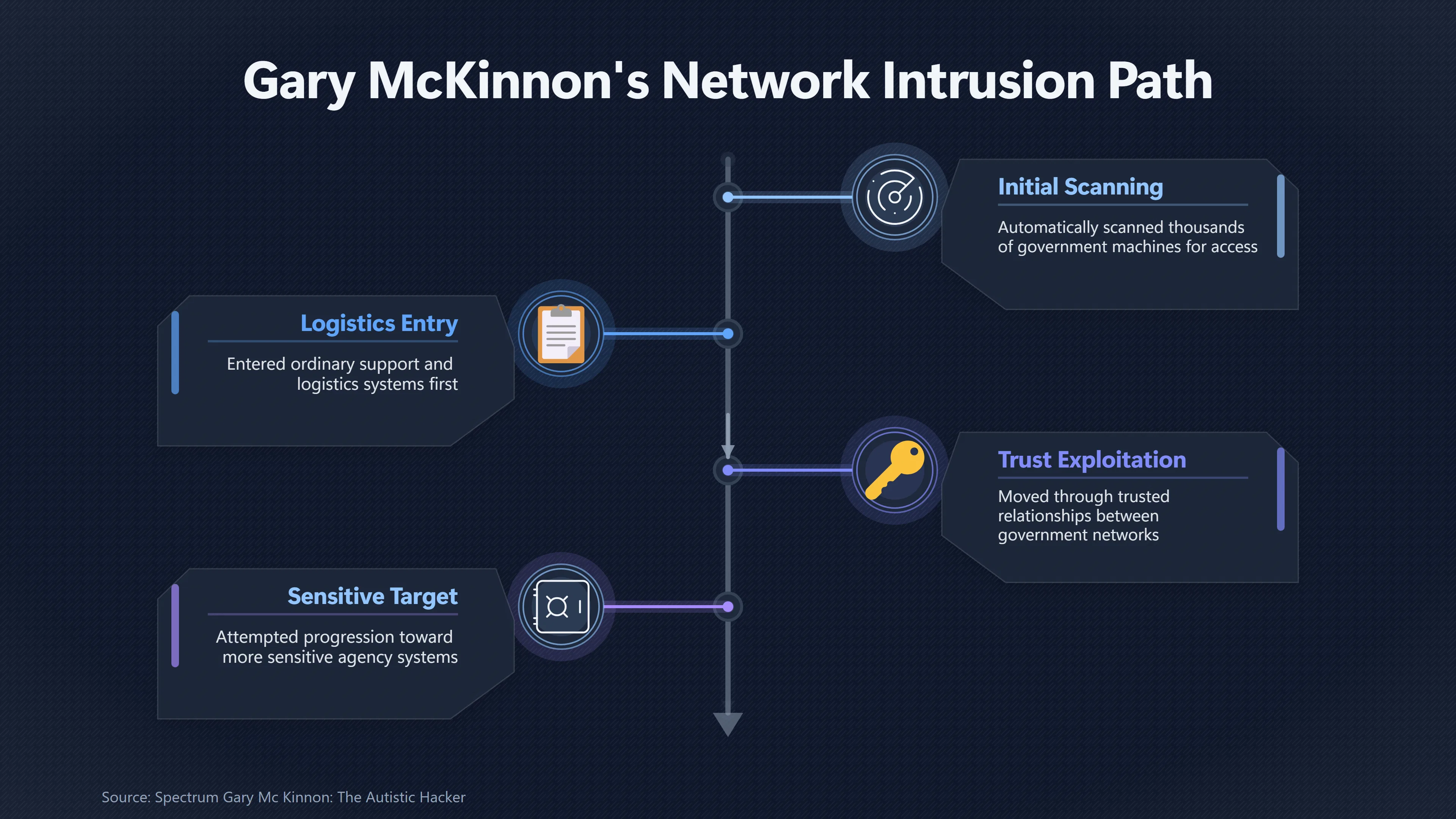
McKinnon later described beginning with relatively ordinary support and logistics systems rather than immediately attacking highly classified computers. Once inside a trusted network, he attempted to move progressively towards systems that appeared more sensitive. This approach relied less on sophisticated hacking techniques than on exploiting weak authentication and poor security practices.[theguardian.com]theguardian.comOpen source on theguardian.com.
One of the striking features of the McKinnon case is that many accounts—including his own—emphasise how little technical sophistication was required. He claimed to have scanned thousands of government machines automatically, discovering administrators who had left passwords blank or unchanged. Whether every detail of his description is accurate, official court documents and the US indictment likewise describe extensive unauthorised access obtained across Army, Navy, Air Force, NASA and Department of Defense systems.[justice.gov]justice.govDepartment of JusticeLondon, England Hacker Indicted Under Computer Fraud and Abuse Act For Accessing Military Computers (November 12, 2002)…
Why American institutions appeared more valuable than British ones
British UFO enthusiasts generally regarded American institutions as possessing three characteristics that made them uniquely interesting.
First, the United States maintained the world’s largest defence establishment and aerospace research infrastructure. If secret aircraft or recovered technologies existed, American agencies appeared more likely than Britain’s to possess them.
Second, NASA offered a civilian image while simultaneously operating alongside military and intelligence programmes. For conspiracy theorists, this combination encouraged speculation that public science concealed classified discoveries.
Third, American government networks were numerous and geographically distributed. Thousands of interconnected systems supporting logistics, research, administration and military operations created a much larger attack surface than that available within British government infrastructure. Even if only peripheral systems were accessible, hackers believed they might eventually lead towards more interesting material.[The Guardian]theguardian.comOpen source on theguardian.com.
How each successful login reinforced the search
An important psychological feature of these cases was the feedback loop created by successful intrusions.
Every successful login appeared to confirm two beliefs simultaneously:
- that American systems really did contain hidden material worth pursuing;
- that further exploration might eventually uncover decisive evidence.
Finding poorly protected government computers could itself seem extraordinary to someone already convinced that major secrets existed behind official walls. Instead of treating easy access as evidence of ordinary cyber security failures, a determined UFO believer could interpret each breakthrough as one step closer to discovering concealed programmes.
McKinnon later described his search as becoming increasingly obsessive. He reported moving from one system to another in the hope of finding stronger evidence, explaining that each discovery encouraged him to continue searching rather than stop.[IEEE Spectrum]spectrum.ieee.orgSpectrum Gary Mc Kinnon: The Autistic HackerIEEE SpectrumGary McKinnon: The Autistic Hacker - IEEE SpectrumJune 27, 2011…

The gap between expectations and verified evidence
Although McKinnon has consistently claimed that he observed unusual files—including references to “non-terrestrial officers” and an image he believed showed an unidentified craft—these claims have never been independently verified. No publicly released forensic evidence has confirmed that such documents represented extraterrestrial technology or hidden space programmes. The claims therefore remain personal testimony rather than established fact.[Wikipedia]WikipediaGary Mc KinnonGary Mc Kinnon
This distinction is important because it explains why American systems remained attractive despite the lack of confirmed discoveries. For believers, the possibility that proof existed somewhere within an immense military bureaucracy justified continued searching. For investigators, however, the lasting significance of these cases lay less in what the hackers claimed to have found than in what their intrusions revealed about cyber security weaknesses across major US government networks.[justice.gov]justice.govDepartment of JusticeLondon, England Hacker Indicted Under Computer Fraud and Abuse Act For Accessing Military Computers (November 12, 2002)…
American targets became symbols as much as objectives
The enduring association between British UFO hackers and American defence systems reflects the convergence of culture and technology rather than either factor alone. UFO folklore directed attention towards US military and space agencies because they dominated popular narratives about secrecy and advanced aerospace research. At the same time, weaknesses in internet-connected government systems made those institutions appear reachable rather than untouchable.
For hackers such as Gary McKinnon, this combination created a powerful incentive. American defence and NASA networks were not merely technical targets—they represented the places where decades of UFO mythology suggested the answers would be found, while their unexpectedly weak security made that search appear achievable.
Amazon book picks
Further Reading
Books and field guides related to Why British UFO Hackers Targeted American Systems. Use these as the next step if you want deeper reading beyond the article.
UFOs: Generals, Pilots, and Government Officials Go on the Re...
NEW YORK TIMES BESTSELLER • Impeccably researched, this riveting journalistic investigation separates fact from fiction, and documents th...
Area 51
The explosive, untold story of the Cold War's biggest secret from the bestselling author of NUCLEAR WAR: A SCENARIO 'An extraordinary boo...
Cyber War
Rating: 3.0/5 from 96 Google Books ratings
An essential, eye-opening book about cyberterrorism, cyber war, and the next great threat to our national security. " Cyber War may be th...
eBay marketplace picks
Marketplace Samples
Live-tested eBay searches with available results related to this page.
Selected fromUFO poster oneBay.co.uk.
Current eBay listing
VINTAGE UFO FLYING SAUCERS COMIC ADVERTISING A2 POSTER PRINT

Current eBay listing
I Want To Believe UFO Poster Giclée Fine Art Heavyweight Print

Endnotes
1.
Source: spectrum.ieee.org
Title: Spectrum Gary Mc Kinnon: The Autistic Hacker
Link:https://spectrum.ieee.org/the-autistic-hacker
Source snippet
IEEE SpectrumGary McKinnon: The Autistic Hacker - IEEE SpectrumJune 27, 2011...
Published: June 27, 2011
2.
Source: justice.gov
Link:https://www.justice.gov/archive/criminal/cybercrime/press-releases/2002/mckinnonIndict.htm
Source snippet
Department of JusticeLondon, England Hacker Indicted Under Computer Fraud and Abuse Act For Accessing Military Computers (November 12, 2002)...
Published: November 12, 2002
3.
Source: Wikipedia
Title: Gary Mc Kinnon
Link:https://en.wikipedia.org/wiki/Gary_McKinnon
4.
Source: Wikipedia
Title: Mathew Bevan
Link:https://en.wikipedia.org/wiki/Mathew_Bevan
5.
Source: seclists.org
Title: Sec Lists Information Security News: UK’s NASA hacker breaks his silence
Link:https://seclists.org/isn/2005/Jul/42
6.
Source: youtube.com
Title: A Tale of Two UFO Hackers: Matthew Bevan & Gary Mc Kinnon | True Crime
Link:https://www.youtube.com/watch?v=rksYZZgSPcY
Source snippet
UFO - Hacker Gary Mckinnon Interview 5-5-2006 BBC...
7.
Source: youtube.com
Link:https://www.youtube.com/watch?v=B00Fv9VMDq0
Source snippet
Hacker Gary McKinnon about NASAs UFOs and other technologies 2015...
8.
Source: theguardian.com
Link:https://www.theguardian.com/uk/2007/apr/03/politics.usa
9.
Source: theguardian.com
Title: The Guardian Profile: Gary Mc Kinnon | Gary Mc Kinnon | The Guardian
Link:https://www.theguardian.com/technology/2009/jul/31/gary-mckinnon-hacking-extradition
Additional References
10.
Source: usubjects.com
Title: the lone hacker that found nasas secret space fleet gary mckinnon interview 1675
Link:https://usubjects.com/article/the-lone-hacker-that-found-nasas-secret-space-fleet-gary-mckinnon-interview-1675
Source snippet
Gary McKinnon discusses his NASA hacking… | USUBJECTSMarch 2, 2026 — GARY MCKINNON DISCUSSES HIS NASA HACKING CLAIMS AND ALLEGED UFO-RELA...
Published: March 2, 2026
11.
Source: thelifehacker.org
Title: There are a lot of interesting stories, far-out fears,
Link:https://thelifehacker.org/2022/12/19/this-man-hacked-nasa-and-describes-what-he-found-in-interview/
Source snippet
This Man Hacked NASA And Describes What He Found in InterviewDecember 19, 2022 — THIS MAN HACKED NASA AND DESCRIBES WHAT HE FOUND IN INTE...
Published: December 19, 2022
12.
Source: youtube.com
Title: UFO Hacker Shares New Secrets | Gary Mc Kinnon
Link:https://www.youtube.com/watch?v=_SOTGFj7BwI
Source snippet
Gary McKinnon UFO hacker military systems NASA Gary Mckinnon: The Hacker Who Found UFOs Thinker...
13.
Source: youtube.com
Link:https://www.youtube.com/watch?v=-1ATzz7Gfdc
Source snippet
UFO Hacker Shares New Secrets | Gary McKinnon...
14.
Source: podcasts.apple.com
Link:https://podcasts.apple.com/gb/podcast/a-tale-of-two-ufo-hackers-matthew-bevan-gary-mckinnon/id1227858637?i=1000753948173
Source snippet
Tale of Two UFO Hackers: Mat…–Somewhere in the Skies – Apple PodcastsMarch 9, 2026 — * 9 MARCH * 34 MIN A TALE OF TWO UFO HACKERS: MATTHE...
Published: March 9, 2026
15.
Source: youtube.com
Title: Gary Mckinnon: The Hacker Who Found UFOs
Link:https://www.youtube.com/watch?v=8_1DuqeU8hw
Source snippet
A Tale of Two UFO Hackers: Matthew Bevan & Gary McKinnon | True Crime...
16.
Source: ufohackers.org
Link:https://www.ufohackers.org/hackers/gary-mckinnon/mckinnon-overview
17.
Source: theregister.com
Title: Mc Kinnon UFO hack ‘looked like cyberterrorist attack’
Link:https://www.theregister.com/security/2008/08/09/mckinnon-ufo-hack-looked-like-cyberterrorist-attack/1323647
18.
Source: wired.com
Title: terrorist or ufo truth seeker
Link:https://www.wired.com/2006/04/terrorist-or-ufo-truth-seeker/
19.
Source: ufohackers.org
Title: 2007 ufo crash con
Link:https://www.ufohackers.org/hackers/gary-mckinnon/2007-ufo-crash-con