Within Richard Pryce
How Rome Laboratory Opened Doors Across US Networks
Compromised Air Force systems let Pryce and his associate appear trusted while probing NASA, contractors and other military networks.
On this page
- Why Rome Laboratory was unusually connected
- How trusted access enabled attacks elsewhere
- Which government and contractor systems were reached
Page outline Jump by section
Introduction
The 1994 Rome Laboratory intrusion became historically significant not simply because attackers penetrated a major US Air Force research facility, but because they transformed that compromise into a platform for reaching many other organisations. Once Richard Pryce (“Datastream Cowboy”) and his associate gained privileged access inside Rome Laboratory, they could make later connections appear to originate from a legitimate Air Force network. That changed the nature of the incident from an isolated break-in into a demonstration of how a trusted government system could become a launching point for wider attacks against military, civilian and contractor networks. The episode exposed weaknesses in the security assumptions of early internet-connected research environments and became a frequently cited example in later US government reviews of network defence.[GAO]gao.govUnited States General Accounting OfficeUnited States General Accounting OfficeMay 8, 2026…
Why Rome Laboratory Was Unusually Connected
Rome Laboratory occupied a distinctive position within the US defence research community. As the Air Force’s principal command-and-control research centre, it collaborated extensively with universities, defence contractors and other government agencies. These partnerships depended on routine internet connectivity at a time when many organisations still placed considerable trust in traffic arriving from recognised government or research networks.[GAO]gao.govUnited States General Accounting OfficeUnited States General Accounting OfficeMay 8, 2026…
This connectivity offered enormous scientific and operational benefits, but it also created an unusually large attack surface. Once the intruders established themselves inside Rome Laboratory, they were no longer operating as unknown outsiders. They had effectively inserted themselves into a network already expected to communicate with numerous external systems.
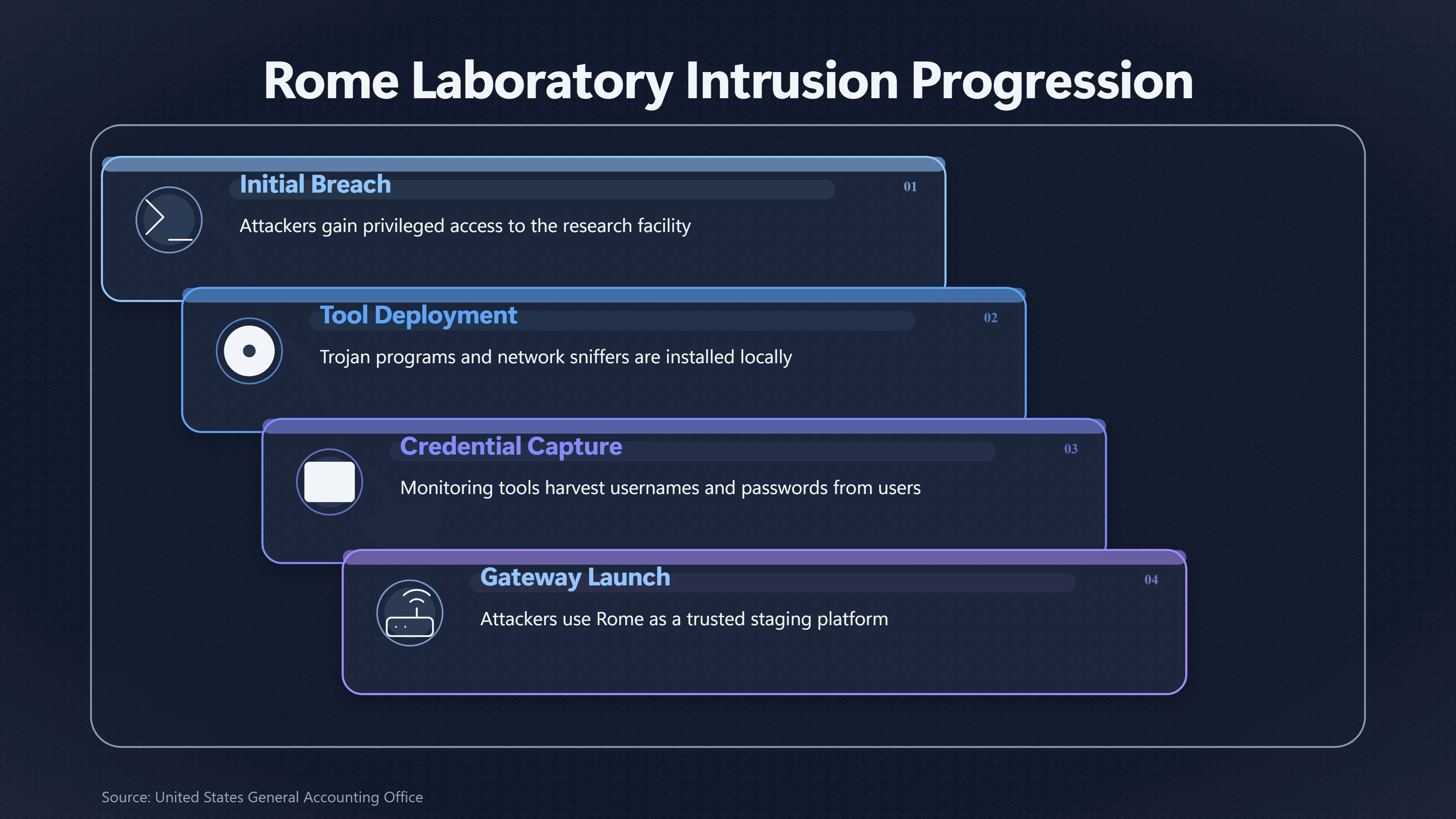
Investigations found that the attackers had installed tools including Trojan horse programs and network sniffers. These enabled them to capture user credentials, maintain access after initial compromises and operate with privileges similar to authorised users. Rather than repeatedly breaking in from the outside, they could exploit Rome’s existing trusted relationships with connected organisations.[GAO]gao.govUnited States General Accounting OfficeUnited States General Accounting OfficeMay 8, 2026…
How Trusted Access Enabled Attacks Elsewhere
The critical mechanism was not merely technical exploitation but the abuse of trust.
After compromising Rome Laboratory, the attackers could initiate new connections that appeared to originate from a genuine Air Force research installation. Many systems of the period relied heavily on network location as part of their security model, particularly within academic and defence research communities. Traffic from Rome therefore appeared considerably less suspicious than traffic arriving directly from an unknown overseas source.[GAO]gao.govUnited States General Accounting OfficeUnited States General Accounting OfficeMay 8, 2026…
The attackers also complicated forensic investigation by hiding the original source of their activity. Before reaching Rome Laboratory, their connections had already been routed through international telephone exchanges and intermediary computer systems spanning several countries. Once Rome itself became an intermediate point, investigators faced an additional layer of indirection: later victims often saw only an Air Force host initiating connections rather than the individuals operating from the United Kingdom.[GAO]gao.govUnited States General Accounting OfficeUnited States General Accounting OfficeMay 8, 2026…
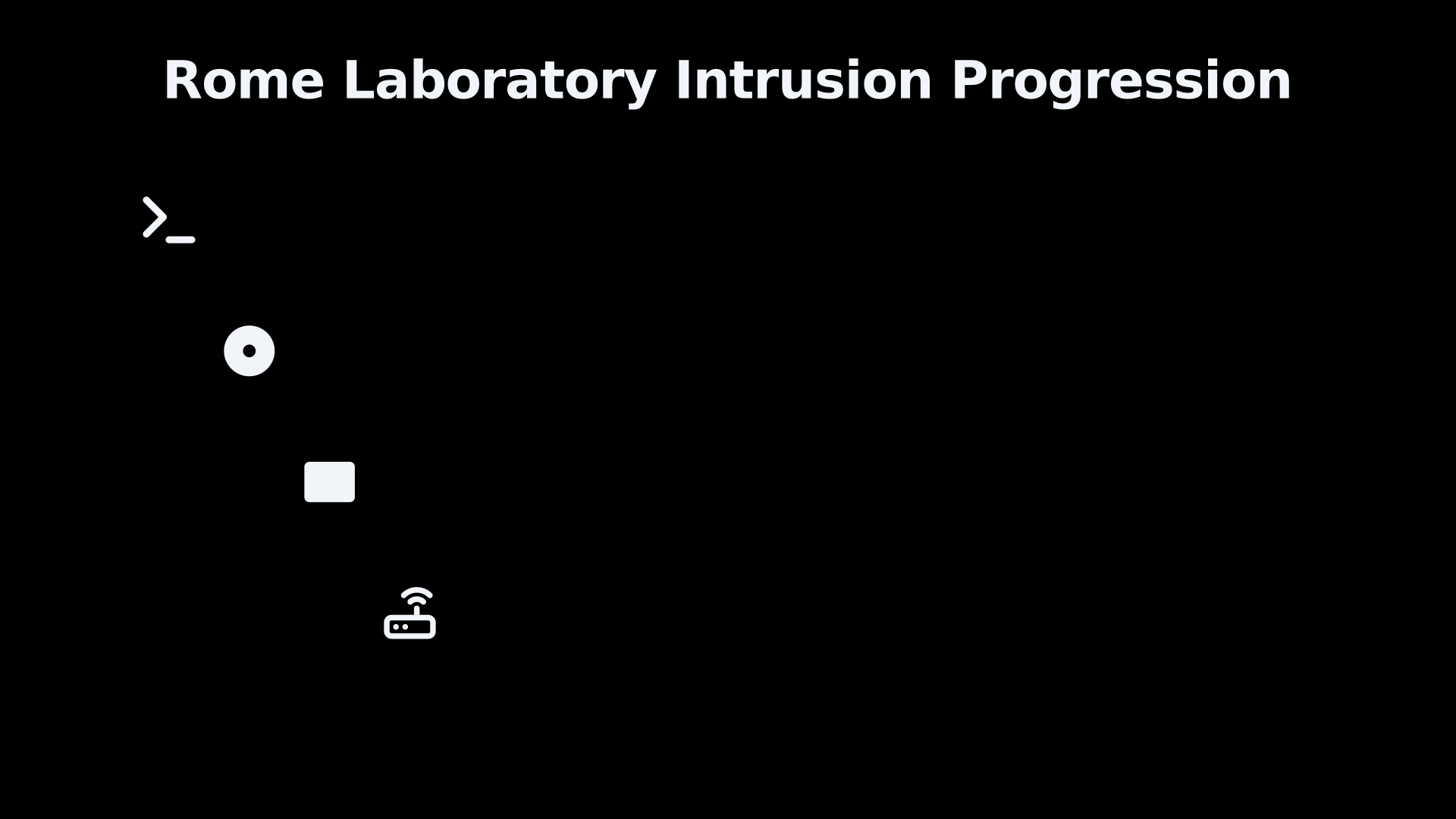
In practical terms, Rome Laboratory served three separate roles simultaneously:
- A target, where privileged access was first obtained.
- A credential source, because monitoring tools captured additional usernames and passwords.
- A staging platform, allowing attacks against further organisations under the apparent identity of a trusted Air Force system.[GAO]gao.govUnited States General Accounting OfficeUnited States General Accounting OfficeMay 8, 2026…
Which Government and Contractor Systems Were Reached
Official investigations concluded that the attackers did not remain confined to Rome Laboratory’s own network. Congressional testimony and Government Accountability Office (GAO) reports identified additional systems that were accessed from Rome after the compromise.
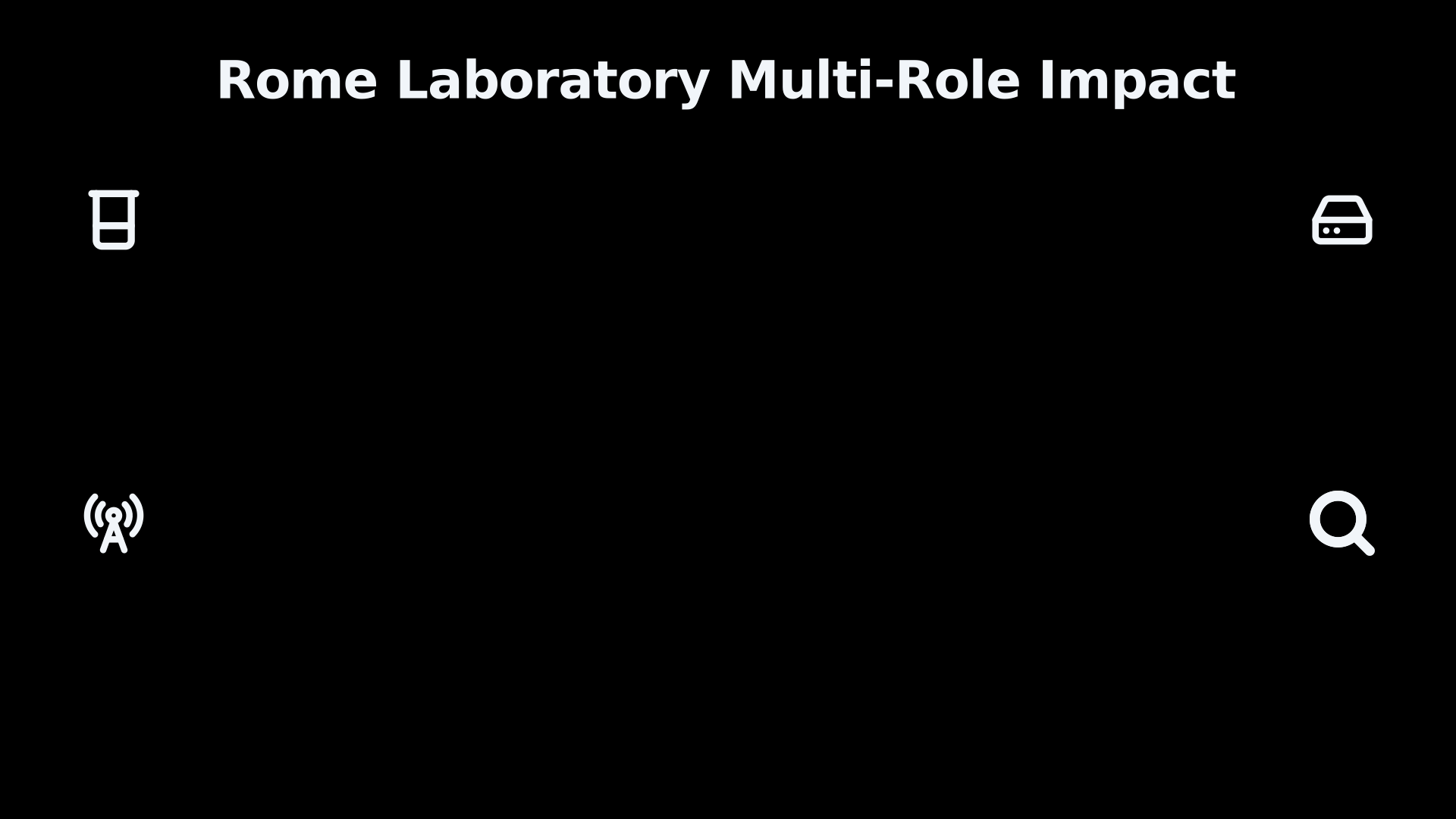
Among the organisations specifically identified were:
- NASA’s Goddard Space Flight Center.[nasa.gov]nasa.govLearn more about the upcomGateway Space Station - NASAJuly 23, 2026 — Editor’s Note: NASA is updating its website to align with the latest Artemis program updates…
- Wright-Patterson Air Force Base.
- Multiple US defence contractors connected to military research programmes.[National Security Archive]nsarchive.gwu.eduNational Security Archive OCR of the Document | National Security ArchiveNational Security Archive OCR of the Document | National Security Archive
These subsequent intrusions demonstrated that the value of compromising Rome Laboratory lay less in the information stored there than in the access it provided to an interconnected research ecosystem.
The broader Datastream Cowboy investigation also linked activity to other military, NASA and contractor systems during the same period. Contemporary reporting distinguished between systems directly compromised from Rome and wider intrusion activity associated with the attackers, illustrating how difficult attribution became once compromised hosts were used as stepping stones.[National Security Archive]nsarchive.gwu.eduNational Security Archive OCR of the Document | National Security ArchiveNational Security Archive OCR of the Document | National Security Archive
Why the Gateway Effect Alarmed Investigators
For investigators, the most troubling aspect was that they could not immediately determine whether the attacks represented ordinary hacking, organised espionage or preparation for something more serious.
The GAO later noted that the Air Force could not conclusively determine whether sensitive research had ultimately reached a foreign intelligence service. One suspected collaborator, known by the online handle “Kuji”, was never identified, leaving uncertainty over what data may have been copied after leaving Rome Laboratory. That uncertainty significantly increased concern within US defence and intelligence communities.[National Security Archive]nsarchive.gwu.eduNational Security Archive OCR of the Document | National Security ArchiveNational Security Archive OCR of the Document | National Security Archive
The incident also highlighted the hidden costs of using a compromised research network as a launchpad. Beyond repairing Rome Laboratory itself, investigators had to notify and examine numerous connected organisations, verify the integrity of systems reached through Rome and determine whether stolen credentials or implanted software remained active elsewhere. These cascading investigations contributed substantially to the overall recovery effort.[National Security Archive]nsarchive.gwu.eduNational Security Archive OCR of the Document | National Security ArchiveNational Security Archive OCR of the Document | National Security Archive
A Lasting Lesson for Network Security
The Rome Laboratory case became an influential illustration of the dangers of implicit trust between connected organisations. Rather than repeatedly attacking every target independently, the attackers demonstrated that compromising one highly connected institution could provide credibility and technical leverage against many others.
This mechanism anticipated what later became widely recognised as “pivoting” or “lateral movement” in modern cybersecurity: using one compromised system as a trusted bridge into additional networks. Although the terminology evolved over subsequent decades, the Rome Laboratory incident remains one of the earliest well-documented examples showing how the compromise of a single defence research network could cascade across government agencies and contractors through existing trust relationships.[GAO]gao.govUnited States General Accounting OfficeUnited States General Accounting OfficeMay 8, 2026…
Amazon book picks
Further Reading
Books and field guides related to How Rome Laboratory Opened Doors Across US Networks. Use these as the next step if you want deeper reading beyond the article.
Dark Territory: The Secret History of Cyber War
“An important, disturbing, and gripping history” (Kirkus Reviews, starred review), the never-before-told story of the computer scientists...
The Fifth Domain: Defending Our Country, Our Companies, and O...
An urgent new warning from two bestselling security experts--and a gripping inside look at how governments, firms, and ordinary citizens...
Sandworm: A New Era of Cyberwar and the Hunt for the Kremlin'...
"With the nuance of a reporter and the pace of a thriller writer, Andy Greenberg gives us a glimpse of the cyberwars of the future while...
eBay marketplace picks
Marketplace Samples
Live-tested eBay searches with available results related to this page.
Selected fromhacker t shirt oneBay.co.uk.
Endnotes
1.
Source: gao.gov
Title: United States General Accounting Office
Link:https://www.gao.gov/assets/aimd-96-84.pdf
Source snippet
United States General Accounting OfficeMay 8, 2026...
Published: May 8, 2026
2.
Source: nasa.gov
Title: Learn more about the upcom
Link:https://www.nasa.gov/reference/gateway-about/
Source snippet
Gateway Space Station - NASAJuly 23, 2026 — Editor’s Note: NASA is updating its website to align with the latest Artemis program updates...
Published: July 23, 2026
3.
Source: ntrs.nasa.gov
Link:https://ntrs.nasa.gov/
Source snippet
NASA Disclaimers, Copyright Notice, and Terms and Conditions of Use for information on how to use NASA’s scientific and technical informa...
4.
Source: gao.gov
Link:https://www.gao.gov/products/gao
Source snippet
February 16, 2017 — NASA COMMERCIAL CREW PROGRAM: SCHEDULE PRESSURE INCREASES AS CONTRACTORS DELAY KEY EVENTS GAO-17-137...
Published: February 16, 2017
5.
Source: gao.gov
Title: osi 95 9
Link:https://www.gao.gov/products/osi
6.
Source: gao.gov
Title: nsiad 94 248
Link:https://www.gao.gov/products/nsiad
7.
Source: gao.gov
Title: nsiad 94 219
Link:https://www.gao.gov/products/nsiad
8.
Source: gao.gov
Title: nsiad 94 220
Link:https://www.gao.gov/products/nsiad
9.
Source: nsarchive.gwu.edu
Title: National Security Archive OCR of the Document | National Security Archive
Link:https://nsarchive.gwu.edu/media/21407/ocr
10.
Source: nsarchive.gwu.edu
Link:https://nsarchive.gwu.edu/document/21406-document-10a
Additional References
11.
Source: youtube.com
Title: UK hacker’s extradition to US blocked
Link:https://www.youtube.com/watch?v=v4Js8DF80HY
Source snippet
This selection provides overview videos and historical context detailing famous intrusions into military and NASA networks, including the...
12.
Source: kujimedia.com
Title: Kuji Media Corporation Ltd
Link:https://www.kujimedia.com/tag/datastream-cowboy/
Source snippet
» Datastream CowboyJune 26, 2008 — Air Force’s premier command-and- control research facility. Rome Lab researchers collaborate with univ...
Published: June 26, 2008
13.
Source: kujimedia.com
Title: Kuji Media Corporation Ltd
Link:https://www.kujimedia.com/tales-of-digital-crime-from-the-shadows-of-cyberspace-chapter-six/
Source snippet
» Blog Archive » Tales of Digital Crime from the Shadows of Cyberspace – Chapter SixJune 26, 2008 — They also end up in the headlines bec...
Published: June 26, 2008
14.
Source: irp.fas.org
Title: Intelligence Resource Program GAO
Link:https://irp.fas.org/gao/aim96084.htm
Source snippet
Intelligence Resource ProgramGAO - Information Security: Computer Attacks at Department of Defense Pose Increasing Risks...
15.
Source: youtube.com
Link:https://www.youtube.com/watch?v=Itopz-raZSY
Source snippet
Who Is The Most Dangerous Hacker Ever? (Tier List) | Sumsub...
16.
Source: youtube.com
Title: Hacking for UFOs and fighting for his life. Who is Gary Mc Kinnon? | Nord VPN
Link:https://www.youtube.com/watch?v=OImdnvQx7sQ
Source snippet
Ancient Aliens: Hacking NASA Secrets (Season 12, Episode 9) | History...
17.
Source: youtube.com
Title: Who Is The Most Dangerous Hacker Ever? (Tier List) | Sumsub
Link:https://www.youtube.com/watch?v=z7OjzYT_-Zo
Source snippet
Hacking for UFOs and fighting for his life. Who is Gary McKinnon? | NordVPN...
18.
Source: youtube.com
Title: Ancient Aliens: Hacking NASA Secrets (Season 12, Episode 9) | History
Link:https://www.youtube.com/watch?v=20rWFDfh68Y
Source snippet
UK hacker's extradition to US blocked - YouTube...
19.
Source: publications.gc.ca
Link:https://publications.gc.ca/site/eng/9.893014/publication.html
20.
Source: kujimedia.com
Title: Kuji Media Corporation Ltd. » Blog Archive » THE SCHOOLBOY SPY. Sunday Times
Link:https://www.kujimedia.com/the-schoolboy-spy-sunday-times/